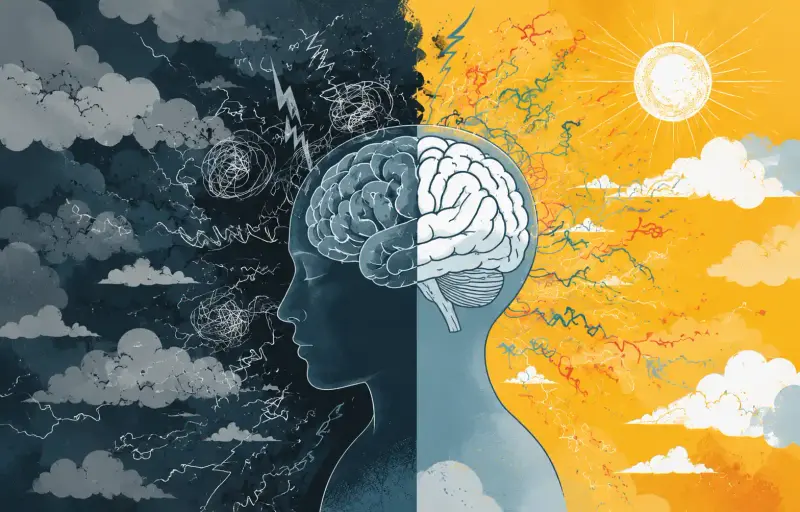
It is normal to experience mood changes because of the problems and obstacles we face during the day. These changes are not a problem when they are tied to a particular circumstance and end when that circumstance passes. The problem arises when a person's life and work become governed by these mood changes—when they interfere with daily duties and tasks, leaving activity, concentration, and the ability to think dependent on the person's current mood. This is what we call bipolar disorder. Given its importance, Tatmeen presents this article to introduce bipolar disorder, its types, and its causes, and to answer key questions that may arise, such as:How do I know if I have bipolar disorder?What is the difference between bipolar disorder and schizophrenia? Can bipolar disorder be cured?
What Is Bipolar Disorder?
Bipolar disorder, also known as manic depression, is a chronic mental health condition that causes changes in mood and emotions. These include elevated states involving mania or hypomania, which can make you feel elated, full of energy, or unusually irritable. The corresponding low states can involve depression, which can leave you feeling sad or hopeless and cause you to lose interest or pleasure in most activities. These mood changes may occur rarely, although some people experience emotional symptoms most of the time. As a result, these changes in mood and emotions can affect sleep, energy, activity, decision-making, behavior, and the ability to think clearly.
Although bipolar disorder is a chronic condition, this does not mean that you cannot manage its mood changes and other accompanying symptoms. This can be achieved by following the necessary treatment plans, which will be explained later. These plans often include medication and psychological counseling (psychotherapy).
Types of Bipolar Disorder
There are several types of bipolar disorder, and a number of other mental health disorders are associated with them. They may involve mania, hypomania, and depression. The symptoms are among the main causes of sudden changes in mood and emotions, which can lead to a persistent sense that life is difficult.
1. Bipolar I Disorder
This involves having at least one manic episode, which may be preceded or followed by hypomanic or major depressive episodes in some cases. Mania may be severe enough to cause a break from reality and lead to psychotic disorders.
2. Bipolar II Disorder
This involves having at least one major depressive episode and at least one hypomanic episode.
3. Cyclothymic Disorder
This involves having many periods of hypomanic symptoms over at least approximately two years—or one year in children and adolescents—or periods of depressive symptoms that are less severe than major depression.
4. Bipolar Disorder Related to Other Conditions
Examples include bipolar and related disorders caused by the use of certain drugs, alcohol consumption, or a medical condition such as multiple sclerosis or stroke.
How Do I Know If I Have Bipolar Disorder?
To begin, it should be noted that people with bipolar disorder may experience mixed episodes of mania or hypomania and depression at the same time. These episodes occur at equal rates among males and females, although symptoms of bipolar disorder usually appear at an earlier age in males than in females. It is also worth noting that symptoms in older adults occur more frequently and are more severe than in younger people.
The nature, severity, and frequency of bipolar disorder symptoms vary from person to person. Some people are more prone to manic episodes, while others are more prone to depressive episodes. For some, manic and depressive episodes alternate equally. Some people with bipolar disorder experience frequent episodes, while others have only a few episodes throughout their lives.
Symptoms of bipolar disorder, based on its types, include the following:
1. Symptoms of Bipolar I Disorder
Symptoms include manic episodes lasting a week or longer, or severe manic episodes that require medical intervention. Some people may also experience severe depressive episodes lasting two weeks or longer. A single manic episode is sufficient for a diagnosis of bipolar I disorder.
2. Symptoms of Bipolar II Disorder
This type involves manic episodes that are less severe than those in bipolar I disorder. They last three to four days and are known as hypomanic episodes. It also includes episodes of severe depression lasting two weeks, which may precede or follow the manic episode.
3. Symptoms of Cyclothymic Disorder
This type resembles bipolar disorders and involves numerous hypomanic and depressive episodes. These episodes persist for two years or longer in adults, or one year in children and adolescents.
4. Symptoms of Manic and Hypomanic Episodes
At first, a person experiencing mania may feel good because of a tremendous amount of energy, enthusiasm, hyperactivity, and increased movement. However, this exaggerated sense of exhilaration may cause some patients to lose control of themselves, leading them to act without considering the consequences.
This can result in irresponsible behavior such as wasting large sums of money, driving recklessly, or using drugs and alcohol. During a manic episode, the person may also feel angry, become excessively agitated, and adopt aggression as a way of resolving problems. It should be noted that hypomanic symptoms are less severe than manic episodes and are not accompanied by hallucinations or delusions.
Symptoms of bipolar disorder associated with mania also include:
Excessive self-confidence, an exaggerated sense of self-worth, and feelings of grandeur and power.
Feeling happy and having boundless energy.
Feeling powerful and able to do anything.
Engaging in many activities at the same time.
Talking more than usual, rapidly and loudly, and moving from one subject to another.
The duration and severity of a depressive episode can vary from one episode to another and from one person to another. Women are more likely to experience depressive episodes in bipolar disorder.
Symptoms of bipolar disorder associated with a depressive episode include:
Mixed episodes involve symptoms of mania and depression occurring at the same time. The person may feel depressed and irritable, anxious, unable to sleep, distracted, and overwhelmed by racing thoughts. They may shift from happiness to frustration and hopelessness, then soon return to feeling euphoric and energetic.
Causes of Bipolar Disorder
The direct causes of bipolar disorder remain unknown. However, several factors are thought to play a role when they occur together, while certain triggers may prompt symptoms to appear or become more severe. Possible causes of bipolar disorder include:
1. Genetic Factors
Many studies indicate that mental illnesses, like physical illnesses, can be inherited. In other words, many mental illnesses may be hereditary when there is a family history of the condition. Examples include psychotic illnesses such as schizophrenia and depression. Although this has not been conclusively established, many studies suggest that certain genes are responsible for causing depression and that one case of depression in a family member is enough to double the likelihood among other family members.
As with most mental illnesses, heredity plays a fundamental role in bipolar disorder, and certain genes are thought to be among its causes. People with a family history—meaning an affected first-degree relative such as a father, son, or sibling with bipolar disorder—have an approximately tenfold higher likelihood of developing it. It should also be noted that many people carry genes that increase their risk but do not develop bipolar disorder. Genetic factors that increase the likelihood of bipolar disorder include, for example, having a family member with depression; a family history of schizophrenia, as schizophrenia and bipolar disorder have some genetic overlap; several family members with bipolar disorder or other mental disorders; and the degree of kinship between the person and affected family members.
The points mentioned above are sufficient to confirm that bipolar disorder is associated with genetic factors. However, no specific gene has yet been identified as its primary cause. The disorder is thought to be associated with several genes, each of which has a small effect on increasing the likelihood of developing it.
2. Physical Factors
Sex is the first biological factor that affects the likelihood of bipolar II disorder, which is more common among women than men. Rates of bipolar I disorder are equal in both sexes, and the reason for this remains unknown. Biological changes in the brain may also have an effect and could be among the causes of bipolar disorder. Hormonal changes, particularly those involving the thyroid gland, can affect brain function. Depression and bipolar disorder are associated with thyroid dysfunction, and people with bipolar disorder often have an underactive thyroid.
Damage to or loss of brain cells is considered a contributing factor in mood disorders, particularly when it affects cells associated with brain function. Dysfunction of neurotransmitters may also contribute. Neurotransmitters are chemicals that help brain cells communicate and regulate mood. An imbalance in brain neurotransmitters, including norepinephrine, serotonin, and dopamine, may be among the causes of bipolar disorder.
Disruption of neurotransmitters or an imbalance in the level of one or more neurotransmitters can lead to some symptoms of bipolar disorder. Manic episodes may be attributed to a very high level of norepinephrine, while depressive episodes may be associated with a low level of norepinephrine.
Disruptions are not limited to brain cells or the thyroid gland; they may also affect the energy-producing structures known as mitochondria. Mitochondrial problems may play a role in mental disorders and could be one of the causes of bipolar disorder. Mitochondria are the cell's energy centers, so a disruption in their function may alter patterns of energy production and use. This might explain some behaviors seen in people with mental disorders.
Overall, many published studies confirm that excessive activity in parts of the brain can affect the coordination of voluntary movement. This can be seen clearly on a brain MRI, which reveals the nature of cellular activity and whether the person has bipolar disorder.
Age also plays a role in the onset and development of bipolar disorder. It usually develops between the ages of 15 and 25, and at least half of cases are diagnosed before age 25. However, symptoms may not appear in some people until they are in their thirties or forties.
3. Environmental Factors
The environment in which a person grows up is one of the main factors affecting mental health. Here, we mean the basic concept of the environment—the setting in which a person was born and raised. Growing up in a family environment that uses abuse and harsh treatment as methods of upbringing can cause children to develop many mental health disorders. Although a person's environment extends beyond the family to much wider circles, the family can be considered the foundation of a person's mental health.
As noted above, the social factors affecting mental health are not limited to the family. A person also interacts with other environments that can affect mental well-being. These may include a stressful, exhausting, and discouraging workplace that can cause burnout; an environment dominated by discrimination, division, and hostility, which may push a person toward isolation or violence; or difficult economic circumstances such as poverty or poor living conditions. Living amid all of this will inevitably lead to poorer mental health.
The same applies to bipolar disorder. Several environmental factors, when combined, may trigger bipolar symptoms and episodes of mania and depression. These include:
Schizophrenia and bipolar disorder are both classified as mental disorders that usually appear in a person's early twenties. Bipolar disorder is a mental illness involving severe mood changes, recurrent depressive episodes, and at least one manic episode—a state of abnormally heightened mood or agitation. As for schizophrenia, it is also a mental illness classified as severe, chronic, and debilitating. A person with schizophrenia may be completely detached from reality. It is worth noting that anyone who develops either condition is more vulnerable to suicide, drug use, or other mental health problems and illnesses later in life.
The direct cause of schizophrenia has not been scientifically identified. However, a combination of genetic, biological, and environmental factors may contribute to its development. These include:
1. Genetic Factors
Having a family history of schizophrenia increases the likelihood of developing it sixfold.
2. Environmental Factors
Environmental factors may include growing up in a home that relies on abuse and harshness as methods of upbringing, or a mother experiencing malnutrition or taking medications that could affect the brain's chemical composition.
3. Biological Factors
These include a fault in the brain's chemical composition that disrupts neurotransmitter function, or taking medications to control psychological changes during adolescence that may affect brain function.
Overall, some studies have shown that a genetic component contributes to the development of both illnesses. They have also found that identical twins are more likely than non-identical twins to share either illness. Studies have also indicated that prenatal problems—such as maternal emotional stress, infection, birth complications, low oxygen levels, or fetal distress—increase the risk of schizophrenia later in life. Environmental factors do not cause either illness, but their presence can increase the appearance of symptoms in people who are genetically at risk.
Bipolar disorder has several types and related disorders and problems, including mania, hypomania, and depression, which we explained earlier. The symptoms of schizophrenia are as follows:
A clear change in behavior that differs from the person's usual nature.
A change in the person's original personality.
Adopting habits, customs, and behaviors that differ from the person's original personality.
Confused thoughts and difficulty expressing them.
Psychotic disturbances characterized by withdrawal from reality.
Inappropriate emotional responses.
The patient may have an unusual way of speaking and thinking, along with abnormal motor symptoms.
Can Bipolar Disorder Be Cured?
Unfortunately, no cure for bipolar disorder has yet been found. However, many treatment approaches can ease its symptoms and enable the patient to manage every aspect of daily life.
It is worth noting that, in severe cases, this disorder may interfere with a patient's ability to work and lead a normal life. However, when patients follow the long-term treatment plans established for their condition by a psychiatrist, some may remain in a stable mood for long periods without any symptoms or with only a few symptoms. Symptoms can therefore be eased for a relatively long time, although they may reappear.
The duration of symptoms varies, and they may persist in some patients despite receiving and adhering to treatment. Every person with bipolar disorder has a different condition and experience. Manic episodes in bipolar I disorder can be severe and dangerous, while people with bipolar II disorder may experience depression for longer periods. The types and doses of prescribed medications therefore depend on the patient's specific symptoms. Whether the patient has bipolar I or bipolar II disorder, treatment may include:
Examples include mood stabilizers, anti-seizure medications, and antidepressants. These medications must not be taken without consulting your specialist psychiatrist. You may need to try different medications or a combination of medications to determine what suits you best. It is therefore important to meet regularly with your mental health care provider to assess how well the treatment is working. If necessary, your provider may periodically adjust your medication to keep symptoms and side effects under control.
2. Psychotherapy Sessions
One example is cognitive behavioral therapy, which enables patients to identify negative behaviors and work to replace them. This means helping to identify the causes of bipolar episodes. A mental health care provider may recommend cognitive behavioral therapy to identify unhealthy, negative beliefs and behaviors and replace them with healthy, positive ones. Other types of therapy may also help, such as social rhythm therapy, which establishes a consistent routine to improve mood management.
3. Electroconvulsive Therapy
This treatment is intended for people experiencing severe depressive periods accompanied by suicidal tendencies or thoughts.
4. Establishing a Healthy Routine
This aims to regulate the patient's sleep, alongside maintaining a healthy diet and exercising. Following a regular schedule, participating in social activities, and joining a support group may also help. If you need advice in these areas, speak with your care provider.
5. Family Therapy
This family-focused treatment is based on the belief that family communication with the patient helps them follow their treatment plan more effectively.
Can Bipolar Disorder Be Treated Without Medication?
Try to persuade the patient to seek treatment calmly, and avoid threatening to take them to the hospital for treatment.
Work to support and reassure the patient by avoiding harassment and continuous personal criticism.
Do not force the patient to change their behavior, and understand that they do not have complete control over it.
Make the necessary effort to show and explain reality to the patient so that there is no room for the fantasies and doubts affecting them.
Supporting the patient never means accepting their unhealthy ideas. Instead, challenge those ideas in a healthy, constructive way to help the patient recognize their unhealthy behavior.
The best treatment for bipolar disorder combines medication and psychotherapy sessions. No specific treatment duration can be set, and the patient may receive treatment throughout life. The success of bipolar disorder treatment depends on the severity of the condition, the patient's adherence to the treatment plan prepared by their doctor, and the level of support they receive from their environment and those close to them.
Content writer and researcher at Tatmeen, working on Arabic and English articles across mental health and everyday life topics, including relationships, stress, work, habits, and family.
Every Tatmeen article is reviewed by care providers licensed by the Saudi Commission for Health Specialties, so what you read is accurate and trustworthy.
This article builds understanding and does not replace a licensed care provider.
Need someone to talk to?
Tatmeen's licensed care providers are available around the clock, and the app's urgent consultation connects you with one within minutes.
Download Tatmeen to explore care providers and booking options.
Smart matchingFour quick questions suggest the right care provider
Urgent consultationTalk to an available care provider within minutes
Free psychological measuresMore than 20 tests to understand how you are doing
Scan to download
{"data":{"id":"6cf2667d-de46-409f-8ee8-0df75d908800","slug":"Bipolar-and-relationship-with-schizophrenia","arTitle":"اضطراب ثنائي القطب - الأعراض والعلاج وعلاقته بالفصام","enTitle":"Bipolar Disorder: Symptoms, Treatment, and Its Link to Schizophrenia","thumbnailAltText":"Overlapping views of a person holding a smartphone with contrasting facial expressions","estimatedReadingTime":5,"likesCount":900,"writer":{"id":"f49e2ee4-e68b-4e04-a40b-01d0b0195161","arBio":"كاتب وباحث محتوى في تطمين، يعمل على مقالات عربية وإنجليزية في موضوعات الصحة النفسية والحياة اليومية، مثل العلاقات، الضغوط، العمل، العادات، والأسرة.","enBio":"Content writer and researcher at Tatmeen, working on Arabic and English articles across mental health and everyday life topics, including relationships, stress, work, habits, and family.","user":{"slug":"sultan-almuhasin","arFullName":"سلطان المحيسن","enFullName":"Sultan Almuhasin","publicProfileImageUrl":"https://cdn.tatmeen.sa/public/profile-images/2494102f-7411-4dda-85b1-0c37a1031b3f/c9d25068aaa97c2c1f80123e2d6a27cc7b5a9b1df6a91493df9411b390a60279.webp","publicProfileImage96Url":"https://cdn.tatmeen.sa/public/profile-images/2494102f-7411-4dda-85b1-0c37a1031b3f/c9d25068aaa97c2c1f80123e2d6a27cc7b5a9b1df6a91493df9411b390a60279-w96.webp","publicProfileImage192Url":"https://cdn.tatmeen.sa/public/profile-images/2494102f-7411-4dda-85b1-0c37a1031b3f/c9d25068aaa97c2c1f80123e2d6a27cc7b5a9b1df6a91493df9411b390a60279-w192.webp"}},"arContent":"","enContent":"","productionDocument":{"headings":[{"id":"article-section-what-is-bipolar-disorder","text":"What Is Bipolar Disorder?"},{"id":"article-section-what-is-bipolar-disorder-2","text":"What Is Bipolar Disorder?"},{"id":"article-section-types-of-bipolar-disorder","text":"Types of Bipolar Disorder"},{"id":"article-section-how-do-i-know-if-i-have-bipolar-disorder","text":"How Do I Know If I Have Bipolar Disorder?"},{"id":"article-section-causes-of-bipolar-disorder","text":"Causes of Bipolar Disorder"},{"id":"article-section-is-bipolar-disorder-the-same-as-schizophrenia","text":"Is Bipolar Disorder the Same as Schizophrenia?"},{"id":"article-section-can-bipolar-disorder-be-cured","text":"Can Bipolar Disorder Be Cured?"},{"id":"article-section-can-bipolar-disorder-be-treated-without-medication","text":"Can Bipolar Disorder Be Treated Without Medication?"}],"faqs":[],"beforeSourcesHtml":"","sources":[],"afterSourcesHtml":"","blocks":[{"type":"html","html":"<h2 class=\"ql-align-right ql-direction-rtl\" id=\"article-section-what-is-bipolar-disorder\" data-toc-heading tabindex=\"-1\"><span id=\"what-is-bipolar-disorder-1\" aria-hidden=\"true\"></span><strong>What Is Bipolar Disorder?</strong></h2><p class=\"ql-align-right ql-direction-rtl\">It is normal to experience mood changes because of the problems and obstacles we face during the day. These changes are not a problem when they are tied to a particular circumstance and end when that circumstance passes. The problem arises when a person's life and work become governed by these mood changes—when they interfere with daily duties and tasks, leaving activity, concentration, and the ability to think dependent on the person's current mood. This is what we call bipolar disorder. Given its importance, Tatmeen presents this article to introduce bipolar disorder, its types, and its causes, and to answer key questions that may arise, such as:<a style=\"background-color:transparent\" href=\"https://www.hakini.net/article/%D9%83%D9%8A%D9%81-%D8%A7%D8%B9%D8%B1%D9%81-%D8%A3%D9%86%D9%8A-%D8%A3%D8%B9%D8%A7%D9%86%D9%8A-%D9%85%D9%86-%D8%A7%D8%B6%D8%B7%D8%B1%D8%A7%D8%A8-%D8%AB%D9%86%D8%A7%D8%A6%D9%8A-%D8%A7%D9%84%D9%82%D8%B7%D8%A8\" target=\"_blank\" rel=\"noopener noreferrer\">How do I know if I have bipolar disorder?</a>What is the difference between bipolar disorder and schizophrenia? Can bipolar disorder be cured?</p><h2 class=\"ql-align-right ql-direction-rtl\" id=\"article-section-what-is-bipolar-disorder-2\" data-toc-heading tabindex=\"-1\"><span id=\"what-is-bipolar-disorder-2\" aria-hidden=\"true\"></span><strong>What Is Bipolar Disorder?</strong></h2><p class=\"ql-align-right ql-direction-rtl\">Bipolar disorder, also known as manic depression, is a chronic mental health condition that causes changes in mood and emotions. These include elevated states involving mania or hypomania, which can make you feel elated, full of energy, or unusually irritable. The corresponding low states can involve <a style=\"background-color:transparent\" href=\"https://www.hakini.net/article/%D8%A7%D9%84%D8%A7%D9%83%D8%AA%D8%A6%D8%A7%D8%A8-%D9%85%D8%A7-%D9%87%D9%8A-%D8%A3%D9%86%D9%88%D8%A7%D8%B9-%D8%A7%D9%84%D8%A7%D9%83%D8%AA%D8%A6%D8%A7%D8%A8-%D9%88%D9%85%D8%A7-%D9%87%D9%8A-%D8%A3%D8%B9%D8%B1%D8%A7%D8%B6%D9%87\" target=\"_blank\" rel=\"noopener noreferrer\">depression</a>, which can leave you feeling sad or hopeless and cause you to lose interest or pleasure in most activities. These mood changes may occur rarely, although some people experience emotional symptoms most of the time. As a result, these changes in mood and emotions can affect sleep, energy, activity, decision-making, behavior, and the ability to think clearly.</p><p class=\"ql-align-right ql-direction-rtl\">Although bipolar disorder is a chronic condition, this does not mean that you cannot manage its mood changes and other accompanying symptoms. This can be achieved by following the necessary treatment plans, which will be explained later. These plans often include medication <a style=\"background-color:transparent\" href=\"https://www.hakini.net/\" target=\"_blank\" rel=\"noopener noreferrer\">and psychological counseling (psychotherapy).</a></p><h2 class=\"ql-align-right ql-direction-rtl\" id=\"article-section-types-of-bipolar-disorder\" data-toc-heading tabindex=\"-1\"><span id=\"types-of-bipolar-disorder-3\" aria-hidden=\"true\"></span><strong>Types of Bipolar Disorder</strong></h2><p class=\"ql-align-right ql-direction-rtl\">There are several types of bipolar disorder, and a number of other mental health disorders are associated with them. They may involve mania, hypomania, and depression. The symptoms are among the main causes of sudden changes in mood and emotions, which can lead to a persistent sense that life is difficult.</p><h3 class=\"ql-align-right ql-direction-rtl\"><strong>1. Bipolar I Disorder</strong></h3><p class=\"ql-align-right ql-direction-rtl\">This involves having at least one manic episode, which may be preceded or followed by hypomanic or major depressive episodes in some cases. Mania may be severe enough to cause a break from reality and lead to psychotic disorders.</p><h3 class=\"ql-align-right ql-direction-rtl\"><strong>2. Bipolar II Disorder</strong></h3><p class=\"ql-align-right ql-direction-rtl\">This involves having at least one major depressive episode and at least one hypomanic episode.</p><h3 class=\"ql-align-right ql-direction-rtl\"><strong>3. Cyclothymic Disorder</strong></h3><p class=\"ql-align-right ql-direction-rtl\">This involves having many periods of hypomanic symptoms over at least approximately two years—or one year in children and adolescents—or periods of depressive symptoms that are less severe than major depression.</p><h3 class=\"ql-align-right ql-direction-rtl\"><strong>4. Bipolar Disorder Related to Other Conditions</strong></h3><p class=\"ql-align-right ql-direction-rtl\">Examples include bipolar and related disorders caused by the use of certain drugs, alcohol consumption, or a medical condition such as multiple sclerosis or stroke.</p><h2 class=\"ql-align-right ql-direction-rtl\" id=\"article-section-how-do-i-know-if-i-have-bipolar-disorder\" data-toc-heading tabindex=\"-1\"><span id=\"how-do-i-know-if-i-have-bipolar-disorder-4\" aria-hidden=\"true\"></span><strong>How Do I Know If I Have Bipolar Disorder?</strong></h2><p class=\"ql-align-right ql-direction-rtl\">To begin, it should be noted that people with bipolar disorder may experience mixed episodes of mania or hypomania and depression at the same time. These episodes occur at equal rates among males and females, although symptoms of bipolar disorder usually appear at an earlier age in males than in females. It is also worth noting that symptoms in older adults occur more frequently and are more severe than in younger people.</p><p class=\"ql-align-right ql-direction-rtl\">The nature, severity, and frequency of bipolar disorder symptoms vary from person to person. Some people are more prone to manic episodes, while others are more prone to depressive episodes. For some, manic and depressive episodes alternate equally. Some people with bipolar disorder experience frequent episodes, while others have only a few episodes throughout their lives.</p><p class=\"ql-align-right ql-direction-rtl\"><strong>Symptoms of bipolar disorder, based on its types, include the following:</strong></p><h3 class=\"ql-align-right ql-direction-rtl\"><strong>1. Symptoms of Bipolar I Disorder</strong></h3><p class=\"ql-align-right ql-direction-rtl\">Symptoms include manic episodes lasting a week or longer, or severe manic episodes that require <a style=\"background-color:transparent\" href=\"https://www.hakini.net/therapists-lists\" target=\"_blank\" rel=\"noopener noreferrer\">medical intervention</a>. Some people may also experience severe depressive episodes lasting two weeks or longer. A single manic episode is sufficient for a diagnosis of bipolar I disorder.</p><h3 class=\"ql-align-right ql-direction-rtl\"><strong>2. Symptoms of Bipolar II Disorder</strong></h3><p class=\"ql-align-right ql-direction-rtl\">This type involves manic episodes that are less severe than those in bipolar I disorder. They last three to four days and are known as hypomanic episodes. It also includes episodes of <a style=\"background-color:transparent\" href=\"https://www.hakini.net/article/%D9%85%D8%A7-%D9%87%D9%8A-%D8%A3%D8%B4%D8%AF-%D8%A3%D9%86%D9%88%D8%A7%D8%B9-%D8%A7%D9%84%D8%A7%D9%83%D8%AA%D8%A6%D8%A7%D8%A8-%D8%A7%D8%B3%D8%A8%D8%A7%D8%A8%D9%87-%D9%88%D8%A7%D8%B9%D8%B1%D8%A7%D8%B6%D9%87-%D9%88%D8%B9%D9%84%D8%A7%D8%AC%D9%87\" target=\"_blank\" rel=\"noopener noreferrer\">severe depression</a> lasting two weeks, which may precede or follow the manic episode.</p><h3 class=\"ql-align-right ql-direction-rtl\"><strong>3. Symptoms of Cyclothymic Disorder</strong></h3><p class=\"ql-align-right ql-direction-rtl\">This type resembles bipolar disorders and involves numerous hypomanic and depressive episodes. These episodes persist for two years or longer in adults, or one year in children and adolescents.</p><h3 class=\"ql-align-right ql-direction-rtl\"><strong>4. Symptoms of Manic and Hypomanic Episodes</strong></h3><p class=\"ql-align-right ql-direction-rtl\">At first, a person experiencing mania may feel good because of a tremendous amount of energy, enthusiasm, hyperactivity, and increased movement. However, this exaggerated sense of exhilaration may cause some patients to lose control of themselves, leading them to act without considering the consequences.</p><p class=\"ql-align-right ql-direction-rtl\">This can result in irresponsible behavior such as wasting large sums of money, driving recklessly, or using drugs and alcohol. During a manic episode, the person may also feel <a style=\"background-color:transparent\" href=\"https://www.hakini.net/article/%D9%85%D8%A7-%D9%87%D9%88-%D8%A7%D9%84%D8%BA%D8%B6%D8%A8-%D9%88%D9%83%D9%8A%D9%81-%D9%8A%D9%85%D9%83%D9%86-%D8%A7%D9%84%D8%AA%D8%AD%D9%83%D9%85-%D8%A8%D9%87-%D9%88%D8%A7%D8%AF%D8%A7%D8%B1%D8%AA%D9%87\" target=\"_blank\" rel=\"noopener noreferrer\">angry</a>, become excessively agitated, and adopt aggression as a way of resolving problems. It should be noted that hypomanic symptoms are less severe than manic episodes and are not accompanied by hallucinations or delusions.</p><p class=\"ql-align-right ql-direction-rtl\">Symptoms of bipolar disorder associated with mania also include:</p><ul><li class=\"ql-align-right ql-direction-rtl\">Excessive self-confidence, an exaggerated <a style=\"background-color:transparent\" href=\"https://www.hakini.net/article/%D9%85%D8%A7-%D9%87%D9%88-%D8%AA%D9%82%D8%AF%D9%8A%D8%B1-%D8%A7%D9%84%D8%B0%D8%A7%D8%AA-%D9%88%D9%83%D9%8A%D9%81-%D8%AA%D9%86%D9%85%D9%8A-%D8%AA%D9%82%D8%AF%D9%8A%D8%B1%D9%83-%D9%84%D8%B0%D8%A7%D8%AA%D9%83\" target=\"_blank\" rel=\"noopener noreferrer\">sense of self-worth</a>, and feelings of grandeur and power.</li><li class=\"ql-align-right ql-direction-rtl\">Feeling happy and having boundless energy.</li><li class=\"ql-align-right ql-direction-rtl\">Feeling powerful and able to do anything.</li><li class=\"ql-align-right ql-direction-rtl\">Engaging in many activities at the same time.</li><li class=\"ql-align-right ql-direction-rtl\">Talking more than usual, rapidly and loudly, and moving from one subject to another.</li><li class=\"ql-align-right ql-direction-rtl\">Conflicting thoughts and being easily distracted.</li><li class=\"ql-align-right ql-direction-rtl\"><a style=\"background-color:transparent\" href=\"https://www.hakini.net/article/%D8%A7%D9%84%D9%86%D9%88%D9%85-%D8%A7%D9%87%D9%85%D9%8A%D8%A9-%D8%A7%D9%84%D9%86%D9%88%D9%85-%D9%88%D8%A7%D8%B6%D8%B1%D8%A7%D8%B1-%D9%82%D9%84%D8%A9-%D8%A7%D9%84%D9%86%D9%88%D9%85\" target=\"_blank\" rel=\"noopener noreferrer\">A reduced need for sleep.</a>.</li><li class=\"ql-align-right ql-direction-rtl\">Increased sexual desire.</li><li class=\"ql-align-right ql-direction-rtl\">Delusions and hallucinations in severe cases.</li></ul><h3 class=\"ql-align-right ql-direction-rtl\"><strong>5. Symptoms of a Depressive Episode</strong></h3><p class=\"ql-align-right ql-direction-rtl\">The duration and severity of a depressive episode can vary from one episode to another and from one person to another. Women are more likely to experience depressive episodes in bipolar disorder.</p><p class=\"ql-align-right ql-direction-rtl\">Symptoms of bipolar disorder associated with a depressive episode include:</p><ul><li class=\"ql-align-right ql-direction-rtl\">Feeling <a style=\"background-color:transparent\" href=\"https://www.hakini.net/article/%D9%85%D8%A7-%D8%A7%D9%84%D9%81%D8%B1%D9%82-%D8%A8%D9%8A%D9%86-%D8%A7%D9%84%D8%A7%D9%83%D8%AA%D8%A6%D8%A7%D8%A8-%D9%88%D8%A7%D9%84%D8%AD%D8%B2%D9%86\" target=\"_blank\" rel=\"noopener noreferrer\">deeply depressed and sad</a>, with intense hopelessness.</li><li class=\"ql-align-right ql-direction-rtl\">Low energy and loss of interest and passion.</li><li class=\"ql-align-right ql-direction-rtl\">Feeling helpless and worthless.</li><li class=\"ql-align-right ql-direction-rtl\"><a style=\"background-color:transparent\" href=\"https://www.hakini.net/article/%D9%83%D9%8A%D9%81-%D8%A7%D8%B9%D8%A7%D9%84%D8%AC-%D9%86%D9%81%D8%B3%D9%8A-%D9%85%D9%86-%D8%B9%D8%AF%D9%85-%D8%A7%D9%84%D8%AB%D9%82%D8%A9-%D8%A8%D8%A7%D9%84%D9%86%D9%81%D8%B3-%D8%AA%D8%B9%D8%B2%D9%8A%D8%B2-%D8%A7%D9%84%D8%AB%D9%82%D8%A9-%D8%A8%D8%A7%D9%84%D9%86%D9%81%D8%B3\" target=\"_blank\" rel=\"noopener noreferrer\">Lack of self-confidence.</a>.</li><li class=\"ql-align-right ql-direction-rtl\">Feelings of guilt.</li><li class=\"ql-align-right ql-direction-rtl\">Fatigue and lethargy.</li><li class=\"ql-align-right ql-direction-rtl\">Difficulty concentrating, remembering, and making decisions.</li><li class=\"ql-align-right ql-direction-rtl\">Being unable to go to work or school.</li><li class=\"ql-align-right ql-direction-rtl\">Insomnia or excessive sleeping.</li><li class=\"ql-align-right ql-direction-rtl\">Sensitivity to noise, smells, and other things.</li><li class=\"ql-align-right ql-direction-rtl\">Increased or decreased appetite, leading to weight gain or loss.</li><li class=\"ql-align-right ql-direction-rtl\">Thinking about death <a style=\"background-color:transparent\" href=\"https://www.hakini.net/article/%D9%85%D8%A7%D8%B0%D8%A7-%D8%AA%D9%81%D8%B9%D9%84-%D8%B9%D9%86%D8%AF%D9%85%D8%A7-%D9%8A%D9%81%D9%83%D8%B1-%D8%A3%D8%AD%D8%AF-%D8%A8%D8%A7%D9%84%D8%A7%D9%86%D8%AA%D8%AD%D8%A7%D8%B1\" target=\"_blank\" rel=\"noopener noreferrer\">and suicide</a> in severe cases.</li></ul><h3 class=\"ql-align-right ql-direction-rtl\"><strong>6. Symptoms of Mixed Episodes</strong></h3><p class=\"ql-align-right ql-direction-rtl\">Mixed episodes involve symptoms of mania and depression occurring at the same time. The person may feel depressed and irritable, <a style=\"background-color:transparent\" href=\"https://www.hakini.net/article/%D9%85%D8%A7-%D9%87%D9%8A-%D8%B7%D8%B1%D9%8A%D9%82%D8%A9-%D8%A7%D9%84%D8%AA%D8%AE%D9%84%D8%B5-%D9%85%D9%86-%D8%A7%D9%84%D9%82%D9%84%D9%82-%D9%88%D8%A7%D9%84%D8%AA%D9%88%D8%AA%D8%B1\" target=\"_blank\" rel=\"noopener noreferrer\">anxious</a>, unable to sleep, distracted, and overwhelmed by racing thoughts. They may shift from happiness to frustration and hopelessness, then soon return to feeling euphoric and energetic.</p><h2 class=\"ql-align-right ql-direction-rtl\" id=\"article-section-causes-of-bipolar-disorder\" data-toc-heading tabindex=\"-1\"><span id=\"causes-of-bipolar-disorder-5\" aria-hidden=\"true\"></span><strong>Causes of Bipolar Disorder</strong></h2><p class=\"ql-align-right ql-direction-rtl\">The direct causes of bipolar disorder remain unknown. However, several factors are thought to play a role when they occur together, while certain triggers may prompt symptoms to appear or become more severe. Possible causes of bipolar disorder include:</p><h3 class=\"ql-align-right ql-direction-rtl\"><strong>1. Genetic Factors</strong></h3><p class=\"ql-align-right ql-direction-rtl\">Many studies indicate that mental illnesses, like physical illnesses, can be inherited. In other words, many mental illnesses may be hereditary when there is a family history of the condition. Examples include psychotic illnesses such as <a style=\"background-color:transparent\" href=\"https://www.hakini.net/article/%D9%87%D9%84-%D8%A7%D9%84%D9%81%D8%B5%D8%A7%D9%85-%D9%85%D8%B1%D8%B6-%D8%B9%D9%82%D9%84%D9%8A-%D8%A3%D9%85-%D9%86%D9%81%D8%B3%D9%8A\" target=\"_blank\" rel=\"noopener noreferrer\">schizophrenia</a> and depression. Although this has not been conclusively established, many studies suggest that certain genes are responsible for causing depression and that one case of depression in a family member is enough to double the likelihood among other family members.</p><p class=\"ql-align-right ql-direction-rtl\">As with most mental illnesses, heredity plays a fundamental role in bipolar disorder, and certain genes are thought to be among its causes. People with a family history—meaning an affected first-degree relative such as a father, son, or sibling with bipolar disorder—have an approximately tenfold higher likelihood of developing it. It should also be noted that many people carry genes that increase their risk but do not develop bipolar disorder. Genetic factors that increase the likelihood of bipolar disorder include, for example, having a family member with depression; a family history of schizophrenia, as schizophrenia and bipolar disorder have some genetic overlap; several family members with bipolar disorder or other mental disorders; and the degree of kinship between the person and affected family members.</p><p class=\"ql-align-right ql-direction-rtl\">The points mentioned above are sufficient to confirm that bipolar disorder is associated with genetic factors. However, no specific gene has yet been identified as its primary cause. The disorder is thought to be associated with several genes, each of which has a small effect on increasing the likelihood of developing it.</p><h3 class=\"ql-align-right ql-direction-rtl\"><strong>2. Physical Factors</strong></h3><p class=\"ql-align-right ql-direction-rtl\">Sex is the first biological factor that affects the likelihood of bipolar II disorder, which is more common among women than men. Rates of bipolar I disorder are equal in both sexes, and the reason for this remains unknown. Biological changes in the brain may also have an effect and could be among the causes of bipolar disorder. Hormonal changes, particularly those involving the thyroid gland, can affect brain function. Depression and bipolar disorder are associated with thyroid dysfunction, and people with bipolar disorder often have an underactive thyroid.</p><p class=\"ql-align-right ql-direction-rtl\">Damage to or loss of brain cells is considered a contributing factor in mood disorders, particularly when it affects cells associated with brain function. Dysfunction of neurotransmitters may also contribute. Neurotransmitters are chemicals that help brain cells communicate and regulate mood. An imbalance in brain neurotransmitters, including norepinephrine, serotonin, and dopamine, may be among the causes of bipolar disorder.</p><p class=\"ql-align-right ql-direction-rtl\">Disruption of neurotransmitters or an imbalance in the level of one or more neurotransmitters can lead to some symptoms of bipolar disorder. Manic episodes may be attributed to a very high level of norepinephrine, while depressive episodes may be associated with a low level of norepinephrine.</p><p class=\"ql-align-right ql-direction-rtl\">Disruptions are not limited to brain cells or the thyroid gland; they may also affect the energy-producing structures known as mitochondria. Mitochondrial problems may play a role in mental disorders and could be one of the causes of bipolar disorder. Mitochondria are the cell's energy centers, so a disruption in their function may alter patterns of energy production and use. This might explain some behaviors seen in people with mental disorders.</p><p class=\"ql-align-right ql-direction-rtl\">Overall, many published studies confirm that excessive activity in parts of the brain can affect the coordination of voluntary movement. This can be seen clearly on a brain MRI, which reveals the nature of cellular activity and whether the person has bipolar disorder.</p><p class=\"ql-align-right ql-direction-rtl\">Age also plays a role in the onset and development of bipolar disorder. It usually develops between the ages of 15 and 25, and at least half of cases are diagnosed before age 25. However, symptoms may not appear in some people until they are in their thirties or forties.</p><h3 class=\"ql-align-right ql-direction-rtl\"><strong>3. Environmental Factors</strong></h3><p class=\"ql-align-right ql-direction-rtl\">The environment in which a person grows up is one of the main factors affecting mental health. Here, we mean the basic concept of the <a style=\"background-color:transparent\" href=\"https://www.hakini.net/article/%D9%83%D9%8A%D9%81-%D8%AA%D8%A4%D8%AB%D8%B1-%D8%A7%D9%84%D8%A8%D9%8A%D8%A6%D8%A9-%D8%A7%D9%84%D8%A7%D8%AC%D8%AA%D9%85%D8%A7%D8%B9%D9%8A%D8%A9-%D8%B9%D9%84%D9%89-%D8%A7%D9%84%D8%AA%D9%86%D8%B4%D8%A6%D8%A9\" target=\"_blank\" rel=\"noopener noreferrer\">environment</a>—the setting in which a person was born and raised. Growing up in a family environment that uses <a style=\"background-color:transparent\" href=\"https://www.hakini.net/article/%D8%A7%D9%84%D8%A5%D8%AF%D8%A7%D8%B1%D8%A9-%D8%A7%D9%84%D8%AC%D9%8A%D8%AF%D8%A9-%D9%84%D8%B3%D9%84%D9%88%D9%83-%D8%A7%D9%84%D8%A3%D8%B7%D9%81%D8%A7%D9%84-%D8%A8%D8%B9%D9%8A%D8%AF%D8%A7-%D8%B9%D9%86-%D8%A7%D9%84%D8%B9%D9%86%D9%81\" target=\"_blank\" rel=\"noopener noreferrer\">abuse</a> and harsh treatment as methods of upbringing can cause children to develop many mental health disorders. Although a person's environment extends beyond the family to much wider circles, the family can be considered the foundation of a person's mental health.</p><p class=\"ql-align-right ql-direction-rtl\">As noted above, the social factors affecting mental health are not limited to the family. A person also interacts with other environments that can affect mental well-being. These may include a stressful, exhausting, and discouraging workplace that can cause burnout; an environment dominated by discrimination, division, and hostility, which may push a person toward isolation or violence; or difficult economic circumstances such as poverty or poor living conditions. Living amid all of this will inevitably lead to poorer mental health.</p><p class=\"ql-align-right ql-direction-rtl\">The same applies to bipolar disorder. Several environmental factors, when combined, may trigger bipolar symptoms and episodes of mania and depression. These include:</p><ul><li class=\"ql-align-right ql-direction-rtl\"><a style=\"background-color:transparent\" href=\"https://www.hakini.net/article/%D8%A7%D8%B6%D8%B7%D8%B1%D8%A7%D8%A8%D8%A7%D8%AA-%D8%A7%D9%84%D9%86%D9%88%D9%85-%D8%AA%D8%B9%D8%B1%D9%81-%D8%B9%D9%84%D9%89-%D8%A7%D9%86%D9%88%D8%A7%D8%B9-%D8%A7%D8%B6%D8%B7%D8%B1%D8%A7%D8%A8%D8%A7%D8%AA-%D9%88%D9%85%D8%B4%D8%A7%D9%83%D9%84-%D8%A7%D9%84%D9%86%D9%88%D9%85\" target=\"_blank\" rel=\"noopener noreferrer\">Disrupted sleep or sleep deprivation.</a>.</li><li class=\"ql-align-right ql-direction-rtl\">Traumatic life events, such as the death of a relative or experiencing an assault.</li><li class=\"ql-align-right ql-direction-rtl\">The pressures of daily life.</li><li class=\"ql-align-right ql-direction-rtl\">Developing an illness or sustaining a physical injury.</li><li class=\"ql-align-right ql-direction-rtl\">Menstrual periods.</li><li class=\"ql-align-right ql-direction-rtl\">Lack of exercise.</li><li class=\"ql-align-right ql-direction-rtl\">Triggers of Manic Episodes</li><li class=\"ql-align-right ql-direction-rtl\">Attending loud parties.</li><li class=\"ql-align-right ql-direction-rtl\">Listening to loud music.</li><li class=\"ql-align-right ql-direction-rtl\">Misusing certain medications or using drugs.</li><li class=\"ql-align-right ql-direction-rtl\"><a style=\"background-color:transparent\" href=\"https://www.hakini.net/article/%D8%A7%D9%84%D8%A7%D8%B6%D8%B7%D8%B1%D8%A7%D8%A8%D8%A7%D8%AA-%D8%A7%D9%84%D9%86%D9%81%D8%B3%D9%8A%D8%A9-%D9%84%D9%85%D8%A7-%D8%A8%D8%B9%D8%AF-%D8%A7%D9%84%D9%88%D9%84%D8%A7%D8%AF%D8%A9\" target=\"_blank\" rel=\"noopener noreferrer\">The postpartum period.</a>.</li></ul><h2 class=\"ql-align-right ql-direction-rtl\" id=\"article-section-is-bipolar-disorder-the-same-as-schizophrenia\" data-toc-heading tabindex=\"-1\"><span id=\"is-bipolar-disorder-the-same-as-schizophrenia-6\" aria-hidden=\"true\"></span><strong>Is Bipolar Disorder the Same as Schizophrenia?</strong></h2><p class=\"ql-align-right ql-direction-rtl\">Schizophrenia and bipolar disorder are both classified as mental disorders that usually appear in a person's early twenties. Bipolar disorder is a mental illness involving severe mood changes, recurrent depressive episodes, and at least one manic episode—a state of abnormally heightened mood or agitation. As for <a style=\"background-color:transparent\" href=\"https://www.hakini.net/article/%D9%85%D8%A7-%D9%87%D9%8A-%D8%A7%D8%B9%D8%B1%D8%A7%D8%B6-%D9%85%D8%B1%D8%B6-%D8%A7%D9%84%D9%81%D8%B5%D8%A7%D9%85\" target=\"_blank\" rel=\"noopener noreferrer\">schizophrenia</a>, it is also a mental illness classified as severe, chronic, and debilitating. A person with schizophrenia may be completely detached from reality. It is worth noting that anyone who develops either condition is more vulnerable to suicide, drug use, or other mental health problems and illnesses later in life.</p><p class=\"ql-align-right ql-direction-rtl\">The direct cause of schizophrenia has not been scientifically identified. However, a combination of genetic, biological, and environmental factors may contribute to its development. These include:</p><h3 class=\"ql-align-right ql-direction-rtl\"><strong>1. Genetic Factors</strong></h3><p class=\"ql-align-right ql-direction-rtl\">Having a family history of schizophrenia increases the likelihood of developing it sixfold.</p><h3 class=\"ql-align-right ql-direction-rtl\"><strong>2. Environmental Factors</strong></h3><p class=\"ql-align-right ql-direction-rtl\">Environmental factors may include growing up in a home that relies on abuse and harshness as methods of upbringing, or a mother experiencing malnutrition or taking medications that could affect the brain's chemical composition.</p><h3 class=\"ql-align-right ql-direction-rtl\"><strong>3. Biological Factors</strong></h3><p class=\"ql-align-right ql-direction-rtl\">These include a fault in the brain's chemical composition that disrupts neurotransmitter function, or taking medications to control psychological changes during adolescence that may affect brain function.</p><p class=\"ql-align-right ql-direction-rtl\">Overall, some studies have shown that a genetic component contributes to the development of both illnesses. They have also found that identical twins are more likely than non-identical twins to share either illness. Studies have also indicated that prenatal problems—such as maternal emotional stress, infection, birth complications, low oxygen levels, or fetal distress—increase the risk of schizophrenia later in life. Environmental factors do not cause either illness, but their presence can increase the appearance of symptoms in people who are genetically at risk.</p><p class=\"ql-align-right ql-direction-rtl\">Bipolar disorder has several types and related disorders and problems, including mania, hypomania, and depression, which we explained earlier. The symptoms of schizophrenia are as follows:</p><ul><li class=\"ql-align-right ql-direction-rtl\">A clear change in behavior that differs from the person's usual nature.</li><li class=\"ql-align-right ql-direction-rtl\">A change in the person's original personality.</li><li class=\"ql-align-right ql-direction-rtl\">Adopting habits, customs, and behaviors that differ from the person's original personality.</li><li class=\"ql-align-right ql-direction-rtl\">Confused thoughts and difficulty expressing them.</li><li class=\"ql-align-right ql-direction-rtl\">Psychotic disturbances characterized by withdrawal from reality.</li><li class=\"ql-align-right ql-direction-rtl\">Inappropriate emotional responses.</li><li class=\"ql-align-right ql-direction-rtl\">The patient may have an unusual way of speaking and thinking, along with abnormal motor symptoms.</li></ul><h2 class=\"ql-align-right ql-direction-rtl\" id=\"article-section-can-bipolar-disorder-be-cured\" data-toc-heading tabindex=\"-1\"><span id=\"can-bipolar-disorder-be-cured-7\" aria-hidden=\"true\"></span><strong>Can Bipolar Disorder Be Cured?</strong></h2><p class=\"ql-align-right ql-direction-rtl\">Unfortunately, no cure for bipolar disorder has yet been found. However, many treatment approaches can ease its symptoms and enable the patient to manage every aspect of daily life.</p><p class=\"ql-align-right ql-direction-rtl\">It is worth noting that, in severe cases, this disorder may interfere with a patient's ability to work and lead a normal life. However, when patients follow the long-term treatment plans established for their condition by a <a style=\"background-color:transparent\" href=\"https://www.hakini.net/therapists-lists\" target=\"_blank\" rel=\"noopener noreferrer\">psychiatrist</a>, some may remain in a stable mood for long periods without any symptoms or with only a few symptoms. Symptoms can therefore be eased for a relatively long time, although they may reappear.</p><p class=\"ql-align-right ql-direction-rtl\">The duration of symptoms varies, and they may persist in some patients despite receiving and adhering to treatment. Every person with bipolar disorder has a different condition and experience. Manic episodes in bipolar I disorder can be severe and dangerous, while people with bipolar II disorder may experience depression for longer periods. The types and doses of prescribed medications therefore depend on the patient's specific symptoms. Whether the patient has bipolar I or bipolar II disorder, treatment may include:</p><h3 class=\"ql-align-right ql-direction-rtl\">1. <a style=\"background-color:transparent\" href=\"https://www.hakini.net/article/%D9%85%D8%AA%D9%89-%D9%8A%D9%84%D8%AC%D8%A3-%D8%A7%D9%84%D8%A3%D8%B7%D8%A8%D8%A7%D8%A1-%D9%84%D9%84%D8%A3%D8%AF%D9%88%D9%8A%D8%A9-%D8%A7%D9%84%D9%86%D9%81%D8%B3%D9%8A%D8%A9-%D9%88%D9%85%D8%A7-%D9%85%D8%AF%D9%89-%D9%81%D8%B9%D8%A7%D9%84%D9%8A%D8%AA%D9%87%D8%A7\" target=\"_blank\" rel=\"noopener noreferrer\"><strong>1. Medication</strong></a></h3><p class=\"ql-align-right ql-direction-rtl\">Examples include mood stabilizers, anti-seizure medications, and antidepressants. These medications must not be taken without consulting your specialist psychiatrist. You may need to try different medications or a combination of medications to determine what suits you best. It is therefore important to meet regularly with your mental health care provider to assess how well the treatment is working. If necessary, your provider may periodically adjust your medication to keep symptoms and side effects under control.</p><h3 class=\"ql-align-right ql-direction-rtl\"><strong>2. Psychotherapy Sessions</strong></h3><p class=\"ql-align-right ql-direction-rtl\">One example is cognitive behavioral therapy, which enables patients to identify negative behaviors and work to replace them. This means helping to identify the causes of bipolar episodes. A mental health care provider may recommend cognitive behavioral therapy to identify unhealthy, negative beliefs and behaviors and replace them with healthy, positive ones. Other types of therapy may also help, such as social rhythm therapy, which establishes a consistent routine to improve mood management.</p><h3 class=\"ql-align-right ql-direction-rtl\"><strong>3. Electroconvulsive Therapy</strong></h3><p class=\"ql-align-right ql-direction-rtl\">This treatment is intended for people experiencing severe depressive periods accompanied by suicidal tendencies or thoughts.</p><h3 class=\"ql-align-right ql-direction-rtl\"><strong>4. Establishing a Healthy Routine</strong></h3><p class=\"ql-align-right ql-direction-rtl\">This aims to regulate the patient's sleep, alongside maintaining a healthy diet and exercising. Following a regular schedule, participating in social activities, and joining a support group may also help. If you need advice in these areas, speak with your care provider.</p><h3 class=\"ql-align-right ql-direction-rtl\"><strong>5. Family Therapy</strong></h3><p class=\"ql-align-right ql-direction-rtl\">This family-focused treatment is based on the belief that family communication with the patient helps them follow their treatment plan more effectively.</p><h2 class=\"ql-align-right ql-direction-rtl\" id=\"article-section-can-bipolar-disorder-be-treated-without-medication\" data-toc-heading tabindex=\"-1\"><span id=\"can-bipolar-disorder-be-treated-without-medication-8\" aria-hidden=\"true\"></span><strong>Can Bipolar Disorder Be Treated Without Medication?</strong></h2><ol><li class=\"ql-align-right ql-direction-rtl\">Try to persuade the patient to seek treatment calmly, and avoid threatening to take them to the hospital for treatment.</li><li class=\"ql-align-right ql-direction-rtl\">Work to support and reassure the patient by avoiding harassment and continuous personal criticism.</li><li class=\"ql-align-right ql-direction-rtl\">Do not force the patient to change their behavior, and understand that they do not have complete control over it.</li><li class=\"ql-align-right ql-direction-rtl\">Make the necessary effort to show and explain reality to the patient so that there is no room for the fantasies and doubts affecting them.</li><li class=\"ql-align-right ql-direction-rtl\">Supporting the patient never means accepting their unhealthy ideas. Instead, challenge those ideas in a healthy, constructive way to help the patient recognize their unhealthy behavior.</li></ol><p class=\"ql-align-right ql-direction-rtl\">The best treatment for bipolar disorder combines medication <a style=\"background-color:transparent\" href=\"https://www.hakini.net/\" target=\"_blank\" rel=\"noopener noreferrer\">and psychotherapy sessions</a>. No specific treatment duration can be set, and the patient may receive treatment throughout life. The success of bipolar disorder treatment depends on the severity of the condition, the patient's adherence to the treatment plan prepared by their doctor, and the level of support they receive from their environment and those close to them.</p><p><br /></p>"}],"inlineCtaSignatures":[],"_experienceAliases":{"v":1,"fields":["html","bodyHtml"]}},"createdAt":"2024-01-08T21:00:00.000Z","updatedAt":"2026-08-11T04:45:02.303Z","disorderGroups":[{"id":"1e82772d-a1a7-4d29-b475-be9d6b67ae02","slug":"common-mental-issues","arName":"اضطرابات نفسية شائعة","enName":"Common Mental Issues"}],"reviewer":{"arFullName":"فريق تطمين","enFullName":"Tatmeen team","slug":"tatmeen-team","kind":"organization"},"productionArticle":true,"promotionAllowed":true,"preparedCover":{"src":"https://cdn.tatmeen.sa/public/article-lcp/article-lcp-v2/sha256-c67976b7478443a2b1ee683a0b247be86f4f8bc620adf46767f53e54747f4010/599-83a01eb311ee6ab6e6749cfdbebd9c0467cb5f226c52e4bbf609a7bb0c8b5959.avif","fallback":"https://cdn.tatmeen.sa/public/article-lcp/article-lcp-v2/sha256-c67976b7478443a2b1ee683a0b247be86f4f8bc620adf46767f53e54747f4010/599-8c6a0250eeb67284ff42e242422661720567ec7aa85707fe4a20840a4574a909.webp","directUrl":"https://cdn.tatmeen.sa/blog-cover/1706456109490-Tatmeen-698.jpg","isGolden":true,"avifSrcset":"https://cdn.tatmeen.sa/public/article-lcp/article-lcp-v2/sha256-c67976b7478443a2b1ee683a0b247be86f4f8bc620adf46767f53e54747f4010/400-0350743c0e9827411fd3947c4ce5d8157c2c504df7252d25ddd7f8c16e9a6840.avif 400w, https://cdn.tatmeen.sa/public/article-lcp/article-lcp-v2/sha256-c67976b7478443a2b1ee683a0b247be86f4f8bc620adf46767f53e54747f4010/599-83a01eb311ee6ab6e6749cfdbebd9c0467cb5f226c52e4bbf609a7bb0c8b5959.avif 599w","webpSrcset":"https://cdn.tatmeen.sa/public/article-lcp/article-lcp-v2/sha256-c67976b7478443a2b1ee683a0b247be86f4f8bc620adf46767f53e54747f4010/400-2618571dae7bb72675828494be454a5f5076549b5bcd8dd06d4a2a82647041e5.webp 400w, https://cdn.tatmeen.sa/public/article-lcp/article-lcp-v2/sha256-c67976b7478443a2b1ee683a0b247be86f4f8bc620adf46767f53e54747f4010/599-8c6a0250eeb67284ff42e242422661720567ec7aa85707fe4a20840a4574a909.webp 599w","phoneAvifSrcset":"https://cdn.tatmeen.sa/public/article-lcp/article-lcp-v2/sha256-c67976b7478443a2b1ee683a0b247be86f4f8bc620adf46767f53e54747f4010/400-0350743c0e9827411fd3947c4ce5d8157c2c504df7252d25ddd7f8c16e9a6840.avif 400w, https://cdn.tatmeen.sa/public/article-lcp/article-lcp-v2/sha256-c67976b7478443a2b1ee683a0b247be86f4f8bc620adf46767f53e54747f4010/599-83a01eb311ee6ab6e6749cfdbebd9c0467cb5f226c52e4bbf609a7bb0c8b5959.avif 599w","phoneWebpSrcset":"https://cdn.tatmeen.sa/public/article-lcp/article-lcp-v2/sha256-c67976b7478443a2b1ee683a0b247be86f4f8bc620adf46767f53e54747f4010/400-2618571dae7bb72675828494be454a5f5076549b5bcd8dd06d4a2a82647041e5.webp 400w, https://cdn.tatmeen.sa/public/article-lcp/article-lcp-v2/sha256-c67976b7478443a2b1ee683a0b247be86f4f8bc620adf46767f53e54747f4010/599-8c6a0250eeb67284ff42e242422661720567ec7aa85707fe4a20840a4574a909.webp 599w","width":599,"height":400},"previewTaxonomy":{"groups":[{"id":"1e82772d-a1a7-4d29-b475-be9d6b67ae02","slug":"common-mental-issues","arName":"اضطرابات نفسية شائعة","enName":"Common Mental Issues"}],"topics":[{"id":"cbe27b78-4467-4df2-9ebc-16d25f8438a1","slug":"schizophrenia","arName":"الفصام","enName":"Schizophrenia","groupSlug":"common-mental-issues","href":"/blog/category/common-mental-issues/schizophrenia/"},{"id":"7a04dceb-8294-4e51-8525-48bda7bdec14","slug":"bipolar-disorder","arName":"اضطراب ثنائي القطب","enName":"Bipolar Disorder","groupSlug":"common-mental-issues","href":"/blog/category/common-mental-issues/bipolar-disorder/"}],"tags":[{"id":"d6bda589-0241-44c2-a689-634f1922ba0e","slug":"bipolar-mania","arName":"اضطراب ثنائي القطب والهوس","enName":"Bipolar & Mania"},{"id":"4c707d91-ad6d-4b38-ad97-78df767b3283","slug":"schizophrenia-psychosis","arName":"الفصام والذهان","enName":"Schizophrenia & Psychosis"},{"id":"c2a6e8d3-de9c-435f-8c95-9727e7db14cc","slug":"explainer-awareness","arName":"دليل توعوي / شرح","enName":"Explainer / Awareness Guide"}]},"previewProviderRecommendations":[{"id":"98afb74a-ce22-4f07-a3c5-dbf120cfbf98","slug":"dr-nouf-alqahtani-5289","arFullName":"د. نوف القحطاني","enFullName":"Dr. Nouf Alqahtani","publicProfileImageUrl":"","publicProfileImage96Url":"","publicProfileImage192Url":"","specialization":{"arName":"طبيب أسرة","enName":"Family Physician"},"profileImageUrl":"","experienceYears":4,"consultantInfo":{"averageRating":{"average":5},"specialization":{"arGeneralName":"طبيب أسرة","enGeneralName":"Family Physician"}}},{"id":"64f18815-de2d-4515-8a7a-cbfb541976ae","slug":"dr-amer-alanazi-9964","arFullName":"د. عامر العنزي","enFullName":"Dr. Amer Alanazi","publicProfileImageUrl":"https://cdn.tatmeen.sa/public/profile-images/64f18815-de2d-4515-8a7a-cbfb541976ae/6a36fee9388645bf5848f119c0927c429246cc9abd7bcf4d6b004ab6db3624a4.webp","publicProfileImage96Url":"https://cdn.tatmeen.sa/public/profile-images/64f18815-de2d-4515-8a7a-cbfb541976ae/6a36fee9388645bf5848f119c0927c429246cc9abd7bcf4d6b004ab6db3624a4-w96.webp","publicProfileImage192Url":"https://cdn.tatmeen.sa/public/profile-images/64f18815-de2d-4515-8a7a-cbfb541976ae/6a36fee9388645bf5848f119c0927c429246cc9abd7bcf4d6b004ab6db3624a4-w192.webp","specialization":{"arName":"طبيب أسرة","enName":"Family Physician"},"profileImageUrl":"https://cdn.tatmeen.sa/public/profile-images/64f18815-de2d-4515-8a7a-cbfb541976ae/6a36fee9388645bf5848f119c0927c429246cc9abd7bcf4d6b004ab6db3624a4-w192.webp","experienceYears":7,"consultantInfo":{"averageRating":{"average":0},"specialization":{"arGeneralName":"طبيب أسرة","enGeneralName":"Family Physician"}}},{"id":"4377737a-0bbd-4ec6-9438-a2a04b384759","slug":"dr-amro-bokhari-9680","arFullName":"د. عمرو بخاري","enFullName":"Dr. Amro Bokhari","publicProfileImageUrl":"https://cdn.tatmeen.sa/public/profile-images/4377737a-0bbd-4ec6-9438-a2a04b384759/0cfd4c08700d691181fa9a7a88a5e744567633a9124e6db6e29cbb8eb560f3d7.webp","publicProfileImage96Url":"https://cdn.tatmeen.sa/public/profile-images/4377737a-0bbd-4ec6-9438-a2a04b384759/0cfd4c08700d691181fa9a7a88a5e744567633a9124e6db6e29cbb8eb560f3d7-w96.webp","publicProfileImage192Url":"https://cdn.tatmeen.sa/public/profile-images/4377737a-0bbd-4ec6-9438-a2a04b384759/0cfd4c08700d691181fa9a7a88a5e744567633a9124e6db6e29cbb8eb560f3d7-w192.webp","specialization":{"arName":"طبيب أسرة","enName":"Family Physician"},"profileImageUrl":"https://cdn.tatmeen.sa/public/profile-images/4377737a-0bbd-4ec6-9438-a2a04b384759/0cfd4c08700d691181fa9a7a88a5e744567633a9124e6db6e29cbb8eb560f3d7-w192.webp","experienceYears":8,"consultantInfo":{"averageRating":{"average":4.989583333333333},"specialization":{"arGeneralName":"طبيب أسرة","enGeneralName":"Family Physician"}}}],"previewCareProviders":[{"id":"09364052-c2a9-4c52-9717-7ce2093b8d0a","slug":"kholoud-alharbi-5221","arFullName":"خلود الحربي","enFullName":"Kholoud Alharbi","publicProfileImageUrl":"https://cdn.tatmeen.sa/public/profile-images/09364052-c2a9-4c52-9717-7ce2093b8d0a/4a0aeb81619e351b77f4323e3605a0a00acc7ca3c82ee7cc5ca2c9e8ef716049.webp","publicProfileImage96Url":"https://cdn.tatmeen.sa/public/profile-images/09364052-c2a9-4c52-9717-7ce2093b8d0a/4a0aeb81619e351b77f4323e3605a0a00acc7ca3c82ee7cc5ca2c9e8ef716049-w96.webp","publicProfileImage192Url":"https://cdn.tatmeen.sa/public/profile-images/09364052-c2a9-4c52-9717-7ce2093b8d0a/4a0aeb81619e351b77f4323e3605a0a00acc7ca3c82ee7cc5ca2c9e8ef716049-w192.webp","gender":"FEMALE","specialization":{"arName":"أخصائي نفسي","enName":"Psychologist"}},{"id":"6f037535-1dca-4b50-a8b2-5974b7323286","slug":"salah-althobaiti-9053","arFullName":"صلاح الثبيتي","enFullName":"Salah Althobaiti","publicProfileImageUrl":"https://cdn.tatmeen.sa/public/profile-images/6f037535-1dca-4b50-a8b2-5974b7323286/35b6bd7fad9b1e004c1835803eb9c1b56dcacd380685ec8bff141f0fb888005c.webp","publicProfileImage96Url":"https://cdn.tatmeen.sa/public/profile-images/6f037535-1dca-4b50-a8b2-5974b7323286/35b6bd7fad9b1e004c1835803eb9c1b56dcacd380685ec8bff141f0fb888005c-w96.webp","publicProfileImage192Url":"https://cdn.tatmeen.sa/public/profile-images/6f037535-1dca-4b50-a8b2-5974b7323286/35b6bd7fad9b1e004c1835803eb9c1b56dcacd380685ec8bff141f0fb888005c-w192.webp","gender":"MALE","specialization":{"arName":"أخصائي نفسي","enName":"Psychologist"}},{"id":"3cc806e8-616b-4884-9f21-a75b378580a2","slug":"aisha-al-hashim-8667","arFullName":"عائشة ال هاشم","enFullName":"Aisha Al Hashim","publicProfileImageUrl":"https://cdn.tatmeen.sa/public/profile-images/3cc806e8-616b-4884-9f21-a75b378580a2/27f523d03be4dcfa1f6a79f70c1773887434e698990d214cd990caec56a44798.webp","publicProfileImage96Url":"https://cdn.tatmeen.sa/public/profile-images/3cc806e8-616b-4884-9f21-a75b378580a2/27f523d03be4dcfa1f6a79f70c1773887434e698990d214cd990caec56a44798-w96.webp","publicProfileImage192Url":"https://cdn.tatmeen.sa/public/profile-images/3cc806e8-616b-4884-9f21-a75b378580a2/27f523d03be4dcfa1f6a79f70c1773887434e698990d214cd990caec56a44798-w192.webp","gender":"FEMALE","specialization":{"arName":"أخصائي نفسي","enName":"Psychologist"}},{"id":"94765496-dbdf-4631-a01b-7df5f788668d","slug":"abdullrahman-alhamoudi-3045","arFullName":"عبدالرحمن الحمودي","enFullName":"Abdulrahman Alhamoudi","publicProfileImageUrl":"https://cdn.tatmeen.sa/public/profile-images/94765496-dbdf-4631-a01b-7df5f788668d/2d49f6b6493c564afb6f50b6c3634231dff3a5cf8353acfab393d1b2a88037d1.webp","publicProfileImage96Url":"https://cdn.tatmeen.sa/public/profile-images/94765496-dbdf-4631-a01b-7df5f788668d/2d49f6b6493c564afb6f50b6c3634231dff3a5cf8353acfab393d1b2a88037d1-w96.webp","publicProfileImage192Url":"https://cdn.tatmeen.sa/public/profile-images/94765496-dbdf-4631-a01b-7df5f788668d/2d49f6b6493c564afb6f50b6c3634231dff3a5cf8353acfab393d1b2a88037d1-w192.webp","gender":"MALE","specialization":{"arName":"أخصائي نفسي","enName":"Psychologist"}},{"id":"618dba89-5b70-4b46-8304-741b7ac8ecd3","slug":"abdullah-mari-1311","arFullName":"عبدالله مرعي","enFullName":"Abdullah Mari","publicProfileImageUrl":"https://cdn.tatmeen.sa/public/profile-images/618dba89-5b70-4b46-8304-741b7ac8ecd3/6b4a3bfb59f8a304ca79083b32859b46baad2e1d692974a47c02c1f66bd11129.webp","publicProfileImage96Url":"https://cdn.tatmeen.sa/public/profile-images/618dba89-5b70-4b46-8304-741b7ac8ecd3/6b4a3bfb59f8a304ca79083b32859b46baad2e1d692974a47c02c1f66bd11129-w96.webp","publicProfileImage192Url":"https://cdn.tatmeen.sa/public/profile-images/618dba89-5b70-4b46-8304-741b7ac8ecd3/6b4a3bfb59f8a304ca79083b32859b46baad2e1d692974a47c02c1f66bd11129-w192.webp","gender":"MALE","specialization":{"arName":"أخصائي نفسي","enName":"Psychologist"}},{"id":"d4ffcb6b-90a7-45b6-b941-964866f4564b","slug":"dhaifallah-alhumaidi-1092","arFullName":"ضيف الله الحميدي","enFullName":"Dhaifallah Alhumaidi","publicProfileImageUrl":"https://cdn.tatmeen.sa/public/profile-images/d4ffcb6b-90a7-45b6-b941-964866f4564b/1817171c5828a9b57d6c30d12332cf154e335272548bc90a6e8456d74d356956.webp","publicProfileImage96Url":"https://cdn.tatmeen.sa/public/profile-images/d4ffcb6b-90a7-45b6-b941-964866f4564b/1817171c5828a9b57d6c30d12332cf154e335272548bc90a6e8456d74d356956-w96.webp","publicProfileImage192Url":"https://cdn.tatmeen.sa/public/profile-images/d4ffcb6b-90a7-45b6-b941-964866f4564b/1817171c5828a9b57d6c30d12332cf154e335272548bc90a6e8456d74d356956-w192.webp","gender":"MALE","specialization":{"arName":"أخصائي نفسي","enName":"Psychologist"}},{"id":"d8fb937b-ad65-4b6f-a65b-276ad8258fed","slug":"azza-alharbi-7286","arFullName":"عزه الحربي","enFullName":"Azza Alharbi","publicProfileImageUrl":"https://cdn.tatmeen.sa/public/profile-images/d8fb937b-ad65-4b6f-a65b-276ad8258fed/378a8ab30f4087833263c41fb2c3102028cbe6bb9655172d7b3439ee1d6b0800.webp","publicProfileImage96Url":"https://cdn.tatmeen.sa/public/profile-images/d8fb937b-ad65-4b6f-a65b-276ad8258fed/378a8ab30f4087833263c41fb2c3102028cbe6bb9655172d7b3439ee1d6b0800-w96.webp","publicProfileImage192Url":"https://cdn.tatmeen.sa/public/profile-images/d8fb937b-ad65-4b6f-a65b-276ad8258fed/378a8ab30f4087833263c41fb2c3102028cbe6bb9655172d7b3439ee1d6b0800-w192.webp","gender":"FEMALE","specialization":{"arName":"أخصائي نفسي","enName":"Psychologist"}},{"id":"025d770d-f6d4-405b-be1c-d45dde63fbf7","slug":"akila-alomran-7545","arFullName":"عقيله العمران","enFullName":"Akila Alomran","publicProfileImageUrl":"https://cdn.tatmeen.sa/public/profile-images/025d770d-f6d4-405b-be1c-d45dde63fbf7/44a990b9294f02c9810c69a68b8913a6afac0eb30d1b7494155f31b6dde9378b.webp","publicProfileImage96Url":"https://cdn.tatmeen.sa/public/profile-images/025d770d-f6d4-405b-be1c-d45dde63fbf7/44a990b9294f02c9810c69a68b8913a6afac0eb30d1b7494155f31b6dde9378b-w96.webp","publicProfileImage192Url":"https://cdn.tatmeen.sa/public/profile-images/025d770d-f6d4-405b-be1c-d45dde63fbf7/44a990b9294f02c9810c69a68b8913a6afac0eb30d1b7494155f31b6dde9378b-w192.webp","gender":"FEMALE","specialization":{"arName":"أخصائي نفسي","enName":"Psychologist"}}],"previewDownload":{"href":"/download","title":{"ar":"خطوة واحدة لأجلك، ابدأ الآن","en":"One step for you, start now"},"description":{"ar":"حمّل تطبيق تطمين لاستكشاف مقدمي الرعاية وخيارات الحجز.","en":"Download Tatmeen to explore care providers and booking options."},"posterSrc":"/images/home/cta-ar-new-1.webp","videoSrc":"/images/home/cta-ar-new-1.mp4","videoPosterSrc":"/images/home/cta-ar-new-1.webp","videoPosterEnSrc":"/images/home/cta-en-new-1.webp","videoType":"video/mp4","appStoreHref":"https://apps.apple.com/us/app/tatmeen-%D8%AA%D8%B7%D9%85%D9%8A%D9%86/id6473836983","googlePlayHref":"https://play.google.com/store/apps/details?id=com.TatmeenApp.user&hl=en"},"previewRelatedArticles":[{"id":"6adfa578-4a36-433e-bd9f-53694ecabee5","slug":"manic-episode-brain-safe-response","route":"/blog/manic-episode-brain-safe-response/","title":{"ar":"نوبة الهوس: ماذا يحدث في الدماغ وكيف نتعامل بأمان؟","en":"Manic Episode: What Happens in the Brain and How Do We Respond Safely?"},"image":"https://cdn.tatmeen.sa/public/article-lcp/article-lcp-v2/sha256-523c2f9b055d9fb486043680219fc4024340f4aee5cb64517ab15369256f785c/800-1ff996114cd55f0d7d0f67f74ced353c7f5a20e46408497ad6f39fdfa25a5f37.webp","directImageFallback":"https://cdn.tatmeen.sa/blog-cover/Tatmeen-1780067556216.webp","arThumbnailAltText":"a brain image split into two halves one half is in shambles and the other one is bright and healthy","thumbnailAltText":"a brain image split into two halves one half is in shambles and the other one is bright and healthy","topic":{"label":{"ar":"اضطرابات نفسية شائعة","en":"Common Mental Issues"}},"readingTimeMinutes":5},{"id":"dab30f4c-4d61-479d-a1d9-02feaec46fa4","slug":"bipolar-disorder-vs-mood-swings-key-differences","route":"/blog/bipolar-disorder-vs-mood-swings-key-differences/","title":{"ar":"اضطراب ثنائي القطب أم تقلّبات مزاجية؟ الفروق الرئيسية التي يجب معرفتها","en":"Bipolar Disorder or Mood Swings? Key Differences You Need to Know"},"image":"https://cdn.tatmeen.sa/public/article-lcp/article-lcp-v2/sha256-8200a899d37c35f760e819914eb8c066d255e561f318246499fd5236022acdc1/800-2efe8356685dfee37243795836b9c07c178f489e62861ed9e001636e4b1f55cf.webp","directImageFallback":"https://cdn.tatmeen.sa/blog-cover/Tatmeen-1775539656468.webp","arThumbnailAltText":"Split face showing electric blue mania half and deep indigo depression half symbolizing bipolar extremes","thumbnailAltText":"Split face showing electric blue mania half and deep indigo depression half symbolizing bipolar extremes","topic":{"label":{"ar":"اضطرابات نفسية شائعة","en":"Common Mental Issues"}},"readingTimeMinutes":5},{"id":"472c3673-bf25-495c-9d5c-2ae06d98fe37","slug":"How-do-I-know-if-I-have-bipolar-disorder","route":"/blog/How-do-I-know-if-I-have-bipolar-disorder/","title":{"ar":"كيف اعرف أني أعاني من اضطراب ثنائي القطب؟","en":"How Do I Know If I Have Bipolar Disorder?"},"image":"https://cdn.tatmeen.sa/public/article-lcp/article-lcp-v2/sha256-5b61e3c20b32d7c59f5fd4ea955a6584681a9b8be940546fcd9be35f83517136/600-ff05f6d3b7c7157c143df08e1acf54999aaea195c44f2f71c6c701fa62e2565b.webp","directImageFallback":"https://cdn.tatmeen.sa/blog-cover/1704735159380-Tatmeen-img-481","arThumbnailAltText":"Person in a wide-brimmed hat overlaid with two faded figures","thumbnailAltText":"Person in a wide-brimmed hat overlaid with two faded figures","topic":{"label":{"ar":"اضطرابات نفسية شائعة","en":"Common Mental Issues"}},"readingTimeMinutes":5},{"id":"f9e335bc-466c-412b-a71d-ba51b83a9e43","slug":"mania-Causes-symptoms-and-treatment","route":"/blog/mania-Causes-symptoms-and-treatment/","title":{"ar":"الهوس: أسبابه وأعراضه وكيف يُعالج بحكمة","en":"Mania: Causes, Symptoms, and Treatment Options"},"image":"https://cdn.tatmeen.sa/public/article-lcp/article-lcp-v2/sha256-b8b4bb51c4b056cbec194d6308fa849206ddee0eae8fd54c2c456584aca68547/800-ab42c787d9bdb8847a8be18484f2b7083f6d5f29807cdb66975c8bb9fa2bbc05.webp","directImageFallback":"https://cdn.tatmeen.sa/blog-cover/Tatmeen-1782671354141.webp","arThumbnailAltText":"Man showing three emotional states—anger, calm, and joy—in split vibrant colors","thumbnailAltText":"Man showing three emotional states—anger, calm, and joy—in split vibrant colors","topic":{"label":{"ar":"اضطرابات نفسية شائعة","en":"Common Mental Issues"}},"readingTimeMinutes":5}],"previewRelatedReadStates":{}},"locale":"en","device":"desktop","path":"/en/blog/Bipolar-and-relationship-with-schizophrenia/","readingControls":false,"config":{"public":{"BUCKET_URL":"https://cdn.tatmeen.sa/","APP_BASE_URL":"https://tatmeen.sa","intercomAppId":"ppcnu9e3"}}}