The art of drawing is considered an important gateway to a child's outer and inner worlds. Today, I will therefore discuss the importance of the development of children's drawings and the relationship between drawing and a child's development, as well as how drawings can contribute to the early detection of delays in different areas of child development.
The development of children's drawing is an important component of a child's physical, cognitive, and emotional development. The stages in this process describe changes in the graphic characteristics of drawings throughout childhood and beyond. Drawing is known to be an important gateway into children's worlds: it expresses their experiences and feelings in daily life and develops in response to them. The stages of drawing development in children are also known to be flexible and fluid.
Children may move from one drawing stage to another, or be in two or more stages at the same time, without fully corresponding to their age.
Changes in graphic characteristics and components generally correspond to children's physical, motor, cognitive, emotional, and social development. The development of children's drawing is considered a universal measure and is only slightly affected by the environment. However, it is influenced by other components, such as children's physical, cognitive, and emotional development, as well as changes in their surroundings that directly or indirectly affect their development and psychological state.
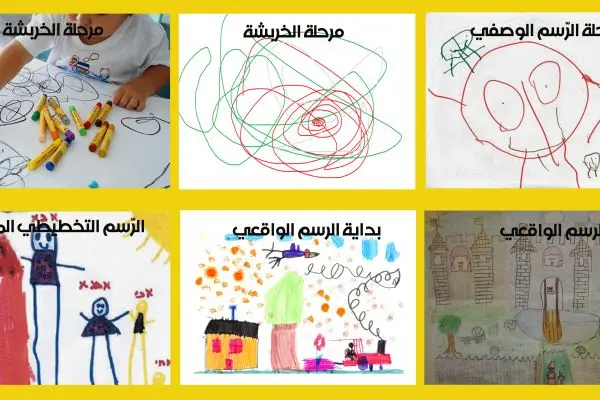
The first drawing stage is called the “scribbling” stage (ages 2–4).
Basic early drawings and free scribbles expressing rudimentary movement.
The scribbling/scrawling stage from ages 1.5–2: random, uneven lines with no attention to the boundaries of the paper. Corresponding to this is the birth of the ego: “I exist.”
The ordered scribbling/scrawling stage from ages 2–4: attempts to distinguish between colors and symbols, the first appearance of a circle and a head, and intersecting lines resembling a cross. Corresponding to this is the emergence of the ability to regulate emotions and control behavior, while the child begins to distinguish between themselves and the surrounding world.
The named scribbling/scrawling stage from ages 2–4: the child names some lines, images, and symbols. Corresponding to this is the emergence of the ability to learn and think, as well as the capacity to use symbols.
The construction stage, the final stage of scribbling: scribbles/scrawls that are clear and arranged harmoniously, with the foundations of repetition and symmetry. This stage involves the ability to analyze, control impulsivity, choose a goal and work toward it, and plan.
The second drawing stage is called the “descriptive drawing” stage (ages 4–7).
Early development of symbols, drawings of undeveloped forms, the appearance of a circle, and the appearance of a head representing people.
It begins with the pre-schematic drawing stage from ages 4–5: outlining drawings and intensifying the color around them. Drawings are usually in the center of the picture, with a focus on drawing people and relationships between figures. The child tries to understand how the things around them are constructed, while their sense of capability and feeling of being understood by others increase.
The third drawing stage is called the “structured schematic drawing” stage (ages 7–9).
Symbols continue to develop, becoming clearer, more meaningful, and more varied.
It begins with the schematic drawing stage, from ages 5–7/9: the paper is divided into three sections—a lower section (the baseline), the middle, and an upper section (the sky)—and cognitive abilities develop. Children with difficulties and lower cognitive abilities often remain in this stage longer. During this stage, the child develops the ability to understand relationships between objects and between the people around them, understand rules and order, connect events, and see the whole picture.
There are three basic ways of expressing the inner world: emphasizing drawings, omitting details, and placing drawings higher.
The fourth drawing stage is called the “beginning of realistic drawing” stage (ages 7–11).
We see drawings with spatial depth and natural colors, along with significant development in artistic expression and the beginnings of depicting the surrounding reality.
At ages 8/9–10/11, we notice a gap between the desire to express what is happening in the inner world and reality, and the ability to express and draw it on paper. There is also an ability to understand complex and new concepts, and to understand differences rather than only similarities. This stage requires the ability to observe closely and examine details. We see depth in the drawing, shading, concealment, omission, the viewpoint from which the child draws, angles, differences, colors, and impressionistic drawing.
The fifth drawing stage is called the “realistic drawing” stage (ages 11–14).
Drawings depict the surrounding environment and daily reality, with greater awareness of figures and events, more explanation and detail, and attention to both small and large details. This is accompanied by the development of abstract thinking, adolescence, perceptions of oneself and others, reflection on personal wishes and needs, the development of hobbies, thinking about relationships between people, and the ability to look at the surrounding world. Thinking broadens and develops considerably, and priorities are established. This is the stage of abstract drawing, drawing from a personal perspective, and drawing that imitates reality.
Download the Tatmeen app on Google Play or the Apple App Store to receive a psychological consultation or access self-help exercises.
Content writer and researcher at Tatmeen, working on Arabic and English articles across mental health and everyday life topics, including relationships, stress, work, habits, and family.
Every Tatmeen article is reviewed by care providers licensed by the Saudi Commission for Health Specialties, so what you read is accurate and trustworthy.
This article builds understanding and does not replace a licensed care provider.
In immediate danger?
If you or someone you know is in danger, call an ambulance on 997 or go to the nearest emergency department.
{"data":{"id":"54bc8788-6080-40e8-89ac-c5f1e78e7b2b","slug":"Understanding-the-progression-of-childrens-drawing","arTitle":"تعلم تطور رسومات الأطفال","enTitle":"Understanding the Development of Children's Drawings","thumbnailAltText":"Six-panel collage of scribbles, simple figures, and detailed colorful scenes","estimatedReadingTime":5,"likesCount":909,"writer":{"id":"f49e2ee4-e68b-4e04-a40b-01d0b0195161","arBio":"كاتب وباحث محتوى في تطمين، يعمل على مقالات عربية وإنجليزية في موضوعات الصحة النفسية والحياة اليومية، مثل العلاقات، الضغوط، العمل، العادات، والأسرة.","enBio":"Content writer and researcher at Tatmeen, working on Arabic and English articles across mental health and everyday life topics, including relationships, stress, work, habits, and family.","user":{"slug":"sultan-almuhasin","arFullName":"سلطان المحيسن","enFullName":"Sultan Almuhasin","publicProfileImageUrl":"https://cdn.tatmeen.sa/public/profile-images/2494102f-7411-4dda-85b1-0c37a1031b3f/c9d25068aaa97c2c1f80123e2d6a27cc7b5a9b1df6a91493df9411b390a60279.webp","publicProfileImage96Url":"https://cdn.tatmeen.sa/public/profile-images/2494102f-7411-4dda-85b1-0c37a1031b3f/c9d25068aaa97c2c1f80123e2d6a27cc7b5a9b1df6a91493df9411b390a60279-w96.webp","publicProfileImage192Url":"https://cdn.tatmeen.sa/public/profile-images/2494102f-7411-4dda-85b1-0c37a1031b3f/c9d25068aaa97c2c1f80123e2d6a27cc7b5a9b1df6a91493df9411b390a60279-w192.webp"}},"arContent":"","enContent":"","productionDocument":{"headings":[],"faqs":[],"beforeSourcesHtml":"","sources":[],"afterSourcesHtml":"","blocks":[{"type":"html","html":"<p class=\"ql-align-right ql-direction-rtl\">The art of <a style=\"background-color:transparent\" href=\"https://www.hakini.net/article/%D9%84%D9%85%D8%A7%D8%B0%D8%A7-%D9%8A%D8%B1%D8%B3%D9%85-%D8%A7%D9%84%D8%B7%D9%91%D9%81%D9%84\" target=\"_blank\" rel=\"noopener noreferrer\">drawing</a> is considered an important gateway to a child's outer and inner worlds. Today, I will therefore discuss the importance of the development of children's drawings and the relationship between drawing and a child's development, as well as how drawings can contribute to the early detection of delays in different areas of child development.</p><p class=\"ql-align-right ql-direction-rtl\">The development of children's drawing is an important component of a child's physical, cognitive, and emotional development. The stages in this process describe changes in the graphic characteristics of drawings throughout childhood and beyond. Drawing is known to be an important gateway into children's worlds: it expresses their experiences and feelings in daily life and develops in response to them. The stages of drawing development in children are also known to be flexible and fluid.</p><p class=\"ql-align-right ql-direction-rtl\">Children may move from one drawing stage to another, or be in two or more stages at the same time, without fully corresponding to their age.</p><p class=\"ql-align-right ql-direction-rtl\">Changes in graphic characteristics and components generally correspond to children's physical, motor, cognitive, emotional, and social development. The development of children's drawing is considered a universal measure and is only slightly affected by the environment. However, it is influenced by other components, such as children's physical, cognitive, and emotional development, as well as changes in their surroundings that directly or indirectly affect their development and psychological state.</p><p class=\"ql-align-right ql-direction-rtl\"><strong><em>The first drawing stage is called the “scribbling” stage (ages 2–4).</em></strong></p><p class=\"ql-align-right ql-direction-rtl\">Basic early drawings and free scribbles expressing rudimentary movement.</p><ul><li class=\"ql-align-right ql-direction-rtl\"><strong>The scribbling/scrawling stage from </strong>ages 1.5–2: random, uneven lines with no attention to the boundaries of the paper. Corresponding to this is the birth of the ego: “I exist.”</li><li class=\"ql-align-right ql-direction-rtl\"><strong>The ordered scribbling/scrawling stage from </strong>ages 2–4: attempts to distinguish between colors and symbols, the first appearance of a circle and a head, and intersecting lines resembling a cross. Corresponding to this is the emergence of the ability to regulate emotions and control behavior, while the child begins to distinguish between themselves and the surrounding world.</li><li class=\"ql-align-right ql-direction-rtl\"><strong>The named scribbling/scrawling stage from </strong>ages 2–4: the child names some lines, images, and symbols. Corresponding to this is the emergence of the ability to learn and think, as well as the capacity to use symbols.</li><li class=\"ql-align-right ql-direction-rtl\"><strong>The construction stage, the final stage of scribbling: scribbles/scrawls</strong> that are clear and arranged harmoniously, with the foundations of repetition and symmetry. This stage involves the ability to analyze, control impulsivity, choose a goal and work toward it, and plan.</li></ul><p class=\"ql-align-right ql-direction-rtl\"><strong><em>The second drawing stage is called the “descriptive drawing” stage (ages 4–7).</em></strong></p><p class=\"ql-align-right ql-direction-rtl\">Early development of symbols, drawings of undeveloped forms, the appearance of a circle, and the appearance of a head representing people.</p><p class=\"ql-align-right ql-direction-rtl\">It begins with <strong>the pre-schematic drawing stage </strong>from <strong> </strong>ages 4–5: outlining drawings and intensifying the color around them. Drawings are usually in the center of the picture, with a focus on drawing people and relationships between figures. The child tries to understand how the things around them are constructed, while their sense of capability and feeling of being understood by others increase.</p><p class=\"ql-align-right ql-direction-rtl\"><strong><em>The third drawing stage is called the “structured schematic drawing” stage (ages 7–9).</em></strong></p><p class=\"ql-align-right ql-direction-rtl\">Symbols continue to develop, becoming clearer, more meaningful, and more varied.</p><p class=\"ql-align-right ql-direction-rtl\">It begins with the schematic drawing stage, from ages 5–7/9: the paper is divided into three sections—a lower section (the baseline), the middle, and an upper section (the sky)—and cognitive abilities develop. Children with difficulties and lower cognitive abilities often remain in this stage longer. During this stage, the child develops the ability to understand relationships between objects and between the people around them, understand rules and order, connect events, and see the whole picture.</p><p class=\"ql-align-right ql-direction-rtl\">There are three basic ways of expressing the inner world: emphasizing drawings, omitting details, and placing drawings higher.</p><p class=\"ql-align-right ql-direction-rtl\"><strong><em>The fourth drawing stage is called the “beginning of realistic drawing” stage (ages 7–11).</em></strong></p><p class=\"ql-align-right ql-direction-rtl\">We see drawings with spatial depth and natural colors, along with significant development in artistic expression and the beginnings of depicting the surrounding reality.</p><p class=\"ql-align-right ql-direction-rtl\">At ages 8/9–10/11, we notice a gap between the desire to express what is happening in the inner world and reality, and the ability to express and draw it on paper. There is also an ability to understand complex and new concepts, and to understand differences rather than only similarities. This stage requires the ability to observe closely and examine details. We see depth in the drawing, shading, concealment, omission, the viewpoint from which the child draws, angles, differences, colors, and impressionistic drawing.</p><p class=\"ql-align-right ql-direction-rtl\"><strong><em>The fifth drawing stage is called the “realistic drawing” stage (ages 11–14).</em></strong></p><p class=\"ql-align-right ql-direction-rtl\">Drawings depict the surrounding environment and daily reality, with greater awareness of figures and events, more explanation and detail, and attention to both small and large details. This is accompanied by the development of abstract thinking, adolescence, perceptions of oneself and others, reflection on personal wishes and needs, the development of hobbies, thinking about relationships between people, and the ability to look at the surrounding world. Thinking broadens and develops considerably, and priorities are established. This is the stage of abstract drawing, drawing from a personal perspective, and drawing that imitates reality.</p><p class=\"ql-align-right ql-direction-rtl\">Download the Tatmeen app on <a style=\"background-color:transparent\" href=\"https://play.google.com/store/apps/details?id=com.hakiniapp\" target=\"_blank\" rel=\"noopener noreferrer\">Google P</a>lay or the <a style=\"background-color:transparent\" href=\"https://apps.apple.com/us/app/hakini/id1618923800\" target=\"_blank\" rel=\"noopener noreferrer\">Apple App Store</a> to receive a psychological consultation or access self-help exercises.</p><p><br /></p>"}],"inlineCtaSignatures":[],"_experienceAliases":{"v":1,"fields":["html","bodyHtml"]}},"createdAt":"2024-01-07T21:00:00.000Z","updatedAt":"2026-08-11T04:45:02.303Z","disorderGroups":[{"id":"9fbda432-3713-400a-987b-3d56754a113e","slug":"children-and-adolescents","arName":"الأطفال والمراهقين","enName":"Children & Adolescents"}],"reviewer":{"arFullName":"فريق تطمين","enFullName":"Tatmeen team","slug":"tatmeen-team","kind":"organization"},"productionArticle":true,"promotionAllowed":false,"preparedCover":{"src":"https://cdn.tatmeen.sa/public/article-lcp/article-lcp-v2/sha256-6c562a623104197f417e4ed9b45feaeeef3d607acd35ebb037914e4c5520a443/600-810216d38882534cd6ed7a38396f7a2c9e416aeb989bedad148c58581c9b4978.avif","fallback":"https://cdn.tatmeen.sa/public/article-lcp/article-lcp-v2/sha256-6c562a623104197f417e4ed9b45feaeeef3d607acd35ebb037914e4c5520a443/600-ef49d94085103a1b3b7da3b0c76f0adba10386308d93efeacd82a0809482afac.webp","directUrl":"https://cdn.tatmeen.sa/blog-cover/1704724725520-Tatmeen-img-747","isGolden":true,"avifSrcset":"https://cdn.tatmeen.sa/public/article-lcp/article-lcp-v2/sha256-6c562a623104197f417e4ed9b45feaeeef3d607acd35ebb037914e4c5520a443/400-9a3d355de7af2731cff082e6b9edcef620c55e4c5f72bcfb8e89696e2c96f1e7.avif 400w, https://cdn.tatmeen.sa/public/article-lcp/article-lcp-v2/sha256-6c562a623104197f417e4ed9b45feaeeef3d607acd35ebb037914e4c5520a443/600-810216d38882534cd6ed7a38396f7a2c9e416aeb989bedad148c58581c9b4978.avif 600w","webpSrcset":"https://cdn.tatmeen.sa/public/article-lcp/article-lcp-v2/sha256-6c562a623104197f417e4ed9b45feaeeef3d607acd35ebb037914e4c5520a443/400-c030b01421064f7f804f8dc574c6e0338c89013604f8621c02ccf0ece68997b4.webp 400w, https://cdn.tatmeen.sa/public/article-lcp/article-lcp-v2/sha256-6c562a623104197f417e4ed9b45feaeeef3d607acd35ebb037914e4c5520a443/600-ef49d94085103a1b3b7da3b0c76f0adba10386308d93efeacd82a0809482afac.webp 600w","phoneAvifSrcset":"https://cdn.tatmeen.sa/public/article-lcp/article-lcp-v2/sha256-6c562a623104197f417e4ed9b45feaeeef3d607acd35ebb037914e4c5520a443/400-9a3d355de7af2731cff082e6b9edcef620c55e4c5f72bcfb8e89696e2c96f1e7.avif 400w, https://cdn.tatmeen.sa/public/article-lcp/article-lcp-v2/sha256-6c562a623104197f417e4ed9b45feaeeef3d607acd35ebb037914e4c5520a443/600-810216d38882534cd6ed7a38396f7a2c9e416aeb989bedad148c58581c9b4978.avif 600w","phoneWebpSrcset":"https://cdn.tatmeen.sa/public/article-lcp/article-lcp-v2/sha256-6c562a623104197f417e4ed9b45feaeeef3d607acd35ebb037914e4c5520a443/400-c030b01421064f7f804f8dc574c6e0338c89013604f8621c02ccf0ece68997b4.webp 400w, https://cdn.tatmeen.sa/public/article-lcp/article-lcp-v2/sha256-6c562a623104197f417e4ed9b45feaeeef3d607acd35ebb037914e4c5520a443/600-ef49d94085103a1b3b7da3b0c76f0adba10386308d93efeacd82a0809482afac.webp 600w","width":600,"height":400},"previewTaxonomy":{"groups":[{"id":"9fbda432-3713-400a-987b-3d56754a113e","slug":"children-and-adolescents","arName":"الأطفال والمراهقين","enName":"Children & Adolescents"}],"topics":[],"tags":[{"id":"52aa8812-914e-495a-9ed5-13bec6c39a93","slug":"parents-children","arName":"الآباء والأطفال","enName":"Parents & Children"},{"id":"c2a6e8d3-de9c-435f-8c95-9727e7db14cc","slug":"explainer-awareness","arName":"دليل توعوي / شرح","enName":"Explainer / Awareness Guide"}]},"previewProviderRecommendations":[],"previewCareProviders":[],"previewDownload":null,"previewRelatedArticles":[{"id":"5b9e52a1-d061-4c61-9b70-be4a9ead6ccc","slug":"Play-therapy-for-children","route":"/blog/Play-therapy-for-children/","title":{"ar":"العلاج باللعب للأطفال","en":"Play Therapy for Children"},"image":"https://cdn.tatmeen.sa/public/article-lcp/article-lcp-v2/sha256-71d8e05d7f7fd7f1c8f446e589c8133bc368e4b40b7518039422aede4592c2ed/600-d3cf50dd1227476cbab0438cdc79605c394479dd4c0be3216111a7af807c1416.webp","directImageFallback":"https://cdn.tatmeen.sa/blog-cover/1704723760916-Tatmeen-img-121","arThumbnailAltText":"A child wearing a helmet and toy rocket backpack rides a red scooter","thumbnailAltText":"A child wearing a helmet and toy rocket backpack rides a red scooter","topic":{"label":{"ar":"الأطفال والمراهقين","en":"Children & Adolescents"}},"readingTimeMinutes":5},{"id":"dac11419-302d-475d-bd57-f69e39bfb56a","slug":"Psychological-Guidance-in-Childhood-Stage","route":"/blog/Psychological-Guidance-in-Childhood-Stage/","title":{"ar":"الإرشاد النفسي في مرحلة الطفولة","en":"Psychological Counseling in Childhood"},"image":"https://cdn.tatmeen.sa/public/article-lcp/article-lcp-v2/sha256-d316db8149614572f4b771b014f5687d34b82da2c989bb7a69622578b52ce28f/600-fa914ccada2c3dd76404d4a3de3467d52d541c6e79df42ba529d4b0af02f972d.webp","directImageFallback":"https://cdn.tatmeen.sa/blog-cover/1704640204510-Tatmeen-img-201","arThumbnailAltText":"Adult and child sit on a sofa, smiling and touching hands","thumbnailAltText":"Adult and child sit on a sofa, smiling and touching hands","topic":{"label":{"ar":"الأطفال والمراهقين","en":"Children & Adolescents"}},"readingTimeMinutes":5},{"id":"5a5abfd8-bf54-443b-8c3c-6e791c20c4e5","slug":"Psychological-problems-in-parents","route":"/blog/Psychological-problems-in-parents/","title":{"ar":"المشاكل النفسية للوالدين وأثرها على أبنائهم","en":"Parents' Mental Health Problems and Their Impact on Children"},"image":"https://cdn.tatmeen.sa/public/article-lcp/article-lcp-v2/sha256-701b408772fd662e503acfdc71fb0ae48ebae8fe6608f1b63497049d57df0912/600-8ce7e012c830394760eecb8dab0399c0dc3b6434b4e692cc84e24a13881cdd89.webp","directImageFallback":"https://cdn.tatmeen.sa/blog-cover/1704290992869-%C3%98%C2%A7%C3%99%C2%84%C3%99%C2%85%C3%98%C2%B4%C3%98%C2%A7%C3%99%C2%83%C3%99%C2%84-%C3%98%C2%A7%C3%99%C2%84%C3%99%C2%86%C3%99%C2%81%C3%98%C2%B3%C3%99%C2%8A%C3%98%C2%A9-%C3%99%C2%84%C3%99%C2%84%C3%99%C2%88%C3%98%C2%A7%C3%99%C2%84%C3%98%C2%AF%C3%99%C2%8A%C3%99%C2%86-%C3%99%C2%88%C3%98%C2%A7%C3%99%C2%94%C3%98%C2%AB%C3%98%C2%B1%C3%99%C2%87%C3%98%C2%A7-%C3%98%C2%B9%C3%99%C2%84%C3%99%C2%89-%C3%98%C2%A7%C3%99%C2%94%C3%98%C2%A8%C3%99%C2%86%C3%98%C2%A7%C3%99%C2%8A%C3%99%C2%94%C3%99%C2%87%C3%99%C2%85-600x400.jpeg","arThumbnailAltText":"A child sits looking down while an adult leans toward them from a nearby sofa","thumbnailAltText":"A child sits looking down while an adult leans toward them from a nearby sofa","topic":{"label":{"ar":"الأطفال والمراهقين","en":"Children & Adolescents"}},"readingTimeMinutes":5},{"id":"2e10a20c-058a-44ea-a72c-08b7d3d3220c","slug":"Child-and-adolescent-suicide","route":"/blog/Child-and-adolescent-suicide/","title":{"ar":"انتحار الأطفال والمراهقين","en":"Suicide in Children and Adolescents"},"image":"https://cdn.tatmeen.sa/public/article-lcp/article-lcp-v2/sha256-eb4e8dd72469336656c66662d9cdebc85f07c88c06a74c97fc28fb0d8fae27f7/600-4b0621c3495ff206040e35eb3c7674dacfc1120242e2285a3495341c331d0ca3.webp","directImageFallback":"https://cdn.tatmeen.sa/blog-cover/1704637210117-Tatmeen-img-111","arThumbnailAltText":"Seated person surrounded by reaching hands beneath a suicide prevention message","thumbnailAltText":"Seated person surrounded by reaching hands beneath a suicide prevention message","topic":{"label":{"ar":"الأطفال والمراهقين","en":"Children & Adolescents"}},"readingTimeMinutes":5}],"previewRelatedReadStates":{}},"locale":"en","device":"desktop","path":"/en/blog/Understanding-the-progression-of-childrens-drawing/","readingControls":false,"config":{"public":{"BUCKET_URL":"https://cdn.tatmeen.sa/","APP_BASE_URL":"https://tatmeen.sa","intercomAppId":"ppcnu9e3"}}}