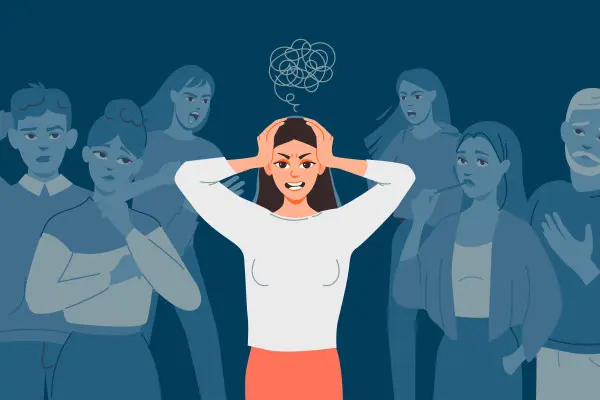
Throughout life, everyone encounters situations in which they may become the focus of attention among those around them, such as giving a speech or talk before a group of people, or even something less demanding, such as meeting new people. When facing situations for the first time, it is entirely natural to feel anxious, confused, and embarrassed. This feeling is expected to be temporary and end when the situation does; it is not normal for it to continue beyond that.
The problem arises when feelings of anxiety and confusion are not limited to a particular situation but accompany the person whenever they face any social situation. This is known as social phobia. People who experience social phobia are overwhelmed by this fear, tension, and intense panic even well before the situation occurs. For people with social phobia, this fear and confusion may accompany simple situations that do not warrant such a reaction, such as waiting among other people, buying necessities and dealing with salespeople, or other everyday situations. They realize that their fear and anxiety are not based on any logical reasons, but they cannot control them.
What Is Social Phobia?
Social phobia is a psychological disorder in which the person feels intense fear and a strong desire to avoid social situations because of anxiety and constant concern about other people's impressions of them, whether others dislike them or feel they do not fit in. This makes them fear embarrassment and humiliation. The person experiences this fear and anxiety to varying degrees, which may become severe enough to impair their ability to carry out daily activities. It may even take a negative course that leads them to stop leaving home for essential tasks such as going to work or school.
Social phobia falls under the umbrella of social anxiety disorder, which is classified as a type of anxiety disorder. Social phobia is also more common among females than males and can affect people at any age, although its symptoms usually begin during adolescence.
Feelings of confusion, fear, and anxiety in some situations do not necessarily indicate social phobia, especially in children. Levels of engagement in social situations vary according to personality traits and life experiences. Some people are naturally introverted, while others are more outgoing.
Social phobia involves fear, anxiety, and avoidance that interfere with daily routines, work, school, or other activities. Social phobia usually begins in early to mid-adolescence, although it can sometimes begin in younger children or adults.
What Causes Social Phobia?
The direct cause of social phobia has not been identified, but a combination of environmental, genetic, and physical factors may play a role in its development.
1. Genetic factors:
Many studies suggest that mental illnesses, like physical illnesses, can be inherited. In other words, many mental illnesses may run in families when there is a family history of the condition. Examples include psychotic disorders such as schizophreniaand depression. Although this has not been conclusively established, many studies point to the existence of genes involved in causing depression, and one case of depression in a family member is enough to double the likelihood of other family members developing it.
The same may apply to social phobia. Genetic factors may play a role in its development, as the risk increases when a family member has social phobia.
2. Physical factors:
An imbalance in the neurotransmitters involved in stabilizing mood is considered one possible cause of social phobia, particularly if it involves elevated levels of neurotransmitters in the brain, such as serotonin and glutamate, or overactivity in several neural circuits in the brain.
Social phobia may also be associated with overactivity in the amygdala, a part of the brain responsible for fear-related responses. This can lead to excessive fear in certain situations and feelings of anxiety without a reason.
3. Environmental factors:
The environment in which a person grows up is one of the main factors affecting their mental health. Here, we mean the primary environment: the setting into which the person was born and in which they were raised. Growing up in a family environment that uses violence and harsh treatment as a parenting approach can contribute to many psychological disorders in its children. A person's environment is certainly not limited to the family and includes much wider circles, but the family can be considered the foundation of a person's mental health.
Accordingly, when a child lives with parents who repeatedly surround them with tension and irritability, while constantly criticizing their behavior, neglecting them, or being overprotective, this can create an enduring sense of fear and confusion that may eventually lead to social phobia.
How Do You Know If You Have Social Phobia?
Not every feeling of confusion or fear in social situations can be considered an indication of social phobia. These feelings must be extremely intense—intense enough to prevent the person from leading their social life normally. It is important to remember that comfort levels in social situations vary depending on a person's character and the experiences they have had in life. Some people are naturally reserved, while others are more outgoing.
Unlike everyday nervousness, the signs of social phobia include fear, anxiety, and isolation that affect the person's relationships with others or the routine daily activities they perform, such as work and study. Social phobia usually begins in early or mid-adolescence, although it may sometimes begin in younger children or adults.
The signs and symptoms of social anxiety disorder may include persistent feelings of the following:
1. Emotional symptoms:
Fear of situations in which you may be judged.
Worry about embarrassing or humiliating yourself.
Intense fear of interacting or speaking with strangers.
Fear that others will notice your anxiety.
Fear of physical symptoms that could embarrass you, such as blushing, sweating, trembling, or having a shaky voice.
Avoiding activities or speaking to people for fear of embarrassment.
Avoiding situations in which you might be the center of attention.
Anxiety in anticipation of a feared activity or event.
Being unable to tolerate a social situation involving intense fear or anxiety.
Spending time after a social situation analyzing your performance and identifying flaws in your interactions.
Always expecting the worst possible consequences because of a previous negative social experience.
In children, anxiety when interacting with adults or peers may appear as crying or tantrums.
2. Physical symptoms:
Physical signs and symptoms may sometimes accompany social anxiety disorder and can include:
Blushing cheeks.
A rapid heartbeat.
Trembling and chills.
Sweating of the face, hands, or entire body.
An upset stomach or nausea.
Difficulty breathing.
Feeling dizzy or lightheaded.
Feeling as though your mind is unable to think.
Muscle tension.
The symptoms of social phobia may change over time. They may intensify if you face many changes, stressors, or demands in your life. Although avoiding situations that trigger social anxiety disorder may make you feel better in the short term, your anxiety is likely to remain over the long term if you do not receive treatment.
Types of Social Phobia
Social phobia is divided into the following types:
Generalized social phobia:This is fear and anxiety about all social situations and interactions.
Specific social phobia:This is fear and anxiety about only one or two situations.
Performance-related social phobia:This affects people who experience severe anxiety about performing a task in front of others or simply being in public places, such as eating outside the home or giving a speech before an audience.
Interaction-related social phobia:This includes people who become anxious in situations where they must speak or interact with others.
What Is Life Like for Someone With Social Phobia?
Their lives can be difficult because they are apprehensive about attending social occasions and doing certain things. They always expect negative outcomes before anything happens and may fear insults, how people see them, or being bullied. At first, the symptoms may appear mild when the person engages with others. In advanced cases, however, they anticipate certain events and prevent themselves from participating, leading to isolation. They may become unable to go to work or take part in their social life. The situation worsens as they compare themselves with others and wonder why they cannot exchange courtesies with them. The person has insight into their condition, but many people try to recover on their own and often fail, leaving their symptoms more deeply entrenched.
Is Social Phobia a Mental Illness?
Social phobia is classified as a psychological disorder known as social anxiety disorder. It affects the person's feelings and behavior, which in turn is reflected in how they act and speak in any social situation they face. It is classified as a disorder because the symptoms recur every day and in every social situation the person encounters, taking the form of anxiety and fear.
Social phobia is also considered one of the most common mental health conditions. Between 7 and 12 out of every 100 people experience social phobia at least once in their lives. It is also more common among women than men, with the rate among women being one and a half times that among men. In most cases, the condition first appears during adolescence.
Social phobia very rarely subsides on its own, and the symptoms remain persistent—especially in adulthood—if the person does not receive medical treatment. The chances of recovery are good when treatment is provided in a scientific and carefully considered manner.
How Can You Treat Yourself for Social Phobia?
Psychologicaltreatment helps ease symptoms in most people with social phobia. During treatment, the person can identify and change the negative patterns of thinking they engage in. They can also develop skills that help them gain self-confidence in social situations. It is important for the person to understand that treatment depends on how much the symptoms of social phobia affect their ability to perform everyday functions. The most common treatment for social phobia includes psychotherapy, medication, or both.
1. Psychotherapy:
Cognitive behavioral therapy is the most effective type of psychotherapy for treating social phobia, whether delivered individually or in a group. Cognitive behavioral therapy aims to expose the person to social situations that trigger symptoms of social phobia. The goal is to prepare them psychologically to face situations that provoke fear and anxiety, improve their coping skills regarding interaction with others, and help them build the confidence needed to handle fear- and anxiety-provoking situations. You can also participate in skills-training sessions or act out certain situations through role-playing to strengthen your social skills and feel more comfortable and confident with others. Exposure to social situations primarily helps you confront your fears.
2. Medication:
Your healthcare provider may also prescribe other medications to treat symptoms of social anxiety, such as:
Antidepressants:You should know that it is normal to try different types of antidepressants to determine which is most effective for your condition and causes the fewest side effects.
Anti-anxiety medications:Anti-anxiety medications are commonly used to reduce anxiety in people with social phobia. Although they can sometimes work quickly, they may cause dependence. It is therefore important to avoid taking them for a long period.
Medications that block the effects of adrenaline:These medications work by blocking the effects of adrenaline, thereby reducing heart rate, blood pressure, voice tremors, and muscle tension. For this reason, they are usually preferred for immediate use to ease symptoms of social phobia in a particular situation and are not recommended as a general treatment for the condition.
You must understand that these medications should not be taken without consulting your specialist psychiatrist, who can determine which of these medications is appropriate for your condition based on your diagnosis. Your psychiatrist is also best placed to determine the dose, which may be increased gradually from a lower to a higher dose so that you do not experience medication side effects. Medication is not a magical solution that ends symptoms as soon as it is taken; it may take several weeks or months before your symptoms improve noticeably.
Do not expect treatment to produce rapid positive results. You can still make progress through psychotherapy over several weeks or months. Treatment also requires additional effort from you to learn new skills for managing your anxiety, and this will take some time. Finding the right treatment may require some trial and error. It is important to know that treatment outcomes vary from one person to another. For some people, the symptoms of social phobia may fade over time, and they may stop taking medication. Others may need to take medication for years to prevent relapse.
For treatment to produce the desired results, you must keep your medical and therapy appointments, set goals for entering social situations you continually avoid, take medications according to your doctor's instructions, and speak with your healthcare provider about any changes in your condition.
3. Alternative treatment methods:
Treatment options for social phobia are not limited to psychotherapy sessions and medication. Several alternative or complementary approaches may support the previous methods, including:
Herbal remedies:Many herbs are used as a means of overcoming anxiety. However, you should be cautious when using them because their results vary. Like medications, they should preferably be taken following medical advice that specifies an appropriate dose, as herbs can cause side effects or interact with medications you are already taking.
Home-based treatment:By home-based treatment, we mean that the person is motivated to make the effort required to reduce the impact of their symptoms by using some of the following methods to manage situations likely to trigger them:
Create a healthy diet for yourself and make sure you follow it.
Make sure not to consume alcohol, narcotic substances, or caffeine.
Practice social interactions within a space that feels safe to you by communicating with people you feel comfortable with. Make this communication a starting point for calming yourself before interacting with other people you do not know.
How Can You Overcome Social Phobia?
Think logically and realistically about what makes you fear or dread social interaction.
Ask yourself about the advantages and disadvantages of interacting socially with those around you, and what consequences those disadvantages might have.
Decide to confront the negative outcomes you imagine may result from interacting with your community. The solution lies in recognizing your fears and facing them.
Talk with those around you about the negative outcomes and fears you imagine. This helps you recognize and understand yourself more fully.
If, despite the previous steps, you feel unable to overcome your social fears, you should receive psychological treatment..
In conclusion, the ideal approach to treating social phobia begins with the conviction that the people around you are just like you: they have strengths and flaws, make mistakes and get things right, and are not perfect. Interacting with them therefore does not require fear or anxiety. No matter how many treatment methods are available, we emphasize that they will not produce results unless you recognize and believe this, understand the importance of treatment, and accept that its first step begins with a decision from you.
You should therefore think about and identify your fears and be able to describe your feelings when you encounter them. This will help you determine the nature of what you are experiencing and help your psychiatrist determine the appropriate treatment plan for you. Then carry out the activities mentioned above, which may reduce your feelings of anxiety, tension, and confusion. Begin gradually and take small steps by setting daily or weekly goals to expose yourself to simple situations that are not too overwhelming.
We cannot assure you that becoming a social person will be easy. It is difficult, but not impossible. Beginnings are always difficult and test your ability to persevere. What we can say with certainty is that committing to the first step is what will make a difference. Despite how difficult or painful things may seem at first, this should not discourage you or cause you to avoid situations that trigger and intensify your social phobia symptoms. Instead, you should face these situations and build and strengthen skills for coping with them.
We recommend working to build a social network by regularly communicating with friends and family members and joining volunteer and interactive groups that provide opportunities to improve communication skills and public speaking, such as associations and youth groups. Strengthen your skills and narratives.
Content writer and researcher at Tatmeen, writing in Arabic and English about mental health and everyday life, from relationships and stress to work, habits, and family.
Every Tatmeen article is reviewed by care providers licensed by the Saudi Commission for Health Specialties, so what you read is accurate and trustworthy.
This article builds understanding and does not replace a licensed care provider.
Need someone to talk to?
Tatmeen's licensed care providers are available around the clock, and the app's urgent consultation connects you with one within minutes.
Download Tatmeen to explore care providers and booking options.
Smart matchingFour quick questions suggest the right care provider
Urgent consultationTalk to an available care provider within minutes
Free psychological measuresMore than 20 tests to understand how you are doing
Scan to download
{"data":{"id":"75379a26-8b8a-435a-bddb-9dd3fca641d5","slug":"Self-treatment-of-social-anxiety","arTitle":"كيف تعالج نفسك من الرهاب الاجتماعي؟","enTitle":"How Can You Treat Yourself for Social Phobia?","thumbnailAltText":"Person standing with arms folded while blurred groups talk in the background","estimatedReadingTime":5,"likesCount":999,"writer":{"id":"d3defdb6-4a23-4b03-aad9-a1ecc054aae5","arBio":"كاتب وباحث محتوى في تطمين، يكتب بالعربية والإنجليزية عن الصحة النفسية والحياة اليومية، من العلاقات والضغوط إلى العمل والعادات والأسرة.\n","enBio":"Content writer and researcher at Tatmeen, writing in Arabic and English about mental health and everyday life, from relationships and stress to work, habits, and family.","user":{"slug":"fahad-almalik","arFullName":"فهد المالك","enFullName":"Fahad Almalik","publicProfileImageUrl":"https://cdn.tatmeen.sa/public/profile-images/a34c8028-5847-45de-ab83-a014942bb7d3/675415e988c16442a04af5d3b8899242613a955c44e0364314cc3ff74cbad082.webp","publicProfileImage96Url":"https://cdn.tatmeen.sa/public/profile-images/a34c8028-5847-45de-ab83-a014942bb7d3/675415e988c16442a04af5d3b8899242613a955c44e0364314cc3ff74cbad082-w96.webp","publicProfileImage192Url":"https://cdn.tatmeen.sa/public/profile-images/a34c8028-5847-45de-ab83-a014942bb7d3/675415e988c16442a04af5d3b8899242613a955c44e0364314cc3ff74cbad082-w192.webp"}},"arContent":"","enContent":"","productionDocument":{"headings":[{"id":"article-section-how-can-you-treat-yourself-for-social-phobia","text":"How Can You Treat Yourself for Social Phobia?"},{"id":"article-section-what-is-social-phobia","text":"What Is Social Phobia?"},{"id":"article-section-what-causes-social-phobia","text":"What Causes Social Phobia?"},{"id":"article-section-how-do-you-know-if-you-have-social-phobia","text":"How Do You Know If You Have Social Phobia?"},{"id":"article-section-types-of-social-phobia","text":"Types of Social Phobia"},{"id":"article-section-what-is-life-like-for-someone-with-social-phobia","text":"What Is Life Like for Someone With Social Phobia?"},{"id":"article-section-is-social-phobia-a-mental-illness","text":"Is Social Phobia a Mental Illness?"},{"id":"article-section-how-can-you-treat-yourself-for-social-phobia-2","text":"How Can You Treat Yourself for Social Phobia?"},{"id":"article-section-how-can-you-overcome-social-phobia","text":"How Can You Overcome Social Phobia?"}],"faqs":[],"beforeSourcesHtml":"","sources":[],"afterSourcesHtml":"","blocks":[{"type":"html","html":"<h2 class=\"ql-align-right ql-direction-rtl\" id=\"article-section-how-can-you-treat-yourself-for-social-phobia\" data-toc-heading tabindex=\"-1\"><span id=\"how-can-you-treat-yourself-for-social-phobia-1\" aria-hidden=\"true\"></span><strong>How Can You Treat Yourself for Social Phobia?</strong></h2><p class=\"ql-align-right ql-direction-rtl\">Throughout life, everyone encounters situations in which they may become the focus of attention among those around them, such as giving a speech or talk before a group of people, or even something less demanding, such as meeting new people. When facing situations for the first time, it is entirely natural to feel <a style=\"background-color:transparent\" href=\"https://www.hakini.net/article/%D9%85%D8%A7-%D9%87%D9%8A-%D8%B7%D8%B1%D9%8A%D9%82%D8%A9-%D8%A7%D9%84%D8%AA%D8%AE%D9%84%D8%B5-%D9%85%D9%86-%D8%A7%D9%84%D9%82%D9%84%D9%82-%D9%88%D8%A7%D9%84%D8%AA%D9%88%D8%AA%D8%B1\" target=\"_blank\" rel=\"noopener noreferrer\">anxious</a>, confused, and embarrassed. This feeling is expected to be temporary and end when the situation does; it is not normal for it to continue beyond that.</p><p class=\"ql-align-right ql-direction-rtl\">The problem arises when feelings of anxiety and confusion are not limited to a particular situation but accompany the person whenever they face any social situation. This is known as social phobia. People who experience <a style=\"background-color:transparent\" href=\"https://www.hakini.net/article/%D9%85%D8%A7-%D9%87%D9%88-%D8%A7%D8%B6%D8%B7%D8%B1%D8%A7%D8%A8-%D8%A7%D9%84%D9%82%D9%84%D9%82-%D8%A7%D9%84%D8%A7%D8%AC%D8%AA%D9%85%D8%A7%D8%B9%D9%8A-%D8%A7%D9%84%D8%B1%D9%87%D8%A7%D8%A8-%D8%A7%D9%84%D8%A7%D8%AC%D8%AA%D9%85%D8%A7%D8%B9%D9%8A\" target=\"_blank\" rel=\"noopener noreferrer\">social phobia</a> are overwhelmed by this fear, tension, and intense <a style=\"background-color:transparent\" href=\"https://www.hakini.net/article/%D9%86%D9%88%D8%A8%D8%A7%D8%AA-%D8%A7%D9%84%D9%87%D9%84%D8%B9-%D8%A7%D8%B9%D8%B1%D8%A7%D8%B6-%D9%88%D8%AD%D9%82%D8%A7%D8%A6%D9%82-%D8%B9%D9%86-%D8%A7%D8%B6%D8%B7%D8%B1%D8%A7%D8%A8-%D8%A7%D9%84%D9%87%D9%84%D8%B9-%D8%A7%D9%84%D8%B0%D8%B9%D8%B1\" target=\"_blank\" rel=\"noopener noreferrer\">panic</a> even well before the situation occurs. For people with social phobia, this fear and confusion may accompany simple situations that do not warrant such a reaction, such as waiting among other people, buying necessities and dealing with salespeople, or other everyday situations. They realize that their fear and anxiety are not based on any logical reasons, but they cannot control them.</p><h2 class=\"ql-align-right ql-direction-rtl\" id=\"article-section-what-is-social-phobia\" data-toc-heading tabindex=\"-1\"><span id=\"what-is-social-phobia-2\" aria-hidden=\"true\"></span><strong>What Is Social Phobia?</strong></h2><p class=\"ql-align-right ql-direction-rtl\">Social phobia is a psychological disorder in which the person feels intense fear and a strong desire to avoid social situations because of anxiety and constant concern about other people's impressions of them, whether others dislike them or feel they do not fit in. This makes them fear embarrassment and humiliation. The person experiences this <a style=\"background-color:transparent\" href=\"https://www.hakini.net/article/%D9%83%D9%8A%D9%81%D9%8A%D8%A9-%D8%B9%D9%84%D8%A7%D8%AC-%D8%A7%D9%84%D9%82%D9%84%D9%82-%D9%88%D8%A7%D9%84%D8%AE%D9%88%D9%81\" target=\"_blank\" rel=\"noopener noreferrer\">fear and anxiety</a> to varying degrees, which may become severe enough to impair their ability to carry out daily activities. It may even take a negative course that leads them to stop leaving home for essential tasks such as going to work or school.</p><p class=\"ql-align-right ql-direction-rtl\">Social phobia falls under the umbrella of <a style=\"background-color:transparent\" href=\"https://www.hakini.net/article/%D8%A7%D8%B6%D8%B7%D8%B1%D8%A7%D8%A8-%D8%A7%D9%84%D9%82%D9%84%D9%82-%D8%A7%D9%84%D8%A7%D8%AC%D8%AA%D9%85%D8%A7%D8%B9%D9%8A-%D8%A7%D9%84%D8%AA%D8%B4%D8%AE%D9%8A%D8%B5-%D9%88%D8%A7%D9%84%D8%B9%D9%84%D8%A7%D8%AC\" target=\"_blank\" rel=\"noopener noreferrer\">social anxiety</a> disorder, which is classified as a type of anxiety disorder. Social phobia is also more common among females than males and can affect people at any age, although its symptoms usually begin during adolescence.</p><p class=\"ql-align-right ql-direction-rtl\">Feelings of confusion, fear, and anxiety in some situations do not necessarily indicate social phobia, especially in children. Levels of engagement in social situations vary according to personality traits and life experiences. Some people are naturally introverted, while others are more outgoing.</p><p class=\"ql-align-right ql-direction-rtl\">Social phobia involves fear, anxiety, and avoidance that interfere with daily routines, work, school, or other activities. Social phobia usually begins in early to mid-adolescence, although it can sometimes begin in younger children or adults.</p><h2 class=\"ql-align-right ql-direction-rtl\" id=\"article-section-what-causes-social-phobia\" data-toc-heading tabindex=\"-1\"><span id=\"what-causes-social-phobia-3\" aria-hidden=\"true\"></span><strong>What Causes Social Phobia?</strong></h2><p class=\"ql-align-right ql-direction-rtl\">The direct cause of social phobia has not been identified, but a combination of environmental, genetic, and physical factors may play a role in its development.</p><h3 class=\"ql-align-right ql-direction-rtl\"><strong>1. Genetic factors:</strong></h3><p class=\"ql-align-right ql-direction-rtl\">Many studies suggest that mental illnesses, like physical illnesses, can be inherited. In other words, many mental illnesses may run in families when there is a family history of the condition. Examples include psychotic disorders such as <a style=\"background-color:transparent\" href=\"https://www.hakini.net/article/%D9%87%D9%84-%D8%A7%D9%84%D9%81%D8%B5%D8%A7%D9%85-%D9%85%D8%B1%D8%B6-%D8%B9%D9%82%D9%84%D9%8A-%D8%A3%D9%85-%D9%86%D9%81%D8%B3%D9%8A\" target=\"_blank\" rel=\"noopener noreferrer\">schizophrenia</a> <a style=\"background-color:transparent\" href=\"https://www.hakini.net/article/%D8%A7%D9%84%D8%A7%D9%83%D8%AA%D8%A6%D8%A7%D8%A8-%D9%85%D8%A7-%D9%87%D9%8A-%D8%A3%D9%86%D9%88%D8%A7%D8%B9-%D8%A7%D9%84%D8%A7%D9%83%D8%AA%D8%A6%D8%A7%D8%A8-%D9%88%D9%85%D8%A7-%D9%87%D9%8A-%D8%A3%D8%B9%D8%B1%D8%A7%D8%B6%D9%87\" target=\"_blank\" rel=\"noopener noreferrer\">and depression</a>. Although this has not been conclusively established, many studies point to the existence of genes involved in causing depression, and one case of depression in a family member is enough to double the likelihood of other family members developing it.</p><p class=\"ql-align-right ql-direction-rtl\">The same may apply to social phobia. Genetic factors may play a role in its development, as the risk increases when a family member has social phobia.</p><h3 class=\"ql-align-right ql-direction-rtl\"><strong>2. Physical factors:</strong></h3><p class=\"ql-align-right ql-direction-rtl\">An imbalance in the neurotransmitters involved in stabilizing mood is considered one possible cause of social phobia, particularly if it involves elevated levels of neurotransmitters in the brain, such as serotonin and glutamate, or overactivity in several neural circuits in the brain.</p><p class=\"ql-align-right ql-direction-rtl\">Social phobia may also be associated with overactivity in the amygdala, a part of the brain responsible for fear-related responses. This can lead to excessive fear in certain situations and feelings of anxiety without a reason.</p><h3 class=\"ql-align-right ql-direction-rtl\"><strong>3. Environmental factors:</strong></h3><p class=\"ql-align-right ql-direction-rtl\"><a style=\"background-color:transparent\" href=\"https://www.hakini.net/article/%D9%83%D9%8A%D9%81-%D8%AA%D8%A4%D8%AB%D8%B1-%D8%A7%D9%84%D8%A8%D9%8A%D8%A6%D8%A9-%D8%A7%D9%84%D8%A7%D8%AC%D8%AA%D9%85%D8%A7%D8%B9%D9%8A%D8%A9-%D8%B9%D9%84%D9%89-%D8%A7%D9%84%D8%AA%D9%86%D8%B4%D8%A6%D8%A9\" target=\"_blank\" rel=\"noopener noreferrer\">The environment</a> in which a person grows up is one of the main factors affecting their mental health. Here, we mean the primary environment: the setting into which the person was born and in which they were raised. Growing up in a family environment that uses violence and harsh treatment as a parenting approach can contribute to many psychological disorders in its children. A person's environment is certainly not limited to the family and includes much wider circles, but the family can be considered the foundation of a person's mental health.</p><p class=\"ql-align-right ql-direction-rtl\">Accordingly, when a child lives with parents who repeatedly surround them with tension and irritability, while constantly criticizing their behavior, neglecting them, or being overprotective, this can create an enduring sense of fear and confusion that may eventually lead to social phobia.</p><h2 class=\"ql-align-right ql-direction-rtl\" id=\"article-section-how-do-you-know-if-you-have-social-phobia\" data-toc-heading tabindex=\"-1\"><span id=\"how-do-you-know-if-you-have-social-phobia-4\" aria-hidden=\"true\"></span><strong>How Do You Know If You Have Social Phobia?</strong></h2><p class=\"ql-align-right ql-direction-rtl\">Not every feeling of confusion or fear in social situations can be considered an indication of social phobia. These feelings must be extremely intense—intense enough to prevent the person from leading their social life normally. It is important to remember that comfort levels in social situations vary depending on a person's character and the experiences they have had in life. Some people are naturally reserved, while others are more outgoing.</p><p class=\"ql-align-right ql-direction-rtl\">Unlike everyday nervousness, the signs of social phobia include fear, anxiety, and isolation that affect the person's relationships with others or the routine daily activities they perform, such as work and study. Social phobia usually begins in early or mid-adolescence, although it may sometimes begin in younger children or adults.</p><p class=\"ql-align-right ql-direction-rtl\"><strong>The signs and symptoms of social anxiety disorder may include persistent feelings of the following:</strong></p><h3 class=\"ql-align-right ql-direction-rtl\"><strong>1. Emotional symptoms:</strong></h3><ul><li class=\"ql-align-right ql-direction-rtl\">Fear of situations in which you may be judged.</li><li class=\"ql-align-right ql-direction-rtl\">Worry about embarrassing or humiliating yourself.</li><li class=\"ql-align-right ql-direction-rtl\">Intense fear of interacting or speaking with strangers.</li><li class=\"ql-align-right ql-direction-rtl\">Fear that others will notice your anxiety.</li><li class=\"ql-align-right ql-direction-rtl\">Fear of physical symptoms that could embarrass you, such as blushing, sweating, trembling, or having a shaky voice.</li><li class=\"ql-align-right ql-direction-rtl\">Avoiding activities or speaking to people for fear of embarrassment.</li><li class=\"ql-align-right ql-direction-rtl\">Avoiding situations in which you might be the center of attention.</li><li class=\"ql-align-right ql-direction-rtl\">Anxiety in anticipation of a feared activity or event.</li><li class=\"ql-align-right ql-direction-rtl\">Being unable to tolerate a social situation involving intense fear or anxiety.</li><li class=\"ql-align-right ql-direction-rtl\">Spending time after a social situation analyzing your performance and identifying flaws in your interactions.</li><li class=\"ql-align-right ql-direction-rtl\">Always expecting the worst possible consequences because of a previous negative social experience.</li><li class=\"ql-align-right ql-direction-rtl\">In children, anxiety when interacting with adults or peers may appear as crying or <a style=\"background-color:transparent\" href=\"https://www.hakini.net/article/%D8%A7%D9%84%D8%BA%D8%B6%D8%A8-%D8%B9%D9%86%D8%AF-%D8%A7%D9%84%D8%A3%D8%B7%D9%81%D8%A7%D9%84-%D9%83%D9%8A%D9%81-%D9%8A%D9%85%D9%83%D9%86-%D8%A5%D8%AF%D8%A7%D8%B1%D8%AA%D9%87-%D9%88%D8%A7%D9%84%D8%AA%D8%AD%D9%83%D9%85-%D8%A8%D9%87\" target=\"_blank\" rel=\"noopener noreferrer\">tantrums.</a></li></ul><h3 class=\"ql-align-right ql-direction-rtl\"><strong>2. Physical symptoms:</strong></h3><p class=\"ql-align-right ql-direction-rtl\">Physical signs and symptoms may sometimes accompany social anxiety disorder and can include:</p><ol><li class=\"ql-align-right ql-direction-rtl\">Blushing cheeks.</li><li class=\"ql-align-right ql-direction-rtl\">A rapid heartbeat.</li><li class=\"ql-align-right ql-direction-rtl\">Trembling and chills.</li><li class=\"ql-align-right ql-direction-rtl\">Sweating of the face, hands, or entire body.</li><li class=\"ql-align-right ql-direction-rtl\">An upset stomach or nausea.</li><li class=\"ql-align-right ql-direction-rtl\">Difficulty breathing.</li><li class=\"ql-align-right ql-direction-rtl\">Feeling dizzy or lightheaded.</li><li class=\"ql-align-right ql-direction-rtl\">Feeling as though your mind is unable to think.</li><li class=\"ql-align-right ql-direction-rtl\">Muscle tension.</li></ol><p class=\"ql-align-right ql-direction-rtl\">The symptoms of social phobia may change over time. They may intensify if you face many changes, stressors, or demands in your life. Although avoiding situations that trigger social anxiety disorder may make you feel better in the short term, your anxiety is likely to remain over the long term if you do not receive treatment.</p><h2 class=\"ql-align-right ql-direction-rtl\" id=\"article-section-types-of-social-phobia\" data-toc-heading tabindex=\"-1\"><span id=\"types-of-social-phobia-5\" aria-hidden=\"true\"></span><strong>Types of Social Phobia</strong></h2><p class=\"ql-align-right ql-direction-rtl\">Social phobia is divided into the following types:</p><ol><li class=\"ql-align-right ql-direction-rtl\"><strong>Generalized social phobia:</strong>This is fear and anxiety about all social situations and interactions.</li><li class=\"ql-align-right ql-direction-rtl\"><strong>Specific social phobia:</strong>This is fear and anxiety about only one or two situations.</li><li class=\"ql-align-right ql-direction-rtl\"><strong>Performance-related social phobia:</strong>This affects people who experience severe anxiety about performing a task in front of others or simply being in public places, such as eating outside the home or giving a speech before an audience.</li><li class=\"ql-align-right ql-direction-rtl\"><strong>Interaction-related social phobia:</strong>This includes people who become anxious in situations where they must speak or interact with others.</li></ol><h2 class=\"ql-align-right ql-direction-rtl\" id=\"article-section-what-is-life-like-for-someone-with-social-phobia\" data-toc-heading tabindex=\"-1\"><span id=\"what-is-life-like-for-someone-with-social-phobia-6\" aria-hidden=\"true\"></span><strong>What Is Life Like for Someone With Social Phobia?</strong></h2><p class=\"ql-align-right ql-direction-rtl\">Their lives can be difficult because they are apprehensive about attending social occasions and doing certain things. They always expect negative outcomes before anything happens and may fear insults, how people see them, or being bullied. At first, the symptoms may appear mild when the person engages with others. In advanced cases, however, they anticipate certain events and prevent themselves from participating, leading to isolation. They may become unable to go to work or take part in their social life. The situation worsens as they compare themselves with others and wonder why they cannot exchange courtesies with them. The person has insight into their condition, but many people try to recover on their own and often fail, leaving their symptoms more deeply entrenched.</p><h2 class=\"ql-align-right ql-direction-rtl\" id=\"article-section-is-social-phobia-a-mental-illness\" data-toc-heading tabindex=\"-1\"><span id=\"is-social-phobia-a-mental-illness-7\" aria-hidden=\"true\"></span><strong>Is Social Phobia a Mental Illness?</strong></h2><p class=\"ql-align-right ql-direction-rtl\">Social phobia is classified as a psychological disorder known as social anxiety disorder. It affects the person's feelings and behavior, which in turn is reflected in how they act and speak in any social situation they face. It is classified as a disorder because the symptoms recur every day and in every social situation the person encounters, taking the form of anxiety and fear.</p><p class=\"ql-align-right ql-direction-rtl\">Social phobia is also considered one of the most common mental health conditions. Between 7 and 12 out of every 100 people experience social phobia at least once in their lives. It is also more common among women than men, with the rate among women being one and a half times that among men. In most cases, the condition first appears during adolescence.</p><p class=\"ql-align-right ql-direction-rtl\">Social phobia very rarely subsides on its own, and the symptoms remain persistent—especially in adulthood—if the person does not receive medical treatment. The chances of recovery are good when treatment is provided in a scientific and carefully considered manner.</p><h2 class=\"ql-align-right ql-direction-rtl\" id=\"article-section-how-can-you-treat-yourself-for-social-phobia-2\" data-toc-heading tabindex=\"-1\"><span id=\"how-can-you-treat-yourself-for-social-phobia-8\" aria-hidden=\"true\"></span><strong>How Can You Treat Yourself for Social Phobia?</strong></h2><p class=\"ql-align-right ql-direction-rtl\">Psychological<a style=\"background-color:transparent\" href=\"https://www.hakini.net/\" target=\"_blank\" rel=\"noopener noreferrer\">treatment</a> helps ease symptoms in most people with social phobia. During treatment, the person can identify and change the negative patterns of thinking they engage in. They can also develop skills that help them gain <a style=\"background-color:transparent\" href=\"https://www.hakini.net/article/%D9%83%D9%8A%D9%81-%D8%A7%D8%B9%D8%A7%D9%84%D8%AC-%D9%86%D9%81%D8%B3%D9%8A-%D9%85%D9%86-%D8%B9%D8%AF%D9%85-%D8%A7%D9%84%D8%AB%D9%82%D8%A9-%D8%A8%D8%A7%D9%84%D9%86%D9%81%D8%B3-%D8%AA%D8%B9%D8%B2%D9%8A%D8%B2-%D8%A7%D9%84%D8%AB%D9%82%D8%A9-%D8%A8%D8%A7%D9%84%D9%86%D9%81%D8%B3\" target=\"_blank\" rel=\"noopener noreferrer\">self-confidence</a> in social situations. It is important for the person to understand that treatment depends on how much the symptoms of social phobia affect their ability to perform everyday functions. The most common treatment for social phobia includes psychotherapy, medication, or both.</p><h3 class=\"ql-align-right ql-direction-rtl\"><strong>1. Psychotherapy:</strong></h3><p class=\"ql-align-right ql-direction-rtl\">Cognitive behavioral therapy is the most effective type of <a style=\"background-color:transparent\" href=\"http://www.hakini.net/\" target=\"_blank\" rel=\"noopener noreferrer\">psychotherapy</a> for treating social phobia, whether delivered individually or in a group. Cognitive behavioral therapy aims to expose the person to social situations that trigger symptoms of social phobia. The goal is to prepare them psychologically to face situations that provoke fear and anxiety, improve their coping skills regarding interaction with others, and help them build the confidence needed to handle fear- and anxiety-provoking situations. You can also participate in skills-training sessions or act out certain situations through role-playing to strengthen your social skills and feel more comfortable and confident with others. Exposure to social situations primarily helps you confront your fears.</p><h3 class=\"ql-align-right ql-direction-rtl\"><strong>2. Medication:</strong></h3><p class=\"ql-align-right ql-direction-rtl\">Your healthcare provider may also prescribe other <a style=\"background-color:transparent\" href=\"https://www.hakini.net/article/%D9%85%D8%AA%D9%89-%D9%8A%D9%84%D8%AC%D8%A3-%D8%A7%D9%84%D8%A3%D8%B7%D8%A8%D8%A7%D8%A1-%D9%84%D9%84%D8%A3%D8%AF%D9%88%D9%8A%D8%A9-%D8%A7%D9%84%D9%86%D9%81%D8%B3%D9%8A%D8%A9-%D9%88%D9%85%D8%A7-%D9%85%D8%AF%D9%89-%D9%81%D8%B9%D8%A7%D9%84%D9%8A%D8%AA%D9%87%D8%A7\" target=\"_blank\" rel=\"noopener noreferrer\">medications</a> to treat symptoms of social anxiety, such as:</p><ul><li class=\"ql-align-right ql-direction-rtl\"><strong>Antidepressants:</strong>You should know that it is normal to try different types of antidepressants to determine which is most effective for your condition and causes the fewest side effects.</li><li class=\"ql-align-right ql-direction-rtl\"><strong>Anti-anxiety medications:</strong>Anti-anxiety medications are commonly used to reduce anxiety in people with social phobia. Although they can sometimes work quickly, they may cause dependence. It is therefore important to avoid taking them for a long period.</li><li class=\"ql-align-right ql-direction-rtl\"><strong>Medications that block the effects of adrenaline:</strong>These medications work by blocking the effects of adrenaline, thereby reducing heart rate, blood pressure, voice tremors, and muscle tension. For this reason, they are usually preferred for immediate use to ease symptoms of social phobia in a particular situation and are not recommended as a general treatment for the condition.</li></ul><p class=\"ql-align-right ql-direction-rtl\">You must understand that these medications should not be taken without consulting your <a style=\"background-color:transparent\" href=\"https://www.hakini.net/therapists-lists\" target=\"_blank\" rel=\"noopener noreferrer\">specialist psychiatrist</a>, who can determine which of these medications is appropriate for your condition based on your diagnosis. Your psychiatrist is also best placed to determine the dose, which may be increased gradually from a lower to a higher dose so that you do not experience medication side effects. Medication is not a magical solution that ends symptoms as soon as it is taken; it may take several weeks or months before your symptoms improve noticeably.</p><p class=\"ql-align-right ql-direction-rtl\">Do not expect treatment to produce rapid positive results. You can still make progress through psychotherapy over several weeks or months. Treatment also requires additional effort from you to learn new skills for managing your anxiety, and this will take some time. Finding the right treatment may require some trial and error. It is important to know that treatment outcomes vary from one person to another. For some people, the symptoms of social phobia may fade over time, and they may stop taking medication. Others may need to take medication for years to prevent relapse.</p><p class=\"ql-align-right ql-direction-rtl\">For treatment to produce the desired results, you must keep <a style=\"background-color:transparent\" href=\"https://www.hakini.net/\" target=\"_blank\" rel=\"noopener noreferrer\">your medical and therapy appointments</a>, set goals for entering social situations you continually avoid, take medications according to your doctor's instructions, and speak with your healthcare provider about any changes in your condition.</p><h3 class=\"ql-align-right ql-direction-rtl\"><strong>3. Alternative treatment methods:</strong></h3><p class=\"ql-align-right ql-direction-rtl\">Treatment options for social phobia are not limited to psychotherapy sessions and medication. Several alternative or complementary approaches may support the previous methods, including:</p><ul><li class=\"ql-align-right ql-direction-rtl\"><strong>Herbal remedies:</strong>Many herbs are used as a means of overcoming anxiety. However, you should be cautious when using them because their results vary. Like medications, they should preferably be taken following medical advice that specifies an appropriate dose, as herbs can cause side effects or interact with medications you are already taking.</li><li class=\"ql-align-right ql-direction-rtl\"><strong>Home-based treatment:</strong>By home-based treatment, we mean that the person is motivated to make the effort required to reduce the impact of their symptoms by using some of the following methods to manage situations likely to trigger them:</li></ul><ol><li class=\"ql-align-right ql-direction-rtl\"><a style=\"background-color:transparent\" href=\"https://www.hakini.net/article/%D9%85%D8%A7-%D9%87%D9%8A-%D8%B7%D8%B1%D9%8A%D9%82%D8%A9-%D8%A7%D9%84%D8%AA%D8%AE%D9%84%D8%B5-%D9%85%D9%86-%D8%A7%D9%84%D9%82%D9%84%D9%82-%D9%88%D8%A7%D9%84%D8%AA%D9%88%D8%AA%D8%B1\" target=\"_blank\" rel=\"noopener noreferrer\">Learn skills for reducing stress and anxiety.</a></li><li class=\"ql-align-right ql-direction-rtl\">Exercise regularly.</li><li class=\"ql-align-right ql-direction-rtl\">Make sure to regulate your <a style=\"background-color:transparent\" href=\"https://www.hakini.net/article/%D8%A7%D9%84%D9%86%D9%88%D9%85-%D8%AC%D9%88%D9%87%D8%B1-%D8%A7%D9%84%D8%B5%D8%AD%D8%A9-%D9%87%D9%84-%D9%85%D9%86-%D8%AD%D9%8A%D9%84%D8%A9-%D8%A8%D8%A3%D9%8A%D8%AF%D9%8A%D9%86%D8%A7-%D8%A3%D9%85%D8%A7%D9%85-%D8%A7%D9%84%D8%AD%D8%B1%D9%85%D8%A7%D9%86-%D9%85%D9%86-%D8%A7%D9%84%D9%86%D9%88%D9%85\" target=\"_blank\" rel=\"noopener noreferrer\">sleep schedule.</a>.</li><li class=\"ql-align-right ql-direction-rtl\">Create a healthy diet for yourself and make sure you follow it.</li><li class=\"ql-align-right ql-direction-rtl\">Make sure not to consume alcohol, narcotic substances, or caffeine.</li><li class=\"ql-align-right ql-direction-rtl\">Practice social interactions within a space that feels safe to you by communicating with people you feel comfortable with. Make this communication a starting point for calming yourself before interacting with other people you do not know.</li></ol><h2 class=\"ql-align-right ql-direction-rtl\" id=\"article-section-how-can-you-overcome-social-phobia\" data-toc-heading tabindex=\"-1\"><span id=\"how-can-you-overcome-social-phobia-9\" aria-hidden=\"true\"></span><strong>How Can You Overcome Social Phobia?</strong></h2><ol><li class=\"ql-align-right ql-direction-rtl\">Think logically and realistically about what makes you fear or dread social interaction.</li><li class=\"ql-align-right ql-direction-rtl\">Ask yourself about the advantages and disadvantages of interacting socially with those around you, and what consequences those disadvantages might have.</li><li class=\"ql-align-right ql-direction-rtl\">Decide to confront the negative outcomes you imagine may result from interacting with your community. The solution lies in recognizing your fears and facing them.</li><li class=\"ql-align-right ql-direction-rtl\">Talk with those around you about the negative outcomes and fears you imagine. This helps you recognize and understand yourself more fully.</li><li class=\"ql-align-right ql-direction-rtl\">If, despite the previous steps, you feel unable to overcome your social fears, you should receive <a style=\"background-color:transparent\" href=\"https://www.hakini.net/\" target=\"_blank\" rel=\"noopener noreferrer\">psychological treatment.</a>.</li></ol><p class=\"ql-align-right ql-direction-rtl\">In conclusion, the ideal approach to treating social phobia begins with the conviction that the people around you are just like you: they have strengths and flaws, make mistakes and get things right, and are not perfect. Interacting with them therefore does not require fear or anxiety. No matter how many treatment methods are available, we emphasize that they will not produce results unless you recognize and believe this, understand the importance of treatment, and accept that its first step begins with a decision from you.</p><p class=\"ql-align-right ql-direction-rtl\">You should therefore think about and identify your fears and be able to describe your feelings when you encounter them. This will help you determine the nature of what you are experiencing and help your <a style=\"background-color:transparent\" href=\"https://www.hakini.net/therapists-lists\" target=\"_blank\" rel=\"noopener noreferrer\">psychiatrist</a> determine the appropriate treatment plan for you. Then carry out the activities mentioned above, which may reduce your feelings of anxiety, tension, and confusion. Begin gradually and take small steps by setting daily or weekly goals to expose yourself to simple situations that are not too overwhelming.</p><p class=\"ql-align-right ql-direction-rtl\">We cannot assure you that becoming a social person will be easy. It is difficult, but not impossible. Beginnings are always difficult and test your ability to persevere. What we can say with certainty is that committing to the first step is what will make a difference. Despite how difficult or painful things may seem at first, this should not discourage you or cause you to avoid situations that trigger and intensify your social phobia symptoms. Instead, you should face these situations and build and strengthen skills for coping with them.</p><p class=\"ql-align-right ql-direction-rtl\">We recommend working to build a social network by regularly communicating with friends and family members and joining volunteer and interactive groups that provide opportunities to improve <a style=\"background-color:transparent\" href=\"https://www.hakini.net/article/%D9%85%D9%87%D8%A7%D8%B1%D8%A7%D8%AA-%D8%A7%D9%84%D8%AA%D9%88%D8%A7%D8%B5%D9%84-%D8%A7%D9%84%D9%81%D8%B9%D8%A7%D9%84-%D9%83%D9%8A%D9%81-%D8%AA%D9%83%D8%AA%D8%B3%D8%A8-%D9%85%D9%87%D8%A7%D8%B1%D8%A7%D8%AA-%D8%A7%D9%84%D8%AA%D9%88%D8%A7%D8%B5%D9%84-%D8%A7%D9%84%D9%81%D8%B9%D8%A7%D9%84\" target=\"_blank\" rel=\"noopener noreferrer\">communication skills</a> and public speaking, such as associations and youth groups. Strengthen your skills and narratives.</p><p><br /></p>"}],"inlineCtaSignatures":[],"_experienceAliases":{"v":1,"fields":["html","bodyHtml"]}},"createdAt":"2024-01-08T21:00:00.000Z","updatedAt":"2026-08-11T04:45:02.303Z","disorderGroups":[{"id":"1e82772d-a1a7-4d29-b475-be9d6b67ae02","slug":"common-mental-issues","arName":"اضطرابات نفسية شائعة","enName":"Common Mental Issues"}],"reviewer":{"arFullName":"فريق تطمين","enFullName":"Tatmeen team","slug":"tatmeen-team","kind":"organization"},"productionArticle":true,"promotionAllowed":true,"preparedCover":{"src":"https://cdn.tatmeen.sa/public/article-lcp/article-lcp-v2/sha256-701801a0d548cf0c3b0b9478e4ea54f95dc2d7344e50b57e60c472ee7886ab5f/800-b3068f9cdc2c818d893ca1d46a61a9c599de07f5f0e4489605c615422fdbd817.avif","fallback":"https://cdn.tatmeen.sa/public/article-lcp/article-lcp-v2/sha256-701801a0d548cf0c3b0b9478e4ea54f95dc2d7344e50b57e60c472ee7886ab5f/800-ec5644651481620c772eb04ac394ca69d219196d9692ba589f19dba75e24bd26.webp","directUrl":"https://cdn.tatmeen.sa/blog-cover/1704815793561-Tatmeen-img-152","isGolden":true,"avifSrcset":"https://cdn.tatmeen.sa/public/article-lcp/article-lcp-v2/sha256-701801a0d548cf0c3b0b9478e4ea54f95dc2d7344e50b57e60c472ee7886ab5f/400-20968c059a8c8926b5b39dde44bf9a96065fff728d0617d3d24de4a45c13a48d.avif 400w, https://cdn.tatmeen.sa/public/article-lcp/article-lcp-v2/sha256-701801a0d548cf0c3b0b9478e4ea54f95dc2d7344e50b57e60c472ee7886ab5f/640-f996afa8e0d4cc72ac706bcc0a52ae25cd2eeb146018044bc974dd76e123dec4.avif 640w, https://cdn.tatmeen.sa/public/article-lcp/article-lcp-v2/sha256-701801a0d548cf0c3b0b9478e4ea54f95dc2d7344e50b57e60c472ee7886ab5f/800-b3068f9cdc2c818d893ca1d46a61a9c599de07f5f0e4489605c615422fdbd817.avif 800w, https://cdn.tatmeen.sa/public/article-lcp/article-lcp-v2/sha256-701801a0d548cf0c3b0b9478e4ea54f95dc2d7344e50b57e60c472ee7886ab5f/1200-416e1edd6d5b6a83077b7ec981541820ff171b51f9bc0d7b2825bba7e39ec14c.avif 1200w","webpSrcset":"https://cdn.tatmeen.sa/public/article-lcp/article-lcp-v2/sha256-701801a0d548cf0c3b0b9478e4ea54f95dc2d7344e50b57e60c472ee7886ab5f/400-2157c9aa27a7cb70d3b2c148801133880b18226e1a278850f1d60e53dab174f9.webp 400w, https://cdn.tatmeen.sa/public/article-lcp/article-lcp-v2/sha256-701801a0d548cf0c3b0b9478e4ea54f95dc2d7344e50b57e60c472ee7886ab5f/640-ba25b69d2a173adfbdff8504923016cb64a19e63dd34eff5351d34912e3a73a6.webp 640w, https://cdn.tatmeen.sa/public/article-lcp/article-lcp-v2/sha256-701801a0d548cf0c3b0b9478e4ea54f95dc2d7344e50b57e60c472ee7886ab5f/800-ec5644651481620c772eb04ac394ca69d219196d9692ba589f19dba75e24bd26.webp 800w, https://cdn.tatmeen.sa/public/article-lcp/article-lcp-v2/sha256-701801a0d548cf0c3b0b9478e4ea54f95dc2d7344e50b57e60c472ee7886ab5f/1200-00d11ad15edead27a0c138a4c643ac17b2607fa183de8bb05c891f2d2fd0db9c.webp 1200w","phoneAvifSrcset":"https://cdn.tatmeen.sa/public/article-lcp/article-lcp-v2/sha256-701801a0d548cf0c3b0b9478e4ea54f95dc2d7344e50b57e60c472ee7886ab5f/400-20968c059a8c8926b5b39dde44bf9a96065fff728d0617d3d24de4a45c13a48d.avif 400w, https://cdn.tatmeen.sa/public/article-lcp/article-lcp-v2/sha256-701801a0d548cf0c3b0b9478e4ea54f95dc2d7344e50b57e60c472ee7886ab5f/640-f996afa8e0d4cc72ac706bcc0a52ae25cd2eeb146018044bc974dd76e123dec4.avif 640w, https://cdn.tatmeen.sa/public/article-lcp/article-lcp-v2/sha256-701801a0d548cf0c3b0b9478e4ea54f95dc2d7344e50b57e60c472ee7886ab5f/800-b3068f9cdc2c818d893ca1d46a61a9c599de07f5f0e4489605c615422fdbd817.avif 800w","phoneWebpSrcset":"https://cdn.tatmeen.sa/public/article-lcp/article-lcp-v2/sha256-701801a0d548cf0c3b0b9478e4ea54f95dc2d7344e50b57e60c472ee7886ab5f/400-2157c9aa27a7cb70d3b2c148801133880b18226e1a278850f1d60e53dab174f9.webp 400w, https://cdn.tatmeen.sa/public/article-lcp/article-lcp-v2/sha256-701801a0d548cf0c3b0b9478e4ea54f95dc2d7344e50b57e60c472ee7886ab5f/640-ba25b69d2a173adfbdff8504923016cb64a19e63dd34eff5351d34912e3a73a6.webp 640w, https://cdn.tatmeen.sa/public/article-lcp/article-lcp-v2/sha256-701801a0d548cf0c3b0b9478e4ea54f95dc2d7344e50b57e60c472ee7886ab5f/800-ec5644651481620c772eb04ac394ca69d219196d9692ba589f19dba75e24bd26.webp 800w","width":800,"height":419},"previewTaxonomy":{"groups":[{"id":"1e82772d-a1a7-4d29-b475-be9d6b67ae02","slug":"common-mental-issues","arName":"اضطرابات نفسية شائعة","enName":"Common Mental Issues"}],"topics":[{"id":"833e7e92-9a41-46f7-9a3d-8f3e504517a0","slug":"social-phobia","arName":"رهاب اجتماعي","enName":"Social Phobia","groupSlug":"common-mental-issues","href":"/blog/category/common-mental-issues/social-phobia/"}],"tags":[{"id":"b17ecf79-93e3-43d7-8e38-1861533199ba","slug":"anxiety-panic-phobia","arName":"القلق والرهاب والهلع","enName":"Anxiety Phobias & Panic"},{"id":"d58e6187-021b-44a5-882c-245bccd77611","slug":"self-help-howto","arName":"مساعدة ذاتية / خطوات عملية","enName":"Self-Help / How-To"}]},"previewProviderRecommendations":[{"id":"23ba62b8-9679-46a2-9439-b2801cafc59b","slug":"dr-mohammed-alanazi-4132","arFullName":"د. محمد العنزي","enFullName":"Dr. Mohammed ALANAZI","publicProfileImageUrl":"https://cdn.tatmeen.sa/public/profile-images/23ba62b8-9679-46a2-9439-b2801cafc59b/233e70d98cd910633553abf60e5ee8dd305797b64c4172746ab379f3b91a1461.webp","publicProfileImage96Url":"https://cdn.tatmeen.sa/public/profile-images/23ba62b8-9679-46a2-9439-b2801cafc59b/233e70d98cd910633553abf60e5ee8dd305797b64c4172746ab379f3b91a1461-w96.webp","publicProfileImage192Url":"https://cdn.tatmeen.sa/public/profile-images/23ba62b8-9679-46a2-9439-b2801cafc59b/233e70d98cd910633553abf60e5ee8dd305797b64c4172746ab379f3b91a1461-w192.webp","specialization":{"arName":"طبيب أسرة","enName":"Family Physician"},"profileImageUrl":"https://cdn.tatmeen.sa/public/profile-images/23ba62b8-9679-46a2-9439-b2801cafc59b/233e70d98cd910633553abf60e5ee8dd305797b64c4172746ab379f3b91a1461-w192.webp","experienceYears":3,"consultantInfo":{"averageRating":{"average":0},"specialization":{"arGeneralName":"طبيب أسرة","enGeneralName":"Family Physician"}}},{"id":"798526a5-3457-41bc-9825-35c7fd1bcd0b","slug":"dr-maeed-algarny-9986","arFullName":"د. معيض القرني","enFullName":"Dr. Maeed Algarny","publicProfileImageUrl":"https://cdn.tatmeen.sa/public/profile-images/798526a5-3457-41bc-9825-35c7fd1bcd0b/8a9d8aa7bd91280f7ac6f9d4e7d75c42a847cbd8896e108e40e4231760a567f4.webp","publicProfileImage96Url":"https://cdn.tatmeen.sa/public/profile-images/798526a5-3457-41bc-9825-35c7fd1bcd0b/8a9d8aa7bd91280f7ac6f9d4e7d75c42a847cbd8896e108e40e4231760a567f4-w96.webp","publicProfileImage192Url":"https://cdn.tatmeen.sa/public/profile-images/798526a5-3457-41bc-9825-35c7fd1bcd0b/8a9d8aa7bd91280f7ac6f9d4e7d75c42a847cbd8896e108e40e4231760a567f4-w192.webp","specialization":{"arName":"طبيب أسرة","enName":"Family Physician"},"profileImageUrl":"https://cdn.tatmeen.sa/public/profile-images/798526a5-3457-41bc-9825-35c7fd1bcd0b/8a9d8aa7bd91280f7ac6f9d4e7d75c42a847cbd8896e108e40e4231760a567f4-w192.webp","experienceYears":16,"consultantInfo":{"averageRating":{"average":0},"specialization":{"arGeneralName":"طبيب أسرة","enGeneralName":"Family Physician"}}},{"id":"54ccedde-16bf-4c68-b1fc-a7b214b2008f","slug":"dr-aljouharah-alanazi-1705","arFullName":"د. د. الجوهرة العنزي","enFullName":"Dr. Dr. Aljouharah Alanazi","publicProfileImageUrl":"https://cdn.tatmeen.sa/public/profile-images/54ccedde-16bf-4c68-b1fc-a7b214b2008f/d5c65313fc71787f5cac4c91230b143748abebe23636baddfa1451fed2056b2c.webp","publicProfileImage96Url":"https://cdn.tatmeen.sa/public/profile-images/54ccedde-16bf-4c68-b1fc-a7b214b2008f/d5c65313fc71787f5cac4c91230b143748abebe23636baddfa1451fed2056b2c-w96.webp","publicProfileImage192Url":"https://cdn.tatmeen.sa/public/profile-images/54ccedde-16bf-4c68-b1fc-a7b214b2008f/d5c65313fc71787f5cac4c91230b143748abebe23636baddfa1451fed2056b2c-w192.webp","specialization":{"arName":"طبيب أسرة","enName":"Family Physician"},"profileImageUrl":"https://cdn.tatmeen.sa/public/profile-images/54ccedde-16bf-4c68-b1fc-a7b214b2008f/d5c65313fc71787f5cac4c91230b143748abebe23636baddfa1451fed2056b2c-w192.webp","experienceYears":3,"consultantInfo":{"averageRating":{"average":0},"specialization":{"arGeneralName":"طبيب أسرة","enGeneralName":"Family Physician"}}}],"previewCareProviders":[{"id":"09364052-c2a9-4c52-9717-7ce2093b8d0a","slug":"kholoud-alharbi-5221","arFullName":"خلود الحربي","enFullName":"Kholoud Alharbi","publicProfileImageUrl":"https://cdn.tatmeen.sa/public/profile-images/09364052-c2a9-4c52-9717-7ce2093b8d0a/4a0aeb81619e351b77f4323e3605a0a00acc7ca3c82ee7cc5ca2c9e8ef716049.webp","publicProfileImage96Url":"https://cdn.tatmeen.sa/public/profile-images/09364052-c2a9-4c52-9717-7ce2093b8d0a/4a0aeb81619e351b77f4323e3605a0a00acc7ca3c82ee7cc5ca2c9e8ef716049-w96.webp","publicProfileImage192Url":"https://cdn.tatmeen.sa/public/profile-images/09364052-c2a9-4c52-9717-7ce2093b8d0a/4a0aeb81619e351b77f4323e3605a0a00acc7ca3c82ee7cc5ca2c9e8ef716049-w192.webp","gender":"FEMALE","specialization":{"arName":"أخصائي نفسي","enName":"Psychologist"}},{"id":"6f037535-1dca-4b50-a8b2-5974b7323286","slug":"salah-althobaiti-9053","arFullName":"صلاح الثبيتي","enFullName":"Salah Althobaiti","publicProfileImageUrl":"https://cdn.tatmeen.sa/public/profile-images/6f037535-1dca-4b50-a8b2-5974b7323286/35b6bd7fad9b1e004c1835803eb9c1b56dcacd380685ec8bff141f0fb888005c.webp","publicProfileImage96Url":"https://cdn.tatmeen.sa/public/profile-images/6f037535-1dca-4b50-a8b2-5974b7323286/35b6bd7fad9b1e004c1835803eb9c1b56dcacd380685ec8bff141f0fb888005c-w96.webp","publicProfileImage192Url":"https://cdn.tatmeen.sa/public/profile-images/6f037535-1dca-4b50-a8b2-5974b7323286/35b6bd7fad9b1e004c1835803eb9c1b56dcacd380685ec8bff141f0fb888005c-w192.webp","gender":"MALE","specialization":{"arName":"أخصائي نفسي","enName":"Psychologist"}},{"id":"3cc806e8-616b-4884-9f21-a75b378580a2","slug":"aisha-al-hashim-8667","arFullName":"عائشة ال هاشم","enFullName":"Aisha Al Hashim","publicProfileImageUrl":"https://cdn.tatmeen.sa/public/profile-images/3cc806e8-616b-4884-9f21-a75b378580a2/27f523d03be4dcfa1f6a79f70c1773887434e698990d214cd990caec56a44798.webp","publicProfileImage96Url":"https://cdn.tatmeen.sa/public/profile-images/3cc806e8-616b-4884-9f21-a75b378580a2/27f523d03be4dcfa1f6a79f70c1773887434e698990d214cd990caec56a44798-w96.webp","publicProfileImage192Url":"https://cdn.tatmeen.sa/public/profile-images/3cc806e8-616b-4884-9f21-a75b378580a2/27f523d03be4dcfa1f6a79f70c1773887434e698990d214cd990caec56a44798-w192.webp","gender":"FEMALE","specialization":{"arName":"أخصائي نفسي","enName":"Psychologist"}},{"id":"db2ce1a0-9325-4471-b7ce-eb2e811c30a3","slug":"amer-qutub-2441","arFullName":"عامر قطب","enFullName":"Amer Qutub","publicProfileImageUrl":"https://cdn.tatmeen.sa/public/profile-images/db2ce1a0-9325-4471-b7ce-eb2e811c30a3/80580f99bfd7fe2b2a9cf8eed73ab532f5086d1efe053b0aa57358c1ce004261.webp","publicProfileImage96Url":"https://cdn.tatmeen.sa/public/profile-images/db2ce1a0-9325-4471-b7ce-eb2e811c30a3/80580f99bfd7fe2b2a9cf8eed73ab532f5086d1efe053b0aa57358c1ce004261-w96.webp","publicProfileImage192Url":"https://cdn.tatmeen.sa/public/profile-images/db2ce1a0-9325-4471-b7ce-eb2e811c30a3/80580f99bfd7fe2b2a9cf8eed73ab532f5086d1efe053b0aa57358c1ce004261-w192.webp","gender":"MALE","specialization":{"arName":"أخصائي نفسي","enName":"Psychologist"}},{"id":"94765496-dbdf-4631-a01b-7df5f788668d","slug":"abdullrahman-alhamoudi-3045","arFullName":"عبدالرحمن الحمودي","enFullName":"Abdulrahman Alhamoudi","publicProfileImageUrl":"https://cdn.tatmeen.sa/public/profile-images/94765496-dbdf-4631-a01b-7df5f788668d/2d49f6b6493c564afb6f50b6c3634231dff3a5cf8353acfab393d1b2a88037d1.webp","publicProfileImage96Url":"https://cdn.tatmeen.sa/public/profile-images/94765496-dbdf-4631-a01b-7df5f788668d/2d49f6b6493c564afb6f50b6c3634231dff3a5cf8353acfab393d1b2a88037d1-w96.webp","publicProfileImage192Url":"https://cdn.tatmeen.sa/public/profile-images/94765496-dbdf-4631-a01b-7df5f788668d/2d49f6b6493c564afb6f50b6c3634231dff3a5cf8353acfab393d1b2a88037d1-w192.webp","gender":"MALE","specialization":{"arName":"أخصائي نفسي","enName":"Psychologist"}},{"id":"618dba89-5b70-4b46-8304-741b7ac8ecd3","slug":"abdullah-mari-1311","arFullName":"عبدالله مرعي","enFullName":"Abdullah Mari","publicProfileImageUrl":"https://cdn.tatmeen.sa/public/profile-images/618dba89-5b70-4b46-8304-741b7ac8ecd3/6b4a3bfb59f8a304ca79083b32859b46baad2e1d692974a47c02c1f66bd11129.webp","publicProfileImage96Url":"https://cdn.tatmeen.sa/public/profile-images/618dba89-5b70-4b46-8304-741b7ac8ecd3/6b4a3bfb59f8a304ca79083b32859b46baad2e1d692974a47c02c1f66bd11129-w96.webp","publicProfileImage192Url":"https://cdn.tatmeen.sa/public/profile-images/618dba89-5b70-4b46-8304-741b7ac8ecd3/6b4a3bfb59f8a304ca79083b32859b46baad2e1d692974a47c02c1f66bd11129-w192.webp","gender":"MALE","specialization":{"arName":"أخصائي نفسي","enName":"Psychologist"}},{"id":"3b50a5d5-e795-407f-8676-fd7f0e1bb7a0","slug":"abdulaziz-bin-hudayan-4940","arFullName":"عبدالعزيز بن هديان","enFullName":"Abdulaziz Bin Hudayan","publicProfileImageUrl":"https://cdn.tatmeen.sa/public/profile-images/3b50a5d5-e795-407f-8676-fd7f0e1bb7a0/710ff0fe1fb00cdb5042092e27b7910b480a439b02251ecded62d7758eefce95.webp","publicProfileImage96Url":"https://cdn.tatmeen.sa/public/profile-images/3b50a5d5-e795-407f-8676-fd7f0e1bb7a0/710ff0fe1fb00cdb5042092e27b7910b480a439b02251ecded62d7758eefce95-w96.webp","publicProfileImage192Url":"https://cdn.tatmeen.sa/public/profile-images/3b50a5d5-e795-407f-8676-fd7f0e1bb7a0/710ff0fe1fb00cdb5042092e27b7910b480a439b02251ecded62d7758eefce95-w192.webp","gender":"MALE","specialization":{"arName":"أخصائي نفسي","enName":"Psychologist"}}],"previewDownload":{"href":"/download","title":{"ar":"خطوة واحدة لأجلك، ابدأ الآن","en":"One step for you, start now"},"description":{"ar":"حمّل تطبيق تطمين لاستكشاف مقدمي الرعاية وخيارات الحجز.","en":"Download Tatmeen to explore care providers and booking options."},"posterSrc":"/images/home/cta-ar-new-1.webp","videoSrc":"/images/home/cta-ar-new-1.mp4","videoPosterSrc":"/images/home/cta-ar-new-1.webp","videoPosterEnSrc":"/images/home/cta-en-new-1.webp","videoType":"video/mp4","appStoreHref":"https://apps.apple.com/us/app/tatmeen-%D8%AA%D8%B7%D9%85%D9%8A%D9%86/id6473836983","googlePlayHref":"https://play.google.com/store/apps/details?id=com.TatmeenApp.user&hl=en"},"previewRelatedArticles":[{"id":"2880b479-5602-4a3d-9067-ee6f23a17127","slug":"Comprehensive-Guide-to-Social-Anxiety-Disorder","route":"/blog/Comprehensive-Guide-to-Social-Anxiety-Disorder/","title":{"ar":"الدليل الشامل عن الرهاب الاجتماعي وأعراضه وطرق تشخيصه وعلاجه","en":"A Comprehensive Guide to Social Anxiety Disorder"},"image":"https://cdn.tatmeen.sa/public/article-lcp/article-lcp-v2/sha256-0c7aa3ed47b4a1a1e253b62f460e88b67cff4f472971be32e04e27074aef265a/600-d998289a37c445fd5910a8dce71e99f8f4d5603966ac50b3148111cc19b5e620.webp","directImageFallback":"https://cdn.tatmeen.sa/blog-cover/1704816866979-Tatmeen-img-862","arThumbnailAltText":"Person holds their head while standing amid a group of people","thumbnailAltText":"Person holds their head while standing amid a group of people","topic":{"label":{"ar":"اضطرابات نفسية شائعة","en":"Common Mental Issues"}},"readingTimeMinutes":5},{"id":"180630e1-d7a9-4613-bead-2225098a16a6","slug":"What-is-Social-Anxiety-Disorder","route":"/blog/What-is-Social-Anxiety-Disorder/","title":{"ar":"ما هو اضطراب القلق الاجتماعي (الرهاب الاجتماعي)؟","en":"What Is Social Anxiety Disorder (Social Phobia)?"},"image":"https://cdn.tatmeen.sa/public/article-lcp/article-lcp-v2/sha256-5fa9fb1beed5e7bec726a8a4769a8798024a378338a27692f186cb4771e38094/600-899628ad89239658c1454e42aa439f7bb02a49621d5dd94eda3eb276d2da1921.webp","directImageFallback":"https://cdn.tatmeen.sa/blog-cover/1704732626373-Tatmeen-img-616","arThumbnailAltText":"Person in red glasses holding their hands to their mouth against a pink background","thumbnailAltText":"Person in red glasses holding their hands to their mouth against a pink background","topic":{"label":{"ar":"اضطرابات نفسية شائعة","en":"Common Mental Issues"}},"readingTimeMinutes":5},{"id":"0f807582-c844-45fd-a679-6047bc5a32db","slug":"social-anxiety-at-work","route":"/blog/social-anxiety-at-work/","title":{"ar":"الرهاب الاجتماعي في العمل: أدوات للاجتماعات والعروض","en":"Social Anxiety at Work: Tools for Meetings and Presentations"},"image":"https://cdn.tatmeen.sa/public/article-lcp/article-lcp-v2/sha256-e5e7454374edb9d63d627d2656086f87553cd1dc06d97bcd7a3db2c369431336/800-cbda7efd77582cf5f502d127c1f6ea12e9dd612b0aa1cf05db37c1e45467144d.webp","directImageFallback":"https://cdn.tatmeen.sa/blog-cover/Tatmeen-1780504618830.webp","arThumbnailAltText":"woman standing on a podium giving a presentation while clearly having social anxiety","thumbnailAltText":"woman standing on a podium giving a presentation while clearly having social anxiety","topic":{"label":{"ar":"اضطرابات نفسية شائعة","en":"Common Mental Issues"}},"readingTimeMinutes":5},{"id":"e6e247f7-80f0-4853-963f-12a43996ed0a","slug":"fear-public-speaking-overcome-social-phobia","route":"/blog/fear-public-speaking-overcome-social-phobia/","title":{"ar":"الخوف من التحدث أمام الجمهور: خطوات للتغلّب على الرهاب الاجتماعي","en":"Fear of Public Speaking: Steps to Overcome Social Phobia"},"image":"https://cdn.tatmeen.sa/public/article-lcp/article-lcp-v2/sha256-18a8e2a1250958c7ea054d1fafa8855f96a873e6c040e95e5e8fbcdad289f995/800-f9b798c7c7b1b94ee4345d59ce403c9d37d59d57658d490f15e4321c871df645.webp","directImageFallback":"https://cdn.tatmeen.sa/blog-cover/Tatmeen-1778338257837.webp","arThumbnailAltText":"Person standing behind a podium taking a deep breath before speaking to a blurred audience","thumbnailAltText":"Person standing behind a podium taking a deep breath before speaking to a blurred audience","topic":{"label":{"ar":"اضطرابات نفسية شائعة","en":"Common Mental Issues"}},"readingTimeMinutes":5}],"previewRelatedReadStates":{}},"locale":"en","device":"desktop","path":"/en/blog/Self-treatment-of-social-anxiety/","readingControls":false,"config":{"public":{"BUCKET_URL":"https://cdn.tatmeen.sa/","APP_BASE_URL":"https://tatmeen.sa","intercomAppId":"ppcnu9e3"}}}