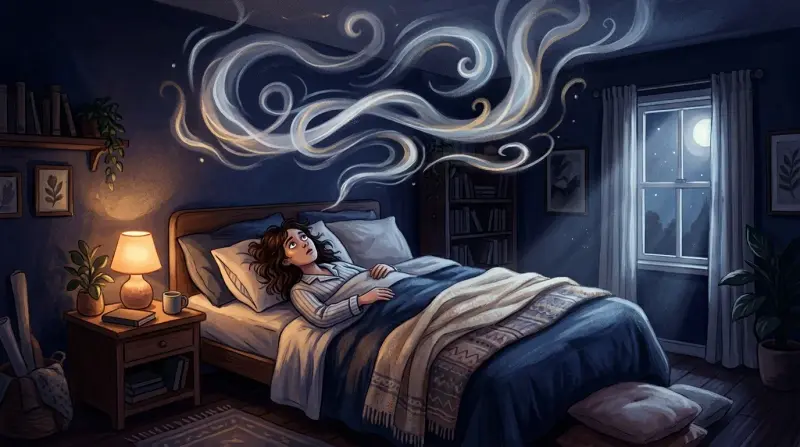
You wake up aware of the room around you, but you cannot move or speak. You may sense someone nearby or feel pressure on your chest. When this happens as you wake up or fall asleep and passes within seconds or minutes, it may be sleep paralysis, sometimes called jathoom in Arabic.
It can be frightening, but the experience alone does not mean you have a mental illness. A typical episode is temporary2 and can occur without another disorder. How often it happens and what accompanies it help a doctor decide whether you need an assessment1.
How can you be awake but unable to move?
During rapid eye movement, or REM, sleep, most muscles you move voluntarily are temporarily relaxed. You may regain awareness before that state ends, or experience the overlap as you fall asleep. You feel awake while your body has not yet regained movement2.
Dream-like sensations can accompany this transition: images, sounds or a sense of someone nearby that feel real at the time. Having these experiences at the boundary of sleep and waking is not enough to diagnose psychosis or another mental illness. Chest pressure1 can also feel like suffocation, although the breathing muscles continue working2 during typical sleep paralysis.
This reassurance applies to a brief episode at the transition into or out of sleep, followed by normal movement returning. New or unexplained sudden weakness outside that transition, unusual weakness remaining after the episode ends, or genuine ongoing difficulty breathing needs a different response. See the emergency advice below.
What can you do during and after an episode?
If you recognise your usual pattern, try reminding yourself: “This is a transition between sleep and waking. It will pass.” Focus on breathing calmly and wait for movement to return. Staying calm may be difficult; struggling to do so does not mean you are making the episode last. The episode may continue briefly even while you try to stay calm. Someone nearby talking to you2 may help the episode end.
Afterwards, take a little time to settle. If episodes recur, note details that may help: did it happen while falling asleep or waking up? How had you slept in the preceding days? Are you very sleepy during the day? You do not need to monitor every night or delay getting help until you have a complete diary.
Start with a change that addresses what is disrupting your sleep:
Allow enough time for sleep. Most adults need around seven to nine hours, with individual variation.
Keep sleeping and waking times reasonably regular where your responsibilities allow. If you work shifts, look for a sleep period you can protect from interruptions.
Reduce caffeine close to your intended bedtime. If episodes occur when you sleep on your back, trying a side position may help.
These steps may help. But if fear of another episode is making you put off sleep, seeking help is more useful1 than enduring the fear and losing more sleep.
When should you seek a medical assessment?
Start with a family doctor or general practitioner1 if episodes recur, make you afraid to sleep or affect your rest and daily life. Mention snoring, gasping or breathing pauses someone else has noticed, as well as medicines you take. You may need treatment for an accompanying condition or a referral to a sleep specialist2.
What you notice
A suitable next step
A brief episode while falling asleep or waking, followed by full return of movement
Understanding the experience and improving sleep may be enough if it does not recur or trouble you.
Recurring episodes with fear of sleep or sleep loss caused by that fear
Arrange an assessment; you do not have to wait until the fear becomes severe.
Unintended sudden sleep during the day
Seek an assessment for narcolepsy or other possible causes. Do not drive if sleepiness or sudden sleep makes it unsafe.
Brief, recurring episodes of emotion-triggered muscle weakness that a doctor has already assessed, with full strength returning afterwards
Follow your clinician's plan and report changes or recurrence. Do not assume new or different weakness is part of the known pattern.
Emotion-triggered muscle weakness3 can occur with narcolepsy, but does not establish that diagnosis. Do not assume new or unexplained sudden weakness4 is caused by sleep; use the emergency guidance below. A recurring pattern that has already been assessed can be followed according to your clinician's plan unless a new or different warning sign appears.
When should you avoid assuming weakness is sleep paralysis?
Seek emergency help immediately for any of these signs:
New or unexplained sudden weakness or paralysis outside the transition into or out of sleep.
Unusual weakness that remains after an episode ends instead of normal movement returning.
Facial drooping, unusual weakness in one limb, or speech difficulty after movement returns.
Genuine difficulty breathing or swallowing.
Do not attribute these signs to sleep paralysis even if you notice them on waking. Do not wait for them to pass, and do not drive yourself. In Saudi Arabia, call 997for an ambulance5.
A brief episode that has ended with normal movement returning does not usually require an ambulance simply because it was frightening. Seek an assessment if it recurs1 or starts affecting your sleep.
Frequently Asked Questions
What is sleep paralysis and why does it happen?
Sleep paralysis is being aware of the room around you as you wake up or fall asleep, but unable to move or speak; it passes within seconds or minutes. During REM sleep, most muscles you move voluntarily are temporarily relaxed, and you may regain awareness before that state ends. It is sometimes associated with insufficient sleep or irregular sleep patterns, including shift work and travel.
Is sleep paralysis a mental illness?
The experience alone does not mean you have a mental illness. A typical episode is temporary and can occur without another disorder. Dream-like images, sounds or a sense of someone nearby at the boundary of sleep and waking are not enough to diagnose psychosis or another mental illness. How often episodes happen and what accompanies them help a doctor decide whether you need an assessment.
What should I do during a sleep paralysis episode?
Remind yourself: “This is a transition between sleep and waking. It will pass.” Then focus on breathing calmly and wait for movement to return. The episode may continue briefly even while you try to stay calm, and struggling to stay calm does not mean you are making it last. Someone nearby talking to you may help it end. Afterwards, take a little time to settle.
When should I see a doctor about sleep paralysis?
Start with a family doctor or general practitioner if episodes recur, make you afraid to sleep or affect your rest and daily life; you do not have to wait until the fear becomes severe. Also mention severe sleepiness or unintended sudden sleep during the day, snoring, gasping or breathing pauses someone else has noticed, and medicines you take. You may need treatment for an accompanying condition or a referral to a sleep specialist.
When is weakness on waking an emergency?
Seek emergency help immediately for new or unexplained sudden weakness or paralysis outside the transition into or out of sleep, unusual weakness that remains after an episode ends, facial drooping, unusual weakness in one limb or speech difficulty after movement returns, or genuine difficulty breathing or swallowing. Do not attribute these signs to sleep paralysis even if you notice them on waking. Do not wait for them to pass, and do not drive yourself. In Saudi Arabia, call 997 for an ambulance. A brief episode that has ended with normal movement returning does not usually require one.
Content writer and researcher at Tatmeen, writing in Arabic and English on mental health and everyday life topics, including relationships, stress, work, habits, and family.
Every Tatmeen article is reviewed by care providers licensed by the Saudi Commission for Health Specialties, so what you read is accurate and trustworthy.
This article builds understanding and does not replace a licensed care provider.
Need someone to talk to?
Tatmeen's licensed care providers are available around the clock, and the app's urgent consultation connects you with one within minutes.
Download Tatmeen to explore care providers and booking options.
Smart matchingFour quick questions suggest the right care provider
Urgent consultationTalk to an available care provider within minutes
Free psychological measuresMore than 20 tests to understand how you are doing
Scan to download
{"data":{"id":"b37fc06e-4901-4a15-a941-6066b6540a7b","slug":"Is-sleep-paralysis-a-mental-disorder","arTitle":"شلل النوم «الجاثوم»: لماذا يحدث، وهل هو مرض نفسي؟","enTitle":"Sleep paralysis: why it happens and whether it is a mental illness","thumbnailAltText":"رجل مستلقٍ في سريره بعينين مفتوحتين، وفوقه هيئة داكنة بعينين مضيئتين، ويظهر القمر من النافذة.","estimatedReadingTime":7,"likesCount":939,"writer":{"id":"c7b27cce-cc91-45c8-9ba1-1d194830c654","arBio":"كاتبة وباحثة محتوى في تطمين، تكتب بالعربية والإنجليزية في موضوعات الصحة النفسية والحياة اليومية، بما يشمل العلاقات، الضغوط، العمل، العادات، والأسرة.","enBio":"Content writer and researcher at Tatmeen, writing in Arabic and English on mental health and everyday life topics, including relationships, stress, work, habits, and family.","user":{"slug":"alanoud-alturki","arFullName":"العنود التركي","enFullName":"Alanoud Alturki","publicProfileImageUrl":"https://cdn.tatmeen.sa/public/profile-images/78d20741-cf98-483e-9055-2f0ca0ab3bd5/4e190bf082a179be202f7a2618844e0dd134e14126b74d947c78eec35b7e390e.webp","publicProfileImage96Url":"https://cdn.tatmeen.sa/public/profile-images/78d20741-cf98-483e-9055-2f0ca0ab3bd5/4e190bf082a179be202f7a2618844e0dd134e14126b74d947c78eec35b7e390e-w96.webp","publicProfileImage192Url":"https://cdn.tatmeen.sa/public/profile-images/78d20741-cf98-483e-9055-2f0ca0ab3bd5/4e190bf082a179be202f7a2618844e0dd134e14126b74d947c78eec35b7e390e-w192.webp"}},"arContent":"","enContent":"","productionDocument":{"headings":[{"id":"article-section-how-can-you-be-awake-but-unable-to-move","text":"How can you be awake but unable to move?"},{"id":"article-section-what-can-you-do-during-and-after-an-episode","text":"What can you do during and after an episode?"},{"id":"article-section-what-might-make-episodes-more-likely","text":"What might make episodes more likely?"},{"id":"article-section-when-should-you-seek-a-medical-assessment","text":"When should you seek a medical assessment?"},{"id":"article-section-when-should-you-avoid-assuming-weakness-is-sleep-paralysis","text":"When should you avoid assuming weakness is sleep paralysis?"}],"faqs":[{"question":"What is sleep paralysis and why does it happen?","answer":"<p>Sleep paralysis is being aware of the room around you as you wake up or fall asleep, but unable to move or speak; it passes within seconds or minutes. During REM sleep, most muscles you move voluntarily are temporarily relaxed, and you may regain awareness before that state ends. It is sometimes associated with insufficient sleep or irregular sleep patterns, including shift work and travel.</p>"},{"question":"Is sleep paralysis a mental illness?","answer":"<p>The experience alone does not mean you have a mental illness. A typical episode is temporary and can occur without another disorder. Dream-like images, sounds or a sense of someone nearby at the boundary of sleep and waking are not enough to diagnose psychosis or another mental illness. How often episodes happen and what accompanies them help a doctor decide whether you need an assessment.</p>"},{"question":"What should I do during a sleep paralysis episode?","answer":"<p>Remind yourself: “This is a transition between sleep and waking. It will pass.” Then focus on breathing calmly and wait for movement to return. The episode may continue briefly even while you try to stay calm, and struggling to stay calm does not mean you are making it last. Someone nearby talking to you may help it end. Afterwards, take a little time to settle.</p>"},{"question":"When should I see a doctor about sleep paralysis?","answer":"<p>Start with a family doctor or general practitioner if episodes recur, make you afraid to sleep or affect your rest and daily life; you do not have to wait until the fear becomes severe. Also mention severe sleepiness or unintended sudden sleep during the day, snoring, gasping or breathing pauses someone else has noticed, and medicines you take. You may need treatment for an accompanying condition or a referral to a sleep specialist.</p>"},{"question":"When is weakness on waking an emergency?","answer":"<p>Seek emergency help immediately for new or unexplained sudden weakness or paralysis outside the transition into or out of sleep, unusual weakness that remains after an episode ends, facial drooping, unusual weakness in one limb or speech difficulty after movement returns, or genuine difficulty breathing or swallowing. Do not attribute these signs to sleep paralysis even if you notice them on waking. Do not wait for them to pass, and do not drive yourself. In Saudi Arabia, call 997 for an ambulance. A brief episode that has ended with normal movement returning does not usually require one.</p>"}],"beforeSourcesHtml":"\n","sources":[{"title":"NHS: Sleep paralysis.","href":"https://www.nhs.uk/conditions/sleep-paralysis/","hostname":"nhs.uk"},{"title":"UCLA Health: What to know about the scary sensation of sleep paralysis, 2021.","href":"https://www.uclahealth.org/news/article/what-to-know-about-the-scary-sensation-of-sleep-paralysis","hostname":"uclahealth.org"},{"title":"NHS: Narcolepsy.","href":"https://www.nhs.uk/conditions/narcolepsy/","hostname":"nhs.uk"},{"title":"NHS: Paralysis and emergency warning signs.","href":"https://www.nhs.uk/symptoms/paralysis/","hostname":"nhs.uk"},{"title":"Saudi Red Crescent Authority: Emergency contact numbers.","href":"https://www.srca.gov.sa/en/contact-us/","hostname":"srca.gov.sa"}],"afterSourcesHtml":"\n","blocks":[{"type":"html","html":"<p>You wake up aware of the room around you, but you cannot move or speak. You may sense someone nearby or feel pressure on your chest. When this happens as you wake up or fall asleep and passes within seconds or minutes, it may be <strong>sleep paralysis</strong>, sometimes called <em>jathoom</em> in Arabic.</p>\n<p>It can be frightening, but <strong>the experience alone does not mean you have a mental illness</strong>. A <a href=\"https://www.uclahealth.org/news/article/what-to-know-about-the-scary-sensation-of-sleep-paralysis\" target=\"_blank\" rel=\"noopener noreferrer\">typical episode is temporary</a> and can occur without another disorder. How often it happens and what accompanies it help a doctor decide <a href=\"https://www.nhs.uk/conditions/sleep-paralysis/\" target=\"_blank\" rel=\"noopener noreferrer\">whether you need an assessment</a>.</p>\n<h2 id=\"article-section-how-can-you-be-awake-but-unable-to-move\" data-toc-heading tabindex=\"-1\"><span id=\"how-can-you-be-awake-but-unable-to-move-1\" aria-hidden=\"true\"></span>How can you be awake but unable to move?</h2>\n<p>During rapid eye movement, or REM, sleep, most muscles you move voluntarily are temporarily relaxed. You may regain awareness before that state ends, or experience the overlap as you fall asleep. You feel awake while your <a href=\"https://www.uclahealth.org/news/article/what-to-know-about-the-scary-sensation-of-sleep-paralysis\" target=\"_blank\" rel=\"noopener noreferrer\">body has not yet regained movement</a>.</p>\n<p>Dream-like sensations can accompany this transition: images, sounds or a sense of someone nearby that feel real at the time. Having these experiences at the boundary of sleep and waking is not enough to diagnose psychosis or another mental illness. <a href=\"https://www.nhs.uk/conditions/sleep-paralysis/\" target=\"_blank\" rel=\"noopener noreferrer\">Chest pressure</a> can also feel like suffocation, although the <a href=\"https://www.uclahealth.org/news/article/what-to-know-about-the-scary-sensation-of-sleep-paralysis\" target=\"_blank\" rel=\"noopener noreferrer\">breathing muscles continue working</a> during typical sleep paralysis.</p>\n<p><strong>This reassurance applies to a brief episode at the transition into or out of sleep, followed by normal movement returning.</strong> New or unexplained sudden weakness outside that transition, unusual weakness remaining after the episode ends, or genuine ongoing difficulty breathing needs a different response. See the emergency advice below.</p>\n<h2 id=\"article-section-what-can-you-do-during-and-after-an-episode\" data-toc-heading tabindex=\"-1\"><span id=\"what-can-you-do-during-and-after-an-episode-2\" aria-hidden=\"true\"></span>What can you do during and after an episode?</h2>\n<p>If you recognise your usual pattern, try reminding yourself: “This is a transition between sleep and waking. It will pass.” Focus on breathing calmly and wait for movement to return. Staying calm may be difficult; struggling to do so does not mean you are making the episode last. The episode may continue briefly even while you try to stay calm. <a href=\"https://www.uclahealth.org/news/article/what-to-know-about-the-scary-sensation-of-sleep-paralysis\" target=\"_blank\" rel=\"noopener noreferrer\">Someone nearby talking to you</a> may help the episode end.</p>\n<p>Afterwards, take a little time to settle. If episodes recur, note details that may help: did it happen while falling asleep or waking up? How had you slept in the preceding days? Are you very sleepy during the day? You do not need to monitor every night or delay getting help until you have a complete diary.</p>\n<h2 id=\"article-section-what-might-make-episodes-more-likely\" data-toc-heading tabindex=\"-1\"><span id=\"what-might-make-episodes-more-likely-3\" aria-hidden=\"true\"></span>What might make episodes more likely?</h2>\n<p>Sleep paralysis is sometimes associated with <a href=\"https://www.nhs.uk/conditions/sleep-paralysis/\" target=\"_blank\" rel=\"noopener noreferrer\">insufficient sleep or irregular sleep patterns</a>, including shift work and travel. It may also accompany <a href=\"https://www.uclahealth.org/news/article/what-to-know-about-the-scary-sensation-of-sleep-paralysis\" target=\"_blank\" rel=\"noopener noreferrer\">insomnia, anxiety or post-traumatic stress disorder</a>. Having one of these conditions does not establish what caused your episode. <a href=\"https://www.nhs.uk/conditions/narcolepsy/\" target=\"_blank\" rel=\"noopener noreferrer\">Sleep paralysis can also accompany narcolepsy</a>; tell the doctor if you have severe sleepiness or unintended sudden sleep during the day.</p>\n<p>Start with a change that addresses what is disrupting your sleep:</p>\n<ul>\n<li>Allow enough time for sleep. Most adults need around seven to nine hours, with individual variation.</li>\n<li>Keep sleeping and waking times reasonably regular where your responsibilities allow. If you work shifts, look for a sleep period you can protect from interruptions.</li>\n<li>Reduce caffeine close to your intended bedtime. If episodes occur when you sleep on your back, trying a side position may help.</li>\n</ul>\n<p>These steps may help. But if fear of another episode is making you put off sleep, <a href=\"https://www.nhs.uk/conditions/sleep-paralysis/\" target=\"_blank\" rel=\"noopener noreferrer\">seeking help is more useful</a> than enduring the fear and losing more sleep.</p>\n<h2 id=\"article-section-when-should-you-seek-a-medical-assessment\" data-toc-heading tabindex=\"-1\"><span id=\"when-should-you-seek-a-medical-assessment-4\" aria-hidden=\"true\"></span>When should you seek a medical assessment?</h2>\n<p>Start with a <a href=\"https://www.nhs.uk/conditions/sleep-paralysis/\" target=\"_blank\" rel=\"noopener noreferrer\">family doctor or general practitioner</a> if episodes recur, make you afraid to sleep or affect your rest and daily life. Mention snoring, gasping or breathing pauses someone else has noticed, as well as medicines you take. You may need treatment for an accompanying condition or a <a href=\"https://www.uclahealth.org/news/article/what-to-know-about-the-scary-sensation-of-sleep-paralysis\" target=\"_blank\" rel=\"noopener noreferrer\">referral to a sleep specialist</a>.</p>\n<div class=\"table-block\"><table>\n<thead>\n<tr>\n<th>What you notice</th>\n<th>A suitable next step</th>\n</tr>\n</thead>\n<tbody>\n<tr>\n<td>A brief episode while falling asleep or waking, followed by full return of movement</td>\n<td>Understanding the experience and improving sleep may be enough if it does not recur or trouble you.</td>\n</tr>\n<tr>\n<td>Recurring episodes with fear of sleep or sleep loss caused by that fear</td>\n<td>Arrange an assessment; you do not have to wait until the fear becomes severe.</td>\n</tr>\n<tr>\n<td>Unintended sudden sleep during the day</td>\n<td>Seek an assessment for narcolepsy or other possible causes. Do not drive if sleepiness or sudden sleep makes it unsafe.</td>\n</tr>\n<tr>\n<td>Brief, recurring episodes of emotion-triggered muscle weakness that a doctor has already assessed, with full strength returning afterwards</td>\n<td>Follow your clinician's plan and report changes or recurrence. Do not assume new or different weakness is part of the known pattern.</td>\n</tr>\n</tbody>\n</table></div>\n<p><a href=\"https://www.nhs.uk/conditions/narcolepsy/\" target=\"_blank\" rel=\"noopener noreferrer\">Emotion-triggered muscle weakness</a> can occur with narcolepsy, but does not establish that diagnosis. <a href=\"https://www.nhs.uk/symptoms/paralysis/\" target=\"_blank\" rel=\"noopener noreferrer\">Do not assume new or unexplained sudden weakness</a> is caused by sleep; use the emergency guidance below. A recurring pattern that has already been assessed can be followed according to your clinician's plan unless a new or different warning sign appears.</p>\n<h2 id=\"article-section-when-should-you-avoid-assuming-weakness-is-sleep-paralysis\" data-toc-heading tabindex=\"-1\"><span id=\"when-should-you-avoid-assuming-weakness-is-sleep-paralysis-5\" aria-hidden=\"true\"></span>When should you avoid assuming weakness is sleep paralysis?</h2>\n<p><strong>Seek emergency help immediately</strong> for any of these signs:</p>\n<ul>\n<li>New or unexplained sudden weakness or paralysis outside the transition into or out of sleep.</li>\n<li>Unusual weakness that remains after an episode ends instead of normal movement returning.</li>\n<li>Facial drooping, unusual weakness in one limb, or speech difficulty after movement returns.</li>\n<li>Genuine difficulty breathing or swallowing.</li>\n</ul>\n<p>Do not attribute these signs to sleep paralysis even if you notice them on waking. Do not wait for them to pass, and do not drive yourself. In Saudi Arabia, call <strong>997</strong> <a href=\"https://www.srca.gov.sa/en/contact-us/\" target=\"_blank\" rel=\"noopener noreferrer\">for an ambulance</a>.</p>\n<p>A brief episode that has ended with normal movement returning does not usually require an ambulance simply because it was frightening. <a href=\"https://www.nhs.uk/conditions/sleep-paralysis/\" target=\"_blank\" rel=\"noopener noreferrer\">Seek an assessment if it recurs</a> or starts affecting your sleep.</p>\n"}],"inlineCtaSignatures":[],"_experienceAliases":{"v":1,"fields":["html","bodyHtml"],"faqs":[0,1,2,3,4]}},"createdAt":"2024-01-07T21:00:00.000Z","updatedAt":"2026-10-30T19:23:35.263Z","disorderGroups":[{"id":"1e82772d-a1a7-4d29-b475-be9d6b67ae02","slug":"common-mental-issues","arName":"اضطرابات نفسية شائعة","enName":"Common Mental Issues"}],"reviewer":{"arFullName":"فريق تطمين","enFullName":"Tatmeen team","slug":"tatmeen-team","kind":"organization"},"productionArticle":true,"promotionAllowed":true,"preparedCover":{"src":"https://cdn.tatmeen.sa/public/article-lcp/article-lcp-v2/sha256-9afd47313d5bc28537f9b369703ef1ff5b31637d7a9eabf58ec90f2ac386b80a/800-1959e8dccbd17872afd59a9dcf9f3a4961e1adbba26ca44aab277f291a4a9bd4.avif","fallback":"https://cdn.tatmeen.sa/public/article-lcp/article-lcp-v2/sha256-9afd47313d5bc28537f9b369703ef1ff5b31637d7a9eabf58ec90f2ac386b80a/800-f338b979ba2b0efccd721efbf5d4f0317703f985d7622bb79095b2a72d2fc625.webp","directUrl":"https://cdn.tatmeen.sa/blog-cover/026e3c06-47fd-492a-878d-82fd246c0144.png","isGolden":true,"avifSrcset":"https://cdn.tatmeen.sa/public/article-lcp/article-lcp-v2/sha256-9afd47313d5bc28537f9b369703ef1ff5b31637d7a9eabf58ec90f2ac386b80a/400-8e685b41485131fcc1fed5437003bab96888dcd9ca1c79b8d016b4c7cff83da1.avif 400w, https://cdn.tatmeen.sa/public/article-lcp/article-lcp-v2/sha256-9afd47313d5bc28537f9b369703ef1ff5b31637d7a9eabf58ec90f2ac386b80a/640-066fd6046a0c1b303141cfa4a290b9cdb9fd0f35a07fa0cc9e3e1a1df2adfe7f.avif 640w, https://cdn.tatmeen.sa/public/article-lcp/article-lcp-v2/sha256-9afd47313d5bc28537f9b369703ef1ff5b31637d7a9eabf58ec90f2ac386b80a/800-1959e8dccbd17872afd59a9dcf9f3a4961e1adbba26ca44aab277f291a4a9bd4.avif 800w, https://cdn.tatmeen.sa/public/article-lcp/article-lcp-v2/sha256-9afd47313d5bc28537f9b369703ef1ff5b31637d7a9eabf58ec90f2ac386b80a/1200-eb075bb0a8d0425f6b0068e7cd5a3fd783954bbbdf221cb1337ed5df8cc973e0.avif 1200w","webpSrcset":"https://cdn.tatmeen.sa/public/article-lcp/article-lcp-v2/sha256-9afd47313d5bc28537f9b369703ef1ff5b31637d7a9eabf58ec90f2ac386b80a/400-9a70f05d614508c2766aec321543ddba90fbe089ec363af5979732483188ac4c.webp 400w, https://cdn.tatmeen.sa/public/article-lcp/article-lcp-v2/sha256-9afd47313d5bc28537f9b369703ef1ff5b31637d7a9eabf58ec90f2ac386b80a/640-2beabd61ae056d2a5aaa1d2068bb2e1da353a4a8bb8357699af37024ce9e6db3.webp 640w, https://cdn.tatmeen.sa/public/article-lcp/article-lcp-v2/sha256-9afd47313d5bc28537f9b369703ef1ff5b31637d7a9eabf58ec90f2ac386b80a/800-f338b979ba2b0efccd721efbf5d4f0317703f985d7622bb79095b2a72d2fc625.webp 800w, https://cdn.tatmeen.sa/public/article-lcp/article-lcp-v2/sha256-9afd47313d5bc28537f9b369703ef1ff5b31637d7a9eabf58ec90f2ac386b80a/1200-0d1ca60fd05e9dd2bacd02586a22a775f16feb6e35521cbfdc4613bf5d38e7d2.webp 1200w","phoneAvifSrcset":"https://cdn.tatmeen.sa/public/article-lcp/article-lcp-v2/sha256-9afd47313d5bc28537f9b369703ef1ff5b31637d7a9eabf58ec90f2ac386b80a/400-8e685b41485131fcc1fed5437003bab96888dcd9ca1c79b8d016b4c7cff83da1.avif 400w, https://cdn.tatmeen.sa/public/article-lcp/article-lcp-v2/sha256-9afd47313d5bc28537f9b369703ef1ff5b31637d7a9eabf58ec90f2ac386b80a/640-066fd6046a0c1b303141cfa4a290b9cdb9fd0f35a07fa0cc9e3e1a1df2adfe7f.avif 640w, https://cdn.tatmeen.sa/public/article-lcp/article-lcp-v2/sha256-9afd47313d5bc28537f9b369703ef1ff5b31637d7a9eabf58ec90f2ac386b80a/800-1959e8dccbd17872afd59a9dcf9f3a4961e1adbba26ca44aab277f291a4a9bd4.avif 800w","phoneWebpSrcset":"https://cdn.tatmeen.sa/public/article-lcp/article-lcp-v2/sha256-9afd47313d5bc28537f9b369703ef1ff5b31637d7a9eabf58ec90f2ac386b80a/400-9a70f05d614508c2766aec321543ddba90fbe089ec363af5979732483188ac4c.webp 400w, https://cdn.tatmeen.sa/public/article-lcp/article-lcp-v2/sha256-9afd47313d5bc28537f9b369703ef1ff5b31637d7a9eabf58ec90f2ac386b80a/640-2beabd61ae056d2a5aaa1d2068bb2e1da353a4a8bb8357699af37024ce9e6db3.webp 640w, https://cdn.tatmeen.sa/public/article-lcp/article-lcp-v2/sha256-9afd47313d5bc28537f9b369703ef1ff5b31637d7a9eabf58ec90f2ac386b80a/800-f338b979ba2b0efccd721efbf5d4f0317703f985d7622bb79095b2a72d2fc625.webp 800w","width":800,"height":533},"previewTaxonomy":{"groups":[{"id":"1e82772d-a1a7-4d29-b475-be9d6b67ae02","slug":"common-mental-issues","arName":"اضطرابات نفسية شائعة","enName":"Common Mental Issues"}],"topics":[{"id":"4c10d5ae-1b63-4868-901f-df8e1ce7f0d7","slug":"sleep-disorders","arName":"اضطرابات النوم","enName":"Sleep Disorders","groupSlug":"common-mental-issues","href":"/blog/category/common-mental-issues/sleep-disorders/"}],"tags":[{"id":"df684f2f-95c6-4603-afba-9a1061c94a62","slug":"sleep-disorders","arName":"اضطرابات النوم","enName":"Sleep Disorders"},{"id":"c2a6e8d3-de9c-435f-8c95-9727e7db14cc","slug":"explainer-awareness","arName":"دليل توعوي / شرح","enName":"Explainer / Awareness Guide"},{"id":"de704583-a213-4b55-a6cd-956c21dd019b","slug":"sleep-paralysis","arName":"شلل النوم","enName":"Sleep paralysis"}]},"previewProviderRecommendations":[{"id":"64f18815-de2d-4515-8a7a-cbfb541976ae","slug":"dr-amer-alanazi-9964","arFullName":"د. عامر العنزي","enFullName":"Dr. Amer Alanazi","publicProfileImageUrl":"https://cdn.tatmeen.sa/public/profile-images/64f18815-de2d-4515-8a7a-cbfb541976ae/6a36fee9388645bf5848f119c0927c429246cc9abd7bcf4d6b004ab6db3624a4.webp","publicProfileImage96Url":"https://cdn.tatmeen.sa/public/profile-images/64f18815-de2d-4515-8a7a-cbfb541976ae/6a36fee9388645bf5848f119c0927c429246cc9abd7bcf4d6b004ab6db3624a4-w96.webp","publicProfileImage192Url":"https://cdn.tatmeen.sa/public/profile-images/64f18815-de2d-4515-8a7a-cbfb541976ae/6a36fee9388645bf5848f119c0927c429246cc9abd7bcf4d6b004ab6db3624a4-w192.webp","specialization":{"arName":"طبيب أسرة","enName":"Family Physician"},"profileImageUrl":"https://cdn.tatmeen.sa/public/profile-images/64f18815-de2d-4515-8a7a-cbfb541976ae/6a36fee9388645bf5848f119c0927c429246cc9abd7bcf4d6b004ab6db3624a4-w192.webp","experienceYears":7,"consultantInfo":{"averageRating":{"average":0},"specialization":{"arGeneralName":"طبيب أسرة","enGeneralName":"Family Physician"}}},{"id":"80353bb6-9e99-42d3-913b-042697e2ba47","slug":"wala-alharbi-3022","arFullName":"ولاء الحربي","enFullName":"Wala Alharbi","publicProfileImageUrl":"","publicProfileImage96Url":"","publicProfileImage192Url":"","specialization":{"arName":"أخصائي نفسي","enName":"Psychologist"},"profileImageUrl":"","experienceYears":11,"consultantInfo":{"averageRating":{"average":0},"specialization":{"arGeneralName":"أخصائي نفسي","enGeneralName":"Psychologist"}}},{"id":"4377737a-0bbd-4ec6-9438-a2a04b384759","slug":"dr-amro-bokhari-9680","arFullName":"د. عمرو بخاري","enFullName":"Dr. Amro Bokhari","publicProfileImageUrl":"https://cdn.tatmeen.sa/public/profile-images/4377737a-0bbd-4ec6-9438-a2a04b384759/0cfd4c08700d691181fa9a7a88a5e744567633a9124e6db6e29cbb8eb560f3d7.webp","publicProfileImage96Url":"https://cdn.tatmeen.sa/public/profile-images/4377737a-0bbd-4ec6-9438-a2a04b384759/0cfd4c08700d691181fa9a7a88a5e744567633a9124e6db6e29cbb8eb560f3d7-w96.webp","publicProfileImage192Url":"https://cdn.tatmeen.sa/public/profile-images/4377737a-0bbd-4ec6-9438-a2a04b384759/0cfd4c08700d691181fa9a7a88a5e744567633a9124e6db6e29cbb8eb560f3d7-w192.webp","specialization":{"arName":"طبيب أسرة","enName":"Family Physician"},"profileImageUrl":"https://cdn.tatmeen.sa/public/profile-images/4377737a-0bbd-4ec6-9438-a2a04b384759/0cfd4c08700d691181fa9a7a88a5e744567633a9124e6db6e29cbb8eb560f3d7-w192.webp","experienceYears":8,"consultantInfo":{"averageRating":{"average":4.980769230769231},"specialization":{"arGeneralName":"طبيب أسرة","enGeneralName":"Family Physician"}}}],"previewCareProviders":[{"id":"09364052-c2a9-4c52-9717-7ce2093b8d0a","slug":"kholoud-alharbi-5221","arFullName":"خلود الحربي","enFullName":"Kholoud Alharbi","publicProfileImageUrl":"https://cdn.tatmeen.sa/public/profile-images/09364052-c2a9-4c52-9717-7ce2093b8d0a/4a0aeb81619e351b77f4323e3605a0a00acc7ca3c82ee7cc5ca2c9e8ef716049.webp","publicProfileImage96Url":"https://cdn.tatmeen.sa/public/profile-images/09364052-c2a9-4c52-9717-7ce2093b8d0a/4a0aeb81619e351b77f4323e3605a0a00acc7ca3c82ee7cc5ca2c9e8ef716049-w96.webp","publicProfileImage192Url":"https://cdn.tatmeen.sa/public/profile-images/09364052-c2a9-4c52-9717-7ce2093b8d0a/4a0aeb81619e351b77f4323e3605a0a00acc7ca3c82ee7cc5ca2c9e8ef716049-w192.webp","gender":"FEMALE","specialization":{"arName":"أخصائي نفسي","enName":"Psychologist"}},{"id":"6f037535-1dca-4b50-a8b2-5974b7323286","slug":"salah-althobaiti-9053","arFullName":"صلاح الثبيتي","enFullName":"Salah Althobaiti","publicProfileImageUrl":"https://cdn.tatmeen.sa/public/profile-images/6f037535-1dca-4b50-a8b2-5974b7323286/35b6bd7fad9b1e004c1835803eb9c1b56dcacd380685ec8bff141f0fb888005c.webp","publicProfileImage96Url":"https://cdn.tatmeen.sa/public/profile-images/6f037535-1dca-4b50-a8b2-5974b7323286/35b6bd7fad9b1e004c1835803eb9c1b56dcacd380685ec8bff141f0fb888005c-w96.webp","publicProfileImage192Url":"https://cdn.tatmeen.sa/public/profile-images/6f037535-1dca-4b50-a8b2-5974b7323286/35b6bd7fad9b1e004c1835803eb9c1b56dcacd380685ec8bff141f0fb888005c-w192.webp","gender":"MALE","specialization":{"arName":"أخصائي نفسي","enName":"Psychologist"}},{"id":"3cc806e8-616b-4884-9f21-a75b378580a2","slug":"aisha-al-hashim-8667","arFullName":"عائشة ال هاشم","enFullName":"Aisha Al Hashim","publicProfileImageUrl":"https://cdn.tatmeen.sa/public/profile-images/3cc806e8-616b-4884-9f21-a75b378580a2/27f523d03be4dcfa1f6a79f70c1773887434e698990d214cd990caec56a44798.webp","publicProfileImage96Url":"https://cdn.tatmeen.sa/public/profile-images/3cc806e8-616b-4884-9f21-a75b378580a2/27f523d03be4dcfa1f6a79f70c1773887434e698990d214cd990caec56a44798-w96.webp","publicProfileImage192Url":"https://cdn.tatmeen.sa/public/profile-images/3cc806e8-616b-4884-9f21-a75b378580a2/27f523d03be4dcfa1f6a79f70c1773887434e698990d214cd990caec56a44798-w192.webp","gender":"FEMALE","specialization":{"arName":"أخصائي نفسي","enName":"Psychologist"}},{"id":"db2ce1a0-9325-4471-b7ce-eb2e811c30a3","slug":"amer-qutub-2441","arFullName":"عامر قطب","enFullName":"Amer Qutub","publicProfileImageUrl":"https://cdn.tatmeen.sa/public/profile-images/db2ce1a0-9325-4471-b7ce-eb2e811c30a3/80580f99bfd7fe2b2a9cf8eed73ab532f5086d1efe053b0aa57358c1ce004261.webp","publicProfileImage96Url":"https://cdn.tatmeen.sa/public/profile-images/db2ce1a0-9325-4471-b7ce-eb2e811c30a3/80580f99bfd7fe2b2a9cf8eed73ab532f5086d1efe053b0aa57358c1ce004261-w96.webp","publicProfileImage192Url":"https://cdn.tatmeen.sa/public/profile-images/db2ce1a0-9325-4471-b7ce-eb2e811c30a3/80580f99bfd7fe2b2a9cf8eed73ab532f5086d1efe053b0aa57358c1ce004261-w192.webp","gender":"MALE","specialization":{"arName":"أخصائي نفسي","enName":"Psychologist"}},{"id":"6043a2b2-c41b-42c8-92bb-881f36083293","slug":"rehab-alharbi-3670","arFullName":"رحاب المعبدي","enFullName":"Rehab Almabadi","publicProfileImageUrl":"https://cdn.tatmeen.sa/public/profile-images/6043a2b2-c41b-42c8-92bb-881f36083293/9f25728f77c844fac517d39615495fdec1cf4c590360b466419ece1bdeb66c2e.webp","publicProfileImage96Url":"https://cdn.tatmeen.sa/public/profile-images/6043a2b2-c41b-42c8-92bb-881f36083293/9f25728f77c844fac517d39615495fdec1cf4c590360b466419ece1bdeb66c2e-w96.webp","publicProfileImage192Url":"https://cdn.tatmeen.sa/public/profile-images/6043a2b2-c41b-42c8-92bb-881f36083293/9f25728f77c844fac517d39615495fdec1cf4c590360b466419ece1bdeb66c2e-w192.webp","gender":"FEMALE","specialization":{"arName":"أخصائي نفسي","enName":"Psychologist"}},{"id":"618dba89-5b70-4b46-8304-741b7ac8ecd3","slug":"abdullah-mari-1311","arFullName":"عبدالله مرعي","enFullName":"Abdullah Mari","publicProfileImageUrl":"https://cdn.tatmeen.sa/public/profile-images/618dba89-5b70-4b46-8304-741b7ac8ecd3/6b4a3bfb59f8a304ca79083b32859b46baad2e1d692974a47c02c1f66bd11129.webp","publicProfileImage96Url":"https://cdn.tatmeen.sa/public/profile-images/618dba89-5b70-4b46-8304-741b7ac8ecd3/6b4a3bfb59f8a304ca79083b32859b46baad2e1d692974a47c02c1f66bd11129-w96.webp","publicProfileImage192Url":"https://cdn.tatmeen.sa/public/profile-images/618dba89-5b70-4b46-8304-741b7ac8ecd3/6b4a3bfb59f8a304ca79083b32859b46baad2e1d692974a47c02c1f66bd11129-w192.webp","gender":"MALE","specialization":{"arName":"أخصائي نفسي","enName":"Psychologist"}},{"id":"94765496-dbdf-4631-a01b-7df5f788668d","slug":"abdullrahman-alhamoudi-3045","arFullName":"عبدالرحمن الحمودي","enFullName":"Abdulrahman Alhamoudi","publicProfileImageUrl":"https://cdn.tatmeen.sa/public/profile-images/94765496-dbdf-4631-a01b-7df5f788668d/2d49f6b6493c564afb6f50b6c3634231dff3a5cf8353acfab393d1b2a88037d1.webp","publicProfileImage96Url":"https://cdn.tatmeen.sa/public/profile-images/94765496-dbdf-4631-a01b-7df5f788668d/2d49f6b6493c564afb6f50b6c3634231dff3a5cf8353acfab393d1b2a88037d1-w96.webp","publicProfileImage192Url":"https://cdn.tatmeen.sa/public/profile-images/94765496-dbdf-4631-a01b-7df5f788668d/2d49f6b6493c564afb6f50b6c3634231dff3a5cf8353acfab393d1b2a88037d1-w192.webp","gender":"MALE","specialization":{"arName":"أخصائي نفسي","enName":"Psychologist"}},{"id":"3b50a5d5-e795-407f-8676-fd7f0e1bb7a0","slug":"abdulaziz-bin-hudayan-4940","arFullName":"عبدالعزيز بن هديان","enFullName":"Abdulaziz Bin Hudayan","publicProfileImageUrl":"https://cdn.tatmeen.sa/public/profile-images/3b50a5d5-e795-407f-8676-fd7f0e1bb7a0/710ff0fe1fb00cdb5042092e27b7910b480a439b02251ecded62d7758eefce95.webp","publicProfileImage96Url":"https://cdn.tatmeen.sa/public/profile-images/3b50a5d5-e795-407f-8676-fd7f0e1bb7a0/710ff0fe1fb00cdb5042092e27b7910b480a439b02251ecded62d7758eefce95-w96.webp","publicProfileImage192Url":"https://cdn.tatmeen.sa/public/profile-images/3b50a5d5-e795-407f-8676-fd7f0e1bb7a0/710ff0fe1fb00cdb5042092e27b7910b480a439b02251ecded62d7758eefce95-w192.webp","gender":"MALE","specialization":{"arName":"أخصائي نفسي","enName":"Psychologist"}},{"id":"d4ffcb6b-90a7-45b6-b941-964866f4564b","slug":"dhaifallah-alhumaidi-1092","arFullName":"ضيف الله الحميدي","enFullName":"Dhaifallah Alhumaidi","publicProfileImageUrl":"https://cdn.tatmeen.sa/public/profile-images/d4ffcb6b-90a7-45b6-b941-964866f4564b/1817171c5828a9b57d6c30d12332cf154e335272548bc90a6e8456d74d356956.webp","publicProfileImage96Url":"https://cdn.tatmeen.sa/public/profile-images/d4ffcb6b-90a7-45b6-b941-964866f4564b/1817171c5828a9b57d6c30d12332cf154e335272548bc90a6e8456d74d356956-w96.webp","publicProfileImage192Url":"https://cdn.tatmeen.sa/public/profile-images/d4ffcb6b-90a7-45b6-b941-964866f4564b/1817171c5828a9b57d6c30d12332cf154e335272548bc90a6e8456d74d356956-w192.webp","gender":"MALE","specialization":{"arName":"أخصائي نفسي","enName":"Psychologist"}}],"previewDownload":{"href":"/download","title":{"ar":"خطوة واحدة لأجلك، ابدأ الآن","en":"One step for you, start now"},"description":{"ar":"حمّل تطبيق تطمين لاستكشاف مقدمي الرعاية وخيارات الحجز.","en":"Download Tatmeen to explore care providers and booking options."},"posterSrc":"/images/home/cta-ar-new-1.webp","videoSrc":"/images/home/cta-ar-new-1.mp4","videoPosterSrc":"/images/home/cta-ar-new-1.webp","videoPosterEnSrc":"/images/home/cta-en-new-1.webp","videoType":"video/mp4","appStoreHref":"https://apps.apple.com/us/app/tatmeen-%D8%AA%D8%B7%D9%85%D9%8A%D9%86/id6473836983","googlePlayHref":"https://play.google.com/store/apps/details?id=com.TatmeenApp.user&hl=en"},"previewRelatedArticles":[{"id":"c80a1f7c-0e3f-4065-ad9a-fe88722d1911","slug":"ramadan-sleep-disruption-body-clock","route":"/blog/ramadan-sleep-disruption-body-clock/","title":{"ar":" اضطراب النوم في رمضان وإعادة ضبط الساعة البيولوجية","en":"Sleep Disruption in Ramadan and Resetting Your Body Clock"},"image":"https://cdn.tatmeen.sa/public/article-lcp/article-lcp-v2/sha256-ea7a146f3630c56b4381ea61e5baee125730ad9f0abcc5fb6348c9a84ab550ce/800-4c6abb85d068c2a70c9406e934a7edf36cd46997d38eee560207b430bc739a3b.webp","directImageFallback":"https://cdn.tatmeen.sa/blog-cover/Tatmeen-1780666452636.webp","arThumbnailAltText":"a bedroom view of a mosque and distant ramadan hilal ","thumbnailAltText":"a bedroom view of a mosque and distant ramadan hilal ","topic":{"label":{"ar":"اضطرابات نفسية شائعة","en":"Common Mental Issues"}},"readingTimeMinutes":5},{"id":"04ac9818-1c04-4179-bcbe-05e3005b8161","slug":"insomnia-tips-improve-sleep-quality","route":"/blog/insomnia-tips-improve-sleep-quality/","title":{"ar":"أفضل النصائح للتعامل مع الأرق وتحسين جودة النوم","en":"Best Tips for Dealing With Insomnia and Improving Sleep Quality"},"image":"https://cdn.tatmeen.sa/public/article-lcp/article-lcp-v2/sha256-b0fddbc2ca8bfb7be43e9efce65f9d8f7ff6b01f5278cbe9c89f3848c13fea21/800-08ba5de0e8ce787ab27f09aa3a52d2e7a7851e65f556867c00685f12b6151f56.webp","directImageFallback":"https://cdn.tatmeen.sa/blog-cover/Tatmeen-1775541323148.webp","arThumbnailAltText":"Moonlit calm lake at night with soft ripples spreading from a single drop under a warm moon glow","thumbnailAltText":"Moonlit calm lake at night with soft ripples spreading from a single drop under a warm moon glow","topic":{"label":{"ar":"اضطرابات نفسية شائعة","en":"Common Mental Issues"}},"readingTimeMinutes":5},{"id":"70b7ed3e-7b09-435c-853a-dbbd7f9d7330","slug":"common-sleep-disorders-causes-solutions","route":"/blog/common-sleep-disorders-causes-solutions/","title":{"ar":"اضطرابات النوم الشائعة وكيفية التغلّب عليها","en":"Common Sleep Disorders and How to Overcome Them"},"image":"https://cdn.tatmeen.sa/public/article-lcp/article-lcp-v2/sha256-8fbf560a07a9bb2bce7053d0c352e63dba9bba6ceb8a15ca03468dbce08d2160/800-315c9e8ea7100a884c9bc34e4a67bf51cbe205bc21ae73de885bc0607a541e1e.webp","directImageFallback":"https://cdn.tatmeen.sa/blog-cover/Tatmeen-1775451036269.webp","arThumbnailAltText":"alt image draft","thumbnailAltText":"alt image draft","topic":{"label":{"ar":"اضطرابات نفسية شائعة","en":"Common Mental Issues"}},"readingTimeMinutes":5},{"id":"2b4e16b1-c32f-4195-bb85-4101e7a9ffd6","slug":"why-cant-i-sleep-when-tired-not-insomnia","route":"/blog/why-cant-i-sleep-when-tired-not-insomnia/","title":{"ar":"لماذا لا أنام رغم أني متعب؟ (قد لا يكون أرقًا دائمًا)","en":"Why Can't I Sleep Even Though I'm Tired? (It May Not Always Be Insomnia)"},"image":"https://cdn.tatmeen.sa/public/article-lcp/article-lcp-v2/sha256-34274f8790b5c3273aab7476d7ff096d2c96eb7ce0563ccbd976abaa2b492fb5/800-8b58a977854117caf6248a2b55bea85da5046f768b91daa465eb01823d6ce54d.webp","directImageFallback":"https://cdn.tatmeen.sa/blog-cover/Tatmeen-1780418056339.webp","arThumbnailAltText":"a person who can't sleep at night from overthinking","thumbnailAltText":"a person who can't sleep at night from overthinking","topic":{"label":{"ar":"اضطرابات نفسية شائعة","en":"Common Mental Issues"}},"readingTimeMinutes":5}],"previewRelatedReadStates":{}},"locale":"en","device":"desktop","path":"/en/blog/Is-sleep-paralysis-a-mental-disorder/","readingControls":false,"config":{"public":{"BUCKET_URL":"https://cdn.tatmeen.sa/","APP_BASE_URL":"https://tatmeen.sa","intercomAppId":"ppcnu9e3"}}}