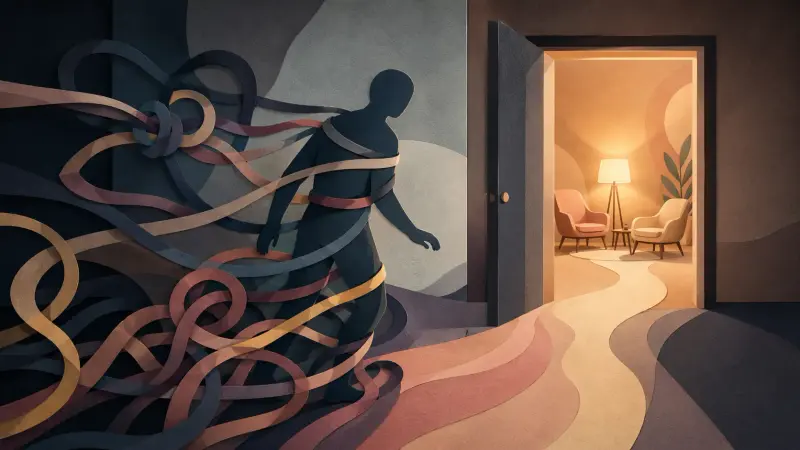
When the mind stays with one thought, a small situation can grow until it fills your whole day. A message that was not answered, a word said casually, a small mistake, or a distant possibility can suddenly send your mind into endless scenarios, as if it is looking for reassurance that is never enough. Overthinking does not mean you are exaggerating or weak. It is often your mind trying to protect you, but doing so in an exhausting way. The answer is not to force thoughts into silence, but to learn how to slow their rush and return to the present moment with more awareness.
In this guide from Tatmeen, we share simple practical exercises that can help you deal with overthinking calmly, reduce the looping through possibilities, and regain a sense of what is present and clear.
It Starts With an Exhausting Need for Reassurance
Overthinking does not always begin with obvious fear. It often begins with a wish that sounds reasonable: to be certain, to understand everything, and to miss no possible risk. After a work meeting, a passing comment from someone close, or even a message that has not been answered, you may feel that continuing to analyze is the only way to avoid making another mistake. It can feel wise, while in reality you are circling the same thought again.
The useful difference is that healthy thinking leads to a step, while overthinking searches for complete certainty that no one really has. When you notice that your question has changed from "What can I do now?" to "How can I guarantee that nothing upsetting will happen later?" this is a sign that you are no longer solving the problem. You are guarding it inside your head. Noticing this shift does not end the loop immediately, but it gives a name to what is happening instead of letting the thought swallow you from the inside.
Name the Loop Before It Expands
The first practical exercise is not to force the thought to stop, but to name it accurately. When you find yourself reviewing the same situation or imagining replies and outcomes again and again, say quietly: "I am looping in the thought right now." This short sentence does not erase the tension, but it creates a small distance between you and the pull toward it, and keeps you from treating every thought as an alarm that must be followed to the end.
Then ask only two questions: Is there one small action I can take today? Am I adding anything new, or repeating the same scenario? If there is no clear action, move your attention to something tangible in front of you: organizing a file, drinking water, or finishing a short task. You may notice that some thoughts lose part of their force once they are no longer in the driver's seat and return to their natural size.
The Fact, Interpretation, and Next Step Page
When details mix with fear, paper can be calmer than the mind. Open a quick note on your phone or write on paper, then divide what is in your mind into only three lines:
The fact: What actually happened?
The interpretation: What meaning did I add?
The step: What small thing can I do now?
If an important person is late to reply, the fact may be that they have not answered yet, while the interpretation quickly becomes "They are upset" or "I ruined the relationship." The step may be waiting until a specific time, sending a clearer message, or leaving it until tomorrow instead of checking it ten times an hour. This exercise reduces the jump from a small event to a broad judgment about yourself or others.
A Worry Time That Stops the Spillover
When worry leaks into every hour of the day, do not try to settle it every time it appears. Give it ten or fifteen minutes at a fixed time, preferably a reasonable while before bed, not at the last moment in bed. If the thought appears before then, tell yourself: "I will return to it at its time." The idea is not to suppress worry, but to stop it from taking over the whole day.
NHS1 explains that setting aside a short, specific worry time, while writing down what is on your mind, can help reduce the rush of thoughts during the rest of the day. During those minutes, do not try to reach final reassurance. Just separate a problem that can be handled with a practical step from an open possibility that has no answer right now. With repetition, the mind learns that worry is not the decision-maker in every moment.
The Body Settles First, Then the Mind Follows
Overthinking does not live in the head alone. You may find it in a tight jaw, raised shoulders, fast breathing, and the urge to review the same thing even when you are tired. Sometimes it helps to begin with the body: place your feet on the floor, soften your mouth and shoulders, then take several calm breaths with the exhale slightly longer than the inhale. The World Health Organization2 offers simple exercises that bring attention back to what you can see, hear, and touch around you, so you do not remain trapped inside one repeating scenario.
This is why we care at Tatmeen about distinguishing passing anxiety that can be calmed with an exercise from a pattern that drains sleep, decisions, and relationships. If overthinking is stealing your hours, pushing you to postpone things, or keeping you in constant anticipation, what you need is not self-criticism or generic advice like "think positive." Speaking with a licensed specialist may help you understand the loop from its roots, especially if you have been delaying this step out of fear of being judged or of exaggerating what you feel.
Finally
Overthinking usually does not disappear with one quick decision, but it can settle when you separate fact from interpretation, give worry a limited time, and return your body to a safer state. Start with only one exercise and repeat it for several days before judging it. If the loop keeps repeating despite your efforts, downloading the Tatmeen app and booking your session today may be a practical step that makes the picture clearer, without needing to carry this weight alone.
Frequently Asked Questions
Should I feel calm immediately after the exercise?
Not necessarily. Some exercises slow the thoughts more than they erase them instantly. The real benefit appears when the loop becomes shorter and less intense, and when you can return to your day faster than before.
What should I do if the same thought comes back hours later?
Treat its return as a sign of a familiar pattern, not as proof that you failed. Repeat the same exercise calmly, and do not search for a new method every time. Staying with one simple tool is more useful than constantly switching tools.
How do I know this has gone beyond self-help exercises?
When overthinking begins to affect your sleep, work, studies, or ability to make simple daily decisions, this is a sign that professional understanding may be more useful than long internal exhaustion.
A writer and researcher specializing in psychiatry, she focuses on mental health and the human emotions we experience but cannot always find the words to name. She writes about us—about humanity and the human experience—and simplifies complex topics to offer content that helps us better understand ourselves and life, ultimately making us feel less alone.
Every Tatmeen article is reviewed by care providers licensed by the Saudi Commission for Health Specialties, so what you read is accurate and trustworthy.
This article builds understanding and does not replace a licensed care provider.
Need someone to talk to?
Tatmeen's licensed care providers are available around the clock, and the app's urgent consultation connects you with one within minutes.
Download Tatmeen to explore care providers and booking options.
Smart matchingFour quick questions suggest the right care provider
Urgent consultationTalk to an available care provider within minutes
Free psychological measuresMore than 20 tests to understand how you are doing
Scan to download
{"data":{"id":"f42175cd-1093-44cc-919c-4cf4902b1588","slug":"Exercises-to-overcome-excessive-thinking","arTitle":"تمارين عملية للتخلص من التفكير الزائد بهدوء","enTitle":"Practical Exercises to Ease Overthinking Calmly","thumbnailAltText":"Person meditating as soft abstract circles float above, symbolizing calm thoughts","estimatedReadingTime":5,"likesCount":1092,"writer":{"id":"3ab72b74-f26f-4337-9b47-3114b0f90de5","arBio":"كاتبة وباحثة متخصصة في مجال الطب النفسي، تهتم بموضوعات الصحة النفسية وبالمشاعر الإنسانية التي نختبرها ولا نجد دائمًا الكلمات لتسميتها. تكتب عنّا؛ عن الإنسان وتجربته، وتبسّط الموضوعات المعقّدة لتقدّم محتوى يساعدنا على فهم ذواتنا والحياة أكثر، ويجعلنا نشعر بأننا بوحدة أقل.","enBio":"A writer and researcher specializing in psychiatry, she focuses on mental health and the human emotions we experience but cannot always find the words to name. She writes about us—about humanity and the human experience—and simplifies complex topics to offer content that helps us better understand ourselves and life, ultimately making us feel less alone.","user":{"slug":"ayat-alnajar","arFullName":"آيات النجار","enFullName":"Ayat Al-Najjar","publicProfileImageUrl":"https://cdn.tatmeen.sa/public/profile-images/02384455-68fa-40b6-ad05-609fde65cafa/21b9a610dde5dfc6d37af110c23e9c7ab3946be080c281beb000debf4f7d31a6.webp","publicProfileImage96Url":"https://cdn.tatmeen.sa/public/profile-images/02384455-68fa-40b6-ad05-609fde65cafa/21b9a610dde5dfc6d37af110c23e9c7ab3946be080c281beb000debf4f7d31a6-w96.webp","publicProfileImage192Url":"https://cdn.tatmeen.sa/public/profile-images/02384455-68fa-40b6-ad05-609fde65cafa/21b9a610dde5dfc6d37af110c23e9c7ab3946be080c281beb000debf4f7d31a6-w192.webp"}},"arContent":"","enContent":"","productionDocument":{"headings":[{"id":"article-section-it-starts-with-an-exhausting-need-for-reassurance","text":"It Starts With an Exhausting Need for Reassurance"},{"id":"article-section-name-the-loop-before-it-expands","text":"Name the Loop Before It Expands"},{"id":"article-section-the-fact-interpretation-and-next-step-page","text":"The Fact, Interpretation, and Next Step Page"},{"id":"article-section-a-worry-time-that-stops-the-spillover","text":"A Worry Time That Stops the Spillover"},{"id":"article-section-the-body-settles-first-then-the-mind-follows","text":"The Body Settles First, Then the Mind Follows"},{"id":"article-section-finally","text":"Finally"}],"faqs":[{"question":"Should I feel calm immediately after the exercise?","answer":"<p><span style=\"color:#000000\">Not necessarily. Some exercises slow the thoughts more than they erase them instantly. The real benefit appears when the loop becomes shorter and less intense, and when you can return to your day faster than before.</span></p>"},{"question":"What should I do if the same thought comes back hours later?","answer":"<p><span style=\"color:#000000\">Treat its return as a sign of a familiar pattern, not as proof that you failed. Repeat the same exercise calmly, and do not search for a new method every time. Staying with one simple tool is more useful than constantly switching tools.</span></p>"},{"question":"How do I know this has gone beyond self-help exercises?","answer":"<p><span style=\"color:#000000\">When overthinking begins to affect your sleep, work, studies, or ability to make simple daily decisions, this is a sign that professional understanding may be more useful than long internal exhaustion.</span></p>"}],"beforeSourcesHtml":"","sources":[{"title":"Tackling Your Worries - NHS","href":"https://www.nhs.uk/every-mind-matters/mental-wellbeing-tips/self-help-cbt-techniques/tackling-your-worries/","hostname":"nhs.uk"},{"title":"Dealing With Stress - WHO","href":"https://www.emro.who.int/mhps/dealing_with_stress.html","hostname":"emro.who.int"},{"title":"Anxiety Disorders - NIMH","href":"https://www.nimh.nih.gov/health/topics/anxiety-disorders","hostname":"nimh.nih.gov"},{"title":"Stress Questions and Answers - WHO","href":"https://www.who.int/news-room/questions-and-answers/item/stress","hostname":"who.int"},{"title":"Stress Effects on the Body - American Psychological Association","href":"https://www.apa.org/topics/stress/body","hostname":"apa.org"}],"afterSourcesHtml":"","blocks":[{"type":"html","html":"<p><span style=\"color:#000000\">When the mind stays with one thought, a small situation can grow until it fills your whole day. A message that was not answered, a word said casually, a small mistake, or a distant possibility can suddenly send your mind into endless scenarios, as if it is looking for reassurance that is never enough. Overthinking does not mean you are exaggerating or weak. It is often your mind trying to protect you, but doing so in an exhausting way. The answer is not to force thoughts into silence, but to learn how to slow their rush and return to the present moment with more awareness.</span></p><p><span style=\"color:#000000\">In this guide from Tatmeen, we share simple practical exercises that can help you deal with overthinking calmly, reduce the looping through possibilities, and regain a sense of what is present and clear.</span></p><h2 id=\"article-section-it-starts-with-an-exhausting-need-for-reassurance\" data-toc-heading tabindex=\"-1\"><span id=\"it-starts-with-an-exhausting-need-for-reassurance-1\" aria-hidden=\"true\"></span><span style=\"color:#000000\"><strong>It Starts With an Exhausting Need for Reassurance</strong></span></h2><p><span style=\"color:#000000\">Overthinking does not always begin with obvious fear. It often begins with a wish that sounds reasonable: to be certain, to understand everything, and to miss no possible risk. After a work meeting, a passing comment from someone close, or even a message that has not been answered, you may feel that continuing to analyze is the only way to avoid making another mistake. It can feel wise, while in reality you are circling the same thought again.</span></p><p><span style=\"color:#000000\">The useful difference is that healthy thinking leads to a step, while overthinking searches for complete certainty that no one really has. When you notice that your question has changed from \"What can I do now?\" to \"How can I guarantee that nothing upsetting will happen later?\" this is a sign that you are no longer solving the problem. You are guarding it inside your head. Noticing this shift does not end the loop immediately, but it gives a name to what is happening instead of letting the thought swallow you from the inside.</span></p><h2 id=\"article-section-name-the-loop-before-it-expands\" data-toc-heading tabindex=\"-1\"><span id=\"name-the-loop-before-it-expands-2\" aria-hidden=\"true\"></span><span style=\"color:#000000\"><strong>Name the Loop Before It Expands</strong></span></h2><p><span style=\"color:#000000\">The first practical exercise is not to force the thought to stop, but to name it accurately. When you find yourself reviewing the same situation or imagining replies and outcomes again and again, say quietly: \"I am looping in the thought right now.\" This short sentence does not erase the tension, but it creates a small distance between you and the pull toward it, and keeps you from treating every thought as an alarm that must be followed to the end.</span></p><p><span style=\"color:#000000\">Then ask only two questions: Is there one small action I can take today? Am I adding anything new, or repeating the same scenario? If there is no clear action, move your attention to something tangible in front of you: organizing a file, drinking water, or finishing a short task. You may notice that some thoughts lose part of their force once they are no longer in the driver's seat and return to their natural size.</span></p><h2 id=\"article-section-the-fact-interpretation-and-next-step-page\" data-toc-heading tabindex=\"-1\"><span id=\"the-fact-interpretation-and-next-step-page-3\" aria-hidden=\"true\"></span><span style=\"color:#000000\"><strong>The Fact, Interpretation, and Next Step Page</strong></span></h2><p><span style=\"color:#000000\">When details mix with fear, paper can be calmer than the mind. Open a quick note on your phone or write on paper, then divide what is in your mind into only three lines:</span></p><ul><li><p><span style=\"color:#000000\">The fact: What actually happened?</span></p></li><li><p><span style=\"color:#000000\">The interpretation: What meaning did I add?</span></p></li><li><p><span style=\"color:#000000\">The step: What small thing can I do now?</span></p></li></ul><p><span style=\"color:#000000\">If an important person is late to reply, the fact may be that they have not answered yet, while the interpretation quickly becomes \"They are upset\" or \"I ruined the relationship.\" The step may be waiting until a specific time, sending a clearer message, or leaving it until tomorrow instead of checking it ten times an hour. This exercise reduces the jump from a small event to a broad judgment about yourself or others.</span></p><h2 id=\"article-section-a-worry-time-that-stops-the-spillover\" data-toc-heading tabindex=\"-1\"><span id=\"a-worry-time-that-stops-the-spillover-4\" aria-hidden=\"true\"></span><span style=\"color:#000000\"><strong>A Worry Time That Stops the Spillover</strong></span></h2><p><span style=\"color:#000000\">When worry leaks into every hour of the day, do not try to settle it every time it appears. Give it ten or fifteen minutes at a fixed time, preferably a reasonable while before bed, not at the last moment in bed. If the thought appears before then, tell yourself: \"I will return to it at its time.\" The idea is not to suppress worry, but to stop it from taking over the whole day.</span></p><p><a href=\"https://www.nhs.uk/every-mind-matters/mental-wellbeing-tips/self-help-cbt-techniques/tackling-your-worries/\" target=\"_blank\" rel=\"nofollow noopener noreferrer\"><span style=\"color:#1155cc\"><u>NHS</u></span></a><span style=\"color:#000000\"> explains that setting aside a short, specific worry time, while writing down what is on your mind, can help reduce the rush of thoughts during the rest of the day. During those minutes, do not try to reach final reassurance. Just separate a problem that can be handled with a practical step from an open possibility that has no answer right now. With repetition, the mind learns that worry is not the decision-maker in every moment.</span></p><h2 id=\"article-section-the-body-settles-first-then-the-mind-follows\" data-toc-heading tabindex=\"-1\"><span id=\"the-body-settles-first-then-the-mind-follows-5\" aria-hidden=\"true\"></span><span style=\"color:#000000\"><strong>The Body Settles First, Then the Mind Follows</strong></span></h2><p><span style=\"color:#000000\">Overthinking does not live in the head alone. You may find it in a tight jaw, raised shoulders, fast breathing, and the urge to review the same thing even when you are tired. Sometimes it helps to begin with the body: place your feet on the floor, soften your mouth and shoulders, then take several calm breaths with the exhale slightly longer than the inhale. The </span><a href=\"https://www.emro.who.int/mhps/dealing_with_stress.html\" target=\"_blank\" rel=\"nofollow noopener noreferrer\"><span style=\"color:#1155cc\"><u>World Health Organization</u></span></a><span style=\"color:#000000\"> offers simple exercises that bring attention back to what you can see, hear, and touch around you, so you do not remain trapped inside one repeating scenario.</span></p><p><span style=\"color:#000000\">This is why we care at Tatmeen about distinguishing passing anxiety that can be calmed with an exercise from a pattern that drains sleep, decisions, and relationships. If overthinking is stealing your hours, pushing you to postpone things, or keeping you in constant anticipation, what you need is not self-criticism or generic advice like \"think positive.\" Speaking with a licensed specialist may help you understand the loop from its roots, especially if you have been delaying this step out of fear of being judged or of exaggerating what you feel.</span></p><h2 id=\"article-section-finally\" data-toc-heading tabindex=\"-1\"><span id=\"finally-6\" aria-hidden=\"true\"></span><span style=\"color:#000000\"><strong>Finally</strong></span></h2><p><span style=\"color:#000000\">Overthinking usually does not disappear with one quick decision, but it can settle when you separate fact from interpretation, give worry a limited time, and return your body to a safer state. Start with only one exercise and repeat it for several days before judging it. If the loop keeps repeating despite your efforts, </span><a href=\"https://tatmeen.sa/download/\"><span style=\"color:#1155cc\"><u>downloading the Tatmeen app and booking your session today</u></span></a><span style=\"color:#000000\"> may be a practical step that makes the picture clearer, without needing to carry this weight alone.</span></p>"}],"inlineCtaSignatures":[],"_experienceAliases":{"v":1,"fields":["html","bodyHtml"],"faqs":[0,1,2]}},"createdAt":"2024-01-11T21:00:00.000Z","updatedAt":"2026-08-11T09:13:00.183Z","disorderGroups":[{"id":"1e82772d-a1a7-4d29-b475-be9d6b67ae02","slug":"common-mental-issues","arName":"اضطرابات نفسية شائعة","enName":"Common Mental Issues"},{"id":"d807ea69-44d4-4e81-bee4-0a059fd36645","slug":"self-development","arName":"تنمية الذات","enName":"Self-Development"}],"reviewer":{"arFullName":"فريق تطمين","enFullName":"Tatmeen team","slug":"tatmeen-team","kind":"organization"},"productionArticle":true,"promotionAllowed":true,"preparedCover":{"src":"https://cdn.tatmeen.sa/public/article-lcp/article-lcp-v2/sha256-fb23d41a4dab41054fa641d0bfb51623a66da116dc4268c6b28ce5cb663d6b41/800-b1758af36c9a116659b2e57823813cb97fb4b2f9e903abd19f055a5fea9c200e.avif","fallback":"https://cdn.tatmeen.sa/public/article-lcp/article-lcp-v2/sha256-fb23d41a4dab41054fa641d0bfb51623a66da116dc4268c6b28ce5cb663d6b41/800-88e340420199dbcc1d17230023fde3ac24539ffaa3a444bb6996a6f377619ced.webp","directUrl":"https://cdn.tatmeen.sa/blog-cover/Tatmeen-1784223415628.webp","isGolden":true,"avifSrcset":"https://cdn.tatmeen.sa/public/article-lcp/article-lcp-v2/sha256-fb23d41a4dab41054fa641d0bfb51623a66da116dc4268c6b28ce5cb663d6b41/400-c6ea1eacff0233fe098e84a68b9461e3683534d2b47f5ee100f14be52bb86e97.avif 400w, https://cdn.tatmeen.sa/public/article-lcp/article-lcp-v2/sha256-fb23d41a4dab41054fa641d0bfb51623a66da116dc4268c6b28ce5cb663d6b41/640-c8cbab6f4c37027dfc684cbcf78fbcfb4e49625f82062757d39b3db85a1f71ee.avif 640w, https://cdn.tatmeen.sa/public/article-lcp/article-lcp-v2/sha256-fb23d41a4dab41054fa641d0bfb51623a66da116dc4268c6b28ce5cb663d6b41/800-b1758af36c9a116659b2e57823813cb97fb4b2f9e903abd19f055a5fea9c200e.avif 800w, https://cdn.tatmeen.sa/public/article-lcp/article-lcp-v2/sha256-fb23d41a4dab41054fa641d0bfb51623a66da116dc4268c6b28ce5cb663d6b41/1200-16297f90b867030868bd52f8cde6b1b2179a2e11a6c7a24aeceb52fd15df3ec0.avif 1200w","webpSrcset":"https://cdn.tatmeen.sa/public/article-lcp/article-lcp-v2/sha256-fb23d41a4dab41054fa641d0bfb51623a66da116dc4268c6b28ce5cb663d6b41/400-4ffc830f51aec703e60c929bcda3e543a14edfdb874cfb8a8a8aeaa20f0bd7f4.webp 400w, https://cdn.tatmeen.sa/public/article-lcp/article-lcp-v2/sha256-fb23d41a4dab41054fa641d0bfb51623a66da116dc4268c6b28ce5cb663d6b41/640-382f344da1f43c6b455db0989cb3ee7eef574b60918ea8f68da68102de6aac23.webp 640w, https://cdn.tatmeen.sa/public/article-lcp/article-lcp-v2/sha256-fb23d41a4dab41054fa641d0bfb51623a66da116dc4268c6b28ce5cb663d6b41/800-88e340420199dbcc1d17230023fde3ac24539ffaa3a444bb6996a6f377619ced.webp 800w, https://cdn.tatmeen.sa/public/article-lcp/article-lcp-v2/sha256-fb23d41a4dab41054fa641d0bfb51623a66da116dc4268c6b28ce5cb663d6b41/1200-3373061a57e048b049eec86fd5662d1a13ac829a3b4f7b4aada2af49e964cfdc.webp 1200w","phoneAvifSrcset":"https://cdn.tatmeen.sa/public/article-lcp/article-lcp-v2/sha256-fb23d41a4dab41054fa641d0bfb51623a66da116dc4268c6b28ce5cb663d6b41/400-c6ea1eacff0233fe098e84a68b9461e3683534d2b47f5ee100f14be52bb86e97.avif 400w, https://cdn.tatmeen.sa/public/article-lcp/article-lcp-v2/sha256-fb23d41a4dab41054fa641d0bfb51623a66da116dc4268c6b28ce5cb663d6b41/640-c8cbab6f4c37027dfc684cbcf78fbcfb4e49625f82062757d39b3db85a1f71ee.avif 640w, https://cdn.tatmeen.sa/public/article-lcp/article-lcp-v2/sha256-fb23d41a4dab41054fa641d0bfb51623a66da116dc4268c6b28ce5cb663d6b41/800-b1758af36c9a116659b2e57823813cb97fb4b2f9e903abd19f055a5fea9c200e.avif 800w","phoneWebpSrcset":"https://cdn.tatmeen.sa/public/article-lcp/article-lcp-v2/sha256-fb23d41a4dab41054fa641d0bfb51623a66da116dc4268c6b28ce5cb663d6b41/400-4ffc830f51aec703e60c929bcda3e543a14edfdb874cfb8a8a8aeaa20f0bd7f4.webp 400w, https://cdn.tatmeen.sa/public/article-lcp/article-lcp-v2/sha256-fb23d41a4dab41054fa641d0bfb51623a66da116dc4268c6b28ce5cb663d6b41/640-382f344da1f43c6b455db0989cb3ee7eef574b60918ea8f68da68102de6aac23.webp 640w, https://cdn.tatmeen.sa/public/article-lcp/article-lcp-v2/sha256-fb23d41a4dab41054fa641d0bfb51623a66da116dc4268c6b28ce5cb663d6b41/800-88e340420199dbcc1d17230023fde3ac24539ffaa3a444bb6996a6f377619ced.webp 800w","width":800,"height":450},"previewTaxonomy":{"groups":[{"id":"1e82772d-a1a7-4d29-b475-be9d6b67ae02","slug":"common-mental-issues","arName":"اضطرابات نفسية شائعة","enName":"Common Mental Issues"},{"id":"d807ea69-44d4-4e81-bee4-0a059fd36645","slug":"self-development","arName":"تنمية الذات","enName":"Self-Development"}],"topics":[{"id":"4b322099-fefa-4ba7-a3d1-4130f206046a","slug":"anxiety","arName":"قلق","enName":"Anxiety","groupSlug":"common-mental-issues","href":"/blog/category/common-mental-issues/anxiety/"},{"id":"12d3f617-fbdf-4a76-9b59-bcf5a6cce447","slug":"mindfulness","arName":"اليقظة الذهنية","enName":"Mindfulness","groupSlug":"self-development","href":"/blog/category/self-development/mindfulness/"}],"tags":[{"id":"ed48558e-5694-415a-9234-3044a5c29fe5","slug":"cognitive-patterns","arName":"الأنماط الذهنية والتشوهات الإدراكية","enName":"Thinking Patterns & Distortions"},{"id":"b17ecf79-93e3-43d7-8e38-1861533199ba","slug":"anxiety-panic-phobia","arName":"القلق والرهاب والهلع","enName":"Anxiety Phobias & Panic"},{"id":"d58e6187-021b-44a5-882c-245bccd77611","slug":"self-help-howto","arName":"مساعدة ذاتية / خطوات عملية","enName":"Self-Help / How-To"}]},"previewProviderRecommendations":[{"id":"deb6b1c3-c452-46e3-abf0-c2698984c77b","slug":"shereen-seddiq-8815","arFullName":"شيرين صديق","enFullName":"Shereen Seddiq","publicProfileImageUrl":"","publicProfileImage96Url":"","publicProfileImage192Url":"","specialization":{"arName":"أخصائي نفسي","enName":"Psychologist"},"profileImageUrl":"","experienceYears":3,"consultantInfo":{"averageRating":{"average":5},"specialization":{"arGeneralName":"أخصائي نفسي","enGeneralName":"Psychologist"}}},{"id":"2f7246d0-92bf-4031-a5a7-36e0a6199114","slug":"dr-rakan-alshaalan-6051","arFullName":"د. راكان الشعلان","enFullName":"Dr. Rakan Alshaalan","publicProfileImageUrl":"https://cdn.tatmeen.sa/public/profile-images/2f7246d0-92bf-4031-a5a7-36e0a6199114/3776034fe5c6572fc48f03a5abcde7abce9c3b1cb6ee81ef0a44eb9fcc10c646.webp","publicProfileImage96Url":"https://cdn.tatmeen.sa/public/profile-images/2f7246d0-92bf-4031-a5a7-36e0a6199114/3776034fe5c6572fc48f03a5abcde7abce9c3b1cb6ee81ef0a44eb9fcc10c646-w96.webp","publicProfileImage192Url":"https://cdn.tatmeen.sa/public/profile-images/2f7246d0-92bf-4031-a5a7-36e0a6199114/3776034fe5c6572fc48f03a5abcde7abce9c3b1cb6ee81ef0a44eb9fcc10c646-w192.webp","specialization":{"arName":"طبيب أسرة","enName":"Family Physician"},"profileImageUrl":"https://cdn.tatmeen.sa/public/profile-images/2f7246d0-92bf-4031-a5a7-36e0a6199114/3776034fe5c6572fc48f03a5abcde7abce9c3b1cb6ee81ef0a44eb9fcc10c646-w192.webp","experienceYears":5,"consultantInfo":{"averageRating":{"average":0},"specialization":{"arGeneralName":"طبيب أسرة","enGeneralName":"Family Physician"}}},{"id":"d8fb937b-ad65-4b6f-a65b-276ad8258fed","slug":"azza-alharbi-7286","arFullName":"عزه الحربي","enFullName":"Azza Alharbi","publicProfileImageUrl":"https://cdn.tatmeen.sa/public/profile-images/d8fb937b-ad65-4b6f-a65b-276ad8258fed/378a8ab30f4087833263c41fb2c3102028cbe6bb9655172d7b3439ee1d6b0800.webp","publicProfileImage96Url":"https://cdn.tatmeen.sa/public/profile-images/d8fb937b-ad65-4b6f-a65b-276ad8258fed/378a8ab30f4087833263c41fb2c3102028cbe6bb9655172d7b3439ee1d6b0800-w96.webp","publicProfileImage192Url":"https://cdn.tatmeen.sa/public/profile-images/d8fb937b-ad65-4b6f-a65b-276ad8258fed/378a8ab30f4087833263c41fb2c3102028cbe6bb9655172d7b3439ee1d6b0800-w192.webp","specialization":{"arName":"أخصائي نفسي","enName":"Psychologist"},"profileImageUrl":"https://cdn.tatmeen.sa/public/profile-images/d8fb937b-ad65-4b6f-a65b-276ad8258fed/378a8ab30f4087833263c41fb2c3102028cbe6bb9655172d7b3439ee1d6b0800-w192.webp","experienceYears":9,"consultantInfo":{"averageRating":{"average":5},"specialization":{"arGeneralName":"أخصائي نفسي","enGeneralName":"Psychologist"}}}],"previewCareProviders":[{"id":"09364052-c2a9-4c52-9717-7ce2093b8d0a","slug":"kholoud-alharbi-5221","arFullName":"خلود الحربي","enFullName":"Kholoud Alharbi","publicProfileImageUrl":"https://cdn.tatmeen.sa/public/profile-images/09364052-c2a9-4c52-9717-7ce2093b8d0a/4a0aeb81619e351b77f4323e3605a0a00acc7ca3c82ee7cc5ca2c9e8ef716049.webp","publicProfileImage96Url":"https://cdn.tatmeen.sa/public/profile-images/09364052-c2a9-4c52-9717-7ce2093b8d0a/4a0aeb81619e351b77f4323e3605a0a00acc7ca3c82ee7cc5ca2c9e8ef716049-w96.webp","publicProfileImage192Url":"https://cdn.tatmeen.sa/public/profile-images/09364052-c2a9-4c52-9717-7ce2093b8d0a/4a0aeb81619e351b77f4323e3605a0a00acc7ca3c82ee7cc5ca2c9e8ef716049-w192.webp","gender":"FEMALE","specialization":{"arName":"أخصائي نفسي","enName":"Psychologist"}},{"id":"6f037535-1dca-4b50-a8b2-5974b7323286","slug":"salah-althobaiti-9053","arFullName":"صلاح الثبيتي","enFullName":"Salah Althobaiti","publicProfileImageUrl":"https://cdn.tatmeen.sa/public/profile-images/6f037535-1dca-4b50-a8b2-5974b7323286/35b6bd7fad9b1e004c1835803eb9c1b56dcacd380685ec8bff141f0fb888005c.webp","publicProfileImage96Url":"https://cdn.tatmeen.sa/public/profile-images/6f037535-1dca-4b50-a8b2-5974b7323286/35b6bd7fad9b1e004c1835803eb9c1b56dcacd380685ec8bff141f0fb888005c-w96.webp","publicProfileImage192Url":"https://cdn.tatmeen.sa/public/profile-images/6f037535-1dca-4b50-a8b2-5974b7323286/35b6bd7fad9b1e004c1835803eb9c1b56dcacd380685ec8bff141f0fb888005c-w192.webp","gender":"MALE","specialization":{"arName":"أخصائي نفسي","enName":"Psychologist"}},{"id":"3cc806e8-616b-4884-9f21-a75b378580a2","slug":"aisha-al-hashim-8667","arFullName":"عائشة ال هاشم","enFullName":"Aisha Al Hashim","publicProfileImageUrl":"https://cdn.tatmeen.sa/public/profile-images/3cc806e8-616b-4884-9f21-a75b378580a2/27f523d03be4dcfa1f6a79f70c1773887434e698990d214cd990caec56a44798.webp","publicProfileImage96Url":"https://cdn.tatmeen.sa/public/profile-images/3cc806e8-616b-4884-9f21-a75b378580a2/27f523d03be4dcfa1f6a79f70c1773887434e698990d214cd990caec56a44798-w96.webp","publicProfileImage192Url":"https://cdn.tatmeen.sa/public/profile-images/3cc806e8-616b-4884-9f21-a75b378580a2/27f523d03be4dcfa1f6a79f70c1773887434e698990d214cd990caec56a44798-w192.webp","gender":"FEMALE","specialization":{"arName":"أخصائي نفسي","enName":"Psychologist"}},{"id":"db2ce1a0-9325-4471-b7ce-eb2e811c30a3","slug":"amer-qutub-2441","arFullName":"عامر قطب","enFullName":"Amer Qutub","publicProfileImageUrl":"https://cdn.tatmeen.sa/public/profile-images/db2ce1a0-9325-4471-b7ce-eb2e811c30a3/80580f99bfd7fe2b2a9cf8eed73ab532f5086d1efe053b0aa57358c1ce004261.webp","publicProfileImage96Url":"https://cdn.tatmeen.sa/public/profile-images/db2ce1a0-9325-4471-b7ce-eb2e811c30a3/80580f99bfd7fe2b2a9cf8eed73ab532f5086d1efe053b0aa57358c1ce004261-w96.webp","publicProfileImage192Url":"https://cdn.tatmeen.sa/public/profile-images/db2ce1a0-9325-4471-b7ce-eb2e811c30a3/80580f99bfd7fe2b2a9cf8eed73ab532f5086d1efe053b0aa57358c1ce004261-w192.webp","gender":"MALE","specialization":{"arName":"أخصائي نفسي","enName":"Psychologist"}},{"id":"94765496-dbdf-4631-a01b-7df5f788668d","slug":"abdullrahman-alhamoudi-3045","arFullName":"عبدالرحمن الحمودي","enFullName":"Abdulrahman Alhamoudi","publicProfileImageUrl":"https://cdn.tatmeen.sa/public/profile-images/94765496-dbdf-4631-a01b-7df5f788668d/2d49f6b6493c564afb6f50b6c3634231dff3a5cf8353acfab393d1b2a88037d1.webp","publicProfileImage96Url":"https://cdn.tatmeen.sa/public/profile-images/94765496-dbdf-4631-a01b-7df5f788668d/2d49f6b6493c564afb6f50b6c3634231dff3a5cf8353acfab393d1b2a88037d1-w96.webp","publicProfileImage192Url":"https://cdn.tatmeen.sa/public/profile-images/94765496-dbdf-4631-a01b-7df5f788668d/2d49f6b6493c564afb6f50b6c3634231dff3a5cf8353acfab393d1b2a88037d1-w192.webp","gender":"MALE","specialization":{"arName":"أخصائي نفسي","enName":"Psychologist"}},{"id":"618dba89-5b70-4b46-8304-741b7ac8ecd3","slug":"abdullah-mari-1311","arFullName":"عبدالله مرعي","enFullName":"Abdullah Mari","publicProfileImageUrl":"https://cdn.tatmeen.sa/public/profile-images/618dba89-5b70-4b46-8304-741b7ac8ecd3/6b4a3bfb59f8a304ca79083b32859b46baad2e1d692974a47c02c1f66bd11129.webp","publicProfileImage96Url":"https://cdn.tatmeen.sa/public/profile-images/618dba89-5b70-4b46-8304-741b7ac8ecd3/6b4a3bfb59f8a304ca79083b32859b46baad2e1d692974a47c02c1f66bd11129-w96.webp","publicProfileImage192Url":"https://cdn.tatmeen.sa/public/profile-images/618dba89-5b70-4b46-8304-741b7ac8ecd3/6b4a3bfb59f8a304ca79083b32859b46baad2e1d692974a47c02c1f66bd11129-w192.webp","gender":"MALE","specialization":{"arName":"أخصائي نفسي","enName":"Psychologist"}},{"id":"d8fb937b-ad65-4b6f-a65b-276ad8258fed","slug":"azza-alharbi-7286","arFullName":"عزه الحربي","enFullName":"Azza Alharbi","publicProfileImageUrl":"https://cdn.tatmeen.sa/public/profile-images/d8fb937b-ad65-4b6f-a65b-276ad8258fed/378a8ab30f4087833263c41fb2c3102028cbe6bb9655172d7b3439ee1d6b0800.webp","publicProfileImage96Url":"https://cdn.tatmeen.sa/public/profile-images/d8fb937b-ad65-4b6f-a65b-276ad8258fed/378a8ab30f4087833263c41fb2c3102028cbe6bb9655172d7b3439ee1d6b0800-w96.webp","publicProfileImage192Url":"https://cdn.tatmeen.sa/public/profile-images/d8fb937b-ad65-4b6f-a65b-276ad8258fed/378a8ab30f4087833263c41fb2c3102028cbe6bb9655172d7b3439ee1d6b0800-w192.webp","gender":"FEMALE","specialization":{"arName":"أخصائي نفسي","enName":"Psychologist"}},{"id":"d4ffcb6b-90a7-45b6-b941-964866f4564b","slug":"dhaifallah-alhumaidi-1092","arFullName":"ضيف الله الحميدي","enFullName":"Dhaifallah Alhumaidi","publicProfileImageUrl":"https://cdn.tatmeen.sa/public/profile-images/d4ffcb6b-90a7-45b6-b941-964866f4564b/1817171c5828a9b57d6c30d12332cf154e335272548bc90a6e8456d74d356956.webp","publicProfileImage96Url":"https://cdn.tatmeen.sa/public/profile-images/d4ffcb6b-90a7-45b6-b941-964866f4564b/1817171c5828a9b57d6c30d12332cf154e335272548bc90a6e8456d74d356956-w96.webp","publicProfileImage192Url":"https://cdn.tatmeen.sa/public/profile-images/d4ffcb6b-90a7-45b6-b941-964866f4564b/1817171c5828a9b57d6c30d12332cf154e335272548bc90a6e8456d74d356956-w192.webp","gender":"MALE","specialization":{"arName":"أخصائي نفسي","enName":"Psychologist"}}],"previewDownload":{"href":"/download","title":{"ar":"خطوة واحدة لأجلك، ابدأ الآن","en":"One step for you, start now"},"description":{"ar":"حمّل تطبيق تطمين لاستكشاف مقدمي الرعاية وخيارات الحجز.","en":"Download Tatmeen to explore care providers and booking options."},"posterSrc":"/images/home/cta-ar-new-1.webp","videoSrc":"/images/home/cta-ar-new-1.mp4","videoPosterSrc":"/images/home/cta-ar-new-1.webp","videoPosterEnSrc":"/images/home/cta-en-new-1.webp","videoType":"video/mp4","appStoreHref":"https://apps.apple.com/us/app/tatmeen-%D8%AA%D8%B7%D9%85%D9%8A%D9%86/id6473836983","googlePlayHref":"https://play.google.com/store/apps/details?id=com.TatmeenApp.user&hl=en"},"previewRelatedArticles":[{"id":"dbdcbe3d-731d-48e7-bb17-fe1705dc2ec7","slug":"why-cancel-therapy-last-minute","route":"/blog/why-cancel-therapy-last-minute/","title":{"ar":"لماذا نشعر بالرغبة في إلغاء جلسة العلاج في اللحظة الأخيرة؟","en":"Why Do We Feel Like Canceling Therapy at the Last Minute?"},"image":"https://cdn.tatmeen.sa/public/article-lcp/article-lcp-v2/sha256-f2547fbf8473d769f2be468e53b712b5f33e8faa8545f8e39410fe713b64e47c/800-c810d1e4661aeb1cbd979626ebe53927ef61f1b907f3c9a8fdac8626b7bea9b5.webp","directImageFallback":"https://cdn.tatmeen.sa/blog-cover/Tatmeen-1776967264668.webp","arThumbnailAltText":"a person approaching the therapy session being held back by negative thoughts","thumbnailAltText":"a person approaching the therapy session being held back by negative thoughts","topic":{"label":{"ar":"اضطرابات نفسية شائعة","en":"Common Mental Issues"}},"readingTimeMinutes":5},{"id":"af904b56-631b-40d5-8a89-c6abf387235a","slug":"How-to-treat-anxiety-and-fear","route":"/blog/How-to-treat-anxiety-and-fear/","title":{"ar":"كيفية علاج القلق والخوف؟","en":"How to Treat Anxiety and Fear"},"image":"https://cdn.tatmeen.sa/public/article-lcp/article-lcp-v2/sha256-931de9b7b43c4633adaec24c0c8cf9efb725ada1d97ffc76d1aef5e51d9e139f/630-ac596fd9d80670a5122493befe493613483a9038c4cf168208d84bab6de3440b.webp","directImageFallback":"https://cdn.tatmeen.sa/blog-cover/1704726770215-Tatmeen-img-812","arThumbnailAltText":"Person grips their hair with both hands and looks ahead with wide eyes","thumbnailAltText":"Person grips their hair with both hands and looks ahead with wide eyes","topic":{"label":{"ar":"اضطرابات نفسية شائعة","en":"Common Mental Issues"}},"readingTimeMinutes":5},{"id":"0568d64f-6c91-4ff6-833e-21f8ac60810c","slug":"understanding-anxiety-symptoms-causes-treatment","route":"/blog/understanding-anxiety-symptoms-causes-treatment/","title":{"ar":"فهم القلق: الأعراض والأسباب وطرق العلاج","en":"Understanding Anxiety: Symptoms, Causes, and Treatment Methods"},"image":"https://cdn.tatmeen.sa/public/article-lcp/article-lcp-v2/sha256-4eed4f1d126cd3aba4f09886799d5f88594e70340069ee2c1f785bcb1440eadd/800-f85f9a2cc1afd3203d39b71739cdb7aa2e894f1fe18b44a6e670ee1875e93dca.webp","directImageFallback":"https://cdn.tatmeen.sa/blog-cover/Tatmeen-1777481890080.webp","arThumbnailAltText":"فهم القلق وأعراضه وأسبابه وطرق العلاج النفسي الفعّال","thumbnailAltText":"فهم القلق وأعراضه وأسبابه وطرق العلاج النفسي الفعّال","topic":{"label":{"ar":"اضطرابات نفسية شائعة","en":"Common Mental Issues"}},"readingTimeMinutes":5},{"id":"5c14a767-bfe6-4834-b1f3-86b73c681ad7","slug":"anxiety-in-children-how-parents-can-help","route":"/blog/anxiety-in-children-how-parents-can-help/","title":{"ar":"القلق عند الأطفال: كيف يمكن للوالدين المساعدة؟","en":"Anxiety in Children: How Can Parents Help?"},"image":"https://cdn.tatmeen.sa/public/article-lcp/article-lcp-v2/sha256-8234034d78c939916cf48de6cd3f733c1129b86f65169ce34c13052c0bd292b7/800-a6c7a0bad4b79bceca55d87d60b71cab720fc4b99f141d92ecdae103e80b02b6.webp","directImageFallback":"https://cdn.tatmeen.sa/blog-cover/Tatmeen-1775621389512.webp","arThumbnailAltText":"A large gentle adult hand cradling a tiny ","thumbnailAltText":"A large gentle adult hand cradling a tiny ","topic":{"label":{"ar":"الأطفال والمراهقين","en":"Children & Adolescents"}},"readingTimeMinutes":5}],"previewRelatedReadStates":{}},"locale":"en","device":"desktop","path":"/en/blog/Exercises-to-overcome-excessive-thinking/","readingControls":false,"config":{"public":{"BUCKET_URL":"https://cdn.tatmeen.sa/","APP_BASE_URL":"https://tatmeen.sa","intercomAppId":"ppcnu9e3"}}}