
The blessed month of Ramadan has arrived. One of the most common questions on many mothers' and fathers' minds is how to encourage children to fast during Ramadan—or, more precisely, how parents can make fasting appealing to their children, like other obligatory acts of worship, so that they practice it without being forced.
As the saying goes, learning in childhood is like engraving on stone. Today, we offer you a comprehensive guide to what fasting means and how to teach it to children, how to explain its meaning to a child, and how to answer the common questions your child may have about what fasting really is. Read on.
To discuss ways of encouraging children to fast during Ramadan, dear reader, let us begin by imagining several scenarios as a starting point for considering the kind of relationship we want children to have with this profound spiritual act of worship.
1. The first scenario: An ordinary day passes like any other in the child's life. The child plays, eats, and drinks whatever food and beverages they enjoy. Suddenly, the mother tells her eight-year-old child that starting tomorrow, they must refrain from eating and drinking from the beginning of the day until the sunset call to prayer.
Do you think this approach is acceptable and likely to make your child love fasting?
2. The second scenario: A father tells his child a week or slightly less before the blessed month that Ramadan is approaching and that, starting this year, the child must fast because fasting is obligatory and God punishes those who do not observe it with Hell and torment.
Has frightening children ever succeeded in making them follow any practice?
3. The third scenario: A mother has a daughter who loves food—so much so that she could be described as having one of thedisorders related to eating that requiresconsulting a doctor—and the mother believes the solution is to force her daughter to fast because this is the only form of “discipline” that works for her.
Do you think any of these scenarios could make children love fasting or even accept it?
Should a child be treated and introduced to fasting through any of these methods or similar ones?
By now, you have probably imagined the child's psychological experience and the connection that would develop between the child and fasting.
So what is the right way to introduce a child to fasting in the first place?
Before looking at ways to encourage children to fast during Ramadan, we need to begin by thinking about the best ways to introduce them to the blessed month itself.
Here are some important points you can follow when introducing children to this sacred month.
1. Start Early
Do not wait until the time when you want your child to begin fasting before introducing the idea. Start earlier through everyday interactions and conversations.
For example, my four-year-old daughter cannot yet understand the precise meaning of fasting, but I can at least tell her that there is a month called Ramadan, during which I will fast and will not be able to eat or drink with her throughout the day.
My daughter may not fully understand what I say, but the words “fasting” and “Ramadan” will enter her vocabulary.
She may ask more questions the following year, and then continue learning year after year until, by the age of seven, for example, she has gathered plenty of information and ideas about fasting.
2. Use Helpful Resources
Stories and tales that appeal to a child's imagination are among the most useful educational tools, and they are important ways of instilling noble values in children.
You can choose any stories you like and tell them to your child before bed, or watch an illustrated story together on YouTube, which is full of stories created for children of all ages.
You can also tell your child how and when fasting was prescribed for the Messenger of God, peace and blessings be upon him.
One of the best ideas I have read about recently is organizing contests among older children to encourage younger children to fast and join the adults.
3. Tell Your Child Ramadan Is Coming and Give It Special Traditions
Children notice details more than we expect. Year after year, establish special Ramadan traditions at home, such as meals prepared especially for Ramadan or acts of worship associated with the blessed month, such as Taraweeh prayers.
These simple practices help the child understand that certain acts of worship are associated with Ramadan.
Now that your child has a strong foundation of knowledge about fasting and Ramadan, you can encourage them to fast. So what are the best ways to encourage children to fast during Ramadan?
Your child has now reached the age of seven or eight, and you have decided to teach them to fast. How can you encourage them to observe this spiritual obligation, which certainly involves some physical strain? Here are the best approaches:
1. Explain the Health Benefits of Fasting
First, you should look into thebenefits of fasting and what it can do for human health. Many studies now confirm these benefits. Read about them online or watch videos on the many YouTube channels available.
This helps you understand what fasting involves and learn about its benefits. You can then share this information with your child while taking their age, abilities, and level of understanding into account.
Always remember that children, especially in their early years, tend to value logic and understanding. If you explain that modern medicine indicates that fasting rids the body of toxins and helps it feel active and energetic, this will encourage the child to begin fasting.
2. Tell Your Child About the Reward for Fasting from God
One of the most important aspects ofparenting is nurturing children's spiritual side, in a way suited to their capacity for understanding. Talk to them about God and about Paradise, where everything they desire can be found, and use this special approach to encourage children to fast.
Tell your child that God, who created Paradise, commanded us to fast so that we may draw closer to Him and obey Him, and that the more we obey God, the greater the reward.
Never overlook that the greatest thing a Muslim can hope for is to attain God's love, which can be achieved by following His commands, including the command to fast.
3. Immerse Your Child in the Ramadan Atmosphere
Create an atmosphere of joy and happiness associated with the blessed month. Children who are used to eating at any time may find it difficult to imagine going without food or drink for an entire day, let alone continuing this abstinence for a full month.
Create a simple counterbalance to this fear by bringing an atmosphere of joy and delight into the home.
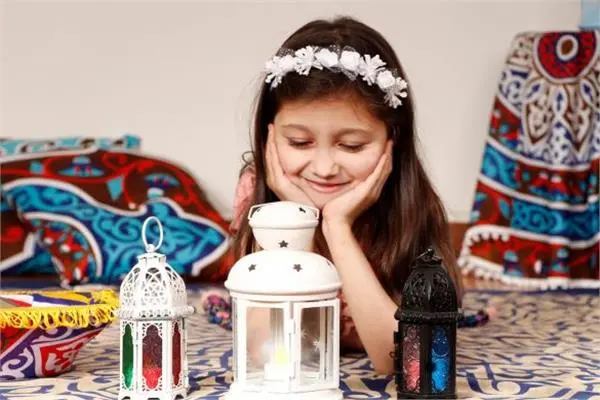
Decorate the home with colorful paper lanterns, illuminated lanterns, and decorations of different shapes. Ask your child to buy them with you, help you hang them around the home, and choose suitable places for them.
All of this is among the most important ways to encourage children to fast during Ramadan and strengthens the child's sense that the blessed month is approaching.
4. Ask Your Child to Help Prepare Food, Drinks, and Sweets
Ramadan is a month of generosity, so many different foods and drinks are prepared during it. You can encourage your child to fast by asking them to help you prepare many of these items.
Choose tasks according to your child's age. If your child is young, for example, ask them to bring you utensils from the kitchen and clean or wash them. If they are older and can buy some items from nearby shops, let them do so.
All of this helps connect the daily traditions of Ramadan with the joy and happiness that positively shape the child's feelings about Ramadan and encourage them to fast.
5. Help Your Child Adjust to Fasting Gradually
Help your child become accustomed to fasting gradually. One well-known modern approach that has proved effective with many of my friends' children is to have the child fast from the ‘Asr prayer in late afternoon until Maghrib at sunset, rather than doing the reverse, as was common in the past, when a child would fast from dawn until the noon call to prayer.
This allows the child to share the joy of iftar with the family and experience a real sense of achievement because they have acted like the adults. Most importantly, it encourages them to fast for the whole day because they have already tried fasting for several hours and succeeded.
Begin this way, then increase the fasting period by half an hour or an hour according to your child's capacity until they can fast from noon until sunset, and continue gradually in this manner.
By now, your child should have come to love fasting and even look forward to it after receiving all this encouragement. However, you should also follow some steps that can help your child fast.
Parents should prepare suitable conditions and make fasting easier for their children. The steps are as follows:
1. Pay Attention to the Suhoor Meal and Choose Its Timing Carefully
A mother should choose foods that will help her child fast and feel full.
The most important of these foods include bananas and yogurt, which are light on the stomach while also being filling.
You should also delay suhoor until shortly before the dawn call to prayer, as this reduces the actual period of abstaining from food.
2. Choose a Suitable Way for Your Child to Spend the Day
Parents tend to follow two schools of thought:
- Some parents believe that keeping their children busy throughout the Ramadan day helps them avoid thinking about food. They may ask the children to handle many household tasks or send them out to run errands.
- Others keep the child resting as much as possible so that they exert no effort and therefore do not feel hungry.
Here, we would like to point out that both approaches contain a serious mistake. You do need to occupy your child's time, but what is the best way to do so?
The most sensible approach is to fill your child's day with activities they enjoy, provided these do not require significant physical effort.
Among our suggestions today is choosing a hands-on activity for your child, such asdrawing, coloring, playing with modeling clay, or helping to prepare iftar.
These activities help pass the time and direct much of the child's attention away from looking for food. The child may also remain absorbed in them for a long time without becoming bored.
3. Make Your Child a Partner in All Ramadan Acts of Worship
Although fasting is an act of worship associated with Ramadan, other good deeds are also connected with the blessed month.
I remember that, during my childhood, we would distribute dates to drivers and passersby in the streets at iftar time. This was one of the things that most encouraged me to observe all the other acts of worship during Ramadan, including fasting, of course.
These actions help connect the child with the spiritual atmosphere of the blessed month and also encourage children to fast during Ramadan.
Along the way, however, parents may make some common mistakes. We explain these in detail in the following section.
If you are looking for ways to encourage children to fast, remember that this experience is still at an early stage and that the child you are encouraging is not an adult who is religiously accountable. You should therefore accept that there may be some setbacks at the beginning.
For example, imagine that your child refuses to fast at all. In that case, encourage them again and explain fasting and its value.
You should also be prepared for your child to ask to break their fast after some time. Of course, do not give in immediately so that the obligation does not lose its value in the child's mind, but do not make it too difficult for them, as they are not yet religiously accountable.
As you take this journey, be careful not to make the following mistakes:
1. Accusing the Child of Lying or Calling Them a Bad Name
Who has not heard an adult recount the tricks they used when fasting was imposed on them as a child? One of the best known is drinking some water while washing their face or bathing.
Some children certainly still use these tricks today. If you discover that your child is one of them, never accuse them of lying or try to frighten or intimidate them.
Instead, explain the situation, tell the child what mistake they made, and make clear that it can be remedied. Do not accuse them of lacking determination, as this may reinforce the idea that fasting is a heavy burden and that observing it involves great hardship.
2. Comparing the Child with Their Peers
Always remember that parenting is an interconnected process whose parts cannot be separated. If comparison is unacceptable in other areas of behavior, it becomes a genuine disaster in matters of worship.
Imagine a child growing up with imitation of others, rather than obedience to God's commands, as the true motivation for performing any act of worship.
3. Frightening the Child with Hell
Adults naturally understand the principle of reward and punishment and worship God through both hope and fear. Children, however, with their broad imaginations, will not understandfear in the same way. Here, we are talking about children whom we are still encouraging to fast, meaning they are between six and eight years old.
Frightening children with God's punishment at such a young age may lead to variousdisorders. It is therefore better to use encouragement and teach the child about the extent of God's mercy and forgiveness.
4. Failing to Answer the Child's Questions
A child may ask why fasting was prescribed and who prescribed it, why an elderly grandfather does not fast, and many other questions—and it is healthy for the child to do so. You should therefore answer all these questions accurately and never prevent the child from asking any question, whatever it may be.
Now that we have reached the end of this comprehensive guide to encouraging children to fast during Ramadan, remember that children's spiritual upbringing presents a major challenge and requires genuine effort and sustained dedication to achieve the best results in raising a conscious Muslim generation with strong faith and the ability to observe all religious obligations in order to draw closer to God.