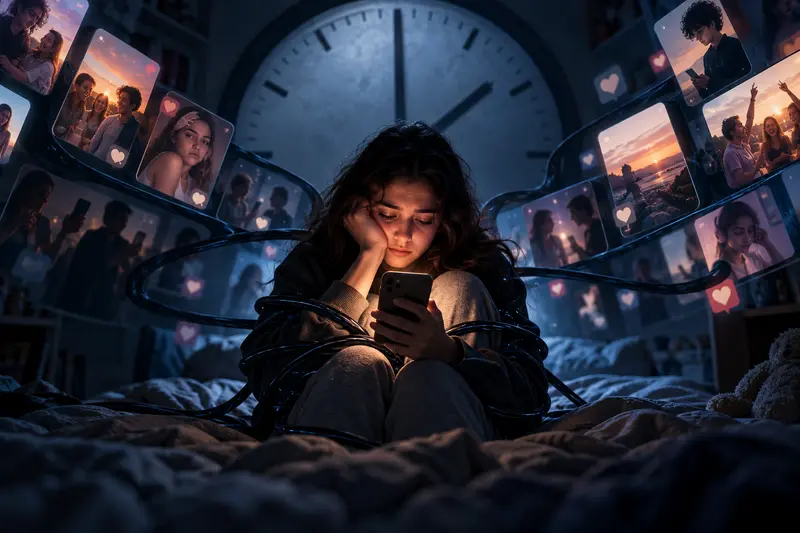
A phone may show three hours of use, but that number does not describe the whole day. Was your teen watching a lesson, talking with a friend or scrolling until bedtime slipped? Do they finish feeling better or more tense?
Start with their day: what are they using, when, and what does it replace? Duration is part of the picture, especially when use crowds out sleep, schoolwork or relationships. It cannot tell you about happiness or safety on its own, and research has not established a single threshold beyond which screens cause unhappiness in every teen.
Better questions than “How many hours?”
Choose the questions that relate to what you have noticed, and listen before proposing a limit. These draw on American Academy of Pediatrics guidance4 about content, what use crowds out, the child's needs and communication.
What do you want to understand?
A question without accusation
Sleep and responsibilities
“Does the phone delay sleep or make it harder to get things done?”
Content and feelings
“What do you enjoy? Does anything leave you tense or feeling bad about yourself?”
Stopping
“When is it hard to stop? What helps?”
Relationships and activity
“Is there still time for friends, movement and interests away from your phone?”
Safety and help
“If someone bothers you or asks for something uncomfortable, can you tell me?”
Consider your own habits too. A conversation about attention during meals is harder to take seriously if you answer notifications throughout dinner. A screen-free time or place can apply to everyone instead of feeling like a punishment for the teen.
Try a clear change, then review its effect
If getting up is difficult after late nights, you might begin: “I've noticed you're tired every morning. What keeps you on your phone after you meant to go to sleep?” Friends' messages or notifications may pull them back into browsing. Choose a time to finish, a place to charge the phone outside the bedroom, and turn off unnecessary notifications. If the phone is their alarm, arrange an alternative before moving it.
If browsing interrupts homework, agree on a period for completing one task without switching between apps, while keeping study needs and essential communication available. They may need the same device to open a lesson; the agreement could be to close the video feed and mute notifications during the task.
Try the agreement for a week, for example. Then ask: is getting up easier? Could they finish the task? Which part of the agreement was difficult? Adjust it around what you notice. A better day helps you find a more suitable routine; it does not establish that screens were the sole cause of any mental-health difficulty.
Agree on what they can do with the time they previously spent on their phone: an activity they enjoy, a walk or a safe meeting with a friend, depending on what the family can offer. Distinguish harmful use that needs stopping for protection from a lesson or useful contact that can remain part of the arrangement.
What did the study linking screens and unhappiness find?
A study published in 2018 analyzed annual surveys of US students in grades 8, 10 and 12 between 1991 and 2016, with a total of 1.1 million participants. It measured aspects of well-being such as self-esteem, life satisfaction and happiness. More time in screen activities was associated with lower psychological well-being1, while nonscreen activities were associated with higher well-being.
It was observational: teens were not randomly assigned to different amounts of screen use. It therefore cannot establish on its own that screens caused lower happiness, or that a particular number of hours is a safe boundary for everyone. Other factors may affect both use and well-being; a young person who is already struggling may also turn to screens more often. Older US data do not necessarily describe a teen's life in Saudi Arabia or today's platforms.
A separate analysis published in 2019 found a negative but small average association2 between digital technology use and adolescent well-being, with results sensitive to analytical choices. This does not dismiss an individual's distress. It does caution against making one study a verdict on every kind of use.
When does a time limit help, and when is it not enough?
The US Surgeon General's May 2026 advisory warns about harmful screen use3 while explaining that most evidence is observational and outcomes vary by age, type, content, context and what use displaces. It discusses sleep, content encouraging harmful behavior and online exploitation among its concerns.
The advisory suggests two hours daily for ages 6–18 within family media-plan guidance. This is a recommendation for organizing use; it does not prove that exceeding two hours causes unhappiness. A clear stopping time can help protect sleep and responsibilities while accounting for your child's needs. Content encouraging harm or a person threatening them needs a response even if they have spent only a short time online.
What about short clips and returning to schoolwork?
Your teen may open short videos for a break, then return to their book unable to remember where they left off. A small 2023 experiment studied this kind of interruption: 60 German-speaking adults aged 19–34 returned to a task requiring them to remember an intended action after a ten-minute break. Performance declined in the TikTok condition8 compared with rest. The study did not test adolescents or establish permanent memory damage or an attention disorder caused by short clips.
Take the difficulty seriously and try making the return easier: write “I'll continue with question three” before the break, then stay away from short clips during it. Consider sleep, stress and the difficulty of the lesson too. This organizes the task; it is not sufficient treatment for persistent attention difficulties. If the difficulty appears in other settings and affects daily life, discuss the broader picture with a professional.
When is help more important than reducing hours?
If your teen reports bullying, threats or blackmail, thank them for telling you and address safety first. Fear of losing their phone should not become a barrier to seeking help. Stop harmful contact and obtain appropriate child-protection support. If they talk about self-harm or wanting to try harmful behavior they have seen, ask what they mean and about current thoughts, and contact a health professional promptly for assessment. Seeing the content alone does not establish an emergency.
Arrange an assessment with a doctor or suitable child and adolescent professional if distress, isolation or changes in sleep, eating or school continue. Screen use may overlap with another problem5; it is not enough to assume it is the only cause.
If your child has thoughts of killing themselves or ending their life now, stay with them and seek urgent assessment; do not leave them alone. In Saudi Arabia, accompany them safely to emergency care or call 997 for an ambulance when there is immediate danger. Also call an ambulance for an ongoing or recent suicide attempt that has not received medical assessment, a serious injury, possible poisoning or harmful ingestion, or an inability to keep them safe.
How many hours of screen time a day is OK for a teenager?
Research has not established a single threshold beyond which screens cause unhappiness in every teen. The US Surgeon General's advisory suggests two hours daily for ages 6–18 within family media-plan guidance, but this is a recommendation for organizing use; it does not prove that exceeding two hours causes unhappiness. Look at what your teen uses, when, and what it replaces. Duration matters most when it crowds out sleep, schoolwork or relationships.
Does screen time cause unhappiness in teenagers?
Studies show an association, but they have not shown that screens are the cause. A 2018 study linked more time in screen activities with lower psychological well-being, but it was observational, and a teen who is already struggling may turn to screens more often. A 2019 analysis found a negative but small average association. This does not dismiss an individual's distress; it cautions against making one study a verdict on every kind of use.
How do I set screen time limits with my teen?
Start with their day rather than the hour count, and listen before proposing a limit. Then agree on one clear change, such as a time to finish, a place to charge the phone outside the bedroom and turning off unnecessary notifications. Try the agreement for a week, for example, then review it and adjust. Agree on what they can do with the time instead: an activity they enjoy, a walk or a safe meeting with a friend.
Do short videos affect concentration when studying?
They may make it harder for your teen to remember where they left off after a break. In a small 2023 experiment with adults, performance on remembering an intended action declined after watching TikTok compared with rest, but the study did not test adolescents or establish permanent memory damage or an attention disorder. Try writing the next step before the break, then staying away from short clips during it.
When does my teen need a professional or urgent help?
Arrange an assessment with a doctor or suitable child and adolescent professional if distress, isolation or changes in sleep, eating or school continue. If your teen has thoughts of killing themselves or ending their life now, stay with them, seek urgent assessment and do not leave them alone. In Saudi Arabia, accompany them safely to emergency care or call 997 for an ambulance when there is immediate danger. Also call an ambulance for an ongoing or recent suicide attempt without medical assessment, a serious injury, possible poisoning or harmful ingestion, or an inability to keep them safe.
Content writer and researcher at Tatmeen, writing in Arabic and English about mental health and everyday life, from relationships and stress to work, habits, and family.
Every Tatmeen article is reviewed by care providers licensed by the Saudi Commission for Health Specialties, so what you read is accurate and trustworthy.
This article builds understanding and does not replace a licensed care provider.
Need someone to talk to?
Tatmeen's licensed care providers are available around the clock, and the app's urgent consultation connects you with one within minutes.
Download Tatmeen to explore care providers and booking options.
Smart matchingFour quick questions suggest the right care provider
Urgent consultationTalk to an available care provider within minutes
Free psychological measuresMore than 20 tests to understand how you are doing
Scan to download
{"data":{"id":"003e59ac-a9da-4da0-aa56-b67e9bbab6ca","slug":"factor_causing_unhappiness_in_teens","arTitle":"وقت الشاشة للمراهقين: كيف تضع حدودًا تناسب يومهم؟","enTitle":"Teen screen time: setting limits that fit daily life","thumbnailAltText":"فتاة تنظر إلى هاتفها على السرير، وحولها أسلاك وصور منشورات، وخلفها ساعة كبيرة.","estimatedReadingTime":8,"likesCount":1,"writer":{"id":"d3defdb6-4a23-4b03-aad9-a1ecc054aae5","arBio":"كاتب وباحث محتوى في تطمين، يكتب بالعربية والإنجليزية عن الصحة النفسية والحياة اليومية، من العلاقات والضغوط إلى العمل والعادات والأسرة.\n","enBio":"Content writer and researcher at Tatmeen, writing in Arabic and English about mental health and everyday life, from relationships and stress to work, habits, and family.","user":{"slug":"fahad-almalik","arFullName":"فهد المالك","enFullName":"Fahad Almalik","publicProfileImageUrl":"https://cdn.tatmeen.sa/public/profile-images/a34c8028-5847-45de-ab83-a014942bb7d3/675415e988c16442a04af5d3b8899242613a955c44e0364314cc3ff74cbad082.webp","publicProfileImage96Url":"https://cdn.tatmeen.sa/public/profile-images/a34c8028-5847-45de-ab83-a014942bb7d3/675415e988c16442a04af5d3b8899242613a955c44e0364314cc3ff74cbad082-w96.webp","publicProfileImage192Url":"https://cdn.tatmeen.sa/public/profile-images/a34c8028-5847-45de-ab83-a014942bb7d3/675415e988c16442a04af5d3b8899242613a955c44e0364314cc3ff74cbad082-w192.webp"}},"arContent":"","enContent":"","productionDocument":{"headings":[{"id":"article-section-better-questions-than-how-many-hours","text":"Better questions than “How many hours?”"},{"id":"article-section-try-a-clear-change-then-review-its-effect","text":"Try a clear change, then review its effect"},{"id":"article-section-what-did-the-study-linking-screens-and-unhappiness-find","text":"What did the study linking screens and unhappiness find?"},{"id":"article-section-when-does-a-time-limit-help-and-when-is-it-not-enough","text":"When does a time limit help, and when is it not enough?"},{"id":"article-section-what-about-short-clips-and-returning-to-schoolwork","text":"What about short clips and returning to schoolwork?"},{"id":"article-section-when-is-help-more-important-than-reducing-hours","text":"When is help more important than reducing hours?"}],"faqs":[{"question":"How many hours of screen time a day is OK for a teenager?","answer":"<p>Research has not established a single threshold beyond which screens cause unhappiness in every teen. The US Surgeon General's advisory suggests two hours daily for ages 6–18 within family media-plan guidance, but this is a recommendation for organizing use; it does not prove that exceeding two hours causes unhappiness. Look at what your teen uses, when, and what it replaces. Duration matters most when it crowds out sleep, schoolwork or relationships.</p>"},{"question":"Does screen time cause unhappiness in teenagers?","answer":"<p>Studies show an association, but they have not shown that screens are the cause. A 2018 study linked more time in screen activities with lower psychological well-being, but it was observational, and a teen who is already struggling may turn to screens more often. A 2019 analysis found a negative but small average association. This does not dismiss an individual's distress; it cautions against making one study a verdict on every kind of use.</p>"},{"question":"How do I set screen time limits with my teen?","answer":"<p>Start with their day rather than the hour count, and listen before proposing a limit. Then agree on one clear change, such as a time to finish, a place to charge the phone outside the bedroom and turning off unnecessary notifications. Try the agreement for a week, for example, then review it and adjust. Agree on what they can do with the time instead: an activity they enjoy, a walk or a safe meeting with a friend.</p>"},{"question":"Do short videos affect concentration when studying?","answer":"<p>They may make it harder for your teen to remember where they left off after a break. In a small 2023 experiment with adults, performance on remembering an intended action declined after watching TikTok compared with rest, but the study did not test adolescents or establish permanent memory damage or an attention disorder. Try writing the next step before the break, then staying away from short clips during it.</p>"},{"question":"When does my teen need a professional or urgent help?","answer":"<p>Arrange an assessment with a doctor or suitable child and adolescent professional if distress, isolation or changes in sleep, eating or school continue. If your teen has thoughts of killing themselves or ending their life now, stay with them, seek urgent assessment and do not leave them alone. In Saudi Arabia, accompany them safely to emergency care or call 997 for an ambulance when there is immediate danger. Also call an ambulance for an ongoing or recent suicide attempt without medical assessment, a serious injury, possible poisoning or harmful ingestion, or an inability to keep them safe.</p>"}],"beforeSourcesHtml":"\n","sources":[{"title":"Twenge, Martin and Campbell: Adolescent psychological well-being and screen time, 2018","href":"https://pubmed.ncbi.nlm.nih.gov/29355336/","hostname":"pubmed.ncbi.nlm.nih.gov"},{"title":"Orben and Przybylski: Adolescent well-being and digital technology use, 2019","href":"https://www.nature.com/articles/s41562-018-0506-1","hostname":"nature.com"},{"title":"US Surgeon General: Warning on the harms of screen use, 2026","href":"https://www.hhs.gov/sites/default/files/us-surgeon-generals-advisory-warning-on-the-harms-of-screen-use.pdf","hostname":"hhs.gov"},{"title":"AAP: The 5 Cs of Media Use","href":"https://www.aap.org/en/patient-care/media-and-children/center-of-excellence-on-social-media-and-youth-mental-health/5cs-of-media-use/","hostname":"aap.org"},{"title":"NIMH: Children and Mental Health","href":"https://www.nimh.nih.gov/health/publications/children-and-mental-health","hostname":"nimh.nih.gov"},{"title":"Saudi Red Crescent Authority: Ambulance service, 997","href":"https://www.srca.gov.sa/en/contact-us/","hostname":"srca.gov.sa"},{"title":"Saudi Ministry of Health: 937 services","href":"https://www.moh.gov.sa/937/pages/default.aspx","hostname":"moh.gov.sa"},{"title":"Chiossi and colleagues: Short-form videos and remembering intentions after an interruption, CHI 2023","href":"https://doi.org/10.1145/3544548.3580778","hostname":"doi.org"},{"title":"AAP: What should I do if my child is thinking about suicide? Updated July 2024","href":"https://www.healthychildren.org/English/tips-tools/ask-the-pediatrician/Pages/what-should-i-do-if-my-child-is-thinking-about-suicide.aspx","hostname":"healthychildren.org"},{"title":"AAP: When your child needs emergency medical services, updated August 2025","href":"https://www.healthychildren.org/English/health-issues/injuries-emergencies/Pages/When-Your-Child-Needs-Emergency-Medical-Services.aspx","hostname":"healthychildren.org"}],"afterSourcesHtml":"\n","blocks":[{"type":"html","html":"<p>A phone may show three hours of use, but that number does not describe the whole day. Was your teen watching a lesson, talking with a friend or scrolling until bedtime slipped? Do they finish feeling better or more tense?</p>\n<p>Start with their day: <strong>what are they using, when, and what does it replace?</strong> Duration is part of the picture, especially when use crowds out sleep, schoolwork or relationships. It cannot tell you about happiness or safety on its own, and research has not established a single threshold beyond which screens cause unhappiness in every teen.</p>\n<h2 id=\"article-section-better-questions-than-how-many-hours\" data-toc-heading tabindex=\"-1\"><span id=\"better-questions-than-how-many-hours-1\" aria-hidden=\"true\"></span>Better questions than “How many hours?”</h2>\n<p>Choose the questions that relate to what you have noticed, and listen before proposing a limit. These draw on <a href=\"https://www.aap.org/en/patient-care/media-and-children/center-of-excellence-on-social-media-and-youth-mental-health/5cs-of-media-use/\" target=\"_blank\" rel=\"noopener noreferrer\">American Academy of Pediatrics guidance</a> about content, what use crowds out, the child's needs and communication.</p>\n<div class=\"table-block\"><table>\n<thead>\n<tr>\n<th>What do you want to understand?</th>\n<th>A question without accusation</th>\n</tr>\n</thead>\n<tbody>\n<tr>\n<td>Sleep and responsibilities</td>\n<td>“Does the phone delay sleep or make it harder to get things done?”</td>\n</tr>\n<tr>\n<td>Content and feelings</td>\n<td>“What do you enjoy? Does anything leave you tense or feeling bad about yourself?”</td>\n</tr>\n<tr>\n<td>Stopping</td>\n<td>“When is it hard to stop? What helps?”</td>\n</tr>\n<tr>\n<td>Relationships and activity</td>\n<td>“Is there still time for friends, movement and interests away from your phone?”</td>\n</tr>\n<tr>\n<td>Safety and help</td>\n<td>“If someone bothers you or asks for something uncomfortable, can you tell me?”</td>\n</tr>\n</tbody>\n</table></div>\n<p>Consider your own habits too. A conversation about attention during meals is harder to take seriously if you answer notifications throughout dinner. A screen-free time or place can apply to everyone instead of feeling like a punishment for the teen.</p>\n<h2 id=\"article-section-try-a-clear-change-then-review-its-effect\" data-toc-heading tabindex=\"-1\"><span id=\"try-a-clear-change-then-review-its-effect-2\" aria-hidden=\"true\"></span>Try a clear change, then review its effect</h2>\n<p>If getting up is difficult after late nights, you might begin: “I've noticed you're tired every morning. What keeps you on your phone after you meant to go to sleep?” Friends' messages or notifications may pull them back into browsing. Choose a time to finish, a place to charge the phone outside the bedroom, and turn off unnecessary notifications. If the phone is their alarm, arrange an alternative before moving it.</p>\n<p>If browsing interrupts homework, agree on a period for completing one task without switching between apps, while keeping study needs and essential communication available. They may need the same device to open a lesson; the agreement could be to close the video feed and mute notifications during the task.</p>\n<p>Try the agreement for a week, for example. Then ask: is getting up easier? Could they finish the task? Which part of the agreement was difficult? Adjust it around what you notice. A better day helps you find a more suitable routine; it does not establish that screens were the sole cause of any mental-health difficulty.</p>\n<p>Agree on what they can do with the time they previously spent on their phone: an activity they enjoy, a walk or a safe meeting with a friend, depending on what the family can offer. Distinguish harmful use that needs stopping for protection from a lesson or useful contact that can remain part of the arrangement.</p>\n<h2 id=\"article-section-what-did-the-study-linking-screens-and-unhappiness-find\" data-toc-heading tabindex=\"-1\"><span id=\"what-did-the-study-linking-screens-and-unhappiness-find-3\" aria-hidden=\"true\"></span>What did the study linking screens and unhappiness find?</h2>\n<p>A study published in 2018 analyzed annual surveys of US students in grades 8, 10 and 12 between 1991 and 2016, with a total of 1.1 million participants. It measured aspects of well-being such as self-esteem, life satisfaction and happiness. More time in screen activities was <a href=\"https://pubmed.ncbi.nlm.nih.gov/29355336/\" target=\"_blank\" rel=\"noopener noreferrer\">associated with lower psychological well-being</a>, while nonscreen activities were associated with higher well-being.</p>\n<p>It was observational: teens were not randomly assigned to different amounts of screen use. It therefore cannot establish on its own that screens caused lower happiness, or that a particular number of hours is a safe boundary for everyone. Other factors may affect both use and well-being; a young person who is already struggling may also turn to screens more often. Older US data do not necessarily describe a teen's life in Saudi Arabia or today's platforms.</p>\n<p>A separate analysis published in 2019 found a <a href=\"https://www.nature.com/articles/s41562-018-0506-1\" target=\"_blank\" rel=\"noopener noreferrer\">negative but small average association</a> between digital technology use and adolescent well-being, with results sensitive to analytical choices. This does not dismiss an individual's distress. It does caution against making one study a verdict on every kind of use.</p>\n<h2 id=\"article-section-when-does-a-time-limit-help-and-when-is-it-not-enough\" data-toc-heading tabindex=\"-1\"><span id=\"when-does-a-time-limit-help-and-when-is-it-not-enough-4\" aria-hidden=\"true\"></span>When does a time limit help, and when is it not enough?</h2>\n<p>The US Surgeon General's May 2026 advisory <a href=\"https://www.hhs.gov/sites/default/files/us-surgeon-generals-advisory-warning-on-the-harms-of-screen-use.pdf\" target=\"_blank\" rel=\"noopener noreferrer\">warns about harmful screen use</a> while explaining that most evidence is observational and outcomes vary by age, type, content, context and what use displaces. It discusses sleep, content encouraging harmful behavior and online exploitation among its concerns.</p>\n<p>The advisory suggests two hours daily for ages 6–18 within family media-plan guidance. <strong>This is a recommendation for organizing use; it does not prove that exceeding two hours causes unhappiness.</strong> A clear stopping time can help protect sleep and responsibilities while accounting for your child's needs. Content encouraging harm or a person threatening them needs a response even if they have spent only a short time online.</p>\n<h2 id=\"article-section-what-about-short-clips-and-returning-to-schoolwork\" data-toc-heading tabindex=\"-1\"><span id=\"what-about-short-clips-and-returning-to-schoolwork-5\" aria-hidden=\"true\"></span>What about short clips and returning to schoolwork?</h2>\n<p>Your teen may open short videos for a break, then return to their book unable to remember where they left off. A small 2023 experiment studied this kind of interruption: 60 German-speaking adults aged 19–34 returned to a task requiring them to remember an intended action after a ten-minute break. <a href=\"https://doi.org/10.1145/3544548.3580778\" target=\"_blank\" rel=\"noopener noreferrer\">Performance declined in the TikTok condition</a> compared with rest. The study did not test adolescents or establish permanent memory damage or an attention disorder caused by short clips.</p>\n<p>Take the difficulty seriously and try making the return easier: write “I'll continue with question three” before the break, then stay away from short clips during it. Consider sleep, stress and the difficulty of the lesson too. This organizes the task; it is not sufficient treatment for persistent attention difficulties. If the difficulty appears in other settings and affects daily life, discuss the broader picture with a professional.</p>\n<h2 id=\"article-section-when-is-help-more-important-than-reducing-hours\" data-toc-heading tabindex=\"-1\"><span id=\"when-is-help-more-important-than-reducing-hours-6\" aria-hidden=\"true\"></span>When is help more important than reducing hours?</h2>\n<p>If your teen reports bullying, threats or blackmail, thank them for telling you and address safety first. Fear of losing their phone should not become a barrier to seeking help. Stop harmful contact and obtain appropriate child-protection support. If they talk about self-harm or wanting to try harmful behavior they have seen, ask what they mean and about current thoughts, and contact a health professional promptly for assessment. Seeing the content alone does not establish an emergency.</p>\n<p>Arrange an assessment with a doctor or suitable child and adolescent professional if distress, isolation or changes in sleep, eating or school continue. Screen use <a href=\"https://www.nimh.nih.gov/health/publications/children-and-mental-health\" target=\"_blank\" rel=\"noopener noreferrer\">may overlap with another problem</a>; it is not enough to assume it is the only cause.</p>\n<p><strong>If your child has thoughts of killing themselves or ending their life now, stay with them and seek urgent assessment; do not leave them alone.</strong> In Saudi Arabia, accompany them safely to emergency care or call <strong>997</strong> for an ambulance when there is immediate danger. Also call an ambulance for an ongoing or recent suicide attempt that has not received medical assessment, a serious injury, possible poisoning or harmful ingestion, or an inability to keep them safe.</p>\n<p>For other concerning thoughts or past self-harm, contact their pediatrician or family doctor promptly, or <strong>937</strong> for <a href=\"https://www.moh.gov.sa/937/pages/default.aspx\" target=\"_blank\" rel=\"noopener noreferrer\">health guidance</a>, and follow any care plan from an earlier assessment. If <a href=\"https://www.healthychildren.org/English/health-issues/injuries-emergencies/Pages/When-Your-Child-Needs-Emergency-Medical-Services.aspx\" target=\"_blank\" rel=\"noopener noreferrer\">safety is uncertain</a>, <a href=\"https://www.healthychildren.org/English/tips-tools/ask-the-pediatrician/Pages/what-should-i-do-if-my-child-is-thinking-about-suicide.aspx\" target=\"_blank\" rel=\"noopener noreferrer\">do not wait for a routine appointment</a>.</p>\n"}],"inlineCtaSignatures":[],"_experienceAliases":{"v":1,"fields":["html","bodyHtml"],"faqs":[0,1,2,3,4]}},"createdAt":"2023-12-31T21:00:00.000Z","updatedAt":"2026-10-30T20:02:10.805Z","disorderGroups":[{"id":"9fbda432-3713-400a-987b-3d56754a113e","slug":"children-and-adolescents","arName":"الأطفال والمراهقين","enName":"Children & Adolescents"}],"reviewer":{"arFullName":"فريق تطمين","enFullName":"Tatmeen team","slug":"tatmeen-team","kind":"organization"},"productionArticle":true,"promotionAllowed":true,"preparedCover":{"src":"https://cdn.tatmeen.sa/public/article-lcp/article-lcp-v2/sha256-250e439df9c7a5418a477082fd01ec3c0aa2994e4fc01d245e6df71ce64b4eb1/800-4d9354009d3a083984ab182598086be9065e4bc5ebcb19742d70ad1a4f324939.avif","fallback":"https://cdn.tatmeen.sa/public/article-lcp/article-lcp-v2/sha256-250e439df9c7a5418a477082fd01ec3c0aa2994e4fc01d245e6df71ce64b4eb1/800-74b41ca00e95764858064f95c127ca400810b52b451d6c3efd7fb13b4626474a.webp","directUrl":"https://cdn.tatmeen.sa/blog-cover/9d79e3fa-dce3-40f1-b0ca-14961a78fef1.png","isGolden":true,"avifSrcset":"https://cdn.tatmeen.sa/public/article-lcp/article-lcp-v2/sha256-250e439df9c7a5418a477082fd01ec3c0aa2994e4fc01d245e6df71ce64b4eb1/400-a58bab691525fd0a2c4425ae4b3d7788cc569217c67259ac5ac3cb9726e6ca59.avif 400w, https://cdn.tatmeen.sa/public/article-lcp/article-lcp-v2/sha256-250e439df9c7a5418a477082fd01ec3c0aa2994e4fc01d245e6df71ce64b4eb1/640-7352a7eb423c8a32da7ed43bc781109777a303e015b1c45e2e855c20bf34f7b9.avif 640w, https://cdn.tatmeen.sa/public/article-lcp/article-lcp-v2/sha256-250e439df9c7a5418a477082fd01ec3c0aa2994e4fc01d245e6df71ce64b4eb1/800-4d9354009d3a083984ab182598086be9065e4bc5ebcb19742d70ad1a4f324939.avif 800w, https://cdn.tatmeen.sa/public/article-lcp/article-lcp-v2/sha256-250e439df9c7a5418a477082fd01ec3c0aa2994e4fc01d245e6df71ce64b4eb1/1200-c195dc3d74592974bf777e35aab70d0364935a351c62202355651ab677b6eeb9.avif 1200w","webpSrcset":"https://cdn.tatmeen.sa/public/article-lcp/article-lcp-v2/sha256-250e439df9c7a5418a477082fd01ec3c0aa2994e4fc01d245e6df71ce64b4eb1/400-5ed174bdc3fa71a191e233e0cc858f6a78308e1b8775ab839d4d754bc4ba61bd.webp 400w, https://cdn.tatmeen.sa/public/article-lcp/article-lcp-v2/sha256-250e439df9c7a5418a477082fd01ec3c0aa2994e4fc01d245e6df71ce64b4eb1/640-b0db55ef71e28bb6c1a53ca214dfffeaee83ae8da9020fde33c82ea790c80e5f.webp 640w, https://cdn.tatmeen.sa/public/article-lcp/article-lcp-v2/sha256-250e439df9c7a5418a477082fd01ec3c0aa2994e4fc01d245e6df71ce64b4eb1/800-74b41ca00e95764858064f95c127ca400810b52b451d6c3efd7fb13b4626474a.webp 800w, https://cdn.tatmeen.sa/public/article-lcp/article-lcp-v2/sha256-250e439df9c7a5418a477082fd01ec3c0aa2994e4fc01d245e6df71ce64b4eb1/1200-b96d6caf5865541523205d66cd831784faab1760b96c5a5a1568ffc47278cda2.webp 1200w","phoneAvifSrcset":"https://cdn.tatmeen.sa/public/article-lcp/article-lcp-v2/sha256-250e439df9c7a5418a477082fd01ec3c0aa2994e4fc01d245e6df71ce64b4eb1/400-a58bab691525fd0a2c4425ae4b3d7788cc569217c67259ac5ac3cb9726e6ca59.avif 400w, https://cdn.tatmeen.sa/public/article-lcp/article-lcp-v2/sha256-250e439df9c7a5418a477082fd01ec3c0aa2994e4fc01d245e6df71ce64b4eb1/640-7352a7eb423c8a32da7ed43bc781109777a303e015b1c45e2e855c20bf34f7b9.avif 640w, https://cdn.tatmeen.sa/public/article-lcp/article-lcp-v2/sha256-250e439df9c7a5418a477082fd01ec3c0aa2994e4fc01d245e6df71ce64b4eb1/800-4d9354009d3a083984ab182598086be9065e4bc5ebcb19742d70ad1a4f324939.avif 800w","phoneWebpSrcset":"https://cdn.tatmeen.sa/public/article-lcp/article-lcp-v2/sha256-250e439df9c7a5418a477082fd01ec3c0aa2994e4fc01d245e6df71ce64b4eb1/400-5ed174bdc3fa71a191e233e0cc858f6a78308e1b8775ab839d4d754bc4ba61bd.webp 400w, https://cdn.tatmeen.sa/public/article-lcp/article-lcp-v2/sha256-250e439df9c7a5418a477082fd01ec3c0aa2994e4fc01d245e6df71ce64b4eb1/640-b0db55ef71e28bb6c1a53ca214dfffeaee83ae8da9020fde33c82ea790c80e5f.webp 640w, https://cdn.tatmeen.sa/public/article-lcp/article-lcp-v2/sha256-250e439df9c7a5418a477082fd01ec3c0aa2994e4fc01d245e6df71ce64b4eb1/800-74b41ca00e95764858064f95c127ca400810b52b451d6c3efd7fb13b4626474a.webp 800w","width":800,"height":533},"previewTaxonomy":{"groups":[{"id":"9fbda432-3713-400a-987b-3d56754a113e","slug":"children-and-adolescents","arName":"الأطفال والمراهقين","enName":"Children & Adolescents"}],"topics":[{"id":"c655ea5a-6a99-4fcd-92db-c57f8dde7bc8","slug":"dealing-with-teens","arName":"التعامل مع المراهقين","enName":"Dealing with Teens","groupSlug":"children-and-adolescents","href":"/blog/category/children-and-adolescents/dealing-with-teens/"}],"tags":[{"id":"18c7be3e-909a-4149-85b9-1584c5f74e3c","slug":"digital-wellbeing","arName":"العافية الرقمية ووقت الشاشة","enName":"Digital Wellbeing & Screen Time"},{"id":"47cc1c83-9579-4656-8e94-f3df78961987","slug":"teens-adolescents","arName":"المراهقون","enName":"Teens & Adolescents"},{"id":"c2a6e8d3-de9c-435f-8c95-9727e7db14cc","slug":"explainer-awareness","arName":"دليل توعوي / شرح","enName":"Explainer / Awareness Guide"},{"id":"f8862bbf-ffdd-4c04-b988-c1a18cc05b61","slug":"family-agreements","arName":"الاتفاقات الأسرية","enName":"Family agreements"}]},"previewProviderRecommendations":[{"id":"80353bb6-9e99-42d3-913b-042697e2ba47","slug":"wala-alharbi-3022","arFullName":"ولاء الحربي","enFullName":"Wala Alharbi","publicProfileImageUrl":"","publicProfileImage96Url":"","publicProfileImage192Url":"","specialization":{"arName":"أخصائي نفسي","enName":"Psychologist"},"profileImageUrl":"","experienceYears":11,"consultantInfo":{"averageRating":{"average":0},"specialization":{"arGeneralName":"أخصائي نفسي","enGeneralName":"Psychologist"}}},{"id":"d0176d46-fc4b-4727-a744-5706db75c5de","slug":"shaima-bu-jubarah-1564","arFullName":"شيماء بوجبارة","enFullName":"Shaima Bu Jubarah","publicProfileImageUrl":"","publicProfileImage96Url":"","publicProfileImage192Url":"","specialization":{"arName":"أخصائي نفسي","enName":"Psychologist"},"profileImageUrl":"","experienceYears":2,"consultantInfo":{"averageRating":{"average":4.4},"specialization":{"arGeneralName":"أخصائي نفسي","enGeneralName":"Psychologist"}}},{"id":"6609569d-d3be-4ec8-a32a-d6e356a74d40","slug":"dalal-alotaibi-5147","arFullName":"دلال العتيبي","enFullName":"Dalal Alotaibi","publicProfileImageUrl":"","publicProfileImage96Url":"","publicProfileImage192Url":"","specialization":{"arName":"أخصائي نفسي","enName":"Psychologist"},"profileImageUrl":"","experienceYears":18,"consultantInfo":{"averageRating":{"average":5},"specialization":{"arGeneralName":"أخصائي نفسي","enGeneralName":"Psychologist"}}}],"previewCareProviders":[{"id":"09364052-c2a9-4c52-9717-7ce2093b8d0a","slug":"kholoud-alharbi-5221","arFullName":"خلود الحربي","enFullName":"Kholoud Alharbi","publicProfileImageUrl":"https://cdn.tatmeen.sa/public/profile-images/09364052-c2a9-4c52-9717-7ce2093b8d0a/4a0aeb81619e351b77f4323e3605a0a00acc7ca3c82ee7cc5ca2c9e8ef716049.webp","publicProfileImage96Url":"https://cdn.tatmeen.sa/public/profile-images/09364052-c2a9-4c52-9717-7ce2093b8d0a/4a0aeb81619e351b77f4323e3605a0a00acc7ca3c82ee7cc5ca2c9e8ef716049-w96.webp","publicProfileImage192Url":"https://cdn.tatmeen.sa/public/profile-images/09364052-c2a9-4c52-9717-7ce2093b8d0a/4a0aeb81619e351b77f4323e3605a0a00acc7ca3c82ee7cc5ca2c9e8ef716049-w192.webp","gender":"FEMALE","specialization":{"arName":"أخصائي نفسي","enName":"Psychologist"}},{"id":"6f037535-1dca-4b50-a8b2-5974b7323286","slug":"salah-althobaiti-9053","arFullName":"صلاح الثبيتي","enFullName":"Salah Althobaiti","publicProfileImageUrl":"https://cdn.tatmeen.sa/public/profile-images/6f037535-1dca-4b50-a8b2-5974b7323286/35b6bd7fad9b1e004c1835803eb9c1b56dcacd380685ec8bff141f0fb888005c.webp","publicProfileImage96Url":"https://cdn.tatmeen.sa/public/profile-images/6f037535-1dca-4b50-a8b2-5974b7323286/35b6bd7fad9b1e004c1835803eb9c1b56dcacd380685ec8bff141f0fb888005c-w96.webp","publicProfileImage192Url":"https://cdn.tatmeen.sa/public/profile-images/6f037535-1dca-4b50-a8b2-5974b7323286/35b6bd7fad9b1e004c1835803eb9c1b56dcacd380685ec8bff141f0fb888005c-w192.webp","gender":"MALE","specialization":{"arName":"أخصائي نفسي","enName":"Psychologist"}},{"id":"3cc806e8-616b-4884-9f21-a75b378580a2","slug":"aisha-al-hashim-8667","arFullName":"عائشة ال هاشم","enFullName":"Aisha Al Hashim","publicProfileImageUrl":"https://cdn.tatmeen.sa/public/profile-images/3cc806e8-616b-4884-9f21-a75b378580a2/27f523d03be4dcfa1f6a79f70c1773887434e698990d214cd990caec56a44798.webp","publicProfileImage96Url":"https://cdn.tatmeen.sa/public/profile-images/3cc806e8-616b-4884-9f21-a75b378580a2/27f523d03be4dcfa1f6a79f70c1773887434e698990d214cd990caec56a44798-w96.webp","publicProfileImage192Url":"https://cdn.tatmeen.sa/public/profile-images/3cc806e8-616b-4884-9f21-a75b378580a2/27f523d03be4dcfa1f6a79f70c1773887434e698990d214cd990caec56a44798-w192.webp","gender":"FEMALE","specialization":{"arName":"أخصائي نفسي","enName":"Psychologist"}},{"id":"db2ce1a0-9325-4471-b7ce-eb2e811c30a3","slug":"amer-qutub-2441","arFullName":"عامر قطب","enFullName":"Amer Qutub","publicProfileImageUrl":"https://cdn.tatmeen.sa/public/profile-images/db2ce1a0-9325-4471-b7ce-eb2e811c30a3/80580f99bfd7fe2b2a9cf8eed73ab532f5086d1efe053b0aa57358c1ce004261.webp","publicProfileImage96Url":"https://cdn.tatmeen.sa/public/profile-images/db2ce1a0-9325-4471-b7ce-eb2e811c30a3/80580f99bfd7fe2b2a9cf8eed73ab532f5086d1efe053b0aa57358c1ce004261-w96.webp","publicProfileImage192Url":"https://cdn.tatmeen.sa/public/profile-images/db2ce1a0-9325-4471-b7ce-eb2e811c30a3/80580f99bfd7fe2b2a9cf8eed73ab532f5086d1efe053b0aa57358c1ce004261-w192.webp","gender":"MALE","specialization":{"arName":"أخصائي نفسي","enName":"Psychologist"}},{"id":"6043a2b2-c41b-42c8-92bb-881f36083293","slug":"rehab-alharbi-3670","arFullName":"رحاب المعبدي","enFullName":"Rehab Almabadi","publicProfileImageUrl":"https://cdn.tatmeen.sa/public/profile-images/6043a2b2-c41b-42c8-92bb-881f36083293/9f25728f77c844fac517d39615495fdec1cf4c590360b466419ece1bdeb66c2e.webp","publicProfileImage96Url":"https://cdn.tatmeen.sa/public/profile-images/6043a2b2-c41b-42c8-92bb-881f36083293/9f25728f77c844fac517d39615495fdec1cf4c590360b466419ece1bdeb66c2e-w96.webp","publicProfileImage192Url":"https://cdn.tatmeen.sa/public/profile-images/6043a2b2-c41b-42c8-92bb-881f36083293/9f25728f77c844fac517d39615495fdec1cf4c590360b466419ece1bdeb66c2e-w192.webp","gender":"FEMALE","specialization":{"arName":"أخصائي نفسي","enName":"Psychologist"}},{"id":"618dba89-5b70-4b46-8304-741b7ac8ecd3","slug":"abdullah-mari-1311","arFullName":"عبدالله مرعي","enFullName":"Abdullah Mari","publicProfileImageUrl":"https://cdn.tatmeen.sa/public/profile-images/618dba89-5b70-4b46-8304-741b7ac8ecd3/6b4a3bfb59f8a304ca79083b32859b46baad2e1d692974a47c02c1f66bd11129.webp","publicProfileImage96Url":"https://cdn.tatmeen.sa/public/profile-images/618dba89-5b70-4b46-8304-741b7ac8ecd3/6b4a3bfb59f8a304ca79083b32859b46baad2e1d692974a47c02c1f66bd11129-w96.webp","publicProfileImage192Url":"https://cdn.tatmeen.sa/public/profile-images/618dba89-5b70-4b46-8304-741b7ac8ecd3/6b4a3bfb59f8a304ca79083b32859b46baad2e1d692974a47c02c1f66bd11129-w192.webp","gender":"MALE","specialization":{"arName":"أخصائي نفسي","enName":"Psychologist"}},{"id":"94765496-dbdf-4631-a01b-7df5f788668d","slug":"abdullrahman-alhamoudi-3045","arFullName":"عبدالرحمن الحمودي","enFullName":"Abdulrahman Alhamoudi","publicProfileImageUrl":"https://cdn.tatmeen.sa/public/profile-images/94765496-dbdf-4631-a01b-7df5f788668d/2d49f6b6493c564afb6f50b6c3634231dff3a5cf8353acfab393d1b2a88037d1.webp","publicProfileImage96Url":"https://cdn.tatmeen.sa/public/profile-images/94765496-dbdf-4631-a01b-7df5f788668d/2d49f6b6493c564afb6f50b6c3634231dff3a5cf8353acfab393d1b2a88037d1-w96.webp","publicProfileImage192Url":"https://cdn.tatmeen.sa/public/profile-images/94765496-dbdf-4631-a01b-7df5f788668d/2d49f6b6493c564afb6f50b6c3634231dff3a5cf8353acfab393d1b2a88037d1-w192.webp","gender":"MALE","specialization":{"arName":"أخصائي نفسي","enName":"Psychologist"}},{"id":"3b50a5d5-e795-407f-8676-fd7f0e1bb7a0","slug":"abdulaziz-bin-hudayan-4940","arFullName":"عبدالعزيز بن هديان","enFullName":"Abdulaziz Bin Hudayan","publicProfileImageUrl":"https://cdn.tatmeen.sa/public/profile-images/3b50a5d5-e795-407f-8676-fd7f0e1bb7a0/710ff0fe1fb00cdb5042092e27b7910b480a439b02251ecded62d7758eefce95.webp","publicProfileImage96Url":"https://cdn.tatmeen.sa/public/profile-images/3b50a5d5-e795-407f-8676-fd7f0e1bb7a0/710ff0fe1fb00cdb5042092e27b7910b480a439b02251ecded62d7758eefce95-w96.webp","publicProfileImage192Url":"https://cdn.tatmeen.sa/public/profile-images/3b50a5d5-e795-407f-8676-fd7f0e1bb7a0/710ff0fe1fb00cdb5042092e27b7910b480a439b02251ecded62d7758eefce95-w192.webp","gender":"MALE","specialization":{"arName":"أخصائي نفسي","enName":"Psychologist"}},{"id":"d4ffcb6b-90a7-45b6-b941-964866f4564b","slug":"dhaifallah-alhumaidi-1092","arFullName":"ضيف الله الحميدي","enFullName":"Dhaifallah Alhumaidi","publicProfileImageUrl":"https://cdn.tatmeen.sa/public/profile-images/d4ffcb6b-90a7-45b6-b941-964866f4564b/1817171c5828a9b57d6c30d12332cf154e335272548bc90a6e8456d74d356956.webp","publicProfileImage96Url":"https://cdn.tatmeen.sa/public/profile-images/d4ffcb6b-90a7-45b6-b941-964866f4564b/1817171c5828a9b57d6c30d12332cf154e335272548bc90a6e8456d74d356956-w96.webp","publicProfileImage192Url":"https://cdn.tatmeen.sa/public/profile-images/d4ffcb6b-90a7-45b6-b941-964866f4564b/1817171c5828a9b57d6c30d12332cf154e335272548bc90a6e8456d74d356956-w192.webp","gender":"MALE","specialization":{"arName":"أخصائي نفسي","enName":"Psychologist"}}],"previewDownload":{"href":"/download","title":{"ar":"خطوة واحدة لأجلك، ابدأ الآن","en":"One step for you, start now"},"description":{"ar":"حمّل تطبيق تطمين لاستكشاف مقدمي الرعاية وخيارات الحجز.","en":"Download Tatmeen to explore care providers and booking options."},"posterSrc":"/images/home/cta-ar-new-1.webp","videoSrc":"/images/home/cta-ar-new-1.mp4","videoPosterSrc":"/images/home/cta-ar-new-1.webp","videoPosterEnSrc":"/images/home/cta-en-new-1.webp","videoType":"video/mp4","appStoreHref":"https://apps.apple.com/us/app/tatmeen-%D8%AA%D8%B7%D9%85%D9%8A%D9%86/id6473836983","googlePlayHref":"https://play.google.com/store/apps/details?id=com.TatmeenApp.user&hl=en"},"previewRelatedArticles":[{"id":"0ae05387-42a8-4e73-af5f-772e4fbe85f1","slug":"adolescence","route":"/blog/adolescence/","title":{"ar":"تغيرات المراهقة: دليل الأهل للبلوغ والاستقلال","en":"Adolescent changes: a parent's guide to puberty and independence"},"image":"https://cdn.tatmeen.sa/public/article-lcp/article-lcp-v2/sha256-f4afad9da699f3ebe89b90598c7ba7eceeb3a07dd630b24fc65243043fb272f8/800-b31163986880b4a3aa5a1945595b877e55e5551111f665a7cb01eec21b451ca4.webp","directImageFallback":"https://cdn.tatmeen.sa/blog-cover/aeb90853-1703-430a-8ef8-3f0701f55fa8.png","arThumbnailAltText":"فتى وفتاة يقفان بظهرين متقابلين، وحولهما صور لمشاعر وأنشطة مختلفة بين خلفية زرقاء وضوء ذهبي.","thumbnailAltText":"فتى وفتاة يقفان بظهرين متقابلين، وحولهما صور لمشاعر وأنشطة مختلفة بين خلفية زرقاء وضوء ذهبي.","topic":{"label":{"ar":"الأطفال والمراهقين","en":"Children & Adolescents"}},"readingTimeMinutes":8},{"id":"fa837920-2e5f-437d-ab94-4271d6b8cd16","slug":"Dealing-with-teenage-children","route":"/blog/Dealing-with-teenage-children/","title":{"ar":"كيف تتحدث مع ابنك المراهق وقت الخلاف؟","en":"How to talk to your teen during an argument"},"image":"https://cdn.tatmeen.sa/public/article-lcp/article-lcp-v2/sha256-b9d66f904b4f97645b717841f181eeb43b92cc4b8c9f7d89f5b34f15b4f42dfd/800-616385b10f805bcf5134abe7a905cfc92154221045e725308bc48dd1c9493866.webp","directImageFallback":"https://cdn.tatmeen.sa/blog-cover/e3151764-f648-4714-9a20-618205ecb015.png","arThumbnailAltText":"مراهق جالس بين امرأة محجبة ورجل يتحدثان معه، وخلفهم صور لوجهه بتعابير مختلفة.","thumbnailAltText":"مراهق جالس بين امرأة محجبة ورجل يتحدثان معه، وخلفهم صور لوجهه بتعابير مختلفة.","topic":{"label":{"ar":"الأطفال والمراهقين","en":"Children & Adolescents"}},"readingTimeMinutes":8},{"id":"9d39a83c-cccc-4e45-af1e-f89c66f74a60","slug":"adhd-adults-signs-coping","route":"/blog/adhd-adults-signs-coping/","title":{"ar":"علامات فرط الحركة وتشتت الانتباه عند البالغين: متى تحتاج تقييمًا وكيف تتعامل؟","en":"Signs of ADHD in Adults: When to Seek Evaluation and How to Cope"},"image":"https://cdn.tatmeen.sa/public/article-lcp/article-lcp-v2/sha256-df3d2478cc52d589131afeac2cf0726b5525bdce679056079beae41e8a7f33ee/800-8520b465ff34d10399e80a9170ac117b56ff08bd3d93cff39a32c05034897300.webp","directImageFallback":"https://cdn.tatmeen.sa/blog-cover/Tatmeen-1781547998250.webp","arThumbnailAltText":"Person balancing tasks on a tightrope, illustrating ADHD challenges and daily focus management.","thumbnailAltText":"Person balancing tasks on a tightrope, illustrating ADHD challenges and daily focus management.","topic":{"label":{"ar":"الأطفال والمراهقين","en":"Children & Adolescents"}},"readingTimeMinutes":5},{"id":"d44f2417-6860-417e-a198-250501ea55ef","slug":"Childhood-depression","route":"/blog/Childhood-depression/","title":{"ar":"اكتئاب الأطفال: كيف تلاحظ العلامات وتساعد طفلك؟","en":"Childhood depression: recognising the signs and supporting your child"},"image":"https://cdn.tatmeen.sa/public/article-lcp/article-lcp-v2/sha256-86e73c36a5668415d958b3d5fef4996d948843b7f3010952f60b42d0af284514/800-7d46c61107390638b4768948d05cc5e4baf6eb795935a4f5c2771667e86d1b65.webp","directImageFallback":"https://cdn.tatmeen.sa/blog-cover/29eba488-fcb4-4222-ba0c-757862a3e02a.png","arThumbnailAltText":"طفل يجلس على سرير قرب نافذة ممطرة، وعلى الجدار المضاء ظلان لشخص بالغ وطفل يمد يده نحوه.","thumbnailAltText":"طفل يجلس على سرير قرب نافذة ممطرة، وعلى الجدار المضاء ظلان لشخص بالغ وطفل يمد يده نحوه.","topic":{"label":{"ar":"الأطفال والمراهقين","en":"Children & Adolescents"}},"readingTimeMinutes":11}],"previewRelatedReadStates":{}},"locale":"en","device":"desktop","path":"/en/blog/factor_causing_unhappiness_in_teens/","readingControls":false,"config":{"public":{"BUCKET_URL":"https://cdn.tatmeen.sa/","APP_BASE_URL":"https://tatmeen.sa","intercomAppId":"ppcnu9e3"}}}