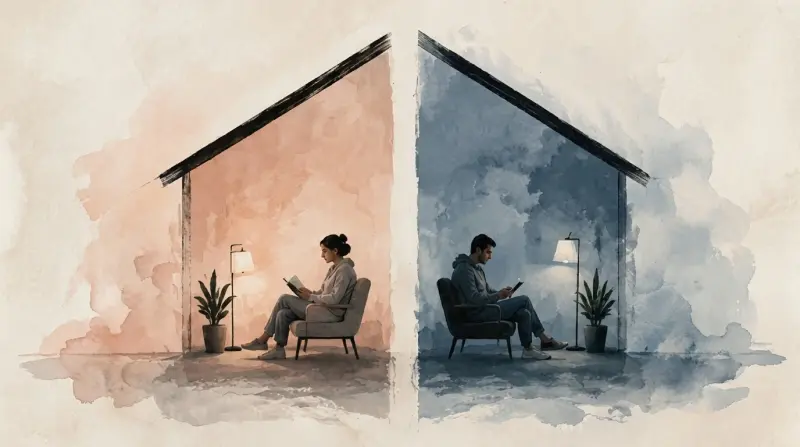
You may realize emotional divorce through small details no one else sees: a quick greeting in the hallway, then each person moves on as if the other is part of the furniture. Under one roof, responsibilities may still be shared and the children still present, yet your inner sense says you are living side by side, not together. The simple questions wear away: How was your day? What is hurting you? And only management, routine, and necessary words remain. This article may help you name what is happening without self-blame and without exposing your privacy. Recovery does not mean forcing yourself to stay or rushing into separation; it means understanding the pattern, protecting psychological safety, then choosing a safe path: repair, boundaries, or specialized support. This article is not legal or religious advice.
Safety note before any communication advice: if what you are living includes hitting, threats, coercion, surveillance, isolation from family, control over money or documents, repeated humiliation, blackmail, forced intimacy, using children as pressure, or fear of your partner's reaction, this is not just emotional divorce. The priority is protection, a safety plan, and trusted support, not trying to improve the dialogue alone.
How Does Emotional Divorce Show Up in Daily Details?
Emotional divorce is not an official decision, and it is not necessarily a loud fight. It is a slow withdrawal from closeness. Outward respect may remain, and practical life continues: expenses, schools, family visits, but feelings are postponed until they fade. Conversation becomes limited to essentials, and silence becomes comfortable because it avoids friction, then it turns into a wall.
Emotional divorce often means coldness, withdrawal, and reduced closeness while some degree of safety and choice remains. Abuse or coercive control appears when one partner uses fear, money, reputation, children, isolation, or threats to force the other into something they do not want. In the first case, boundaries and safe dialogue may help; in the second, advice to communicate more may be insufficient, even dangerous.
Sometimes it shows up as distance within the same room: each person on their own device, in their own corner, or on a different schedule. It can also show up as dryness in sharing: no response, no real interest, no listening. Over time, an exhausting communication cycle may form: one partner tries to open the conversation because they are hurt, while the other withdraws because they do not know how to handle the tension. Blaming only one side is rarely useful; what matters is understanding the pattern and setting a minimum of respect and safety.
If you are wondering, does this mean love is over? Not always. Sometimes what has ended is the ability to feel safe while talking, or the trust that conversation will not turn into blame, or simply the energy after years of work pressure and responsibilities.
Why Do We Stay Together Despite Feeling Like Strangers?
In a society that values family and stability, staying may be tied to sincere values: protecting the children, avoiding social consequences, or preserving a home built with effort. It is not fair to reduce it to one word: fear. Many people stay because they want to act wisely, even if the cost is heavy for them.
But staying alone does not create peace. When emotional closeness is absent, a kind of loneliness can appear inside marriage, along with chronic pressure that seeps into sleep, focus, and mood. Healing does not necessarily mean a big, immediate decision. Sometimes it begins by changing the form of coexisting: from silent coexisting that consumes you, to conscious coexisting that sets clear respect rules and protects the children from becoming an emotional middle between you.
Having children does not mean staying at any cost, and it does not mean bringing them into the details of conflict. A child does not need to be a messenger, judge, or pressure point between parents. Children need steady routines, reassuring language, and protection from yelling, humiliation, and threats. You can simply say: The conflict between adults is not your responsibility, and we will try to keep your day as safe as possible. If a child is exposed to violence, threats, or repeated fear at home, seek specialized help and appropriate protection.
Realistic Steps Toward Healing While You Are Still Under the Same Roof
The first step is easing harshness toward yourself. You do not need to convince yourself you are happy, and you do not need to hate your partner to justify your pain. Name the state as it is: numbness, distance, unfamiliarity. Naming gives you some control because you understand what you are dealing with.
Then try redefining the goal temporarily: instead of demanding warmth return all at once, ask for a minimum level of peace. Peace here means respectful speech, no breaking dignity, and reducing friction in front of the children. Simple agreements can help, such as:
Not opening sensitive discussions in front of the children or during extreme exhaustion
Allowing each person personal space without long explanations
Stating needs with I feel instead of You always
After that comes what looks like small bridges, but only if you are sure the conversation is safe and will not expose you to punishment, threats, or humiliation. You can try small, neutral communication: a short question, a specific thank-you, or a practical household agreement. If talking opens the door to fear or escalation, do not start a one-on-one confrontation; seek safe support first.
This shift may help calm some homes when both partners can respect boundaries: moving from who is at fault? to what do we need now to make the home safer? But it is not enough on its own if there is fear, control, or harm. If a conversation may lead to violence, threats, humiliation, stalking, financial control, or using the children as pressure, do not force a discussion alone. Seek trusted support and prioritize safety. And do not forget yourself in all of this: living in long coldness can quietly drain your energy. Care is not a luxury; it is fuel for continuing.
When Does Closeness Return, and When Is Peace Enough?
The question that exhausts many people is: do I try, or do I give up? It is better to ask a more precise question: is there mutual readiness for one small step? Readiness does not mean big promises; it means one sign: the other person accepts a short conversation without sarcasm, keeps a simple agreement, or admits the situation is tiring.
If you find that sign, give it time. Closeness after years does not return in a week. It returns when safe experiences repeat: a word said and respected, boundaries maintained, an apology not used as ammunition. And if you find no readiness at all, that does not mean your life is over. It means your focus needs to shift toward protecting yourself psychologically inside the home: clearer boundaries, wider social support, and calmer expectations so you are not drained every day.
In both cases, there is no shame in seeking a licensed specialist to help you organize your thoughts, understand what you can change and what you cannot, and build a plan that fits your circumstances without rushed decisions.
Finally...
Healing from emotional divorce is not a race to restore the past; it is an attempt to build a present that is less harsh and safer. This week, choose one realistic step: a small household agreement, a 10-minute conversation at a calm time if dialogue is safe, or a decision to stop discussions that harm either of you. After safety is secured, and if the situation is not urgent, you can download Tatmeen and book a session with a mental-health specialist to help you understand the pattern and build steps that fit you. Tatmeen is not a substitute for emergency or protection services, and it does not guarantee a specific outcome or decision.
Frequently Asked Questions
Does emotional divorce mean the relationship is completely over?
Not necessarily. Sometimes withdrawal is the result of accumulation, exhaustion, and a lack of safety in dialogue, not the absence of feelings. Focus on readiness for a small step: respectful speech and simple agreements. These indicators matter more than big words.
How do I live for the children without burning out?
Make the goal the peace of the home first: reduce tension in front of them, set clear boundaries for conflict, and keep a steady daily routine as much as possible. Get support from someone you trust, and give yourself personal time, even if brief, to release pressure instead of swallowing it.
Can affection return after years of coldness?
Sometimes it can, but it takes time and repeated safe experiences. Start with small bridges: a sincere question, a specific thank-you, and a respect agreement. If you meet ongoing resistance or sarcasm, start by protecting yourself and your boundaries before chasing closeness.
A writer and researcher specializing in psychiatry, she focuses on mental health and the human emotions we experience but cannot always find the words to name. She writes about us—about humanity and the human experience—and simplifies complex topics to offer content that helps us better understand ourselves and life, ultimately making us feel less alone.
Every Tatmeen article is reviewed by care providers licensed by the Saudi Commission for Health Specialties, so what you read is accurate and trustworthy.
This article builds understanding and does not replace a licensed care provider.
Need someone to talk to?
Tatmeen's licensed care providers are available around the clock, and the app's urgent consultation connects you with one within minutes.
Download Tatmeen to explore care providers and booking options.
Smart matchingFour quick questions suggest the right care provider
Urgent consultationTalk to an available care provider within minutes
Free psychological measuresMore than 20 tests to understand how you are doing
Scan to download
{"data":{"id":"09c99eb7-5c99-416d-96d1-986eef5da6f4","slug":"emotional-divorce-under-one-roof","arTitle":"التعافي من الطلاق العاطفي تحت سقف واحد","enTitle":"Recovering from Emotional Divorce Under One Roof","thumbnailAltText":"Watercolor illustration of a house divided by distance, with a couple sitting apart inside.","estimatedReadingTime":5,"likesCount":205,"writer":{"id":"3ab72b74-f26f-4337-9b47-3114b0f90de5","arBio":"كاتبة وباحثة متخصصة في مجال الطب النفسي، تهتم بموضوعات الصحة النفسية وبالمشاعر الإنسانية التي نختبرها ولا نجد دائمًا الكلمات لتسميتها. تكتب عنّا؛ عن الإنسان وتجربته، وتبسّط الموضوعات المعقّدة لتقدّم محتوى يساعدنا على فهم ذواتنا والحياة أكثر، ويجعلنا نشعر بأننا بوحدة أقل.","enBio":"A writer and researcher specializing in psychiatry, she focuses on mental health and the human emotions we experience but cannot always find the words to name. She writes about us—about humanity and the human experience—and simplifies complex topics to offer content that helps us better understand ourselves and life, ultimately making us feel less alone.","user":{"slug":"ayat-alnajar","arFullName":"آيات النجار","enFullName":"Ayat Al-Najjar","publicProfileImageUrl":"https://cdn.tatmeen.sa/public/profile-images/02384455-68fa-40b6-ad05-609fde65cafa/21b9a610dde5dfc6d37af110c23e9c7ab3946be080c281beb000debf4f7d31a6.webp","publicProfileImage96Url":"https://cdn.tatmeen.sa/public/profile-images/02384455-68fa-40b6-ad05-609fde65cafa/21b9a610dde5dfc6d37af110c23e9c7ab3946be080c281beb000debf4f7d31a6-w96.webp","publicProfileImage192Url":"https://cdn.tatmeen.sa/public/profile-images/02384455-68fa-40b6-ad05-609fde65cafa/21b9a610dde5dfc6d37af110c23e9c7ab3946be080c281beb000debf4f7d31a6-w192.webp"}},"arContent":"","enContent":"","productionDocument":{"headings":[{"id":"article-section-how-does-emotional-divorce-show-up-in-daily-details","text":"How Does Emotional Divorce Show Up in Daily Details?"},{"id":"article-section-why-do-we-stay-together-despite-feeling-like-strangers","text":"Why Do We Stay Together Despite Feeling Like Strangers?"},{"id":"article-section-realistic-steps-toward-healing-while-you-are-still-under-the-same-roof","text":"Realistic Steps Toward Healing While You Are Still Under the Same Roof"},{"id":"article-section-when-does-closeness-return-and-when-is-peace-enough","text":"When Does Closeness Return, and When Is Peace Enough?"},{"id":"article-section-finally","text":"Finally..."}],"faqs":[{"question":"Does emotional divorce mean the relationship is completely over?","answer":"<p><span style=\"color:#000000\">Not necessarily. Sometimes withdrawal is the result of accumulation, exhaustion, and a lack of safety in dialogue, not the absence of feelings. Focus on readiness for a small step: respectful speech and simple agreements. These indicators matter more than big words.</span></p>"},{"question":"How do I live for the children without burning out?","answer":"<p><span style=\"color:#000000\">Make the goal the peace of the home first: reduce tension in front of them, set clear boundaries for conflict, and keep a steady daily routine as much as possible. Get support from someone you trust, and give yourself personal time, even if brief, to release pressure instead of swallowing it.</span></p>"},{"question":"Can affection return after years of coldness?","answer":"<p><span style=\"color:#000000\">Sometimes it can, but it takes time and repeated safe experiences. Start with small bridges: a sincere question, a specific thank-you, and a respect agreement. If you meet ongoing resistance or sarcasm, start by protecting yourself and your boundaries before chasing closeness.</span></p>"}],"beforeSourcesHtml":"<p></p>","sources":[],"afterSourcesHtml":"","blocks":[{"type":"html","html":"<p><span style=\"color:#000000\">You may realize emotional divorce through small details no one else sees: a quick greeting in the hallway, then each person moves on as if the other is part of the furniture. Under one roof, responsibilities may still be shared and the children still present, yet your inner sense says you are living side by side, not together. The simple questions wear away: How was your day? What is hurting you? And only management, routine, and necessary words remain. This article may help you name what is happening without self-blame and without exposing your privacy. Recovery does not mean forcing yourself to stay or rushing into separation; it means understanding the pattern, protecting psychological safety, then choosing a safe path: repair, boundaries, or specialized support. This article is not legal or religious advice.</span></p><p><span style=\"color:#000000\">Safety note before any communication advice: if what you are living includes hitting, threats, coercion, surveillance, isolation from family, control over money or documents, repeated humiliation, blackmail, forced intimacy, using children as pressure, or fear of your partner's reaction, this is not just emotional divorce. The priority is protection, a safety plan, and trusted support, not trying to improve the dialogue alone.</span></p><h2 id=\"article-section-how-does-emotional-divorce-show-up-in-daily-details\" data-toc-heading tabindex=\"-1\"><span id=\"how-does-emotional-divorce-show-up-in-daily-details-1\" aria-hidden=\"true\"></span><span style=\"color:#000000\">How Does Emotional Divorce Show Up in Daily Details?</span></h2><p><span style=\"color:#000000\">Emotional divorce is not an official decision, and it is not necessarily a loud fight. It is a slow withdrawal from closeness. Outward respect may remain, and practical life continues: expenses, schools, family visits, but feelings are postponed until they fade. Conversation becomes limited to essentials, and silence becomes comfortable because it avoids friction, then it turns into a wall.</span></p><p><span style=\"color:#000000\">Emotional divorce often means coldness, withdrawal, and reduced closeness while some degree of safety and choice remains. Abuse or coercive control appears when one partner uses fear, money, reputation, children, isolation, or threats to force the other into something they do not want. In the first case, boundaries and safe dialogue may help; in the second, advice to communicate more may be insufficient, even dangerous.</span></p><p><span style=\"color:#000000\">Sometimes it shows up as distance within the same room: each person on their own device, in their own corner, or on a different schedule. It can also show up as dryness in sharing: no response, no real interest, no listening. Over time, an exhausting communication cycle may form: one partner tries to open the conversation because they are hurt, while the other withdraws because they do not know how to handle the tension. Blaming only one side is rarely useful; what matters is understanding the pattern and setting a minimum of respect and safety.</span></p><p><span style=\"color:#000000\">If you are wondering, does this mean love is over? Not always. Sometimes what has ended is the ability to feel safe while talking, or the trust that conversation will not turn into blame, or simply the energy after years of work pressure and responsibilities.</span></p><h2 id=\"article-section-why-do-we-stay-together-despite-feeling-like-strangers\" data-toc-heading tabindex=\"-1\"><span id=\"why-do-we-stay-together-despite-feeling-like-strangers-2\" aria-hidden=\"true\"></span><span style=\"color:#000000\">Why Do We Stay Together Despite Feeling Like Strangers?</span></h2><p><span style=\"color:#000000\">In a society that values family and stability, staying may be tied to sincere values: protecting the children, avoiding social consequences, or preserving a home built with effort. It is not fair to reduce it to one word: fear. Many people stay because they want to act wisely, even if the cost is heavy for them.</span></p><p><span style=\"color:#000000\">But staying alone does not create peace. When emotional closeness is absent, a kind of loneliness can appear inside marriage, along with chronic pressure that seeps into sleep, focus, and mood. Healing does not necessarily mean a big, immediate decision. Sometimes it begins by changing the form of coexisting: from silent coexisting that consumes you, to conscious coexisting that sets clear respect rules and protects the children from becoming an emotional middle between you.</span></p><p><span style=\"color:#000000\">Having children does not mean staying at any cost, and it does not mean bringing them into the details of conflict. A child does not need to be a messenger, judge, or pressure point between parents. Children need steady routines, reassuring language, and protection from yelling, humiliation, and threats. You can simply say: The conflict between adults is not your responsibility, and we will try to keep your day as safe as possible. If a child is exposed to violence, threats, or repeated fear at home, seek specialized help and appropriate protection.</span></p><h2 id=\"article-section-realistic-steps-toward-healing-while-you-are-still-under-the-same-roof\" data-toc-heading tabindex=\"-1\"><span id=\"realistic-steps-toward-healing-while-you-are-still-under-the-same-roof-3\" aria-hidden=\"true\"></span><span style=\"color:#000000\">Realistic Steps Toward Healing While You Are Still Under the Same Roof</span></h2><p><span style=\"color:#000000\">The first step is easing harshness toward yourself. You do not need to convince yourself you are happy, and you do not need to hate your partner to justify your pain. Name the state as it is: numbness, distance, unfamiliarity. Naming gives you some control because you understand what you are dealing with.</span></p><p><span style=\"color:#000000\">Then try redefining the goal temporarily: instead of demanding warmth return all at once, ask for a minimum level of peace. Peace here means respectful speech, no breaking dignity, and reducing friction in front of the children. Simple agreements can help, such as:</span></p><p><span style=\"color:#000000\">Not opening sensitive discussions in front of the children or during extreme exhaustion</span></p><p><span style=\"color:#000000\">Allowing each person personal space without long explanations</span></p><p><span style=\"color:#000000\">Stating needs with I feel instead of You always</span></p><p><span style=\"color:#000000\">After that comes what looks like small bridges, but only if you are sure the conversation is safe and will not expose you to punishment, threats, or humiliation. You can try small, neutral communication: a short question, a specific thank-you, or a practical household agreement. If talking opens the door to fear or escalation, do not start a one-on-one confrontation; seek safe support first.</span></p><p><span style=\"color:#000000\">This shift may help calm some homes when both partners can respect boundaries: moving from who is at fault? to what do we need now to make the home safer? But it is not enough on its own if there is fear, control, or harm. If a conversation may lead to violence, threats, humiliation, stalking, financial control, or using the children as pressure, do not force a discussion alone. Seek trusted support and prioritize safety. And do not forget yourself in all of this: living in long coldness can quietly drain your energy. Care is not a luxury; it is fuel for continuing.</span></p><h2 id=\"article-section-when-does-closeness-return-and-when-is-peace-enough\" data-toc-heading tabindex=\"-1\"><span id=\"when-does-closeness-return-and-when-is-peace-enough-4\" aria-hidden=\"true\"></span><span style=\"color:#000000\">When Does Closeness Return, and When Is Peace Enough?</span></h2><p><span style=\"color:#000000\">The question that exhausts many people is: do I try, or do I give up? It is better to ask a more precise question: is there mutual readiness for one small step? Readiness does not mean big promises; it means one sign: the other person accepts a short conversation without sarcasm, keeps a simple agreement, or admits the situation is tiring.</span></p><p><span style=\"color:#000000\">If you find that sign, give it time. Closeness after years does not return in a week. It returns when safe experiences repeat: a word said and respected, boundaries maintained, an apology not used as ammunition. And if you find no readiness at all, that does not mean your life is over. It means your focus needs to shift toward protecting yourself psychologically inside the home: clearer boundaries, wider social support, and calmer expectations so you are not drained every day.</span></p><p><span style=\"color:#000000\">In both cases, there is no shame in seeking a licensed specialist to help you organize your thoughts, understand what you can change and what you cannot, and build a plan that fits your circumstances without rushed decisions.</span></p><h2 id=\"article-section-finally\" data-toc-heading tabindex=\"-1\"><span id=\"finally-5\" aria-hidden=\"true\"></span><span style=\"color:#000000\">Finally...</span></h2><p><span style=\"color:#000000\">Healing from emotional divorce is not a race to restore the past; it is an attempt to build a present that is less harsh and safer. This week, choose one realistic step: a small household agreement, a 10-minute conversation at a calm time if dialogue is safe, or a decision to stop discussions that harm either of you. After safety is secured, and if the situation is not urgent, you can </span><a href=\"https://tatmeen.sa/download/\"><span style=\"color:#1155cc\"><u>download Tatmeen and book a session</u></span></a><span style=\"color:#000000\"> with a mental-health specialist to help you understand the pattern and build steps that fit you. Tatmeen is not a substitute for emergency or protection services, and it does not guarantee a specific outcome or decision.</span></p>"}],"inlineCtaSignatures":[],"_experienceAliases":{"v":1,"fields":["html","bodyHtml"],"faqs":[0,1,2]}},"createdAt":"2026-06-05T21:00:00.000Z","updatedAt":"2026-06-12T16:04:05.506Z","disorderGroups":[{"id":"01b1a587-3584-435b-971a-c40ffce29802","slug":"family-and-marital-relations","arName":"العلاقات الأسرية والزوجية","enName":"Family & Marital Relations"},{"id":"d807ea69-44d4-4e81-bee4-0a059fd36645","slug":"self-development","arName":"تنمية الذات","enName":"Self-Development"}],"reviewer":{"arFullName":"فريق تطمين","enFullName":"Tatmeen team","slug":"tatmeen-team","kind":"organization"},"productionArticle":true,"promotionAllowed":true,"preparedCover":{"src":"https://cdn.tatmeen.sa/public/article-lcp/article-lcp-v2/sha256-41acd7e3c58c53aff552a50514850ed7ebfe94435caf1eeaea3e4fef6a1962e5/800-dcde4cf479580bde2d523b38caa7c878d17c970d67bd38c7772fe48bd2ed5218.avif","fallback":"https://cdn.tatmeen.sa/public/article-lcp/article-lcp-v2/sha256-41acd7e3c58c53aff552a50514850ed7ebfe94435caf1eeaea3e4fef6a1962e5/800-bc41c60611eafc84a0687dcc400751b5396fcc64cc38e55d290bf4e40e39c817.webp","directUrl":"https://cdn.tatmeen.sa/blog-cover/Tatmeen-1780760991063.webp","isGolden":true,"avifSrcset":"https://cdn.tatmeen.sa/public/article-lcp/article-lcp-v2/sha256-41acd7e3c58c53aff552a50514850ed7ebfe94435caf1eeaea3e4fef6a1962e5/400-6d36a1f14449f5f874ca9caa781417cebfb1c95010b3ba2768492d04ba12b875.avif 400w, https://cdn.tatmeen.sa/public/article-lcp/article-lcp-v2/sha256-41acd7e3c58c53aff552a50514850ed7ebfe94435caf1eeaea3e4fef6a1962e5/640-f238550879b2c9c67237ab30c21779b44d7dc6c8cd519da0e2c08cf4ed9ac328.avif 640w, https://cdn.tatmeen.sa/public/article-lcp/article-lcp-v2/sha256-41acd7e3c58c53aff552a50514850ed7ebfe94435caf1eeaea3e4fef6a1962e5/800-dcde4cf479580bde2d523b38caa7c878d17c970d67bd38c7772fe48bd2ed5218.avif 800w, https://cdn.tatmeen.sa/public/article-lcp/article-lcp-v2/sha256-41acd7e3c58c53aff552a50514850ed7ebfe94435caf1eeaea3e4fef6a1962e5/1200-6ce82973af5226ef6cf4fdd0d854ec100cb3c82d7a2e335a8d919d16d211584a.avif 1200w","webpSrcset":"https://cdn.tatmeen.sa/public/article-lcp/article-lcp-v2/sha256-41acd7e3c58c53aff552a50514850ed7ebfe94435caf1eeaea3e4fef6a1962e5/400-ec164ccf2886384f58c48c6f998cc713d98f9521466fcc1840a15d38786a34cc.webp 400w, https://cdn.tatmeen.sa/public/article-lcp/article-lcp-v2/sha256-41acd7e3c58c53aff552a50514850ed7ebfe94435caf1eeaea3e4fef6a1962e5/640-d39606f1ecca12208c31e1742d3c4b5531cbb8bb6aa5e92065a9b7273cbc7ea7.webp 640w, https://cdn.tatmeen.sa/public/article-lcp/article-lcp-v2/sha256-41acd7e3c58c53aff552a50514850ed7ebfe94435caf1eeaea3e4fef6a1962e5/800-bc41c60611eafc84a0687dcc400751b5396fcc64cc38e55d290bf4e40e39c817.webp 800w, https://cdn.tatmeen.sa/public/article-lcp/article-lcp-v2/sha256-41acd7e3c58c53aff552a50514850ed7ebfe94435caf1eeaea3e4fef6a1962e5/1200-3dfaccf258177d0605a40026cb3fe1e66eb6de2b5a136045e9b165f5d17e2cb7.webp 1200w","phoneAvifSrcset":"https://cdn.tatmeen.sa/public/article-lcp/article-lcp-v2/sha256-41acd7e3c58c53aff552a50514850ed7ebfe94435caf1eeaea3e4fef6a1962e5/400-6d36a1f14449f5f874ca9caa781417cebfb1c95010b3ba2768492d04ba12b875.avif 400w, https://cdn.tatmeen.sa/public/article-lcp/article-lcp-v2/sha256-41acd7e3c58c53aff552a50514850ed7ebfe94435caf1eeaea3e4fef6a1962e5/640-f238550879b2c9c67237ab30c21779b44d7dc6c8cd519da0e2c08cf4ed9ac328.avif 640w, https://cdn.tatmeen.sa/public/article-lcp/article-lcp-v2/sha256-41acd7e3c58c53aff552a50514850ed7ebfe94435caf1eeaea3e4fef6a1962e5/800-dcde4cf479580bde2d523b38caa7c878d17c970d67bd38c7772fe48bd2ed5218.avif 800w","phoneWebpSrcset":"https://cdn.tatmeen.sa/public/article-lcp/article-lcp-v2/sha256-41acd7e3c58c53aff552a50514850ed7ebfe94435caf1eeaea3e4fef6a1962e5/400-ec164ccf2886384f58c48c6f998cc713d98f9521466fcc1840a15d38786a34cc.webp 400w, https://cdn.tatmeen.sa/public/article-lcp/article-lcp-v2/sha256-41acd7e3c58c53aff552a50514850ed7ebfe94435caf1eeaea3e4fef6a1962e5/640-d39606f1ecca12208c31e1742d3c4b5531cbb8bb6aa5e92065a9b7273cbc7ea7.webp 640w, https://cdn.tatmeen.sa/public/article-lcp/article-lcp-v2/sha256-41acd7e3c58c53aff552a50514850ed7ebfe94435caf1eeaea3e4fef6a1962e5/800-bc41c60611eafc84a0687dcc400751b5396fcc64cc38e55d290bf4e40e39c817.webp 800w","width":800,"height":447},"previewTaxonomy":{"groups":[{"id":"01b1a587-3584-435b-971a-c40ffce29802","slug":"family-and-marital-relations","arName":"العلاقات الأسرية والزوجية","enName":"Family & Marital Relations"},{"id":"d807ea69-44d4-4e81-bee4-0a059fd36645","slug":"self-development","arName":"تنمية الذات","enName":"Self-Development"}],"topics":[{"id":"f7424e7c-5097-4ff5-a1ad-b378d36bcbb6","slug":"couple-communication","arName":"التواصل بين الشريكين","enName":"Couple Communication","groupSlug":"family-and-marital-relations","href":"/blog/category/family-and-marital-relations/couple-communication/"},{"id":"785d9b22-1cd8-4f1a-a300-5170c1348b2f","slug":"setting-boundaries","arName":"وضع حدود شخصية","enName":"Setting Boundaries","groupSlug":"self-development","href":"/blog/category/self-development/setting-boundaries/"},{"id":"26f6a16d-155f-4fec-bded-c8ce2c8f9305","slug":"relationship-rut","arName":"فتور العلاقة","enName":"Relationship Rut","groupSlug":"family-and-marital-relations","href":"/blog/category/family-and-marital-relations/relationship-rut/"}],"tags":[{"id":"8666ef73-6ba1-47b4-9a44-767b6a474092","slug":"marriage-couples","arName":"الزواج والعلاقات الزوجية","enName":"Marriage & Couples"},{"id":"0917d35f-62dd-4fb6-909d-a8a95e98938c","slug":"infidelity-betrayal-divorce","arName":"الخيانة والانفصال","enName":"Infidelity Betrayal & Separation"},{"id":"d58e6187-021b-44a5-882c-245bccd77611","slug":"self-help-howto","arName":"مساعدة ذاتية / خطوات عملية","enName":"Self-Help / How-To"}]},"previewProviderRecommendations":[{"id":"025d770d-f6d4-405b-be1c-d45dde63fbf7","slug":"akila-alomran-7545","arFullName":"عقيله العمران","enFullName":"Akila Alomran","publicProfileImageUrl":"https://cdn.tatmeen.sa/public/profile-images/025d770d-f6d4-405b-be1c-d45dde63fbf7/44a990b9294f02c9810c69a68b8913a6afac0eb30d1b7494155f31b6dde9378b.webp","publicProfileImage96Url":"https://cdn.tatmeen.sa/public/profile-images/025d770d-f6d4-405b-be1c-d45dde63fbf7/44a990b9294f02c9810c69a68b8913a6afac0eb30d1b7494155f31b6dde9378b-w96.webp","publicProfileImage192Url":"https://cdn.tatmeen.sa/public/profile-images/025d770d-f6d4-405b-be1c-d45dde63fbf7/44a990b9294f02c9810c69a68b8913a6afac0eb30d1b7494155f31b6dde9378b-w192.webp","specialization":{"arName":"أخصائي نفسي","enName":"Psychologist"},"profileImageUrl":"https://cdn.tatmeen.sa/public/profile-images/025d770d-f6d4-405b-be1c-d45dde63fbf7/44a990b9294f02c9810c69a68b8913a6afac0eb30d1b7494155f31b6dde9378b-w192.webp","experienceYears":3,"consultantInfo":{"averageRating":{"average":5},"specialization":{"arGeneralName":"أخصائي نفسي","enGeneralName":"Psychologist"}}},{"id":"94765496-dbdf-4631-a01b-7df5f788668d","slug":"abdullrahman-alhamoudi-3045","arFullName":"عبدالرحمن الحمودي","enFullName":"Abdulrahman Alhamoudi","publicProfileImageUrl":"https://cdn.tatmeen.sa/public/profile-images/94765496-dbdf-4631-a01b-7df5f788668d/2d49f6b6493c564afb6f50b6c3634231dff3a5cf8353acfab393d1b2a88037d1.webp","publicProfileImage96Url":"https://cdn.tatmeen.sa/public/profile-images/94765496-dbdf-4631-a01b-7df5f788668d/2d49f6b6493c564afb6f50b6c3634231dff3a5cf8353acfab393d1b2a88037d1-w96.webp","publicProfileImage192Url":"https://cdn.tatmeen.sa/public/profile-images/94765496-dbdf-4631-a01b-7df5f788668d/2d49f6b6493c564afb6f50b6c3634231dff3a5cf8353acfab393d1b2a88037d1-w192.webp","specialization":{"arName":"أخصائي نفسي","enName":"Psychologist"},"profileImageUrl":"https://cdn.tatmeen.sa/public/profile-images/94765496-dbdf-4631-a01b-7df5f788668d/2d49f6b6493c564afb6f50b6c3634231dff3a5cf8353acfab393d1b2a88037d1-w192.webp","experienceYears":9,"consultantInfo":{"averageRating":{"average":5},"specialization":{"arGeneralName":"أخصائي نفسي","enGeneralName":"Psychologist"}}},{"id":"6f037535-1dca-4b50-a8b2-5974b7323286","slug":"salah-althobaiti-9053","arFullName":"صلاح الثبيتي","enFullName":"Salah Althobaiti","publicProfileImageUrl":"https://cdn.tatmeen.sa/public/profile-images/6f037535-1dca-4b50-a8b2-5974b7323286/35b6bd7fad9b1e004c1835803eb9c1b56dcacd380685ec8bff141f0fb888005c.webp","publicProfileImage96Url":"https://cdn.tatmeen.sa/public/profile-images/6f037535-1dca-4b50-a8b2-5974b7323286/35b6bd7fad9b1e004c1835803eb9c1b56dcacd380685ec8bff141f0fb888005c-w96.webp","publicProfileImage192Url":"https://cdn.tatmeen.sa/public/profile-images/6f037535-1dca-4b50-a8b2-5974b7323286/35b6bd7fad9b1e004c1835803eb9c1b56dcacd380685ec8bff141f0fb888005c-w192.webp","specialization":{"arName":"أخصائي نفسي","enName":"Psychologist"},"profileImageUrl":"https://cdn.tatmeen.sa/public/profile-images/6f037535-1dca-4b50-a8b2-5974b7323286/35b6bd7fad9b1e004c1835803eb9c1b56dcacd380685ec8bff141f0fb888005c-w192.webp","experienceYears":6,"consultantInfo":{"averageRating":{"average":4.98876404494382},"specialization":{"arGeneralName":"أخصائي نفسي","enGeneralName":"Psychologist"}}}],"previewCareProviders":[{"id":"09364052-c2a9-4c52-9717-7ce2093b8d0a","slug":"kholoud-alharbi-5221","arFullName":"خلود الحربي","enFullName":"Kholoud Alharbi","publicProfileImageUrl":"https://cdn.tatmeen.sa/public/profile-images/09364052-c2a9-4c52-9717-7ce2093b8d0a/4a0aeb81619e351b77f4323e3605a0a00acc7ca3c82ee7cc5ca2c9e8ef716049.webp","publicProfileImage96Url":"https://cdn.tatmeen.sa/public/profile-images/09364052-c2a9-4c52-9717-7ce2093b8d0a/4a0aeb81619e351b77f4323e3605a0a00acc7ca3c82ee7cc5ca2c9e8ef716049-w96.webp","publicProfileImage192Url":"https://cdn.tatmeen.sa/public/profile-images/09364052-c2a9-4c52-9717-7ce2093b8d0a/4a0aeb81619e351b77f4323e3605a0a00acc7ca3c82ee7cc5ca2c9e8ef716049-w192.webp","gender":"FEMALE","specialization":{"arName":"أخصائي نفسي","enName":"Psychologist"}},{"id":"6f037535-1dca-4b50-a8b2-5974b7323286","slug":"salah-althobaiti-9053","arFullName":"صلاح الثبيتي","enFullName":"Salah Althobaiti","publicProfileImageUrl":"https://cdn.tatmeen.sa/public/profile-images/6f037535-1dca-4b50-a8b2-5974b7323286/35b6bd7fad9b1e004c1835803eb9c1b56dcacd380685ec8bff141f0fb888005c.webp","publicProfileImage96Url":"https://cdn.tatmeen.sa/public/profile-images/6f037535-1dca-4b50-a8b2-5974b7323286/35b6bd7fad9b1e004c1835803eb9c1b56dcacd380685ec8bff141f0fb888005c-w96.webp","publicProfileImage192Url":"https://cdn.tatmeen.sa/public/profile-images/6f037535-1dca-4b50-a8b2-5974b7323286/35b6bd7fad9b1e004c1835803eb9c1b56dcacd380685ec8bff141f0fb888005c-w192.webp","gender":"MALE","specialization":{"arName":"أخصائي نفسي","enName":"Psychologist"}},{"id":"3cc806e8-616b-4884-9f21-a75b378580a2","slug":"aisha-al-hashim-8667","arFullName":"عائشة ال هاشم","enFullName":"Aisha Al Hashim","publicProfileImageUrl":"https://cdn.tatmeen.sa/public/profile-images/3cc806e8-616b-4884-9f21-a75b378580a2/27f523d03be4dcfa1f6a79f70c1773887434e698990d214cd990caec56a44798.webp","publicProfileImage96Url":"https://cdn.tatmeen.sa/public/profile-images/3cc806e8-616b-4884-9f21-a75b378580a2/27f523d03be4dcfa1f6a79f70c1773887434e698990d214cd990caec56a44798-w96.webp","publicProfileImage192Url":"https://cdn.tatmeen.sa/public/profile-images/3cc806e8-616b-4884-9f21-a75b378580a2/27f523d03be4dcfa1f6a79f70c1773887434e698990d214cd990caec56a44798-w192.webp","gender":"FEMALE","specialization":{"arName":"أخصائي نفسي","enName":"Psychologist"}},{"id":"db2ce1a0-9325-4471-b7ce-eb2e811c30a3","slug":"amer-qutub-2441","arFullName":"عامر قطب","enFullName":"Amer Qutub","publicProfileImageUrl":"https://cdn.tatmeen.sa/public/profile-images/db2ce1a0-9325-4471-b7ce-eb2e811c30a3/80580f99bfd7fe2b2a9cf8eed73ab532f5086d1efe053b0aa57358c1ce004261.webp","publicProfileImage96Url":"https://cdn.tatmeen.sa/public/profile-images/db2ce1a0-9325-4471-b7ce-eb2e811c30a3/80580f99bfd7fe2b2a9cf8eed73ab532f5086d1efe053b0aa57358c1ce004261-w96.webp","publicProfileImage192Url":"https://cdn.tatmeen.sa/public/profile-images/db2ce1a0-9325-4471-b7ce-eb2e811c30a3/80580f99bfd7fe2b2a9cf8eed73ab532f5086d1efe053b0aa57358c1ce004261-w192.webp","gender":"MALE","specialization":{"arName":"أخصائي نفسي","enName":"Psychologist"}},{"id":"94765496-dbdf-4631-a01b-7df5f788668d","slug":"abdullrahman-alhamoudi-3045","arFullName":"عبدالرحمن الحمودي","enFullName":"Abdulrahman Alhamoudi","publicProfileImageUrl":"https://cdn.tatmeen.sa/public/profile-images/94765496-dbdf-4631-a01b-7df5f788668d/2d49f6b6493c564afb6f50b6c3634231dff3a5cf8353acfab393d1b2a88037d1.webp","publicProfileImage96Url":"https://cdn.tatmeen.sa/public/profile-images/94765496-dbdf-4631-a01b-7df5f788668d/2d49f6b6493c564afb6f50b6c3634231dff3a5cf8353acfab393d1b2a88037d1-w96.webp","publicProfileImage192Url":"https://cdn.tatmeen.sa/public/profile-images/94765496-dbdf-4631-a01b-7df5f788668d/2d49f6b6493c564afb6f50b6c3634231dff3a5cf8353acfab393d1b2a88037d1-w192.webp","gender":"MALE","specialization":{"arName":"أخصائي نفسي","enName":"Psychologist"}},{"id":"618dba89-5b70-4b46-8304-741b7ac8ecd3","slug":"abdullah-mari-1311","arFullName":"عبدالله مرعي","enFullName":"Abdullah Mari","publicProfileImageUrl":"https://cdn.tatmeen.sa/public/profile-images/618dba89-5b70-4b46-8304-741b7ac8ecd3/6b4a3bfb59f8a304ca79083b32859b46baad2e1d692974a47c02c1f66bd11129.webp","publicProfileImage96Url":"https://cdn.tatmeen.sa/public/profile-images/618dba89-5b70-4b46-8304-741b7ac8ecd3/6b4a3bfb59f8a304ca79083b32859b46baad2e1d692974a47c02c1f66bd11129-w96.webp","publicProfileImage192Url":"https://cdn.tatmeen.sa/public/profile-images/618dba89-5b70-4b46-8304-741b7ac8ecd3/6b4a3bfb59f8a304ca79083b32859b46baad2e1d692974a47c02c1f66bd11129-w192.webp","gender":"MALE","specialization":{"arName":"أخصائي نفسي","enName":"Psychologist"}},{"id":"3b50a5d5-e795-407f-8676-fd7f0e1bb7a0","slug":"abdulaziz-bin-hudayan-4940","arFullName":"عبدالعزيز بن هديان","enFullName":"Abdulaziz Bin Hudayan","publicProfileImageUrl":"https://cdn.tatmeen.sa/public/profile-images/3b50a5d5-e795-407f-8676-fd7f0e1bb7a0/710ff0fe1fb00cdb5042092e27b7910b480a439b02251ecded62d7758eefce95.webp","publicProfileImage96Url":"https://cdn.tatmeen.sa/public/profile-images/3b50a5d5-e795-407f-8676-fd7f0e1bb7a0/710ff0fe1fb00cdb5042092e27b7910b480a439b02251ecded62d7758eefce95-w96.webp","publicProfileImage192Url":"https://cdn.tatmeen.sa/public/profile-images/3b50a5d5-e795-407f-8676-fd7f0e1bb7a0/710ff0fe1fb00cdb5042092e27b7910b480a439b02251ecded62d7758eefce95-w192.webp","gender":"MALE","specialization":{"arName":"أخصائي نفسي","enName":"Psychologist"}}],"previewDownload":{"href":"/download","title":{"ar":"خطوة واحدة لأجلك، ابدأ الآن","en":"One step for you, start now"},"description":{"ar":"حمّل تطبيق تطمين لاستكشاف مقدمي الرعاية وخيارات الحجز.","en":"Download Tatmeen to explore care providers and booking options."},"posterSrc":"/images/home/cta-ar-new-1.webp","videoSrc":"/images/home/cta-ar-new-1.mp4","videoPosterSrc":"/images/home/cta-ar-new-1.webp","videoPosterEnSrc":"/images/home/cta-en-new-1.webp","videoType":"video/mp4","appStoreHref":"https://apps.apple.com/us/app/tatmeen-%D8%AA%D8%B7%D9%85%D9%8A%D9%86/id6473836983","googlePlayHref":"https://play.google.com/store/apps/details?id=com.TatmeenApp.user&hl=en"},"previewRelatedArticles":[{"id":"52af4281-3ab3-4bd0-b081-0764a54a76d0","slug":"Can-love-last","route":"/blog/Can-love-last/","title":{"ar":"هل يستطيع الحب أن يستمر؟","en":"Can Love Last?"},"image":"https://cdn.tatmeen.sa/public/article-lcp/article-lcp-v2/sha256-3c06b8d73e5ed8cbb34447d3639e25eec0228e70aa653f9fa8766a3799fadf67/800-a14e43c22230c4bf0368ec8d0bc1f15f772e179dbd47608922839f83787dad7a.webp","directImageFallback":"https://cdn.tatmeen.sa/blog-cover/Tatmeen-1783873802637.webp","arThumbnailAltText":"Missing puzzle piece reveals red center beneath white pieces symbolizing love’s gap","thumbnailAltText":"Missing puzzle piece reveals red center beneath white pieces symbolizing love’s gap","topic":{"label":{"ar":"العلاقات الأسرية والزوجية","en":"Family & Marital Relations"}},"readingTimeMinutes":5},{"id":"55eb8038-0eb1-4d15-afa6-ecf4e103b04b","slug":"Improving-marital-relationship-through-exercise","route":"/blog/Improving-marital-relationship-through-exercise/","title":{"ar":"كيف تحسن ممارسة الرياضة العلاقة الزوجية؟","en":"How Can Exercise Improve the Marital Relationship?"},"image":"https://cdn.tatmeen.sa/public/article-lcp/article-lcp-v2/sha256-5240f2b15af945b40b6c5624f8f136e5d3cb9bfad0c3a13c2a276715ff0a224b/800-146b8425469f0c0fc8f77447a647c557bd7e0e4dbb72fdb11eb3b6649d3988fa.webp","directImageFallback":"https://cdn.tatmeen.sa/blog-cover/Tatmeen-1782572202398.webp","arThumbnailAltText":"a couple jogging together at sunset along a coastal path.","thumbnailAltText":"a couple jogging together at sunset along a coastal path.","topic":{"label":{"ar":"العلاقات الأسرية والزوجية","en":"Family & Marital Relations"}},"readingTimeMinutes":5},{"id":"11c6e1c9-26a6-43c0-8ee7-00bd83960447","slug":"social-exhaustion-events-recharge","route":"/blog/social-exhaustion-events-recharge/","title":{"ar":" الإرهاق الاجتماعي: لماذا تتعب من المناسبات وكيف تشحن طاقتك","en":" Social Exhaustion: Why Events Drain You and How to Recharge"},"image":"https://cdn.tatmeen.sa/public/article-lcp/article-lcp-v2/sha256-de96123a92b703a4acfda902ee0eedf68fc80de8a30d705d9e000d382a9af9be/800-57059325ea6d787dc99400da17df79ec2a2708c8ecc6a4f9ba9946519880bd85.webp","directImageFallback":"https://cdn.tatmeen.sa/blog-cover/Tatmeen-1781545984113.webp","arThumbnailAltText":"Overwhelmed person surrounded by chatter, with tangled thoughts symbolizing social exhaustion.","thumbnailAltText":"Overwhelmed person surrounded by chatter, with tangled thoughts symbolizing social exhaustion.","topic":{"label":{"ar":"تحديات الحياة والضغوط","en":"Life Challenges & Stress"}},"readingTimeMinutes":5},{"id":"aa816dd1-a504-4bf9-965d-0068aaa294fb","slug":"Healthy-communication-with-your-life-partner","route":"/blog/Healthy-communication-with-your-life-partner/","title":{"ar":"كيف يكون الحوار الصحي مع شريك الحياة؟","en":"What Does Healthy Dialogue with a Life Partner Look Like?"},"image":"https://cdn.tatmeen.sa/public/article-lcp/article-lcp-v2/sha256-651f5f3d6f00134b22dd2ee736a084898371b1ae05d87072900a84ee405da98e/800-8a6d73c7b693b6cd815b00782e92f9ce76dfa24cf940d4a1b91954763c7408ea.webp","directImageFallback":"https://cdn.tatmeen.sa/blog-cover/Tatmeen-1782927558960.webp","arThumbnailAltText":"Couple sitting cross-legged, smiling and talking while holding mugs in a calm, minimal setting","thumbnailAltText":"Couple sitting cross-legged, smiling and talking while holding mugs in a calm, minimal setting","topic":{"label":{"ar":"العلاقات الأسرية والزوجية","en":"Family & Marital Relations"}},"readingTimeMinutes":7}],"previewRelatedReadStates":{}},"locale":"en","device":"desktop","path":"/en/blog/emotional-divorce-under-one-roof/","readingControls":false,"config":{"public":{"BUCKET_URL":"https://cdn.tatmeen.sa/","APP_BASE_URL":"https://tatmeen.sa","intercomAppId":"ppcnu9e3"}}}