It is nearly time to leave, and your child says “No” each time you ask them to put on their shoes. There may be no time for a long conversation, but calling the instruction again from across the room will not fix what is getting in the way. Move closer and start with one step: “Your shoes are here. Will you put them on, or would you like help?” If they hurt or the child cannot get a foot inside, address that first.
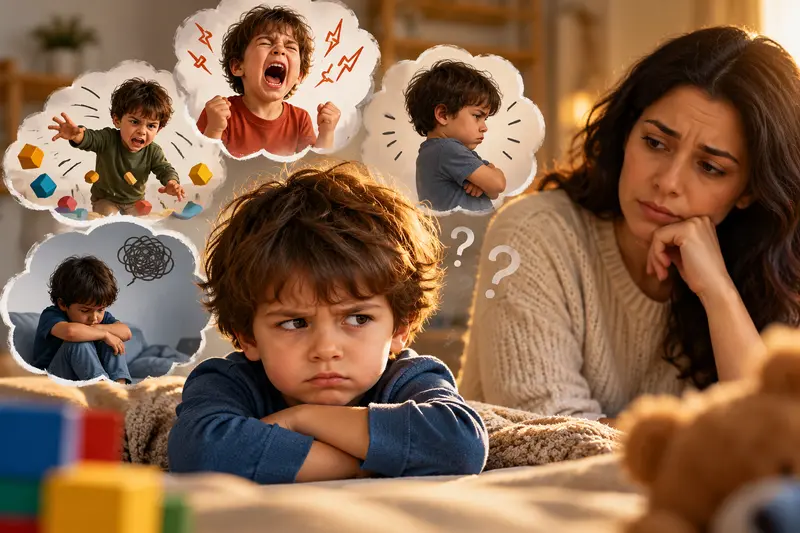
Help your child begin a reasonable task and offer a genuine choice where you can. Calling them stubborn or spoiled does not tell you whether they want to finish playing, misunderstood the request or need assistance. Hearing an objection does not require agreeing to everything they want.
One instruction they can carry out
Instead of “Get ready,” tell a younger child, “Put the book in your bag,” pointing to its place if needed. Make sure they hear you without forcing eye contact, and give them time to begin. Avoid adding three more steps while they are still working on the first.
CDC guidance for young children recommends clear, manageable directions and limited choices1. It distinguishes inability from disobedience. A child may need a demonstration, picture or your help getting started. If you say, “We'll put these away together,” be ready to do part of it.
Reconsidering a request does not mean abandoning every limit. A tired child might collect crayons rather than tidy an entire room. If belongings have no obvious home, agree on a place they can reach. The request becomes clearer for both of you.
Offer a choice within the limit
Play may need to end while there is still room to choose how to move on. Explain what will happen, then give two options you can accept:
Situation
A practical example
Getting dressed
“You need a shirt. The green one or the white one?”
Leaving a play space
“We'll leave after this round. Will you carry the ball or the small bag?”
Putting drawing materials away
“These go back in their places. Paper first or crayons first?”
Packing a school-age child's bag
“The bag needs to be ready before bed. Let's agree on a time this evening and where you'll leave it.”
If there is no time for a final turn, do not promise one. If refusal is not an available option in this situation, avoid asking as though it is. A choice you immediately cancel creates another disagreement.
The child may refuse both options. With a younger child, choose one and help them begin without threats or harmful force: “I'll bring the green shirt, and we'll start together.” With an older child, return to the objection at a calmer time. A rushed departure cannot resolve everything that bothers them, but you can still make time to listen later.
In immediate danger, such as approaching a road, protect the child and state what they need to do. Do not delay protection to offer choices.
Household responsibility begins with learning
Adults may do everything for a child, then suddenly expect them to tidy a room alone. Choose a small contribution they can learn. CDC suggests that young children can help put toys or laundry in a basket2. That is different from independently tidying a whole room.
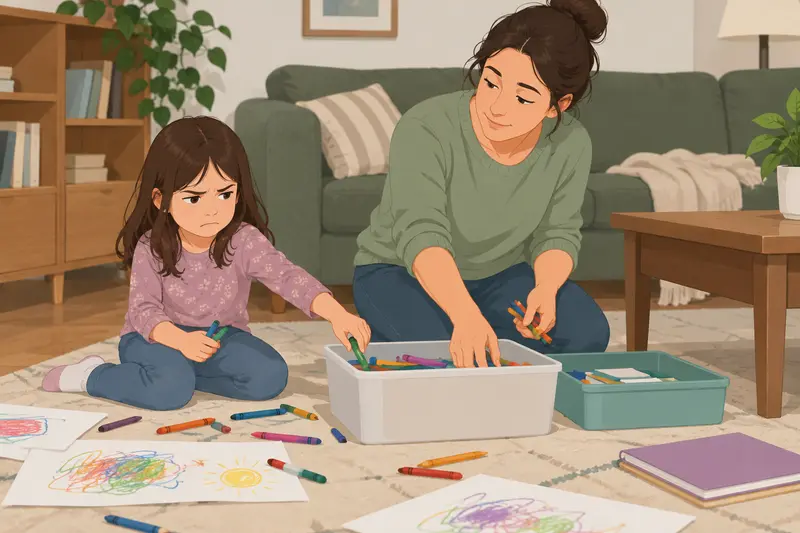
Demonstrate, do a portion together and leave the child a clear part. You might hold the crayon box open while they put crayons inside. A school-age child could check tomorrow's belongings against an agreed list. Reminders and help at the start are part of teaching, not proof of laziness.
When they finish, describe the action: “You collected the crayons; the space is ready.” If they struggle, return to the difficult part rather than comparing siblings or predicting failure in adult life. A contribution at home does not make a child responsible for family safety or for caring for younger siblings in place of an adult.
If refusal continues
Once you have checked understanding and ability, keep a limit you can follow through on. New activity materials wait until you collect the earlier ones together; a toy thrown at people stays aside until it can be used safely. Explain the connection without withdrawing food, sleep or essential care.
Being unhappy does not need an extra consequence. If the child collects the crayons while saying, “I hate tidying,” the task is done. You can acknowledge, “I know it's not your favourite job,” and carry on with the day. When a younger child's refusal turns into intense crying, use fewer words and help them settle before teaching more.
Repeated school refusal, or refusal accompanied by fear, pain or a report of harm, needs attention to the cause. Do not reduce it to choosing shoes or passing an obedience test. Listen and work with the school and your child's doctor to address what is happening and plan safe, supported attendance3. Remaining in a harmful situation is not a reasonable parenting limit.
If refusal recurs across many settings, involves harm or accompanies communication or school difficulties, discuss the wider picture with a professional. Examples of what comes before refusal and what helps are more useful than the label “stubborn.”
Frequently Asked Questions
How should I respond when my child refuses to do what I ask?
Move closer and ask for one reasonable thing they can do, then help them begin. Make sure they hear you, give them time to start, and avoid adding more steps while they are still working on the first. A child may need a demonstration, a picture or your help getting started. If something is getting in the way, such as shoes that hurt, address that first.
How do I give my child choices without giving up the limit?
Explain what will happen, then offer two options you can accept: “You need a shirt. The green one or the white one?” If refusal is not an option in this situation, do not ask as though it is, and do not promise a final turn you have no time for. In immediate danger, such as approaching a road, protect the child first; do not delay protection to offer choices.
What if my child refuses both options?
With a younger child, choose one yourself and help them begin, without threats or harmful force: “I'll bring the green shirt, and we'll start together.” With an older child, return to the objection at a calmer time. A rushed departure cannot resolve everything that bothers them, but you can still make time to listen later.
How do I teach my child to tidy their room?
Start with a small contribution they can learn, such as putting toys or laundry in a basket; that is different from tidying a whole room alone. Demonstrate, do a portion together and leave them a clear part. Reminders and help at the start are part of teaching, not proof of laziness. When they finish, describe the action: “You collected the crayons; the space is ready.”
When should I talk to a professional about my child's refusal?
Discuss the wider picture with a professional if refusal recurs across many settings, involves harm or comes with communication or school difficulties. Repeated school refusal, or refusal with fear, pain or a report of harm, needs attention to the cause: listen, and work with the school and your child's doctor to plan safe, supported attendance. Examples of what comes before refusal and what helps are more useful than the label “stubborn.”
Content writer and researcher at Tatmeen, writing in Arabic and English on mental health and everyday life topics, including relationships, stress, work, habits, and family.
Every Tatmeen article is reviewed by care providers licensed by the Saudi Commission for Health Specialties, so what you read is accurate and trustworthy.
This article builds understanding and does not replace a licensed care provider.
Need someone to talk to?
Tatmeen's licensed care providers are available around the clock, and the app's urgent consultation connects you with one within minutes.
Download Tatmeen to explore care providers and booking options.
Smart matchingFour quick questions suggest the right care provider
Urgent consultationTalk to an available care provider within minutes
Free psychological measuresMore than 20 tests to understand how you are doing
Scan to download
{"data":{"id":"f426952d-7a87-452d-8f9d-696e5eac08c2","slug":"Dealing-with-a-stubborn-child","arTitle":"طفلي يرفض: حدود واضحة وخيارات تساعده على التعاون","enTitle":"When your child refuses: clear limits and choices that help","thumbnailAltText":"طفلة عابسة وامرأة تجمعان أقلام التلوين في صندوق، وحولهما رسومات على أرض غرفة الجلوس.","estimatedReadingTime":6,"likesCount":952,"writer":{"id":"c7b27cce-cc91-45c8-9ba1-1d194830c654","arBio":"كاتبة وباحثة محتوى في تطمين، تكتب بالعربية والإنجليزية في موضوعات الصحة النفسية والحياة اليومية، بما يشمل العلاقات، الضغوط، العمل، العادات، والأسرة.","enBio":"Content writer and researcher at Tatmeen, writing in Arabic and English on mental health and everyday life topics, including relationships, stress, work, habits, and family.","user":{"slug":"alanoud-alturki","arFullName":"العنود التركي","enFullName":"Alanoud Alturki","publicProfileImageUrl":"https://cdn.tatmeen.sa/public/profile-images/78d20741-cf98-483e-9055-2f0ca0ab3bd5/4e190bf082a179be202f7a2618844e0dd134e14126b74d947c78eec35b7e390e.webp","publicProfileImage96Url":"https://cdn.tatmeen.sa/public/profile-images/78d20741-cf98-483e-9055-2f0ca0ab3bd5/4e190bf082a179be202f7a2618844e0dd134e14126b74d947c78eec35b7e390e-w96.webp","publicProfileImage192Url":"https://cdn.tatmeen.sa/public/profile-images/78d20741-cf98-483e-9055-2f0ca0ab3bd5/4e190bf082a179be202f7a2618844e0dd134e14126b74d947c78eec35b7e390e-w192.webp"}},"arContent":"","enContent":"","productionDocument":{"headings":[{"id":"article-section-one-instruction-they-can-carry-out","text":"One instruction they can carry out"},{"id":"article-section-offer-a-choice-within-the-limit","text":"Offer a choice within the limit"},{"id":"article-section-household-responsibility-begins-with-learning","text":"Household responsibility begins with learning"},{"id":"article-section-if-refusal-continues","text":"If refusal continues"}],"faqs":[{"question":"How should I respond when my child refuses to do what I ask?","answer":"<p>Move closer and ask for one reasonable thing they can do, then help them begin. Make sure they hear you, give them time to start, and avoid adding more steps while they are still working on the first. A child may need a demonstration, a picture or your help getting started. If something is getting in the way, such as shoes that hurt, address that first.</p>"},{"question":"How do I give my child choices without giving up the limit?","answer":"<p>Explain what will happen, then offer two options you can accept: “You need a shirt. The green one or the white one?” If refusal is not an option in this situation, do not ask as though it is, and do not promise a final turn you have no time for. In immediate danger, such as approaching a road, protect the child first; do not delay protection to offer choices.</p>"},{"question":"What if my child refuses both options?","answer":"<p>With a younger child, choose one yourself and help them begin, without threats or harmful force: “I'll bring the green shirt, and we'll start together.” With an older child, return to the objection at a calmer time. A rushed departure cannot resolve everything that bothers them, but you can still make time to listen later.</p>"},{"question":"How do I teach my child to tidy their room?","answer":"<p>Start with a small contribution they can learn, such as putting toys or laundry in a basket; that is different from tidying a whole room alone. Demonstrate, do a portion together and leave them a clear part. Reminders and help at the start are part of teaching, not proof of laziness. When they finish, describe the action: “You collected the crayons; the space is ready.”</p>"},{"question":"When should I talk to a professional about my child's refusal?","answer":"<p>Discuss the wider picture with a professional if refusal recurs across many settings, involves harm or comes with communication or school difficulties. Repeated school refusal, or refusal with fear, pain or a report of harm, needs attention to the cause: listen, and work with the school and your child's doctor to plan safe, supported attendance. Examples of what comes before refusal and what helps are more useful than the label “stubborn.”</p>"}],"beforeSourcesHtml":"\n","sources":[{"title":"CDC: Tips for giving directions","href":"https://www.cdc.gov/parenting-toddlers/communication/giving-directions.html","hostname":"cdc.gov"},{"title":"CDC: Milestones and support at two years","href":"https://www.cdc.gov/act-early/milestones/2-years.html","hostname":"cdc.gov"},{"title":"American Academy of Child and Adolescent Psychiatry: School refusal","href":"https://www.aacap.org/AACAP/Families_and_Youth/Facts_for_Families/FFF-Guide/School-Refusal-007.aspx","hostname":"aacap.org"}],"afterSourcesHtml":"\n","blocks":[{"type":"html","html":"<p>It is nearly time to leave, and your child says “No” each time you ask them to put on their shoes. There may be no time for a long conversation, but calling the instruction again from across the room will not fix what is getting in the way. Move closer and start with one step: “Your shoes are here. Will you put them on, or would you like help?” If they hurt or the child cannot get a foot inside, address that first.</p>\n<p>Help your child begin a reasonable task and offer a genuine choice where you can. Calling them stubborn or spoiled does not tell you whether they want to finish playing, misunderstood the request or need assistance. Hearing an objection does not require agreeing to everything they want.</p>\n<h2 id=\"article-section-one-instruction-they-can-carry-out\" data-toc-heading tabindex=\"-1\"><span id=\"one-instruction-they-can-carry-out-1\" aria-hidden=\"true\"></span>One instruction they can carry out</h2>\n<p>Instead of “Get ready,” tell a younger child, “Put the book in your bag,” pointing to its place if needed. Make sure they hear you without forcing eye contact, and give them time to begin. Avoid adding three more steps while they are still working on the first.</p>\n<p>CDC guidance for young children recommends clear, <a href=\"https://www.cdc.gov/parenting-toddlers/communication/giving-directions.html\" target=\"_blank\" rel=\"noopener noreferrer\">manageable directions and limited choices</a>. It distinguishes inability from disobedience. A child may need a demonstration, picture or your help getting started. If you say, “We'll put these away together,” be ready to do part of it.</p>\n<p>Reconsidering a request does not mean abandoning every limit. A tired child might collect crayons rather than tidy an entire room. If belongings have no obvious home, agree on a place they can reach. The request becomes clearer for both of you.</p>\n<h2 id=\"article-section-offer-a-choice-within-the-limit\" data-toc-heading tabindex=\"-1\"><span id=\"offer-a-choice-within-the-limit-2\" aria-hidden=\"true\"></span>Offer a choice within the limit</h2>\n<p>Play may need to end while there is still room to choose how to move on. Explain what will happen, then give two options you can accept:</p>\n<div class=\"table-block\"><table>\n<thead>\n<tr>\n<th>Situation</th>\n<th>A practical example</th>\n</tr>\n</thead>\n<tbody>\n<tr>\n<td>Getting dressed</td>\n<td>“You need a shirt. The green one or the white one?”</td>\n</tr>\n<tr>\n<td>Leaving a play space</td>\n<td>“We'll leave after this round. Will you carry the ball or the small bag?”</td>\n</tr>\n<tr>\n<td>Putting drawing materials away</td>\n<td>“These go back in their places. Paper first or crayons first?”</td>\n</tr>\n<tr>\n<td>Packing a school-age child's bag</td>\n<td>“The bag needs to be ready before bed. Let's agree on a time this evening and where you'll leave it.”</td>\n</tr>\n</tbody>\n</table></div>\n<p>If there is no time for a final turn, do not promise one. If refusal is not an available option in this situation, avoid asking as though it is. A choice you immediately cancel creates another disagreement.</p>\n<p>The child may refuse both options. With a younger child, choose one and help them begin without threats or harmful force: “I'll bring the green shirt, and we'll start together.” With an older child, return to the objection at a calmer time. A rushed departure cannot resolve everything that bothers them, but you can still make time to listen later.</p>\n<p>In immediate danger, such as approaching a road, protect the child and state what they need to do. Do not delay protection to offer choices.</p>\n<h2 id=\"article-section-household-responsibility-begins-with-learning\" data-toc-heading tabindex=\"-1\"><span id=\"household-responsibility-begins-with-learning-3\" aria-hidden=\"true\"></span>Household responsibility begins with learning</h2>\n<p>Adults may do everything for a child, then suddenly expect them to tidy a room alone. Choose a small contribution they can learn. CDC suggests that young children can help put <a href=\"https://www.cdc.gov/act-early/milestones/2-years.html\" target=\"_blank\" rel=\"noopener noreferrer\">toys or laundry in a basket</a>. That is different from independently tidying a whole room.</p>\n<p>Demonstrate, do a portion together and leave the child a clear part. You might hold the crayon box open while they put crayons inside. A school-age child could check tomorrow's belongings against an agreed list. Reminders and help at the start are part of teaching, not proof of laziness.</p>\n<p>When they finish, describe the action: “You collected the crayons; the space is ready.” If they struggle, return to the difficult part rather than comparing siblings or predicting failure in adult life. A contribution at home does not make a child responsible for family safety or for caring for younger siblings in place of an adult.</p>\n<h2 id=\"article-section-if-refusal-continues\" data-toc-heading tabindex=\"-1\"><span id=\"if-refusal-continues-4\" aria-hidden=\"true\"></span>If refusal continues</h2>\n<p>Once you have checked understanding and ability, keep a limit you can follow through on. New activity materials wait until you collect the earlier ones together; a toy thrown at people stays aside until it can be used safely. Explain the connection without withdrawing food, sleep or essential care.</p>\n<p>Being unhappy does not need an extra consequence. If the child collects the crayons while saying, “I hate tidying,” the task is done. You can acknowledge, “I know it's not your favourite job,” and carry on with the day. When a younger child's refusal turns into intense crying, use fewer words and help them settle before teaching more.</p>\n<p>Repeated school refusal, or refusal accompanied by fear, pain or a report of harm, needs attention to the cause. Do not reduce it to choosing shoes or passing an obedience test. Listen and work with the school and your child's doctor to address what is happening and <a href=\"https://www.aacap.org/AACAP/Families_and_Youth/Facts_for_Families/FFF-Guide/School-Refusal-007.aspx\" target=\"_blank\" rel=\"noopener noreferrer\">plan safe, supported attendance</a>. Remaining in a harmful situation is not a reasonable parenting limit.</p>\n<p>If refusal recurs across many settings, involves harm or accompanies communication or school difficulties, discuss the wider picture with a professional. Examples of what comes before refusal and what helps are more useful than the label “stubborn.”</p>\n"}],"inlineCtaSignatures":[],"_experienceAliases":{"v":1,"fields":["html","bodyHtml"],"faqs":[0,1,2,3,4]}},"createdAt":"2024-01-06T21:00:00.000Z","updatedAt":"2026-10-30T21:00:59.464Z","disorderGroups":[{"id":"9fbda432-3713-400a-987b-3d56754a113e","slug":"children-and-adolescents","arName":"الأطفال والمراهقين","enName":"Children & Adolescents"}],"reviewer":{"arFullName":"فريق تطمين","enFullName":"Tatmeen team","slug":"tatmeen-team","kind":"organization"},"productionArticle":true,"promotionAllowed":true,"preparedCover":{"src":"https://cdn.tatmeen.sa/public/article-lcp/article-lcp-v2/sha256-8447415e3dcf04726778dac12ce0a096c392253c1bb49f2aebf9b962440ef1f0/800-15c3ba7ab878efa95aef58deea4b67d0f6854ee1d85726f48828dd9bf6749112.avif","fallback":"https://cdn.tatmeen.sa/public/article-lcp/article-lcp-v2/sha256-8447415e3dcf04726778dac12ce0a096c392253c1bb49f2aebf9b962440ef1f0/800-97644b024d304807421ddb81cf8bc962ed8a5aab81f69982b50847bf29c3cac8.webp","directUrl":"https://cdn.tatmeen.sa/blog-cover/08872b7d-b3a9-4072-b281-55b581725f21.png","isGolden":true,"avifSrcset":"https://cdn.tatmeen.sa/public/article-lcp/article-lcp-v2/sha256-8447415e3dcf04726778dac12ce0a096c392253c1bb49f2aebf9b962440ef1f0/400-05ed432b9c4ab464e5b85821823dc062e0140254c6cbd74b8fcc8ebfcb6283f2.avif 400w, https://cdn.tatmeen.sa/public/article-lcp/article-lcp-v2/sha256-8447415e3dcf04726778dac12ce0a096c392253c1bb49f2aebf9b962440ef1f0/640-31a3dca7eb8df833d440483c30ce900940825e003a4e84d1196e8d2d22be1c3e.avif 640w, https://cdn.tatmeen.sa/public/article-lcp/article-lcp-v2/sha256-8447415e3dcf04726778dac12ce0a096c392253c1bb49f2aebf9b962440ef1f0/800-15c3ba7ab878efa95aef58deea4b67d0f6854ee1d85726f48828dd9bf6749112.avif 800w, https://cdn.tatmeen.sa/public/article-lcp/article-lcp-v2/sha256-8447415e3dcf04726778dac12ce0a096c392253c1bb49f2aebf9b962440ef1f0/1200-f38ddf1cfb0d6aa60173ff9808a46c7bfed6da16c988b65372c3e19ca770cd18.avif 1200w","webpSrcset":"https://cdn.tatmeen.sa/public/article-lcp/article-lcp-v2/sha256-8447415e3dcf04726778dac12ce0a096c392253c1bb49f2aebf9b962440ef1f0/400-f99a594d1b5f6d316ebdc898a4aca9c6bc546c9efba0a9e556ba5cf3cc038c5e.webp 400w, https://cdn.tatmeen.sa/public/article-lcp/article-lcp-v2/sha256-8447415e3dcf04726778dac12ce0a096c392253c1bb49f2aebf9b962440ef1f0/640-78c705ce386729bb187b8f3b44ab509b1681be11a194b7f8727b96c18bd3146a.webp 640w, https://cdn.tatmeen.sa/public/article-lcp/article-lcp-v2/sha256-8447415e3dcf04726778dac12ce0a096c392253c1bb49f2aebf9b962440ef1f0/800-97644b024d304807421ddb81cf8bc962ed8a5aab81f69982b50847bf29c3cac8.webp 800w, https://cdn.tatmeen.sa/public/article-lcp/article-lcp-v2/sha256-8447415e3dcf04726778dac12ce0a096c392253c1bb49f2aebf9b962440ef1f0/1200-0e8faf8178d45766cffba639be0e40d198b7cbff8c6d8e4e89b825a6384342ac.webp 1200w","phoneAvifSrcset":"https://cdn.tatmeen.sa/public/article-lcp/article-lcp-v2/sha256-8447415e3dcf04726778dac12ce0a096c392253c1bb49f2aebf9b962440ef1f0/400-05ed432b9c4ab464e5b85821823dc062e0140254c6cbd74b8fcc8ebfcb6283f2.avif 400w, https://cdn.tatmeen.sa/public/article-lcp/article-lcp-v2/sha256-8447415e3dcf04726778dac12ce0a096c392253c1bb49f2aebf9b962440ef1f0/640-31a3dca7eb8df833d440483c30ce900940825e003a4e84d1196e8d2d22be1c3e.avif 640w, https://cdn.tatmeen.sa/public/article-lcp/article-lcp-v2/sha256-8447415e3dcf04726778dac12ce0a096c392253c1bb49f2aebf9b962440ef1f0/800-15c3ba7ab878efa95aef58deea4b67d0f6854ee1d85726f48828dd9bf6749112.avif 800w","phoneWebpSrcset":"https://cdn.tatmeen.sa/public/article-lcp/article-lcp-v2/sha256-8447415e3dcf04726778dac12ce0a096c392253c1bb49f2aebf9b962440ef1f0/400-f99a594d1b5f6d316ebdc898a4aca9c6bc546c9efba0a9e556ba5cf3cc038c5e.webp 400w, https://cdn.tatmeen.sa/public/article-lcp/article-lcp-v2/sha256-8447415e3dcf04726778dac12ce0a096c392253c1bb49f2aebf9b962440ef1f0/640-78c705ce386729bb187b8f3b44ab509b1681be11a194b7f8727b96c18bd3146a.webp 640w, https://cdn.tatmeen.sa/public/article-lcp/article-lcp-v2/sha256-8447415e3dcf04726778dac12ce0a096c392253c1bb49f2aebf9b962440ef1f0/800-97644b024d304807421ddb81cf8bc962ed8a5aab81f69982b50847bf29c3cac8.webp 800w","width":800,"height":533},"previewTaxonomy":{"groups":[{"id":"9fbda432-3713-400a-987b-3d56754a113e","slug":"children-and-adolescents","arName":"الأطفال والمراهقين","enName":"Children & Adolescents"}],"topics":[{"id":"aa57ccb9-d146-4629-8aa1-8b6d36c4c9ee","slug":"parenting-skills","arName":"تربية الأطفال","enName":"Parenting Skills","groupSlug":"children-and-adolescents","href":"/blog/category/children-and-adolescents/parenting-skills/"}],"tags":[{"id":"52aa8812-914e-495a-9ed5-13bec6c39a93","slug":"parents-children","arName":"الآباء والأطفال","enName":"Parents & Children"},{"id":"d58e6187-021b-44a5-882c-245bccd77611","slug":"self-help-howto","arName":"مساعدة ذاتية / خطوات عملية","enName":"Self-Help / How-To"},{"id":"733b18c1-97b2-4275-b9ab-07660eb940ff","slug":"healthy-boundaries","arName":"الحدود الصحية","enName":"Healthy Boundaries"},{"id":"f58e2e68-c3a0-4b1e-b569-5f5020453b3e","slug":"positive-discipline","arName":"التأديب الإيجابي","enName":"Positive discipline"}]},"previewProviderRecommendations":[{"id":"d0176d46-fc4b-4727-a744-5706db75c5de","slug":"shaima-bu-jubarah-1564","arFullName":"شيماء بوجبارة","enFullName":"Shaima Bu Jubarah","publicProfileImageUrl":"","publicProfileImage96Url":"","publicProfileImage192Url":"","specialization":{"arName":"أخصائي نفسي","enName":"Psychologist"},"profileImageUrl":"","experienceYears":2,"consultantInfo":{"averageRating":{"average":4.4},"specialization":{"arGeneralName":"أخصائي نفسي","enGeneralName":"Psychologist"}}},{"id":"025d770d-f6d4-405b-be1c-d45dde63fbf7","slug":"akila-alomran-7545","arFullName":"عقيله العمران","enFullName":"Akila Alomran","publicProfileImageUrl":"","publicProfileImage96Url":"","publicProfileImage192Url":"","specialization":{"arName":"أخصائي نفسي","enName":"Psychologist"},"profileImageUrl":"","experienceYears":3,"consultantInfo":{"averageRating":{"average":5},"specialization":{"arGeneralName":"أخصائي نفسي","enGeneralName":"Psychologist"}}},{"id":"a0a9dce9-6750-4ffa-bdc6-22d543504410","slug":"fatimah-aldhneen-9827","arFullName":"فاطمه الدهنين","enFullName":"Fatimah Aldhneen","publicProfileImageUrl":"","publicProfileImage96Url":"","publicProfileImage192Url":"","specialization":{"arName":"أخصائي نفسي","enName":"Psychologist"},"profileImageUrl":"","experienceYears":2,"consultantInfo":{"averageRating":{"average":5},"specialization":{"arGeneralName":"أخصائي نفسي","enGeneralName":"Psychologist"}}}],"previewCareProviders":[{"id":"09364052-c2a9-4c52-9717-7ce2093b8d0a","slug":"kholoud-alharbi-5221","arFullName":"خلود الحربي","enFullName":"Kholoud Alharbi","publicProfileImageUrl":"https://cdn.tatmeen.sa/public/profile-images/09364052-c2a9-4c52-9717-7ce2093b8d0a/4a0aeb81619e351b77f4323e3605a0a00acc7ca3c82ee7cc5ca2c9e8ef716049.webp","publicProfileImage96Url":"https://cdn.tatmeen.sa/public/profile-images/09364052-c2a9-4c52-9717-7ce2093b8d0a/4a0aeb81619e351b77f4323e3605a0a00acc7ca3c82ee7cc5ca2c9e8ef716049-w96.webp","publicProfileImage192Url":"https://cdn.tatmeen.sa/public/profile-images/09364052-c2a9-4c52-9717-7ce2093b8d0a/4a0aeb81619e351b77f4323e3605a0a00acc7ca3c82ee7cc5ca2c9e8ef716049-w192.webp","gender":"FEMALE","specialization":{"arName":"أخصائي نفسي","enName":"Psychologist"}},{"id":"6f037535-1dca-4b50-a8b2-5974b7323286","slug":"salah-althobaiti-9053","arFullName":"صلاح الثبيتي","enFullName":"Salah Althobaiti","publicProfileImageUrl":"https://cdn.tatmeen.sa/public/profile-images/6f037535-1dca-4b50-a8b2-5974b7323286/35b6bd7fad9b1e004c1835803eb9c1b56dcacd380685ec8bff141f0fb888005c.webp","publicProfileImage96Url":"https://cdn.tatmeen.sa/public/profile-images/6f037535-1dca-4b50-a8b2-5974b7323286/35b6bd7fad9b1e004c1835803eb9c1b56dcacd380685ec8bff141f0fb888005c-w96.webp","publicProfileImage192Url":"https://cdn.tatmeen.sa/public/profile-images/6f037535-1dca-4b50-a8b2-5974b7323286/35b6bd7fad9b1e004c1835803eb9c1b56dcacd380685ec8bff141f0fb888005c-w192.webp","gender":"MALE","specialization":{"arName":"أخصائي نفسي","enName":"Psychologist"}},{"id":"3cc806e8-616b-4884-9f21-a75b378580a2","slug":"aisha-al-hashim-8667","arFullName":"عائشة ال هاشم","enFullName":"Aisha Al Hashim","publicProfileImageUrl":"https://cdn.tatmeen.sa/public/profile-images/3cc806e8-616b-4884-9f21-a75b378580a2/27f523d03be4dcfa1f6a79f70c1773887434e698990d214cd990caec56a44798.webp","publicProfileImage96Url":"https://cdn.tatmeen.sa/public/profile-images/3cc806e8-616b-4884-9f21-a75b378580a2/27f523d03be4dcfa1f6a79f70c1773887434e698990d214cd990caec56a44798-w96.webp","publicProfileImage192Url":"https://cdn.tatmeen.sa/public/profile-images/3cc806e8-616b-4884-9f21-a75b378580a2/27f523d03be4dcfa1f6a79f70c1773887434e698990d214cd990caec56a44798-w192.webp","gender":"FEMALE","specialization":{"arName":"أخصائي نفسي","enName":"Psychologist"}},{"id":"db2ce1a0-9325-4471-b7ce-eb2e811c30a3","slug":"amer-qutub-2441","arFullName":"عامر قطب","enFullName":"Amer Qutub","publicProfileImageUrl":"https://cdn.tatmeen.sa/public/profile-images/db2ce1a0-9325-4471-b7ce-eb2e811c30a3/80580f99bfd7fe2b2a9cf8eed73ab532f5086d1efe053b0aa57358c1ce004261.webp","publicProfileImage96Url":"https://cdn.tatmeen.sa/public/profile-images/db2ce1a0-9325-4471-b7ce-eb2e811c30a3/80580f99bfd7fe2b2a9cf8eed73ab532f5086d1efe053b0aa57358c1ce004261-w96.webp","publicProfileImage192Url":"https://cdn.tatmeen.sa/public/profile-images/db2ce1a0-9325-4471-b7ce-eb2e811c30a3/80580f99bfd7fe2b2a9cf8eed73ab532f5086d1efe053b0aa57358c1ce004261-w192.webp","gender":"MALE","specialization":{"arName":"أخصائي نفسي","enName":"Psychologist"}},{"id":"6043a2b2-c41b-42c8-92bb-881f36083293","slug":"rehab-alharbi-3670","arFullName":"رحاب المعبدي","enFullName":"Rehab Almabadi","publicProfileImageUrl":"https://cdn.tatmeen.sa/public/profile-images/6043a2b2-c41b-42c8-92bb-881f36083293/9f25728f77c844fac517d39615495fdec1cf4c590360b466419ece1bdeb66c2e.webp","publicProfileImage96Url":"https://cdn.tatmeen.sa/public/profile-images/6043a2b2-c41b-42c8-92bb-881f36083293/9f25728f77c844fac517d39615495fdec1cf4c590360b466419ece1bdeb66c2e-w96.webp","publicProfileImage192Url":"https://cdn.tatmeen.sa/public/profile-images/6043a2b2-c41b-42c8-92bb-881f36083293/9f25728f77c844fac517d39615495fdec1cf4c590360b466419ece1bdeb66c2e-w192.webp","gender":"FEMALE","specialization":{"arName":"أخصائي نفسي","enName":"Psychologist"}},{"id":"618dba89-5b70-4b46-8304-741b7ac8ecd3","slug":"abdullah-mari-1311","arFullName":"عبدالله مرعي","enFullName":"Abdullah Mari","publicProfileImageUrl":"https://cdn.tatmeen.sa/public/profile-images/618dba89-5b70-4b46-8304-741b7ac8ecd3/6b4a3bfb59f8a304ca79083b32859b46baad2e1d692974a47c02c1f66bd11129.webp","publicProfileImage96Url":"https://cdn.tatmeen.sa/public/profile-images/618dba89-5b70-4b46-8304-741b7ac8ecd3/6b4a3bfb59f8a304ca79083b32859b46baad2e1d692974a47c02c1f66bd11129-w96.webp","publicProfileImage192Url":"https://cdn.tatmeen.sa/public/profile-images/618dba89-5b70-4b46-8304-741b7ac8ecd3/6b4a3bfb59f8a304ca79083b32859b46baad2e1d692974a47c02c1f66bd11129-w192.webp","gender":"MALE","specialization":{"arName":"أخصائي نفسي","enName":"Psychologist"}},{"id":"94765496-dbdf-4631-a01b-7df5f788668d","slug":"abdullrahman-alhamoudi-3045","arFullName":"عبدالرحمن الحمودي","enFullName":"Abdulrahman Alhamoudi","publicProfileImageUrl":"https://cdn.tatmeen.sa/public/profile-images/94765496-dbdf-4631-a01b-7df5f788668d/2d49f6b6493c564afb6f50b6c3634231dff3a5cf8353acfab393d1b2a88037d1.webp","publicProfileImage96Url":"https://cdn.tatmeen.sa/public/profile-images/94765496-dbdf-4631-a01b-7df5f788668d/2d49f6b6493c564afb6f50b6c3634231dff3a5cf8353acfab393d1b2a88037d1-w96.webp","publicProfileImage192Url":"https://cdn.tatmeen.sa/public/profile-images/94765496-dbdf-4631-a01b-7df5f788668d/2d49f6b6493c564afb6f50b6c3634231dff3a5cf8353acfab393d1b2a88037d1-w192.webp","gender":"MALE","specialization":{"arName":"أخصائي نفسي","enName":"Psychologist"}},{"id":"3b50a5d5-e795-407f-8676-fd7f0e1bb7a0","slug":"abdulaziz-bin-hudayan-4940","arFullName":"عبدالعزيز بن هديان","enFullName":"Abdulaziz Bin Hudayan","publicProfileImageUrl":"https://cdn.tatmeen.sa/public/profile-images/3b50a5d5-e795-407f-8676-fd7f0e1bb7a0/710ff0fe1fb00cdb5042092e27b7910b480a439b02251ecded62d7758eefce95.webp","publicProfileImage96Url":"https://cdn.tatmeen.sa/public/profile-images/3b50a5d5-e795-407f-8676-fd7f0e1bb7a0/710ff0fe1fb00cdb5042092e27b7910b480a439b02251ecded62d7758eefce95-w96.webp","publicProfileImage192Url":"https://cdn.tatmeen.sa/public/profile-images/3b50a5d5-e795-407f-8676-fd7f0e1bb7a0/710ff0fe1fb00cdb5042092e27b7910b480a439b02251ecded62d7758eefce95-w192.webp","gender":"MALE","specialization":{"arName":"أخصائي نفسي","enName":"Psychologist"}},{"id":"d4ffcb6b-90a7-45b6-b941-964866f4564b","slug":"dhaifallah-alhumaidi-1092","arFullName":"ضيف الله الحميدي","enFullName":"Dhaifallah Alhumaidi","publicProfileImageUrl":"https://cdn.tatmeen.sa/public/profile-images/d4ffcb6b-90a7-45b6-b941-964866f4564b/1817171c5828a9b57d6c30d12332cf154e335272548bc90a6e8456d74d356956.webp","publicProfileImage96Url":"https://cdn.tatmeen.sa/public/profile-images/d4ffcb6b-90a7-45b6-b941-964866f4564b/1817171c5828a9b57d6c30d12332cf154e335272548bc90a6e8456d74d356956-w96.webp","publicProfileImage192Url":"https://cdn.tatmeen.sa/public/profile-images/d4ffcb6b-90a7-45b6-b941-964866f4564b/1817171c5828a9b57d6c30d12332cf154e335272548bc90a6e8456d74d356956-w192.webp","gender":"MALE","specialization":{"arName":"أخصائي نفسي","enName":"Psychologist"}}],"previewDownload":{"href":"/download","title":{"ar":"خطوة واحدة لأجلك، ابدأ الآن","en":"One step for you, start now"},"description":{"ar":"حمّل تطبيق تطمين لاستكشاف مقدمي الرعاية وخيارات الحجز.","en":"Download Tatmeen to explore care providers and booking options."},"posterSrc":"/images/home/cta-ar-new-1.webp","videoSrc":"/images/home/cta-ar-new-1.mp4","videoPosterSrc":"/images/home/cta-ar-new-1.webp","videoPosterEnSrc":"/images/home/cta-en-new-1.webp","videoType":"video/mp4","appStoreHref":"https://apps.apple.com/us/app/tatmeen-%D8%AA%D8%B7%D9%85%D9%8A%D9%86/id6473836983","googlePlayHref":"https://play.google.com/store/apps/details?id=com.TatmeenApp.user&hl=en"},"previewRelatedArticles":[{"id":"1ab2549b-990a-4b2d-accb-6c37afe6d7fb","slug":"Why-do-children-draw","route":"/blog/Why-do-children-draw/","title":{"ar":"رسم الأطفال: كيف تشجّع طفلك وتفهم تطور رسوماته؟","en":"Children's drawing: encouraging play and understanding development"},"image":"https://cdn.tatmeen.sa/public/article-lcp/article-lcp-v2/sha256-d84e88649ea70e55502d0aa5c50a14c9930f60843da848ea22c9fa7edbe1e70e/800-eda3aad6425bfb03f2ce25b577d962ecc7f673c1036a1b90986b0256161ade06.webp","directImageFallback":"https://cdn.tatmeen.sa/blog-cover/74d2715a-b96c-43fc-ab71-94b012c187a7.png","arThumbnailAltText":"طفلة تحمل قلم تلوين أمام ورقة، وتحيط بها رسومات ملونة لشمس وبيت وديناصور وصاروخ وقارب.","thumbnailAltText":"طفلة تحمل قلم تلوين أمام ورقة، وتحيط بها رسومات ملونة لشمس وبيت وديناصور وصاروخ وقارب.","topic":{"label":{"ar":"الأطفال والمراهقين","en":"Children & Adolescents"}},"readingTimeMinutes":7},{"id":"83c89c14-8982-408f-aa70-2e75aea60639","slug":"The-parent-child-relationship","route":"/blog/The-parent-child-relationship/","title":{"ar":"علاقتك بوالديك وزواجك: فهم الأثر وتحسين الحوار","en":"Parents and marriage: understanding the past and improving communication"},"image":"https://cdn.tatmeen.sa/public/article-lcp/article-lcp-v2/sha256-d09eea4184d04714f853e1e50c3223a2f053d9733daf0219da3287a870e89ad6/800-74890d844448ba9421848efcfa2019957046ce7759a754510377864b61e6461f.webp","directImageFallback":"https://cdn.tatmeen.sa/blog-cover/a01150d4-403c-4789-84d4-70ccc028788d.png","arThumbnailAltText":"طفلة تسند وجهها إلى يديها أمام أريكة يجلس عليها رجل وامرأة يلتفت كل منهما بعيدًا عن الآخر.","thumbnailAltText":"طفلة تسند وجهها إلى يديها أمام أريكة يجلس عليها رجل وامرأة يلتفت كل منهما بعيدًا عن الآخر.","topic":{"label":{"ar":"العلاقات الأسرية والزوجية","en":"Family & Marital Relations"}},"readingTimeMinutes":7},{"id":"8965f5f3-9ffd-40cd-8547-d380805309ce","slug":"The-pursuit-of-ideal-parenting","route":"/blog/The-pursuit-of-ideal-parenting/","title":{"ar":"ضغط التربية المثالية: كيف تخفف التوقعات وتطلب المساندة؟","en":"The pressure to parent perfectly: easing expectations and finding support"},"image":"https://cdn.tatmeen.sa/public/article-lcp/article-lcp-v2/sha256-2431457e6ae3a491d394fc75724f529f139f94ae09414c191d51526c9ffb9a6d/800-17db72a502a162d3710e93975e4bd20464e6d351e00a243cfc46419f0aadd537.webp","directImageFallback":"https://cdn.tatmeen.sa/blog-cover/7511849a-b22b-4c82-b493-3b8d84e5eefb.png","arThumbnailAltText":"أسرة من بالغين وطفلين تمشي على طريق يبدأ بكتب كبيرة ويتعرج نحو مبانٍ مضيئة عند الغروب.","thumbnailAltText":"أسرة من بالغين وطفلين تمشي على طريق يبدأ بكتب كبيرة ويتعرج نحو مبانٍ مضيئة عند الغروب.","topic":{"label":{"ar":"الأطفال والمراهقين","en":"Children & Adolescents"}},"readingTimeMinutes":6},{"id":"df86d3e4-a549-41ae-86fb-acaa677893d6","slug":"childrens-behavior","route":"/blog/childrens-behavior/","title":{"ar":"تعديل سلوك الطفل: فهم الضرب والرفض والتعامل معهما","en":"Child behaviour: understanding and responding to hitting and refusal"},"image":"https://cdn.tatmeen.sa/public/article-lcp/article-lcp-v2/sha256-87f534bdac4eeb911910246aefcc0c5b4b20235aedb27038cea5e92db54a5fd7/800-118343b34dd4ba976683573c42127415c43db9e4070d0413068619b5ce2a5a27.webp","directImageFallback":"https://cdn.tatmeen.sa/blog-cover/cdabc979-2a79-4c66-b267-1b767f97f74b.png","arThumbnailAltText":"طفل عابس بجوار امرأة، وحوله صور صغيرة لطفل يصرخ ويرمي المكعبات ويجلس منفردًا.","thumbnailAltText":"طفل عابس بجوار امرأة، وحوله صور صغيرة لطفل يصرخ ويرمي المكعبات ويجلس منفردًا.","topic":{"label":{"ar":"الأطفال والمراهقين","en":"Children & Adolescents"}},"readingTimeMinutes":9}],"previewRelatedReadStates":{}},"locale":"en","device":"desktop","path":"/en/blog/Dealing-with-a-stubborn-child/","readingControls":false,"config":{"public":{"BUCKET_URL":"https://cdn.tatmeen.sa/","APP_BASE_URL":"https://tatmeen.sa","intercomAppId":"ppcnu9e3"}}}