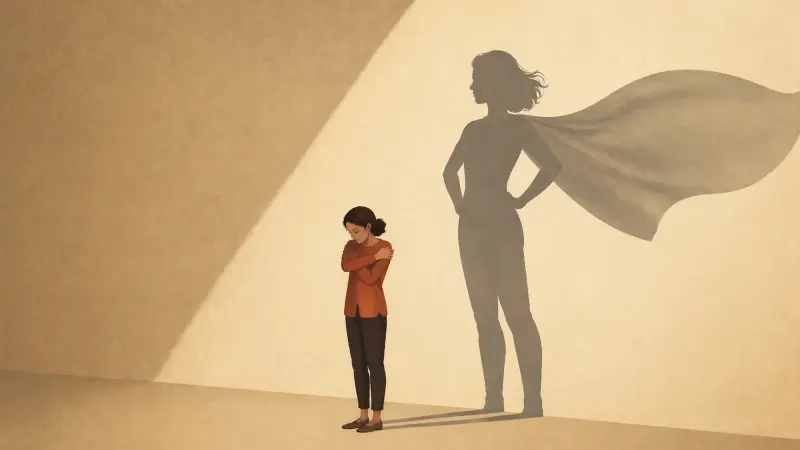
When you live trying to hide what you see as lacking in yourself, relationships become more exhausting than they appear. You do not enter closeness as your true self, but through an image you guard against criticism, disappointment, and misunderstanding. In this guide from Tatmeen, we explain how accepting your personal imperfections is connected to your ability to accept others, and why self-criticism does not make a person better, but creates a more tense relationship with oneself and with people.
When Imperfection Becomes a Threat to Your Identity
The problem does not begin with having imperfections, but with the meaning you give them. When you see a mistake as proof that you are less than others, or see hesitation as an unforgivable weakness, every social situation becomes a test of your worth rather than an ordinary experience. That is why you may overinterpret people’s reactions, cling quickly to praise, and feel wounded by a small remark as though it were a complete judgment on you.
In this state, you are no longer only seeking acceptance, but trying to survive being exposed. That is why you may seem highly sensitive, defensive, or swing between withdrawal and excessive people-pleasing. Not because you are a difficult person, but because you enter relationships carrying an old fear: what if they see in me what I myself am trying not to see?
Self-Acceptance Is Not Blind Admiration
Accepting imperfection does not mean justifying everything you do, nor living without reflection or growth. It means seeing yourself honestly without excessive harshness: you have strengths, and you have areas of weakness, and you do not have to hate yourself in order to improve. The American Psychological Association1 explains that self-acceptance is based on a more objective awareness of one’s abilities and achievements, along with recognizing and accepting one’s weaknesses.
This understanding softens the common idea that being hard on yourself is the only path to growth. In truth, a person who sees their flaws without inner humiliation is more able to change them, because they do not collapse every time they face a shortcoming, nor turn every remark into a personal scandal. Acceptance here is not the end of change, but the ground on which change can stand without constant fear.
Whoever Is at War with Themselves Becomes Harder on Others
When your relationship with yourself is built on constant criticism, that spills into the way you deal with people. You may become less tolerant of their differences, more easily irritated by their spontaneity, and more inclined to interpret their behavior as rejection or belittlement of you. In romantic relationships, you may seek repeated reassurance or monitor details too closely, not because you do not love the other person, but because you do not feel safe with your own image of yourself.
The other side of this pattern is that inner harshness may turn into harshness toward others. Someone who finds it hard to forgive their own imperfections may find it hard to forgive a small mistake from a friend, partner, or family member. And someone who gives themselves no room to be human may, without realizing it, demand from others an ideal image they cannot actually live within. That is why accepting others is not merely a social skill, but a direct extension of the way you see yourself.
A Calmer Relationship with Yourself Means a Clearer Relationship with Others
When the intensity of the inner war softens, relationships begin to change from within. You become more able to hear a remark without collapsing, to say “I was wrong” without feeling that your dignity has fallen, and to ask for what you need without excessive apology. You also become less driven to prove yourself in every discussion, because your worth is no longer hanging entirely on a passing opinion from another person.
The NHS also notes that the relationship you have with yourself is an important part of your psychological well-being, and that respect and honest communication support healthy relationships. This explains why real closeness does not begin with trying to please everyone, but with building an inner voice that is less contemptuous and more balanced. The calmer you become with your own flaws, the more able you are to see people as they are, rather than as threats to your self-image.
What Actually Changes This Cycle?
Change usually does not begin with one big idea, but with small moments that reorganize the way you see yourself. Noticing how you speak to yourself after a simple mistake. Distinguishing between “I made a mistake” and “I am a failure.” Stopping the comparison between your inner weaknesses and other people’s outer appearances. And asking yourself honestly: do I demand from myself what I would never demand from someone I love?
That is why, at Tatmeen, we point out that difficulty accepting imperfection is not always just passing sensitivity. Sometimes it is connected to an upbringing built on criticism, or experiences that made acceptance feel conditional on achievement, or old relationships that taught you that mistakes threaten love itself. And if rejecting yourself is exhausting your relationships, or making you cling to people’s approval in a draining way, then understanding this pattern with a licensed specialist may help you gently untangle it instead of merely blaming yourself or pretending to be strong.
Finally...
Accepting your imperfections does not lessen your ambition, nor justify your shortcomings, but it frees you from living relationships as though they were a courtroom open all day long. When your view of yourself becomes calmer, accepting others becomes less difficult and more sincere. And if this inner struggle has gone on for too long and is affecting your closeness with people, booking a session with a trusted specialist through Tatmeen may be a practical step that helps you begin gently.
Frequently Asked Questions
Does accepting my imperfections mean I should be satisfied with everything in my personality?
No. Accepting imperfection means seeing what is in you clearly, without contempt or denial. You can acknowledge a trait that harms you and work to change it, without making it broad proof that you are unworthy of love or respect.
Why do I need other people’s acceptance so badly when I reject myself?
Because you may make other people’s opinions a primary source of your worth. When your view of yourself is harsh or unstable, any outside acceptance feels like temporary relief, and any criticism feels like a major threat beyond its real size.
What if I understand the idea but return to self-blame every time?
Understanding is not always enough, because some patterns are older than what can be changed by a quick decision. If you keep repeating the same harshness despite being aware of it, then it is likely that the matter needs deeper psychological work to help you build a more just inner voice toward yourself.
A writer and researcher specializing in psychiatry, she focuses on mental health and the human emotions we experience but cannot always find the words to name. She writes about us—about humanity and the human experience—and simplifies complex topics to offer content that helps us better understand ourselves and life, ultimately making us feel less alone.
Every Tatmeen article is reviewed by care providers licensed by the Saudi Commission for Health Specialties, so what you read is accurate and trustworthy.
This article builds understanding and does not replace a licensed care provider.
Need someone to talk to?
Tatmeen's licensed care providers are available around the clock, and the app's urgent consultation connects you with one within minutes.
Download Tatmeen to explore care providers and booking options.
Smart matchingFour quick questions suggest the right care provider
Urgent consultationTalk to an available care provider within minutes
Free psychological measuresMore than 20 tests to understand how you are doing
Scan to download
{"data":{"id":"bc688d7d-39ac-4b0d-a10d-ff18f8c17745","slug":"self-acceptance-accepting-others","arTitle":"قبول الآخرين يبدأ من تقبل نقصك","enTitle":"Accepting Others Begins with Accepting Your Own Imperfections","thumbnailAltText":"Two people sitting together on a rock, watching a warm sunset over distant mountains","estimatedReadingTime":4,"likesCount":199,"writer":{"id":"3ab72b74-f26f-4337-9b47-3114b0f90de5","arBio":"كاتبة وباحثة متخصصة في مجال الطب النفسي، تهتم بموضوعات الصحة النفسية وبالمشاعر الإنسانية التي نختبرها ولا نجد دائمًا الكلمات لتسميتها. تكتب عنّا؛ عن الإنسان وتجربته، وتبسّط الموضوعات المعقّدة لتقدّم محتوى يساعدنا على فهم ذواتنا والحياة أكثر، ويجعلنا نشعر بأننا بوحدة أقل.","enBio":"A writer and researcher specializing in psychiatry, she focuses on mental health and the human emotions we experience but cannot always find the words to name. She writes about us—about humanity and the human experience—and simplifies complex topics to offer content that helps us better understand ourselves and life, ultimately making us feel less alone.","user":{"slug":"ayat-alnajar","arFullName":"آيات النجار","enFullName":"Ayat Al-Najjar","publicProfileImageUrl":"https://cdn.tatmeen.sa/public/profile-images/02384455-68fa-40b6-ad05-609fde65cafa/21b9a610dde5dfc6d37af110c23e9c7ab3946be080c281beb000debf4f7d31a6.webp","publicProfileImage96Url":"https://cdn.tatmeen.sa/public/profile-images/02384455-68fa-40b6-ad05-609fde65cafa/21b9a610dde5dfc6d37af110c23e9c7ab3946be080c281beb000debf4f7d31a6-w96.webp","publicProfileImage192Url":"https://cdn.tatmeen.sa/public/profile-images/02384455-68fa-40b6-ad05-609fde65cafa/21b9a610dde5dfc6d37af110c23e9c7ab3946be080c281beb000debf4f7d31a6-w192.webp"}},"arContent":"","enContent":"","productionDocument":{"headings":[{"id":"article-section-when-imperfection-becomes-a-threat-to-your-identity","text":"When Imperfection Becomes a Threat to Your Identity"},{"id":"article-section-self-acceptance-is-not-blind-admiration","text":"Self-Acceptance Is Not Blind Admiration"},{"id":"article-section-whoever-is-at-war-with-themselves-becomes-harder-on-others","text":"Whoever Is at War with Themselves Becomes Harder on Others"},{"id":"article-section-a-calmer-relationship-with-yourself-means-a-clearer-relationship-with-others","text":"A Calmer Relationship with Yourself Means a Clearer Relationship with Others"},{"id":"article-section-what-actually-changes-this-cycle","text":"What Actually Changes This Cycle?"},{"id":"article-section-finally","text":"Finally..."}],"faqs":[{"question":"Does accepting my imperfections mean I should be satisfied with everything in my personality?","answer":"<p><span style=\"color:#000000\">No. Accepting imperfection means seeing what is in you clearly, without contempt or denial. You can acknowledge a trait that harms you and work to change it, without making it broad proof that you are unworthy of love or respect.</span></p>"},{"question":"Why do I need other people’s acceptance so badly when I reject myself?","answer":"<p><span style=\"color:#000000\">Because you may make other people’s opinions a primary source of your worth. When your view of yourself is harsh or unstable, any outside acceptance feels like temporary relief, and any criticism feels like a major threat beyond its real size.</span></p>"},{"question":"What if I understand the idea but return to self-blame every time?","answer":"<p><span style=\"color:#000000\">Understanding is not always enough, because some patterns are older than what can be changed by a quick decision. If you keep repeating the same harshness despite being aware of it, then it is likely that the matter needs deeper psychological work to help you build a more just inner voice toward yourself.</span></p>"}],"beforeSourcesHtml":"","sources":[{"title":"APA Dictionary of Psychology: Self-Acceptance","href":"https://dictionary.apa.org/self-acceptance","hostname":"dictionary.apa.org"},{"title":"NHS: Maintaining Healthy Relationships and Mental Wellbeing","href":"https://www.nhs.uk/every-mind-matters/lifes-challenges/maintaining-healthy-relationships-and-mental-wellbeing/","hostname":"nhs.uk"},{"title":"Self-Compassion and Current Close Interpersonal Relationships: A Scoping Literature Review","href":"https://pmc.ncbi.nlm.nih.gov/articles/PMC8932676/","hostname":"pmc.ncbi.nlm.nih.gov"}],"afterSourcesHtml":"","blocks":[{"type":"html","html":"<p><span style=\"color:#000000\">When you live trying to hide what you see as lacking in yourself, relationships become more exhausting than they appear. You do not enter closeness as your true self, but through an image you guard against criticism, disappointment, and misunderstanding. In this guide from Tatmeen, we explain how accepting your personal imperfections is connected to your ability to accept others, and why self-criticism does not make a person better, but creates a more tense relationship with oneself and with people.</span></p><h2 id=\"article-section-when-imperfection-becomes-a-threat-to-your-identity\" data-toc-heading tabindex=\"-1\"><span id=\"when-imperfection-becomes-a-threat-to-your-identity-1\" aria-hidden=\"true\"></span><span style=\"color:#000000\"><strong>When Imperfection Becomes a Threat to Your Identity</strong></span></h2><p><span style=\"color:#000000\">The problem does not begin with having imperfections, but with the meaning you give them. When you see a mistake as proof that you are less than others, or see hesitation as an unforgivable weakness, every social situation becomes a test of your worth rather than an ordinary experience. That is why you may overinterpret people’s reactions, cling quickly to praise, and feel wounded by a small remark as though it were a complete judgment on you.</span></p><p><span style=\"color:#000000\">In this state, you are no longer only seeking acceptance, but trying to survive being exposed. That is why you may seem highly sensitive, defensive, or swing between withdrawal and excessive people-pleasing. Not because you are a difficult person, but because you enter relationships carrying an old fear: what if they see in me what I myself am trying not to see?</span></p><h2 id=\"article-section-self-acceptance-is-not-blind-admiration\" data-toc-heading tabindex=\"-1\"><span id=\"self-acceptance-is-not-blind-admiration-2\" aria-hidden=\"true\"></span><span style=\"color:#000000\"><strong>Self-Acceptance Is Not Blind Admiration</strong></span></h2><p><span style=\"color:#000000\">Accepting imperfection does not mean justifying everything you do, nor living without reflection or growth. It means seeing yourself honestly without excessive harshness: you have strengths, and you have areas of weakness, and you do not have to hate yourself in order to improve. The </span><a href=\"https://dictionary.apa.org/self-acceptance\" target=\"_blank\" rel=\"nofollow noopener noreferrer\"><span style=\"color:#1155cc\"><u>American Psychological Association</u></span></a><span style=\"color:#000000\"> explains that self-acceptance is based on a more objective awareness of one’s abilities and achievements, along with recognizing and accepting one’s weaknesses.</span></p><p><span style=\"color:#000000\">This understanding softens the common idea that being hard on yourself is the only path to growth. In truth, a person who sees their flaws without inner humiliation is more able to change them, because they do not collapse every time they face a shortcoming, nor turn every remark into a personal scandal. Acceptance here is not the end of change, but the ground on which change can stand without constant fear.</span></p><h2 id=\"article-section-whoever-is-at-war-with-themselves-becomes-harder-on-others\" data-toc-heading tabindex=\"-1\"><span id=\"whoever-is-at-war-with-themselves-becomes-harder-on-others-3\" aria-hidden=\"true\"></span><span style=\"color:#000000\"><strong>Whoever Is at War with Themselves Becomes Harder on Others</strong></span></h2><p><span style=\"color:#000000\">When your relationship with yourself is built on constant criticism, that spills into the way you deal with people. You may become less tolerant of their differences, more easily irritated by their spontaneity, and more inclined to interpret their behavior as rejection or belittlement of you. In romantic relationships, you may seek repeated reassurance or monitor details too closely, not because you do not love the other person, but because you do not feel safe with your own image of yourself.</span></p><p><span style=\"color:#000000\">The other side of this pattern is that inner harshness may turn into harshness toward others. Someone who finds it hard to forgive their own imperfections may find it hard to forgive a small mistake from a friend, partner, or family member. And someone who gives themselves no room to be human may, without realizing it, demand from others an ideal image they cannot actually live within. That is why accepting others is not merely a social skill, but a direct extension of the way you see yourself.</span></p><h2 id=\"article-section-a-calmer-relationship-with-yourself-means-a-clearer-relationship-with-others\" data-toc-heading tabindex=\"-1\"><span id=\"a-calmer-relationship-with-yourself-means-a-clearer-relationship-with-others-4\" aria-hidden=\"true\"></span><span style=\"color:#000000\"><strong>A Calmer Relationship with Yourself Means a Clearer Relationship with Others</strong></span></h2><p><span style=\"color:#000000\">When the intensity of the inner war softens, relationships begin to change from within. You become more able to hear a remark without collapsing, to say “I was wrong” without feeling that your dignity has fallen, and to ask for what you need without excessive apology. You also become less driven to prove yourself in every discussion, because your worth is no longer hanging entirely on a passing opinion from another person.</span></p><p><span style=\"color:#000000\">The NHS also notes that the relationship you have with yourself is an important part of your psychological well-being, and that respect and honest communication support healthy relationships. This explains why real closeness does not begin with trying to please everyone, but with building an inner voice that is less contemptuous and more balanced. The calmer you become with your own flaws, the more able you are to see people as they are, rather than as threats to your self-image.</span></p><h2 id=\"article-section-what-actually-changes-this-cycle\" data-toc-heading tabindex=\"-1\"><span id=\"what-actually-changes-this-cycle-5\" aria-hidden=\"true\"></span><span style=\"color:#000000\"><strong>What Actually Changes This Cycle?</strong></span></h2><p><span style=\"color:#000000\">Change usually does not begin with one big idea, but with small moments that reorganize the way you see yourself. Noticing how you speak to yourself after a simple mistake. Distinguishing between “I made a mistake” and “I am a failure.” Stopping the comparison between your inner weaknesses and other people’s outer appearances. And asking yourself honestly: do I demand from myself what I would never demand from someone I love?</span></p><p><span style=\"color:#000000\">That is why, at Tatmeen, we point out that difficulty accepting imperfection is not always just passing sensitivity. Sometimes it is connected to an upbringing built on criticism, or experiences that made acceptance feel conditional on achievement, or old relationships that taught you that mistakes threaten love itself. And if rejecting yourself is exhausting your relationships, or making you cling to people’s approval in a draining way, then understanding this pattern with a licensed specialist may help you gently untangle it instead of merely blaming yourself or pretending to be strong.</span></p><h2 id=\"article-section-finally\" data-toc-heading tabindex=\"-1\"><span id=\"finally-6\" aria-hidden=\"true\"></span><span style=\"color:#000000\"><strong>Finally...</strong></span></h2><p><span style=\"color:#000000\">Accepting your imperfections does not lessen your ambition, nor justify your shortcomings, but it frees you from living relationships as though they were a courtroom open all day long. When your view of yourself becomes calmer, accepting others becomes less difficult and more sincere. And if this inner struggle has gone on for too long and is affecting your closeness with people, </span><a href=\"https://tatmeen.sa/download/\"><span style=\"color:#1155cc\"><u>booking a session with a trusted specialist through Tatmeen</u></span></a><span style=\"color:#000000\"> may be a practical step that helps you begin gently.</span></p>"}],"inlineCtaSignatures":[],"_experienceAliases":{"v":1,"fields":["html","bodyHtml"],"faqs":[0,1,2]}},"createdAt":"2026-06-25T21:00:00.000Z","updatedAt":"2026-06-29T17:30:20.563Z","disorderGroups":[{"id":"d807ea69-44d4-4e81-bee4-0a059fd36645","slug":"self-development","arName":"تنمية الذات","enName":"Self-Development"}],"reviewer":{"arFullName":"فريق تطمين","enFullName":"Tatmeen team","slug":"tatmeen-team","kind":"organization"},"productionArticle":true,"promotionAllowed":true,"preparedCover":{"src":"https://cdn.tatmeen.sa/public/article-lcp/article-lcp-v2/sha256-49eb72094988bca7a88a56ba3c046abdf052831a29a6a21cb243541ca85c6167/800-83cc49b29f3dbf84415ca6d456b3591393d9819e8df11ed37dafc4e15a3f16ce.avif","fallback":"https://cdn.tatmeen.sa/public/article-lcp/article-lcp-v2/sha256-49eb72094988bca7a88a56ba3c046abdf052831a29a6a21cb243541ca85c6167/800-854d644d92902d8a888ce5ebee2444ad9bd41d88e5a911125ccbcfadcaeaae4b.webp","directUrl":"https://cdn.tatmeen.sa/blog-cover/Tatmeen-1782485320093.webp","isGolden":true,"avifSrcset":"https://cdn.tatmeen.sa/public/article-lcp/article-lcp-v2/sha256-49eb72094988bca7a88a56ba3c046abdf052831a29a6a21cb243541ca85c6167/400-43848065a375099f900c83be09e4bff9574f4dea0a546258890a9289f800ef88.avif 400w, https://cdn.tatmeen.sa/public/article-lcp/article-lcp-v2/sha256-49eb72094988bca7a88a56ba3c046abdf052831a29a6a21cb243541ca85c6167/640-6793ed32e79aa58a72149c3a2decaa78173d4f30487d8a7a0042d4b2ed0b6b9d.avif 640w, https://cdn.tatmeen.sa/public/article-lcp/article-lcp-v2/sha256-49eb72094988bca7a88a56ba3c046abdf052831a29a6a21cb243541ca85c6167/800-83cc49b29f3dbf84415ca6d456b3591393d9819e8df11ed37dafc4e15a3f16ce.avif 800w, https://cdn.tatmeen.sa/public/article-lcp/article-lcp-v2/sha256-49eb72094988bca7a88a56ba3c046abdf052831a29a6a21cb243541ca85c6167/1200-03a408489f3e7dcadec9876ac22639183edf925fe344fd7e0f2e97ee275117b4.avif 1200w","webpSrcset":"https://cdn.tatmeen.sa/public/article-lcp/article-lcp-v2/sha256-49eb72094988bca7a88a56ba3c046abdf052831a29a6a21cb243541ca85c6167/400-d4d17471ad2f95b11166b28dcbe64c3925b0f8e0b195bc6d577cf287d109ec68.webp 400w, https://cdn.tatmeen.sa/public/article-lcp/article-lcp-v2/sha256-49eb72094988bca7a88a56ba3c046abdf052831a29a6a21cb243541ca85c6167/640-69fd20bf6ebabd61bb206b404ab3e551ed41bd7aa0fba60ea9232d71407d00d0.webp 640w, https://cdn.tatmeen.sa/public/article-lcp/article-lcp-v2/sha256-49eb72094988bca7a88a56ba3c046abdf052831a29a6a21cb243541ca85c6167/800-854d644d92902d8a888ce5ebee2444ad9bd41d88e5a911125ccbcfadcaeaae4b.webp 800w, https://cdn.tatmeen.sa/public/article-lcp/article-lcp-v2/sha256-49eb72094988bca7a88a56ba3c046abdf052831a29a6a21cb243541ca85c6167/1200-866a39b73a9d8bb74c33ac611434d28f969cacebacd6dcd2773e323e88eeecab.webp 1200w","phoneAvifSrcset":"https://cdn.tatmeen.sa/public/article-lcp/article-lcp-v2/sha256-49eb72094988bca7a88a56ba3c046abdf052831a29a6a21cb243541ca85c6167/400-43848065a375099f900c83be09e4bff9574f4dea0a546258890a9289f800ef88.avif 400w, https://cdn.tatmeen.sa/public/article-lcp/article-lcp-v2/sha256-49eb72094988bca7a88a56ba3c046abdf052831a29a6a21cb243541ca85c6167/640-6793ed32e79aa58a72149c3a2decaa78173d4f30487d8a7a0042d4b2ed0b6b9d.avif 640w, https://cdn.tatmeen.sa/public/article-lcp/article-lcp-v2/sha256-49eb72094988bca7a88a56ba3c046abdf052831a29a6a21cb243541ca85c6167/800-83cc49b29f3dbf84415ca6d456b3591393d9819e8df11ed37dafc4e15a3f16ce.avif 800w","phoneWebpSrcset":"https://cdn.tatmeen.sa/public/article-lcp/article-lcp-v2/sha256-49eb72094988bca7a88a56ba3c046abdf052831a29a6a21cb243541ca85c6167/400-d4d17471ad2f95b11166b28dcbe64c3925b0f8e0b195bc6d577cf287d109ec68.webp 400w, https://cdn.tatmeen.sa/public/article-lcp/article-lcp-v2/sha256-49eb72094988bca7a88a56ba3c046abdf052831a29a6a21cb243541ca85c6167/640-69fd20bf6ebabd61bb206b404ab3e551ed41bd7aa0fba60ea9232d71407d00d0.webp 640w, https://cdn.tatmeen.sa/public/article-lcp/article-lcp-v2/sha256-49eb72094988bca7a88a56ba3c046abdf052831a29a6a21cb243541ca85c6167/800-854d644d92902d8a888ce5ebee2444ad9bd41d88e5a911125ccbcfadcaeaae4b.webp 800w","width":800,"height":450},"previewTaxonomy":{"groups":[{"id":"d807ea69-44d4-4e81-bee4-0a059fd36645","slug":"self-development","arName":"تنمية الذات","enName":"Self-Development"}],"topics":[{"id":"f495e682-facf-4a75-b8d2-369cf476488b","slug":"low-self-confidence","arName":"ضعف الثقة بالنفس","enName":"Low Self-Confidence","groupSlug":"self-development","href":"/blog/category/self-development/low-self-confidence/"},{"id":"7795b6e4-e390-47a5-baf0-09243b44e066","slug":"self-compassion","arName":"تعاطف مع الذات","enName":"Self-Compassion","groupSlug":"self-development","href":"/blog/category/self-development/self-compassion/"}],"tags":[]},"previewProviderRecommendations":[{"id":"025d770d-f6d4-405b-be1c-d45dde63fbf7","slug":"akila-alomran-7545","arFullName":"عقيله العمران","enFullName":"Akila Alomran","publicProfileImageUrl":"https://cdn.tatmeen.sa/public/profile-images/025d770d-f6d4-405b-be1c-d45dde63fbf7/44a990b9294f02c9810c69a68b8913a6afac0eb30d1b7494155f31b6dde9378b.webp","publicProfileImage96Url":"https://cdn.tatmeen.sa/public/profile-images/025d770d-f6d4-405b-be1c-d45dde63fbf7/44a990b9294f02c9810c69a68b8913a6afac0eb30d1b7494155f31b6dde9378b-w96.webp","publicProfileImage192Url":"https://cdn.tatmeen.sa/public/profile-images/025d770d-f6d4-405b-be1c-d45dde63fbf7/44a990b9294f02c9810c69a68b8913a6afac0eb30d1b7494155f31b6dde9378b-w192.webp","specialization":{"arName":"أخصائي نفسي","enName":"Psychologist"},"profileImageUrl":"https://cdn.tatmeen.sa/public/profile-images/025d770d-f6d4-405b-be1c-d45dde63fbf7/44a990b9294f02c9810c69a68b8913a6afac0eb30d1b7494155f31b6dde9378b-w192.webp","experienceYears":3,"consultantInfo":{"averageRating":{"average":5},"specialization":{"arGeneralName":"أخصائي نفسي","enGeneralName":"Psychologist"}}},{"id":"6f037535-1dca-4b50-a8b2-5974b7323286","slug":"salah-althobaiti-9053","arFullName":"صلاح الثبيتي","enFullName":"Salah Althobaiti","publicProfileImageUrl":"https://cdn.tatmeen.sa/public/profile-images/6f037535-1dca-4b50-a8b2-5974b7323286/35b6bd7fad9b1e004c1835803eb9c1b56dcacd380685ec8bff141f0fb888005c.webp","publicProfileImage96Url":"https://cdn.tatmeen.sa/public/profile-images/6f037535-1dca-4b50-a8b2-5974b7323286/35b6bd7fad9b1e004c1835803eb9c1b56dcacd380685ec8bff141f0fb888005c-w96.webp","publicProfileImage192Url":"https://cdn.tatmeen.sa/public/profile-images/6f037535-1dca-4b50-a8b2-5974b7323286/35b6bd7fad9b1e004c1835803eb9c1b56dcacd380685ec8bff141f0fb888005c-w192.webp","specialization":{"arName":"أخصائي نفسي","enName":"Psychologist"},"profileImageUrl":"https://cdn.tatmeen.sa/public/profile-images/6f037535-1dca-4b50-a8b2-5974b7323286/35b6bd7fad9b1e004c1835803eb9c1b56dcacd380685ec8bff141f0fb888005c-w192.webp","experienceYears":6,"consultantInfo":{"averageRating":{"average":4.98876404494382},"specialization":{"arGeneralName":"أخصائي نفسي","enGeneralName":"Psychologist"}}},{"id":"ef9ee02f-1e3c-448b-bb17-130a7010e75a","slug":"mutib-alotaibi-3262","arFullName":"متعب العتيبي","enFullName":"Mutib Alotaibi","publicProfileImageUrl":"https://cdn.tatmeen.sa/public/profile-images/ef9ee02f-1e3c-448b-bb17-130a7010e75a/090319abda1d037060a78082f4f9d61709ae0b90ea8bcab1b912116921fd8ac1.webp","publicProfileImage96Url":"https://cdn.tatmeen.sa/public/profile-images/ef9ee02f-1e3c-448b-bb17-130a7010e75a/090319abda1d037060a78082f4f9d61709ae0b90ea8bcab1b912116921fd8ac1-w96.webp","publicProfileImage192Url":"https://cdn.tatmeen.sa/public/profile-images/ef9ee02f-1e3c-448b-bb17-130a7010e75a/090319abda1d037060a78082f4f9d61709ae0b90ea8bcab1b912116921fd8ac1-w192.webp","specialization":{"arName":"أخصائي نفسي","enName":"Psychologist"},"profileImageUrl":"https://cdn.tatmeen.sa/public/profile-images/ef9ee02f-1e3c-448b-bb17-130a7010e75a/090319abda1d037060a78082f4f9d61709ae0b90ea8bcab1b912116921fd8ac1-w192.webp","experienceYears":15,"consultantInfo":{"averageRating":{"average":5},"specialization":{"arGeneralName":"أخصائي نفسي","enGeneralName":"Psychologist"}}}],"previewCareProviders":[{"id":"09364052-c2a9-4c52-9717-7ce2093b8d0a","slug":"kholoud-alharbi-5221","arFullName":"خلود الحربي","enFullName":"Kholoud Alharbi","publicProfileImageUrl":"https://cdn.tatmeen.sa/public/profile-images/09364052-c2a9-4c52-9717-7ce2093b8d0a/4a0aeb81619e351b77f4323e3605a0a00acc7ca3c82ee7cc5ca2c9e8ef716049.webp","publicProfileImage96Url":"https://cdn.tatmeen.sa/public/profile-images/09364052-c2a9-4c52-9717-7ce2093b8d0a/4a0aeb81619e351b77f4323e3605a0a00acc7ca3c82ee7cc5ca2c9e8ef716049-w96.webp","publicProfileImage192Url":"https://cdn.tatmeen.sa/public/profile-images/09364052-c2a9-4c52-9717-7ce2093b8d0a/4a0aeb81619e351b77f4323e3605a0a00acc7ca3c82ee7cc5ca2c9e8ef716049-w192.webp","gender":"FEMALE","specialization":{"arName":"أخصائي نفسي","enName":"Psychologist"}},{"id":"6f037535-1dca-4b50-a8b2-5974b7323286","slug":"salah-althobaiti-9053","arFullName":"صلاح الثبيتي","enFullName":"Salah Althobaiti","publicProfileImageUrl":"https://cdn.tatmeen.sa/public/profile-images/6f037535-1dca-4b50-a8b2-5974b7323286/35b6bd7fad9b1e004c1835803eb9c1b56dcacd380685ec8bff141f0fb888005c.webp","publicProfileImage96Url":"https://cdn.tatmeen.sa/public/profile-images/6f037535-1dca-4b50-a8b2-5974b7323286/35b6bd7fad9b1e004c1835803eb9c1b56dcacd380685ec8bff141f0fb888005c-w96.webp","publicProfileImage192Url":"https://cdn.tatmeen.sa/public/profile-images/6f037535-1dca-4b50-a8b2-5974b7323286/35b6bd7fad9b1e004c1835803eb9c1b56dcacd380685ec8bff141f0fb888005c-w192.webp","gender":"MALE","specialization":{"arName":"أخصائي نفسي","enName":"Psychologist"}},{"id":"3cc806e8-616b-4884-9f21-a75b378580a2","slug":"aisha-al-hashim-8667","arFullName":"عائشة ال هاشم","enFullName":"Aisha Al Hashim","publicProfileImageUrl":"https://cdn.tatmeen.sa/public/profile-images/3cc806e8-616b-4884-9f21-a75b378580a2/27f523d03be4dcfa1f6a79f70c1773887434e698990d214cd990caec56a44798.webp","publicProfileImage96Url":"https://cdn.tatmeen.sa/public/profile-images/3cc806e8-616b-4884-9f21-a75b378580a2/27f523d03be4dcfa1f6a79f70c1773887434e698990d214cd990caec56a44798-w96.webp","publicProfileImage192Url":"https://cdn.tatmeen.sa/public/profile-images/3cc806e8-616b-4884-9f21-a75b378580a2/27f523d03be4dcfa1f6a79f70c1773887434e698990d214cd990caec56a44798-w192.webp","gender":"FEMALE","specialization":{"arName":"أخصائي نفسي","enName":"Psychologist"}},{"id":"db2ce1a0-9325-4471-b7ce-eb2e811c30a3","slug":"amer-qutub-2441","arFullName":"عامر قطب","enFullName":"Amer Qutub","publicProfileImageUrl":"https://cdn.tatmeen.sa/public/profile-images/db2ce1a0-9325-4471-b7ce-eb2e811c30a3/80580f99bfd7fe2b2a9cf8eed73ab532f5086d1efe053b0aa57358c1ce004261.webp","publicProfileImage96Url":"https://cdn.tatmeen.sa/public/profile-images/db2ce1a0-9325-4471-b7ce-eb2e811c30a3/80580f99bfd7fe2b2a9cf8eed73ab532f5086d1efe053b0aa57358c1ce004261-w96.webp","publicProfileImage192Url":"https://cdn.tatmeen.sa/public/profile-images/db2ce1a0-9325-4471-b7ce-eb2e811c30a3/80580f99bfd7fe2b2a9cf8eed73ab532f5086d1efe053b0aa57358c1ce004261-w192.webp","gender":"MALE","specialization":{"arName":"أخصائي نفسي","enName":"Psychologist"}},{"id":"94765496-dbdf-4631-a01b-7df5f788668d","slug":"abdullrahman-alhamoudi-3045","arFullName":"عبدالرحمن الحمودي","enFullName":"Abdulrahman Alhamoudi","publicProfileImageUrl":"https://cdn.tatmeen.sa/public/profile-images/94765496-dbdf-4631-a01b-7df5f788668d/2d49f6b6493c564afb6f50b6c3634231dff3a5cf8353acfab393d1b2a88037d1.webp","publicProfileImage96Url":"https://cdn.tatmeen.sa/public/profile-images/94765496-dbdf-4631-a01b-7df5f788668d/2d49f6b6493c564afb6f50b6c3634231dff3a5cf8353acfab393d1b2a88037d1-w96.webp","publicProfileImage192Url":"https://cdn.tatmeen.sa/public/profile-images/94765496-dbdf-4631-a01b-7df5f788668d/2d49f6b6493c564afb6f50b6c3634231dff3a5cf8353acfab393d1b2a88037d1-w192.webp","gender":"MALE","specialization":{"arName":"أخصائي نفسي","enName":"Psychologist"}},{"id":"618dba89-5b70-4b46-8304-741b7ac8ecd3","slug":"abdullah-mari-1311","arFullName":"عبدالله مرعي","enFullName":"Abdullah Mari","publicProfileImageUrl":"https://cdn.tatmeen.sa/public/profile-images/618dba89-5b70-4b46-8304-741b7ac8ecd3/6b4a3bfb59f8a304ca79083b32859b46baad2e1d692974a47c02c1f66bd11129.webp","publicProfileImage96Url":"https://cdn.tatmeen.sa/public/profile-images/618dba89-5b70-4b46-8304-741b7ac8ecd3/6b4a3bfb59f8a304ca79083b32859b46baad2e1d692974a47c02c1f66bd11129-w96.webp","publicProfileImage192Url":"https://cdn.tatmeen.sa/public/profile-images/618dba89-5b70-4b46-8304-741b7ac8ecd3/6b4a3bfb59f8a304ca79083b32859b46baad2e1d692974a47c02c1f66bd11129-w192.webp","gender":"MALE","specialization":{"arName":"أخصائي نفسي","enName":"Psychologist"}},{"id":"3b50a5d5-e795-407f-8676-fd7f0e1bb7a0","slug":"abdulaziz-bin-hudayan-4940","arFullName":"عبدالعزيز بن هديان","enFullName":"Abdulaziz Bin Hudayan","publicProfileImageUrl":"https://cdn.tatmeen.sa/public/profile-images/3b50a5d5-e795-407f-8676-fd7f0e1bb7a0/710ff0fe1fb00cdb5042092e27b7910b480a439b02251ecded62d7758eefce95.webp","publicProfileImage96Url":"https://cdn.tatmeen.sa/public/profile-images/3b50a5d5-e795-407f-8676-fd7f0e1bb7a0/710ff0fe1fb00cdb5042092e27b7910b480a439b02251ecded62d7758eefce95-w96.webp","publicProfileImage192Url":"https://cdn.tatmeen.sa/public/profile-images/3b50a5d5-e795-407f-8676-fd7f0e1bb7a0/710ff0fe1fb00cdb5042092e27b7910b480a439b02251ecded62d7758eefce95-w192.webp","gender":"MALE","specialization":{"arName":"أخصائي نفسي","enName":"Psychologist"}}],"previewDownload":{"href":"/download","title":{"ar":"خطوة واحدة لأجلك، ابدأ الآن","en":"One step for you, start now"},"description":{"ar":"حمّل تطبيق تطمين لاستكشاف مقدمي الرعاية وخيارات الحجز.","en":"Download Tatmeen to explore care providers and booking options."},"posterSrc":"/images/home/cta-ar-new-1.webp","videoSrc":"/images/home/cta-ar-new-1.mp4","videoPosterSrc":"/images/home/cta-ar-new-1.webp","videoPosterEnSrc":"/images/home/cta-en-new-1.webp","videoType":"video/mp4","appStoreHref":"https://apps.apple.com/us/app/tatmeen-%D8%AA%D8%B7%D9%85%D9%8A%D9%86/id6473836983","googlePlayHref":"https://play.google.com/store/apps/details?id=com.TatmeenApp.user&hl=en"},"previewRelatedArticles":[{"id":"714688fd-a525-4eee-8f68-9f41359bbd26","slug":"learn-self-compassion-be-kind-yourself","route":"/blog/learn-self-compassion-be-kind-yourself/","title":{"ar":"تعلم كيف ترحم نفسك","en":"Learn How to Be Kind to Yourself"},"image":"https://cdn.tatmeen.sa/public/article-lcp/article-lcp-v2/sha256-7bc11d8f65d0df7b24148ca5ea914600bd2978fc8fcd17618fa0ea42a2cb1165/800-b1be516d3b4cea4ac67bd35040c822dc4033a295018a82ef8a70ea70e9a27747.webp","directImageFallback":"https://cdn.tatmeen.sa/blog-cover/Tatmeen-1777217243827.webp","arThumbnailAltText":"Person gently hugging themselves by a window in warm morning light in a tender self-care moment","thumbnailAltText":"Person gently hugging themselves by a window in warm morning light in a tender self-care moment","topic":{"label":{"ar":"تنمية الذات","en":"Self-Development"}},"readingTimeMinutes":5},{"id":"905061d1-a165-4733-ab5c-269ac4e93ac0","slug":"healthy-relationship-builds-self-love","route":"/blog/healthy-relationship-builds-self-love/","title":{"ar":"هل العلاقة الصحية تساعدك في بناء علاقة صحية مع ذاتك؟","en":"Does a Healthy Relationship Help You Build a Healthy Relationship with Yourself?"},"image":"https://cdn.tatmeen.sa/public/article-lcp/article-lcp-v2/sha256-5bd2e63c4c461f12873d78ccb4d5eb178c5d4abed1bc9479770b62f3bfe3a8f7/800-e48e778148957db043aa05bd1235b5dfb64cdd2b16b187473817918a232480b8.webp","directImageFallback":"https://cdn.tatmeen.sa/blog-cover/Tatmeen-1778777494053.webp","arThumbnailAltText":"couple sitting together at a dock watching the sunset","thumbnailAltText":"couple sitting together at a dock watching the sunset","topic":{"label":{"ar":"العلاقات الأسرية والزوجية","en":"Family & Marital Relations"}},"readingTimeMinutes":5},{"id":"6949ce01-cbba-4b86-bb2e-cae96b2fcd81","slug":"emotional-eating-after-iftar-ramadan","route":"/blog/emotional-eating-after-iftar-ramadan/","title":{"ar":"الأكل العاطفي بعد الإفطار في رمضان: فهم الدافع وحدود رحيمة","en":"Emotional Eating After Iftar in Ramadan: Understanding the Drive and Compassiona"},"image":"https://cdn.tatmeen.sa/public/article-lcp/article-lcp-v2/sha256-8352cca0c7a563ec19409248bb26f92b3fd960c9d388251b9659a7083748e3c1/800-dfe5cbe67bf146bb6bed0b74768c8fb99d5161384aa877e86824c4e48733cc3d.webp","directImageFallback":"https://cdn.tatmeen.sa/blog-cover/Tatmeen-1780506841790.webp","arThumbnailAltText":"a person sitting at a table at iftar time during ramadan representing emotional eating","thumbnailAltText":"a person sitting at a table at iftar time during ramadan representing emotional eating","topic":{"label":{"ar":"صحة عامة","en":"General Health"}},"readingTimeMinutes":5},{"id":"efab8126-5750-42d9-93a6-5f710a24dd52","slug":"sensitivity-is-not-weakness-but-hidden-strength","route":"/blog/sensitivity-is-not-weakness-but-hidden-strength/","title":{"ar":"حساسيتك ليست نقطة ضعف بل قوة كامنة","en":"Your Sensitivity Is Not a Weakness but a Hidden Strength"},"image":"https://cdn.tatmeen.sa/public/article-lcp/article-lcp-v2/sha256-f70216cd59907c1914462adf851ae85db4b421f6574949fe51bbd2876482473c/800-bdc19c8e5a103ff6ffc7b81610863046a99447a3c0922e2f0e5b8515150a3603.webp","directImageFallback":"https://cdn.tatmeen.sa/blog-cover/Tatmeen-1776959536018.webp","arThumbnailAltText":"a woman feeling sensitive not knowing that she's strong","thumbnailAltText":"a woman feeling sensitive not knowing that she's strong","topic":{"label":{"ar":"تنمية الذات","en":"Self-Development"}},"readingTimeMinutes":5}],"previewRelatedReadStates":{}},"locale":"en","device":"desktop","path":"/en/blog/self-acceptance-accepting-others/","readingControls":false,"config":{"public":{"BUCKET_URL":"https://cdn.tatmeen.sa/","APP_BASE_URL":"https://tatmeen.sa","intercomAppId":"ppcnu9e3"}}}