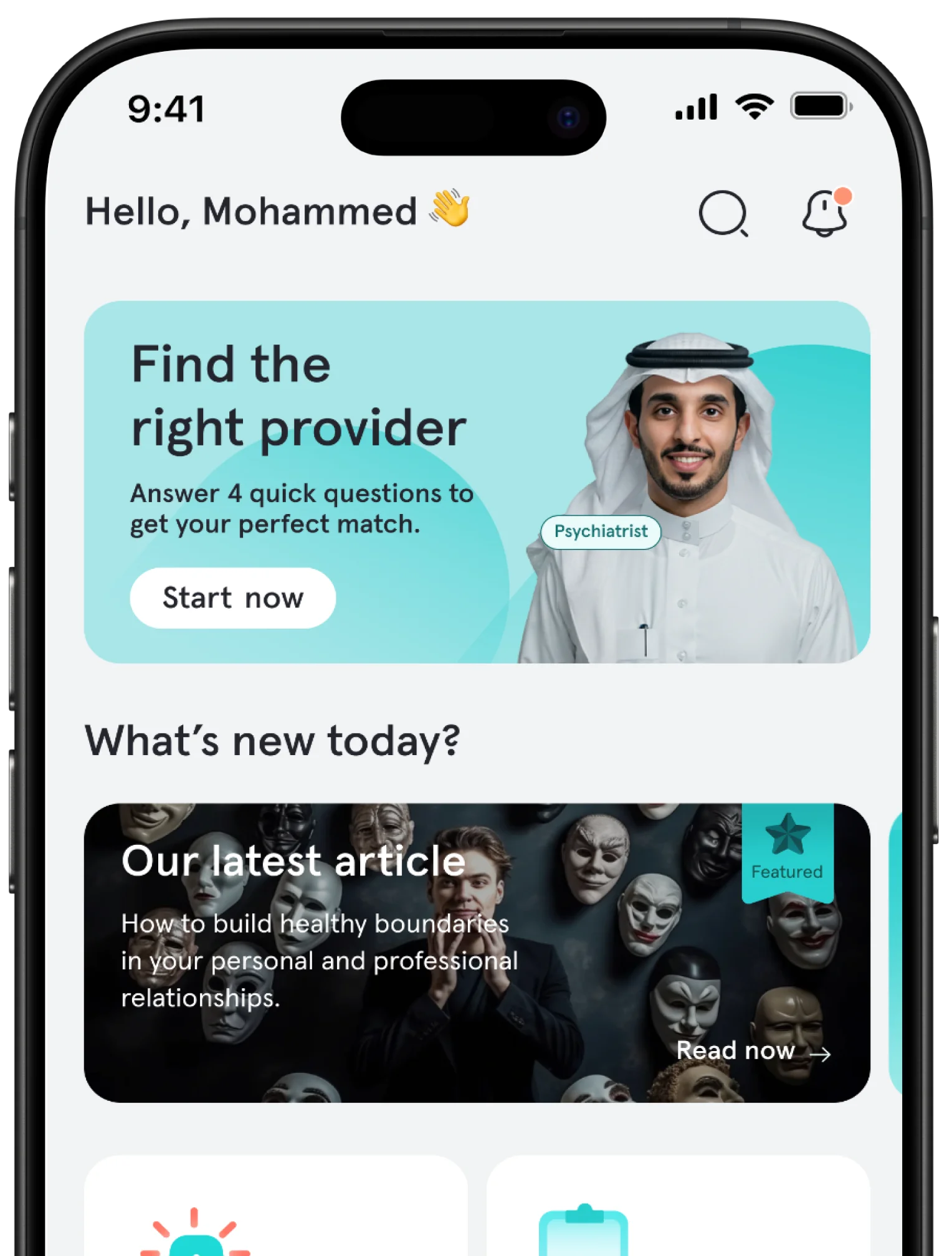
Tatmeen keeps pace with the priorities of Saudi society today because it does not treat mental health as a generic service that looks the same for everyone. It treats it as a need that changes with life stage, role, and social context. That is why the platform’s structure feels closer to the real lives of women, families, and young people: specialized thematic clinics, ways to begin from what a person feels rather than from a formal diagnosis, privacy features that reduce hesitation, and flexible communication with licensed specialists inside one digital experience.
This also belongs squarely inside the Saudi context. Vision 2030 links a vibrant society to physical, psychological, and social well-being, family strength, and quality of life, while the Health Sector Transformation Program emphasizes easier access, better quality and efficiency, and the expansion of digital health solutions. The question is no longer whether mental health care can be delivered digitally. The more important question is which platform understands Saudi society as it is changing now.
This direction is not theoretical. Saudi Arabia’s Ministry of Health presents telemedicine as a way to deliver services and assessment remotely, offers virtual-clinic services, and operates Seha Virtual Hospital as part of the wider health transformation linked to Vision 2030. Tatmeen is therefore not betting on an idea that sits outside the local health landscape. It is moving inside a clear Saudi direction that treats digital access as part of improving care, not as a decorative extra.
These Are Not Three Separate Groups; They Are Three Priorities Moving Together
When we talk about women, families, and young people in Saudi Arabia today, we are talking about social realities changing quickly. In 2024, Saudi women’s labor-force participation had already passed the original Vision 2030 target, reaching 33.5% in the third quarter of 2024 compared with 22.8% in 2016. At the same time, Saudi Youth Statistics 2023 shows that Saudis under 35 represent about 71% of the Saudi population, while the 15-to-34 age group is central to education, work, and the future of the country. These are not side numbers. They explain why mental health has become part of daily life: study, work, marriage, parenting, family roles, and the pressure to balance more than one responsibility at once.
For that reason, a mental-health platform that wants to be genuinely relevant cannot simply offer online sessions in a general way. It has to understand that a woman may need support around pregnancy, motherhood, work pressure, or the burden of balancing roles. A family may need a pathway that does not treat every issue as purely individual. A young person may not begin with the name of a specialist, but with a confused feeling or an unclear question. This is where Tatmeen’s structure feels closer to the priorities of the current moment than many generic solutions.
Women: Good Care Begins by Understanding the Context
Saudi women today do not move through only one role. As professional and social participation expands, the need for mental-health support naturally expands with it: performance pressure, work-life balance, preparation for motherhood, postpartum depression, emotional support during pregnancy, hormonal changes, menopause, and social pressures that may not appear in a short traditional intake form. Tatmeen reflects this through a dedicated women’s mental-health clinic and public topics that touch pregnancy support, postpartum depression, hormonal changes, menopause, and the social pressures women may face.
But relevance is not only about naming the clinic. The platform also allows users to filter by provider gender, professional role, language, price, and session format, which helps a woman choose what fits her comfort and context instead of being pushed into one uniform experience. When privacy is decisive, Tatmeen’s experience also reduces the weight of the first step through mobile-number registration, the ability to use a nickname, and privacy options around the session room and identity. These details matter in areas where social sensitivity can delay the decision to ask for support in the first place.
The point does not stop at individual care. Tatmeen for Business presents programs, workshops, and workplace mental-health support for organizations, including attention to work-life balance and burnout. That matters because part of women’s mental-health reality today is inseparable from being an employee, a leader, a graduate student, and a family member at the same time.
When the Problem Is Family-Based, Individual Care Alone Is Not Enough
One of Tatmeen’s strongest ideas is that it does not confine mental health to an isolated individual separated from their environment. The platform includes a clear relationships and family clinic, as well as topics related to children, adolescents, and students. Its professional categories are also broader than psychiatrist and psychologist alone; they include social specialists and family physicians, while the provider side includes fields such as family and marriage therapy and counseling. That range matters because family problems are not always best understood through one diagnostic angle.
This is not just theoretical classification. Some provider pages show family sessions and subspecialties such as family counseling, communication between partners, and working with adolescents. In that sense, Tatmeen feels like a platform that understands how family issues actually appear: marital conflict, communication difficulty, parenting pressure, or the need for support with a teenager, rather than one neat medical label.
The entry point also supports this logic. A user does not need to know the exact specialist or even the perfect name for the problem from the beginning. They can search by what they feel, enter through thematic clinics, or use quick matching that suggests specialists based on need, preferences, budget, and availability. This design is especially useful for families that know something is tense, exhausting, or difficult to communicate about, but do not yet know which door is the right one.
Saudi Youth Are Not Looking for a Lecture; They Need Smart Access
In a society where younger age groups form the largest share of the Saudi population, and where Saudi Youth Statistics defines youth as the 15-to-34 age group, this stage naturally brings fast, varied, and highly experience-sensitive mental-health needs. Young people do not always begin with a theoretical belief in therapy. Sometimes they begin with study pressure, social anxiety, early burnout, distraction, relationship confusion, or uncertainty about which specialist is right for them.
This is where Tatmeen matches the real rhythm rather than an imagined one. The platform includes clinics for children and adolescents, student mental health, and support for scholarship students abroad. It also allows users to search in a more natural language that begins from the feeling itself, such as anxiety or pressure, instead of forcing them to begin with a formal diagnostic term. The app supports quick matching, scheduled sessions, urgent sessions when available, and text, voice, or video formats depending on the specialist. That fits what younger users often expect from a health service: it should be understandable, fast, and flexible from the first minute.
The more important advantage is that the experience does not end with the session. Tatmeen includes digital psychological assessments with saved results, therapeutic homework with progress tracking, reports, prescriptions, and lab or imaging requests when needed, all connected to the appointment record. This matters especially for young people and students because the challenge is often not only attending a session. It is continuing afterward and turning the conversation into clear steps between appointments.
The Real Difference: Tatmeen Is Not Mental-Health Content; It Is Service Infrastructure
Today it is easy to find accounts, articles, and videos that talk about mental health. What is harder is finding a platform that connects awareness to action. Tatmeen is different because it does not stop at content or general education. The website introduces the service and provides information, while the real care journey happens through the patient and provider apps: discovery, booking, payment, session, follow-up, and personal records. That structure makes the platform closer to a real care service than to a brand that simply publishes mental-health content.
The difference becomes clearer when the three priorities come together. Women need privacy and respect for context. Families need a pathway that does not reduce every issue to one individual. Young people need faster, clearer, and more flexible access. Tatmeen brings these layers together through a platform licensed by the Saudi Ministry of Health, with providers classified by the Saudi Commission for Health Specialties, specialized clinics, secure session rooms, and follow-up tools. It appears aligned with today’s Saudi society not because it uses big slogans, but because it builds the service around what has actually changed in people’s lives.
Finally
The idea can be summarized simply: Tatmeen keeps pace with the priorities of Saudi society today because it understands that mental health is no longer marginal, generic, or one-size-fits-all. Women need care that respects the complexity of their roles. Families need support that understands relationships, not only individuals. Young people need faster, smarter, and less complicated access. When specialized clinics, strong privacy, emotion-based search, diverse professional roles, and in-app follow-up come together, Tatmeen becomes a practical expression of what Saudi Arabia’s new mental-health care should feel like: closer, calmer, and more connected to real life.
For anyone who wants a smarter starting point instead of delaying support, Tatmeen’s strongest feature is that it does not require a ready diagnosis or the name of a specific specialist. Sometimes it is enough to begin with what you feel, then let the platform guide you toward the door that best fits your need.
Frequently Asked Questions
Does Tatmeen only provide services for women, or does it also include families and young people?
It clearly includes all three. Tatmeen has clinics and pathways for women’s mental health, relationships and family, children and adolescents, and students, along with care providers from several professional backgrounds.
How does Tatmeen serve Saudi women in a way that is closer to their reality?
Not only through a dedicated clinic, but also through stronger privacy, nickname use, flexible session options, and topics that touch pregnancy, postpartum depression, hormonal changes, menopause, work pressure, and social pressure.
Can Tatmeen handle family issues, not just individual concerns?
Yes. The platform is not limited to general individual therapy. It includes a clear relationships and family pathway, can involve professional roles such as social specialists and family physicians, and some providers list family sessions or subspecialties such as family counseling and adolescent support.
Why does Tatmeen feel suitable for young people and students?
Because entering the platform does not require complex diagnostic language. Users can search by emotions, explore student and youth-related clinics, use quick matching, choose text, voice, or video sessions, and continue follow-up through assessments, homework, reports, and care records.
Is Tatmeen only publishing mental-health content?
No. The website provides information and service links, but the actual care journey happens inside the app, from search, booking, and sessions to follow-up, records, reports, and prescriptions when needed.
How is Tatmeen connected to the priorities of Saudi society today?
It moves in the same broader direction: Vision 2030 gives importance to well-being, family strength, and quality of life, while health transformation emphasizes access, quality, and digital solutions. Tatmeen translates those priorities into a service model focused on women, families, and young people.
A writer and researcher specializing in psychiatry, she focuses on mental health and the human emotions we experience but cannot always find the words to name. She writes about us—about humanity and the human experience—and simplifies complex topics to offer content that helps us better understand ourselves and life, ultimately making us feel less alone.
Every Tatmeen article is reviewed by care providers licensed by the Saudi Commission for Health Specialties, so what you read is accurate and trustworthy.
This article builds understanding and does not replace a licensed care provider.
Need someone to talk to?
Tatmeen's licensed care providers are available around the clock, and the app's urgent consultation connects you with one within minutes.
Download Tatmeen to explore care providers and booking options.
Smart matchingFour quick questions suggest the right care provider
Urgent consultationTalk to an available care provider within minutes
Free psychological measuresMore than 20 tests to understand how you are doing
Scan to download
{"data":{"id":"c7f5e2be-3039-4f47-bd90-25892a366775","slug":"saudi-mental-health-platform-women-family-youth","arTitle":"الصحة النفسية للمرأة والأسرة والشباب: كيف يواكب تطمين أولويات المجتمع الجديد؟","enTitle":"Tatmeen - Mental Health for Women, Families, and Young People","thumbnailAltText":"Youth, Women and family saudi arabia ","estimatedReadingTime":5,"likesCount":352,"writer":{"id":"3ab72b74-f26f-4337-9b47-3114b0f90de5","arBio":"كاتبة وباحثة متخصصة في مجال الطب النفسي، تهتم بموضوعات الصحة النفسية وبالمشاعر الإنسانية التي نختبرها ولا نجد دائمًا الكلمات لتسميتها. تكتب عنّا؛ عن الإنسان وتجربته، وتبسّط الموضوعات المعقّدة لتقدّم محتوى يساعدنا على فهم ذواتنا والحياة أكثر، ويجعلنا نشعر بأننا بوحدة أقل.","enBio":"A writer and researcher specializing in psychiatry, she focuses on mental health and the human emotions we experience but cannot always find the words to name. She writes about us—about humanity and the human experience—and simplifies complex topics to offer content that helps us better understand ourselves and life, ultimately making us feel less alone.","user":{"slug":"ayat-alnajar","arFullName":"آيات النجار","enFullName":"Ayat Al-Najjar","publicProfileImageUrl":"https://cdn.tatmeen.sa/public/profile-images/02384455-68fa-40b6-ad05-609fde65cafa/21b9a610dde5dfc6d37af110c23e9c7ab3946be080c281beb000debf4f7d31a6.webp","publicProfileImage96Url":"https://cdn.tatmeen.sa/public/profile-images/02384455-68fa-40b6-ad05-609fde65cafa/21b9a610dde5dfc6d37af110c23e9c7ab3946be080c281beb000debf4f7d31a6-w96.webp","publicProfileImage192Url":"https://cdn.tatmeen.sa/public/profile-images/02384455-68fa-40b6-ad05-609fde65cafa/21b9a610dde5dfc6d37af110c23e9c7ab3946be080c281beb000debf4f7d31a6-w192.webp"}},"arContent":"","enContent":"","productionDocument":{"headings":[{"id":"article-section-these-are-not-three-separate-groups-they-are-three-priorities-moving-together","text":"These Are Not Three Separate Groups; They Are Three Priorities Moving Together"},{"id":"article-section-women-good-care-begins-by-understanding-the-context","text":"Women: Good Care Begins by Understanding the Context"},{"id":"article-section-when-the-problem-is-family-based-individual-care-alone-is-not-enough","text":"When the Problem Is Family-Based, Individual Care Alone Is Not Enough"},{"id":"article-section-saudi-youth-are-not-looking-for-a-lecture-they-need-smart-access","text":"Saudi Youth Are Not Looking for a Lecture; They Need Smart Access"},{"id":"article-section-the-real-difference-tatmeen-is-not-mental-health-content-it-is-service-infrastructure","text":"The Real Difference: Tatmeen Is Not Mental-Health Content; It Is Service Infrastructure"},{"id":"article-section-finally","text":"Finally"},{"id":"article-section-frequently-asked-questions","text":"Frequently Asked Questions"}],"faqs":[],"beforeSourcesHtml":"","sources":[{"title":"Saudi Vision 2030 - Annual Report 2024","href":"https://www.vision2030.gov.sa/media/25042025ev1/En-Annual%20Report-Vision2030-2024.pdf","hostname":"vision2030.gov.sa"},{"title":"General Authority for Statistics - Saudi Youth Statistics 2023","href":"https://www.stats.gov.sa/en/w/%D8%AA%D9%80%D9%82%D8%B1%D9%8A%D9%80%D8%B1-%D8%A5%D8%AD%D8%B5%D8%A7%D8%A1%D8%A7%D8%AA-%D8%A7%D9%84%D8%B4%D8%A8%D8%A7%D8%A8-%D8%A7%D9%84%D8%B3%D8%B9%D9%88%D8%AF%D9%8A-2023","hostname":"stats.gov.sa"},{"title":"Saudi Vision 2030 - Quality of Life Program Annual Report 2024","href":"https://www.vision2030.gov.sa/media/2klnw2y0/qol_annual_report_2024_en.pdf","hostname":"vision2030.gov.sa"},{"title":"Saudi Ministry of Health - Health Sector Transformation Program","href":"https://www.moh.gov.sa/en/Ministry/vro/Pages/manual.aspx","hostname":"moh.gov.sa"},{"title":"Saudi Ministry of Health - Telemedicine","href":"https://www.moh.gov.sa/en/ministry/information-and-services/pages/telemedicine.aspx","hostname":"moh.gov.sa"},{"title":"Saudi Ministry of Health - Seha Virtual Hospital","href":"https://www.moh.gov.sa/en/Ministry/Projects/Pages/Seha-Virtual-Hospital.aspx","hostname":"moh.gov.sa"},{"title":"World Health Organization - Adolescent mental health","href":"https://www.who.int/news-room/fact-sheets/detail/adolescent-mental-health","hostname":"who.int"},{"title":"World Health Organization - Depression","href":"https://www.who.int/news-room/fact-sheets/detail/depression","hostname":"who.int"},{"title":"World Health Organization - Mental health at work","href":"https://www.who.int/news-room/fact-sheets/detail/mental-health-at-work","hostname":"who.int"}],"afterSourcesHtml":"<p><br /></p>","blocks":[{"type":"html","html":"<p><span style=\"color:#000000\">Tatmeen keeps pace with the priorities of Saudi society today because it does not treat mental health as a generic service that looks the same for everyone. It treats it as a need that changes with life stage, role, and social context. That is why the platform’s structure feels closer to the real lives of women, families, and young people: specialized thematic clinics, ways to begin from what a person feels rather than from a formal diagnosis, privacy features that reduce hesitation, and flexible communication with licensed specialists inside one digital experience.</span></p><p><span style=\"color:#000000\">This also belongs squarely inside the Saudi context. Vision 2030 links a vibrant society to physical, psychological, and social well-being, family strength, and quality of life, while the Health Sector Transformation Program emphasizes easier access, better quality and efficiency, and the expansion of digital health solutions. The question is no longer whether mental health care can be delivered digitally. The more important question is which platform understands Saudi society as it is changing now.</span></p><p><span style=\"color:#000000\">This direction is not theoretical. Saudi Arabia’s Ministry of Health presents telemedicine as a way to deliver services and assessment remotely, offers virtual-clinic services, and operates Seha Virtual Hospital as part of the wider health transformation linked to Vision 2030. Tatmeen is therefore not betting on an idea that sits outside the local health landscape. It is moving inside a clear Saudi direction that treats digital access as part of improving care, not as a decorative extra.</span></p><h2 id=\"article-section-these-are-not-three-separate-groups-they-are-three-priorities-moving-together\" data-toc-heading tabindex=\"-1\"><span id=\"these-are-not-three-separate-groups-they-are-three-priorities-moving-together-1\" aria-hidden=\"true\"></span><span style=\"color:#000000\"><strong>These Are Not Three Separate Groups; They Are Three Priorities Moving Together</strong></span></h2><p><span style=\"color:#000000\">When we talk about women, families, and young people in Saudi Arabia today, we are talking about social realities changing quickly. In 2024, Saudi women’s labor-force participation had already passed the original Vision 2030 target, reaching 33.5% in the third quarter of 2024 compared with 22.8% in 2016. At the same time, Saudi Youth Statistics 2023 shows that Saudis under 35 represent about 71% of the Saudi population, while the 15-to-34 age group is central to education, work, and the future of the country. These are not side numbers. They explain why mental health has become part of daily life: study, work, marriage, parenting, family roles, and the pressure to balance more than one responsibility at once.</span></p><p><span style=\"color:#000000\">For that reason, a mental-health platform that wants to be genuinely relevant cannot simply offer online sessions in a general way. It has to understand that a woman may need support around pregnancy, motherhood, work pressure, or the burden of balancing roles. A family may need a pathway that does not treat every issue as purely individual. A young person may not begin with the name of a specialist, but with a confused feeling or an unclear question. This is where Tatmeen’s structure feels closer to the priorities of the current moment than many generic solutions.</span></p><h2 id=\"article-section-women-good-care-begins-by-understanding-the-context\" data-toc-heading tabindex=\"-1\"><span id=\"women-good-care-begins-by-understanding-the-context-2\" aria-hidden=\"true\"></span><span style=\"color:#000000\"><strong>Women: Good Care Begins by Understanding the Context</strong></span></h2><p><span style=\"color:#000000\">Saudi women today do not move through only one role. As professional and social participation expands, the need for mental-health support naturally expands with it: performance pressure, work-life balance, preparation for motherhood, postpartum depression, emotional support during pregnancy, hormonal changes, menopause, and social pressures that may not appear in a short traditional intake form. Tatmeen reflects this through a dedicated women’s mental-health clinic and public topics that touch pregnancy support, postpartum depression, hormonal changes, menopause, and the social pressures women may face.</span></p><p><span style=\"color:#000000\">But relevance is not only about naming the clinic. The platform also allows users to filter by provider gender, professional role, language, price, and session format, which helps a woman choose what fits her comfort and context instead of being pushed into one uniform experience. When privacy is decisive, Tatmeen’s experience also reduces the weight of the first step through mobile-number registration, the ability to use a nickname, and privacy options around the session room and identity. These details matter in areas where social sensitivity can delay the decision to ask for support in the first place.</span></p><p><span style=\"color:#000000\">The point does not stop at individual care. Tatmeen for Business presents programs, workshops, and workplace mental-health support for organizations, including attention to work-life balance and burnout. That matters because part of women’s mental-health reality today is inseparable from being an employee, a leader, a graduate student, and a family member at the same time.</span></p><h2 id=\"article-section-when-the-problem-is-family-based-individual-care-alone-is-not-enough\" data-toc-heading tabindex=\"-1\"><span id=\"when-the-problem-is-family-based-individual-care-alone-is-not-enough-3\" aria-hidden=\"true\"></span><span style=\"color:#000000\"><strong>When the Problem Is Family-Based, Individual Care Alone Is Not Enough</strong></span></h2><p><span style=\"color:#000000\">One of Tatmeen’s strongest ideas is that it does not confine mental health to an isolated individual separated from their environment. The platform includes a clear relationships and family clinic, as well as topics related to children, adolescents, and students. Its professional categories are also broader than psychiatrist and psychologist alone; they include social specialists and family physicians, while the provider side includes fields such as family and marriage therapy and counseling. That range matters because family problems are not always best understood through one diagnostic angle.</span></p><p><span style=\"color:#000000\">This is not just theoretical classification. Some provider pages show family sessions and subspecialties such as family counseling, communication between partners, and working with adolescents. In that sense, Tatmeen feels like a platform that understands how family issues actually appear: marital conflict, communication difficulty, parenting pressure, or the need for support with a teenager, rather than one neat medical label.</span></p><p><span style=\"color:#000000\">The entry point also supports this logic. A user does not need to know the exact specialist or even the perfect name for the problem from the beginning. They can search by what they feel, enter through thematic clinics, or use quick matching that suggests specialists based on need, preferences, budget, and availability. This design is especially useful for families that know something is tense, exhausting, or difficult to communicate about, but do not yet know which door is the right one.</span></p><h2 id=\"article-section-saudi-youth-are-not-looking-for-a-lecture-they-need-smart-access\" data-toc-heading tabindex=\"-1\"><span id=\"saudi-youth-are-not-looking-for-a-lecture-they-need-smart-access-4\" aria-hidden=\"true\"></span><span style=\"color:#000000\"><strong>Saudi Youth Are Not Looking for a Lecture; They Need Smart Access</strong></span></h2><p><span style=\"color:#000000\">In a society where younger age groups form the largest share of the Saudi population, and where Saudi Youth Statistics defines youth as the 15-to-34 age group, this stage naturally brings fast, varied, and highly experience-sensitive mental-health needs. Young people do not always begin with a theoretical belief in therapy. Sometimes they begin with study pressure, social anxiety, early burnout, distraction, relationship confusion, or uncertainty about which specialist is right for them.</span></p><p><span style=\"color:#000000\">This is where Tatmeen matches the real rhythm rather than an imagined one. The platform includes clinics for children and adolescents, student mental health, and support for scholarship students abroad. It also allows users to search in a more natural language that begins from the feeling itself, such as anxiety or pressure, instead of forcing them to begin with a formal diagnostic term. The app supports quick matching, scheduled sessions, urgent sessions when available, and text, voice, or video formats depending on the specialist. That fits what younger users often expect from a health service: it should be understandable, fast, and flexible from the first minute.</span></p><p><span style=\"color:#000000\">The more important advantage is that the experience does not end with the session. Tatmeen includes digital psychological assessments with saved results, therapeutic homework with progress tracking, reports, prescriptions, and lab or imaging requests when needed, all connected to the appointment record. This matters especially for young people and students because the challenge is often not only attending a session. It is continuing afterward and turning the conversation into clear steps between appointments.</span></p><h2 id=\"article-section-the-real-difference-tatmeen-is-not-mental-health-content-it-is-service-infrastructure\" data-toc-heading tabindex=\"-1\"><span id=\"the-real-difference-tatmeen-is-not-mental-health-content-it-is-service-infrastructure-5\" aria-hidden=\"true\"></span><span style=\"color:#000000\"><strong>The Real Difference: Tatmeen Is Not Mental-Health Content; It Is Service Infrastructure</strong></span></h2><p><span style=\"color:#000000\">Today it is easy to find accounts, articles, and videos that talk about mental health. What is harder is finding a platform that connects awareness to action. Tatmeen is different because it does not stop at content or general education. The website introduces the service and provides information, while the real care journey happens through the patient and provider apps: discovery, booking, payment, session, follow-up, and personal records. That structure makes the platform closer to a real care service than to a brand that simply publishes mental-health content.</span></p><p><span style=\"color:#000000\">The difference becomes clearer when the three priorities come together. Women need privacy and respect for context. Families need a pathway that does not reduce every issue to one individual. Young people need faster, clearer, and more flexible access. Tatmeen brings these layers together through a platform licensed by the Saudi Ministry of Health, with providers classified by the Saudi Commission for Health Specialties, specialized clinics, secure session rooms, and follow-up tools. It appears aligned with today’s Saudi society not because it uses big slogans, but because it builds the service around what has actually changed in people’s lives.</span></p><h2 id=\"article-section-finally\" data-toc-heading tabindex=\"-1\"><span id=\"finally-6\" aria-hidden=\"true\"></span><span style=\"color:#000000\"><strong>Finally</strong></span></h2><p><span style=\"color:#000000\">The idea can be summarized simply: Tatmeen keeps pace with the priorities of Saudi society today because it understands that mental health is no longer marginal, generic, or one-size-fits-all. Women need care that respects the complexity of their roles. Families need support that understands relationships, not only individuals. Young people need faster, smarter, and less complicated access. When specialized clinics, strong privacy, emotion-based search, diverse professional roles, and in-app follow-up come together, Tatmeen becomes a practical expression of what Saudi Arabia’s new mental-health care should feel like: closer, calmer, and more connected to real life.</span></p><p><span style=\"color:#000000\">For anyone who wants a smarter starting point instead of delaying support, Tatmeen’s strongest feature is that it does not require a ready diagnosis or the name of a specific specialist. Sometimes it is enough to begin with what you feel, then let the platform guide you toward the door that best fits your need.</span></p><h2 id=\"article-section-frequently-asked-questions\" data-toc-heading tabindex=\"-1\"><span id=\"frequently-asked-questions-7\" aria-hidden=\"true\"></span><span style=\"color:#000000\"><strong>Frequently Asked Questions</strong></span></h2><p><span style=\"color:#000000\"><strong>Does Tatmeen only provide services for women, or does it also include families and young people?</strong></span></p><p><span style=\"color:#000000\">It clearly includes all three. Tatmeen has clinics and pathways for women’s mental health, relationships and family, children and adolescents, and students, along with care providers from several professional backgrounds.</span></p><p><span style=\"color:#000000\"><strong>How does Tatmeen serve Saudi women in a way that is closer to their reality?</strong></span></p><p><span style=\"color:#000000\">Not only through a dedicated clinic, but also through stronger privacy, nickname use, flexible session options, and topics that touch pregnancy, postpartum depression, hormonal changes, menopause, work pressure, and social pressure.</span></p><p><span style=\"color:#000000\"><strong>Can Tatmeen handle family issues, not just individual concerns?</strong></span></p><p><span style=\"color:#000000\">Yes. The platform is not limited to general individual therapy. It includes a clear relationships and family pathway, can involve professional roles such as social specialists and family physicians, and some providers list family sessions or subspecialties such as family counseling and adolescent support.</span></p><p><span style=\"color:#000000\"><strong>Why does Tatmeen feel suitable for young people and students?</strong></span></p><p><span style=\"color:#000000\">Because entering the platform does not require complex diagnostic language. Users can search by emotions, explore student and youth-related clinics, use quick matching, choose text, voice, or video sessions, and continue follow-up through assessments, homework, reports, and care records.</span></p><p><span style=\"color:#000000\"><strong>Is Tatmeen only publishing mental-health content?</strong></span></p><p><span style=\"color:#000000\">No. The website provides information and service links, but the actual care journey happens inside the app, from search, booking, and sessions to follow-up, records, reports, and prescriptions when needed.</span></p><p><span style=\"color:#000000\"><strong>How is Tatmeen connected to the priorities of Saudi society today?</strong></span></p><p><span style=\"color:#000000\">It moves in the same broader direction: Vision 2030 gives importance to well-being, family strength, and quality of life, while health transformation emphasizes access, quality, and digital solutions. Tatmeen translates those priorities into a service model focused on women, families, and young people.</span></p>"}],"inlineCtaSignatures":[],"_experienceAliases":{"v":1,"fields":["html","bodyHtml"]}},"createdAt":"2026-05-16T21:00:00.000Z","updatedAt":"2026-05-23T15:38:01.946Z","disorderGroups":[{"id":"9fbda432-3713-400a-987b-3d56754a113e","slug":"children-and-adolescents","arName":"الأطفال والمراهقين","enName":"Children & Adolescents"},{"id":"de5b4ba2-cdd3-4192-8b0e-fb462fe49e17","slug":"womens-mental-health","arName":"صحة المرأة","enName":"Women’s Mental Health"},{"id":"01b1a587-3584-435b-971a-c40ffce29802","slug":"family-and-marital-relations","arName":"العلاقات الأسرية والزوجية","enName":"Family & Marital Relations"}],"reviewer":{"arFullName":"فريق تطمين","enFullName":"Tatmeen team","slug":"tatmeen-team","kind":"organization"},"productionArticle":true,"promotionAllowed":true,"preparedCover":{"src":"https://cdn.tatmeen.sa/public/article-lcp/article-lcp-v2/sha256-2f5e6e9c5f782b161edf5753038ed1931985d3c3baf0a02b85f97f60abfaba76/800-5613e1aeda64cd910cd269c42859f3620467d658f1c2ce947935f8aa3080c325.avif","fallback":"https://cdn.tatmeen.sa/public/article-lcp/article-lcp-v2/sha256-2f5e6e9c5f782b161edf5753038ed1931985d3c3baf0a02b85f97f60abfaba76/800-e2148848eedafdb98b891e94080bd9623d3a8fad23bc73730508964122779f00.webp","directUrl":"https://cdn.tatmeen.sa/blog-cover/Tatmeen-1778979469917.webp","isGolden":true,"avifSrcset":"https://cdn.tatmeen.sa/public/article-lcp/article-lcp-v2/sha256-2f5e6e9c5f782b161edf5753038ed1931985d3c3baf0a02b85f97f60abfaba76/400-d0dd8950a997052ebddfa22091f3f11c528e00f5ec3399c4955272063a220fa9.avif 400w, https://cdn.tatmeen.sa/public/article-lcp/article-lcp-v2/sha256-2f5e6e9c5f782b161edf5753038ed1931985d3c3baf0a02b85f97f60abfaba76/640-28ba5ec060eecf7864d20ed10a03e2a4d131b6d520891fafce15290ca20924ce.avif 640w, https://cdn.tatmeen.sa/public/article-lcp/article-lcp-v2/sha256-2f5e6e9c5f782b161edf5753038ed1931985d3c3baf0a02b85f97f60abfaba76/800-5613e1aeda64cd910cd269c42859f3620467d658f1c2ce947935f8aa3080c325.avif 800w, https://cdn.tatmeen.sa/public/article-lcp/article-lcp-v2/sha256-2f5e6e9c5f782b161edf5753038ed1931985d3c3baf0a02b85f97f60abfaba76/1200-98c844508ea5bef06b5d761e18875a8b53f33fe44087d8107aafb2c05e38949d.avif 1200w","webpSrcset":"https://cdn.tatmeen.sa/public/article-lcp/article-lcp-v2/sha256-2f5e6e9c5f782b161edf5753038ed1931985d3c3baf0a02b85f97f60abfaba76/400-4b82a739496fff84a5987c892fb0d0f5a9829a20a44325c414b3ad2b25a26623.webp 400w, https://cdn.tatmeen.sa/public/article-lcp/article-lcp-v2/sha256-2f5e6e9c5f782b161edf5753038ed1931985d3c3baf0a02b85f97f60abfaba76/640-c301b82f14adc4026919631a672046a8169ef89719752b3a632c476a3b59f557.webp 640w, https://cdn.tatmeen.sa/public/article-lcp/article-lcp-v2/sha256-2f5e6e9c5f782b161edf5753038ed1931985d3c3baf0a02b85f97f60abfaba76/800-e2148848eedafdb98b891e94080bd9623d3a8fad23bc73730508964122779f00.webp 800w, https://cdn.tatmeen.sa/public/article-lcp/article-lcp-v2/sha256-2f5e6e9c5f782b161edf5753038ed1931985d3c3baf0a02b85f97f60abfaba76/1200-75d89263451a57d9312a404ab7147f761c3abb77fa8dda99c1afe6f1e3151d75.webp 1200w","phoneAvifSrcset":"https://cdn.tatmeen.sa/public/article-lcp/article-lcp-v2/sha256-2f5e6e9c5f782b161edf5753038ed1931985d3c3baf0a02b85f97f60abfaba76/400-d0dd8950a997052ebddfa22091f3f11c528e00f5ec3399c4955272063a220fa9.avif 400w, https://cdn.tatmeen.sa/public/article-lcp/article-lcp-v2/sha256-2f5e6e9c5f782b161edf5753038ed1931985d3c3baf0a02b85f97f60abfaba76/640-28ba5ec060eecf7864d20ed10a03e2a4d131b6d520891fafce15290ca20924ce.avif 640w, https://cdn.tatmeen.sa/public/article-lcp/article-lcp-v2/sha256-2f5e6e9c5f782b161edf5753038ed1931985d3c3baf0a02b85f97f60abfaba76/800-5613e1aeda64cd910cd269c42859f3620467d658f1c2ce947935f8aa3080c325.avif 800w","phoneWebpSrcset":"https://cdn.tatmeen.sa/public/article-lcp/article-lcp-v2/sha256-2f5e6e9c5f782b161edf5753038ed1931985d3c3baf0a02b85f97f60abfaba76/400-4b82a739496fff84a5987c892fb0d0f5a9829a20a44325c414b3ad2b25a26623.webp 400w, https://cdn.tatmeen.sa/public/article-lcp/article-lcp-v2/sha256-2f5e6e9c5f782b161edf5753038ed1931985d3c3baf0a02b85f97f60abfaba76/640-c301b82f14adc4026919631a672046a8169ef89719752b3a632c476a3b59f557.webp 640w, https://cdn.tatmeen.sa/public/article-lcp/article-lcp-v2/sha256-2f5e6e9c5f782b161edf5753038ed1931985d3c3baf0a02b85f97f60abfaba76/800-e2148848eedafdb98b891e94080bd9623d3a8fad23bc73730508964122779f00.webp 800w","width":800,"height":500},"previewTaxonomy":{"groups":[{"id":"9fbda432-3713-400a-987b-3d56754a113e","slug":"children-and-adolescents","arName":"الأطفال والمراهقين","enName":"Children & Adolescents"},{"id":"de5b4ba2-cdd3-4192-8b0e-fb462fe49e17","slug":"womens-mental-health","arName":"صحة المرأة","enName":"Women’s Mental Health"},{"id":"01b1a587-3584-435b-971a-c40ffce29802","slug":"family-and-marital-relations","arName":"العلاقات الأسرية والزوجية","enName":"Family & Marital Relations"}],"topics":[],"tags":[{"id":"0a7fb6ee-560f-4ee0-b5f5-a8af3b1bb1da","slug":"tatmeen","arName":"تطمين","enName":"Tatmeen"},{"id":"2d8923db-c6f5-48c4-a0d5-1a0664497491","slug":"saudi","arName":"السعودية","enName":"Saudi Arabia"},{"id":"b2671a14-7beb-4858-86ac-0945b7a87c2f","slug":"women-mothers","arName":"المرأة والأمومة","enName":"Women & Mothers"},{"id":"c2a6e8d3-de9c-435f-8c95-9727e7db14cc","slug":"explainer-awareness","arName":"دليل توعوي / شرح","enName":"Explainer / Awareness Guide"}]},"previewProviderRecommendations":[{"id":"23ba62b8-9679-46a2-9439-b2801cafc59b","slug":"dr-mohammed-alanazi-4132","arFullName":"د. محمد العنزي","enFullName":"Dr. Mohammed ALANAZI","publicProfileImageUrl":"https://cdn.tatmeen.sa/public/profile-images/23ba62b8-9679-46a2-9439-b2801cafc59b/233e70d98cd910633553abf60e5ee8dd305797b64c4172746ab379f3b91a1461.webp","publicProfileImage96Url":"https://cdn.tatmeen.sa/public/profile-images/23ba62b8-9679-46a2-9439-b2801cafc59b/233e70d98cd910633553abf60e5ee8dd305797b64c4172746ab379f3b91a1461-w96.webp","publicProfileImage192Url":"https://cdn.tatmeen.sa/public/profile-images/23ba62b8-9679-46a2-9439-b2801cafc59b/233e70d98cd910633553abf60e5ee8dd305797b64c4172746ab379f3b91a1461-w192.webp","specialization":{"arName":"طبيب أسرة","enName":"Family Physician"},"profileImageUrl":"https://cdn.tatmeen.sa/public/profile-images/23ba62b8-9679-46a2-9439-b2801cafc59b/233e70d98cd910633553abf60e5ee8dd305797b64c4172746ab379f3b91a1461-w192.webp","experienceYears":3,"consultantInfo":{"averageRating":{"average":0},"specialization":{"arGeneralName":"طبيب أسرة","enGeneralName":"Family Physician"}}},{"id":"025d770d-f6d4-405b-be1c-d45dde63fbf7","slug":"akila-alomran-7545","arFullName":"عقيله العمران","enFullName":"Akila Alomran","publicProfileImageUrl":"https://cdn.tatmeen.sa/public/profile-images/025d770d-f6d4-405b-be1c-d45dde63fbf7/44a990b9294f02c9810c69a68b8913a6afac0eb30d1b7494155f31b6dde9378b.webp","publicProfileImage96Url":"https://cdn.tatmeen.sa/public/profile-images/025d770d-f6d4-405b-be1c-d45dde63fbf7/44a990b9294f02c9810c69a68b8913a6afac0eb30d1b7494155f31b6dde9378b-w96.webp","publicProfileImage192Url":"https://cdn.tatmeen.sa/public/profile-images/025d770d-f6d4-405b-be1c-d45dde63fbf7/44a990b9294f02c9810c69a68b8913a6afac0eb30d1b7494155f31b6dde9378b-w192.webp","specialization":{"arName":"أخصائي نفسي","enName":"Psychologist"},"profileImageUrl":"https://cdn.tatmeen.sa/public/profile-images/025d770d-f6d4-405b-be1c-d45dde63fbf7/44a990b9294f02c9810c69a68b8913a6afac0eb30d1b7494155f31b6dde9378b-w192.webp","experienceYears":3,"consultantInfo":{"averageRating":{"average":5},"specialization":{"arGeneralName":"أخصائي نفسي","enGeneralName":"Psychologist"}}},{"id":"52730b90-770d-48b1-9406-4e480ef451cc","slug":"dr-abdullah-al-naser-3837","arFullName":"د. عبدالله الناصر","enFullName":"Dr. Abdullah Al Naser","publicProfileImageUrl":"https://cdn.tatmeen.sa/public/profile-images/52730b90-770d-48b1-9406-4e480ef451cc/e0c2e950e474fa226e50ae221ba3ae8fb7dacf2a96e9bb9bbb7e48115add53c5.webp","publicProfileImage96Url":"https://cdn.tatmeen.sa/public/profile-images/52730b90-770d-48b1-9406-4e480ef451cc/e0c2e950e474fa226e50ae221ba3ae8fb7dacf2a96e9bb9bbb7e48115add53c5-w96.webp","publicProfileImage192Url":"https://cdn.tatmeen.sa/public/profile-images/52730b90-770d-48b1-9406-4e480ef451cc/e0c2e950e474fa226e50ae221ba3ae8fb7dacf2a96e9bb9bbb7e48115add53c5-w192.webp","specialization":{"arName":"طبيب أسرة","enName":"Family Physician"},"profileImageUrl":"https://cdn.tatmeen.sa/public/profile-images/52730b90-770d-48b1-9406-4e480ef451cc/e0c2e950e474fa226e50ae221ba3ae8fb7dacf2a96e9bb9bbb7e48115add53c5-w192.webp","experienceYears":10,"consultantInfo":{"averageRating":{"average":0},"specialization":{"arGeneralName":"طبيب أسرة","enGeneralName":"Family Physician"}}}],"previewCareProviders":[{"id":"09364052-c2a9-4c52-9717-7ce2093b8d0a","slug":"kholoud-alharbi-5221","arFullName":"خلود الحربي","enFullName":"Kholoud Alharbi","publicProfileImageUrl":"https://cdn.tatmeen.sa/public/profile-images/09364052-c2a9-4c52-9717-7ce2093b8d0a/4a0aeb81619e351b77f4323e3605a0a00acc7ca3c82ee7cc5ca2c9e8ef716049.webp","publicProfileImage96Url":"https://cdn.tatmeen.sa/public/profile-images/09364052-c2a9-4c52-9717-7ce2093b8d0a/4a0aeb81619e351b77f4323e3605a0a00acc7ca3c82ee7cc5ca2c9e8ef716049-w96.webp","publicProfileImage192Url":"https://cdn.tatmeen.sa/public/profile-images/09364052-c2a9-4c52-9717-7ce2093b8d0a/4a0aeb81619e351b77f4323e3605a0a00acc7ca3c82ee7cc5ca2c9e8ef716049-w192.webp","gender":"FEMALE","specialization":{"arName":"أخصائي نفسي","enName":"Psychologist"}},{"id":"6f037535-1dca-4b50-a8b2-5974b7323286","slug":"salah-althobaiti-9053","arFullName":"صلاح الثبيتي","enFullName":"Salah Althobaiti","publicProfileImageUrl":"https://cdn.tatmeen.sa/public/profile-images/6f037535-1dca-4b50-a8b2-5974b7323286/35b6bd7fad9b1e004c1835803eb9c1b56dcacd380685ec8bff141f0fb888005c.webp","publicProfileImage96Url":"https://cdn.tatmeen.sa/public/profile-images/6f037535-1dca-4b50-a8b2-5974b7323286/35b6bd7fad9b1e004c1835803eb9c1b56dcacd380685ec8bff141f0fb888005c-w96.webp","publicProfileImage192Url":"https://cdn.tatmeen.sa/public/profile-images/6f037535-1dca-4b50-a8b2-5974b7323286/35b6bd7fad9b1e004c1835803eb9c1b56dcacd380685ec8bff141f0fb888005c-w192.webp","gender":"MALE","specialization":{"arName":"أخصائي نفسي","enName":"Psychologist"}},{"id":"3cc806e8-616b-4884-9f21-a75b378580a2","slug":"aisha-al-hashim-8667","arFullName":"عائشة ال هاشم","enFullName":"Aisha Al Hashim","publicProfileImageUrl":"https://cdn.tatmeen.sa/public/profile-images/3cc806e8-616b-4884-9f21-a75b378580a2/27f523d03be4dcfa1f6a79f70c1773887434e698990d214cd990caec56a44798.webp","publicProfileImage96Url":"https://cdn.tatmeen.sa/public/profile-images/3cc806e8-616b-4884-9f21-a75b378580a2/27f523d03be4dcfa1f6a79f70c1773887434e698990d214cd990caec56a44798-w96.webp","publicProfileImage192Url":"https://cdn.tatmeen.sa/public/profile-images/3cc806e8-616b-4884-9f21-a75b378580a2/27f523d03be4dcfa1f6a79f70c1773887434e698990d214cd990caec56a44798-w192.webp","gender":"FEMALE","specialization":{"arName":"أخصائي نفسي","enName":"Psychologist"}},{"id":"db2ce1a0-9325-4471-b7ce-eb2e811c30a3","slug":"amer-qutub-2441","arFullName":"عامر قطب","enFullName":"Amer Qutub","publicProfileImageUrl":"https://cdn.tatmeen.sa/public/profile-images/db2ce1a0-9325-4471-b7ce-eb2e811c30a3/80580f99bfd7fe2b2a9cf8eed73ab532f5086d1efe053b0aa57358c1ce004261.webp","publicProfileImage96Url":"https://cdn.tatmeen.sa/public/profile-images/db2ce1a0-9325-4471-b7ce-eb2e811c30a3/80580f99bfd7fe2b2a9cf8eed73ab532f5086d1efe053b0aa57358c1ce004261-w96.webp","publicProfileImage192Url":"https://cdn.tatmeen.sa/public/profile-images/db2ce1a0-9325-4471-b7ce-eb2e811c30a3/80580f99bfd7fe2b2a9cf8eed73ab532f5086d1efe053b0aa57358c1ce004261-w192.webp","gender":"MALE","specialization":{"arName":"أخصائي نفسي","enName":"Psychologist"}},{"id":"94765496-dbdf-4631-a01b-7df5f788668d","slug":"abdullrahman-alhamoudi-3045","arFullName":"عبدالرحمن الحمودي","enFullName":"Abdulrahman Alhamoudi","publicProfileImageUrl":"https://cdn.tatmeen.sa/public/profile-images/94765496-dbdf-4631-a01b-7df5f788668d/2d49f6b6493c564afb6f50b6c3634231dff3a5cf8353acfab393d1b2a88037d1.webp","publicProfileImage96Url":"https://cdn.tatmeen.sa/public/profile-images/94765496-dbdf-4631-a01b-7df5f788668d/2d49f6b6493c564afb6f50b6c3634231dff3a5cf8353acfab393d1b2a88037d1-w96.webp","publicProfileImage192Url":"https://cdn.tatmeen.sa/public/profile-images/94765496-dbdf-4631-a01b-7df5f788668d/2d49f6b6493c564afb6f50b6c3634231dff3a5cf8353acfab393d1b2a88037d1-w192.webp","gender":"MALE","specialization":{"arName":"أخصائي نفسي","enName":"Psychologist"}},{"id":"618dba89-5b70-4b46-8304-741b7ac8ecd3","slug":"abdullah-mari-1311","arFullName":"عبدالله مرعي","enFullName":"Abdullah Mari","publicProfileImageUrl":"https://cdn.tatmeen.sa/public/profile-images/618dba89-5b70-4b46-8304-741b7ac8ecd3/6b4a3bfb59f8a304ca79083b32859b46baad2e1d692974a47c02c1f66bd11129.webp","publicProfileImage96Url":"https://cdn.tatmeen.sa/public/profile-images/618dba89-5b70-4b46-8304-741b7ac8ecd3/6b4a3bfb59f8a304ca79083b32859b46baad2e1d692974a47c02c1f66bd11129-w96.webp","publicProfileImage192Url":"https://cdn.tatmeen.sa/public/profile-images/618dba89-5b70-4b46-8304-741b7ac8ecd3/6b4a3bfb59f8a304ca79083b32859b46baad2e1d692974a47c02c1f66bd11129-w192.webp","gender":"MALE","specialization":{"arName":"أخصائي نفسي","enName":"Psychologist"}},{"id":"3b50a5d5-e795-407f-8676-fd7f0e1bb7a0","slug":"abdulaziz-bin-hudayan-4940","arFullName":"عبدالعزيز بن هديان","enFullName":"Abdulaziz Bin Hudayan","publicProfileImageUrl":"https://cdn.tatmeen.sa/public/profile-images/3b50a5d5-e795-407f-8676-fd7f0e1bb7a0/710ff0fe1fb00cdb5042092e27b7910b480a439b02251ecded62d7758eefce95.webp","publicProfileImage96Url":"https://cdn.tatmeen.sa/public/profile-images/3b50a5d5-e795-407f-8676-fd7f0e1bb7a0/710ff0fe1fb00cdb5042092e27b7910b480a439b02251ecded62d7758eefce95-w96.webp","publicProfileImage192Url":"https://cdn.tatmeen.sa/public/profile-images/3b50a5d5-e795-407f-8676-fd7f0e1bb7a0/710ff0fe1fb00cdb5042092e27b7910b480a439b02251ecded62d7758eefce95-w192.webp","gender":"MALE","specialization":{"arName":"أخصائي نفسي","enName":"Psychologist"}}],"previewDownload":{"href":"/download","title":{"ar":"خطوة واحدة لأجلك، ابدأ الآن","en":"One step for you, start now"},"description":{"ar":"حمّل تطبيق تطمين لاستكشاف مقدمي الرعاية وخيارات الحجز.","en":"Download Tatmeen to explore care providers and booking options."},"posterSrc":"/images/home/cta-ar-new-1.webp","videoSrc":"/images/home/cta-ar-new-1.mp4","videoPosterSrc":"/images/home/cta-ar-new-1.webp","videoPosterEnSrc":"/images/home/cta-en-new-1.webp","videoType":"video/mp4","appStoreHref":"https://apps.apple.com/us/app/tatmeen-%D8%AA%D8%B7%D9%85%D9%8A%D9%86/id6473836983","googlePlayHref":"https://play.google.com/store/apps/details?id=com.TatmeenApp.user&hl=en"},"previewRelatedArticles":[{"id":"188ff17c-f8df-46ca-a8eb-a10e2b4ced43","slug":"Mental-health-in-women","route":"/blog/Mental-health-in-women/","title":{"ar":"الصحة النفسية لدى النساء","en":"Women’s Mental Health"},"image":"https://cdn.tatmeen.sa/public/article-lcp/article-lcp-v2/sha256-00e26e1e275ee9191c240e1ca9be5089d4d8c5d2d7ff56c3555e8af69ead0de6/600-77f43f53124effb703c0be9cd4a99fd1a5178b8d688dd414d1f0e66f94192eab.webp","directImageFallback":"https://cdn.tatmeen.sa/blog-cover/1706455624659-Tatmeen-534.jpg","arThumbnailAltText":"Person curled up on a sofa, resting their head on folded arms","thumbnailAltText":"Person curled up on a sofa, resting their head on folded arms","topic":{"label":{"ar":"اضطرابات نفسية شائعة","en":"Common Mental Issues"}},"readingTimeMinutes":5},{"id":"e8cd46e1-f989-4baf-b852-a6e751af0757","slug":"womens-mental-health-signs-and-support","route":"/blog/womens-mental-health-signs-and-support/","title":{"ar":"الصحة النفسية لدى النساء وما يستحق الانتباه","en":"Mental Health in Women and What Deserves Attention"},"image":"https://cdn.tatmeen.sa/public/article-lcp/article-lcp-v2/sha256-4d29848876657756b4b33809e8dcfbc57fd548056496a17a95c88db4677204b8/800-88f1274ddd2da181851c5af434b155f66de69818944ed8a5bc571ae23094d29c.webp","directImageFallback":"https://cdn.tatmeen.sa/blog-cover/Tatmeen-1783193618585.webp","arThumbnailAltText":"Woman gently hugging herself, surrounded by soft leaves and flowers, calm and reflective mood","thumbnailAltText":"Woman gently hugging herself, surrounded by soft leaves and flowers, calm and reflective mood","topic":{"label":{"ar":"صحة المرأة","en":"Women’s Mental Health"}},"readingTimeMinutes":5},{"id":"519c7517-f1bb-431f-ab97-5767eb22abf6","slug":"attachment-in-children","route":"/blog/attachment-in-children/","title":{"ar":"التعلق عند الأطفال - الأسباب والأعراض","en":"Attachment in Children: Causes and Symptoms"},"image":"https://cdn.tatmeen.sa/public/article-lcp/article-lcp-v2/sha256-010601a7cd298510111ab9f44d480581e34898cdc07a0ae2d9c027ca0d71d250/600-41530371ad65c59baad3a64164bf35b04d342f958c6f59896a08fff0fdf51342.webp","directImageFallback":"https://cdn.tatmeen.sa/blog-cover/1704372111135-%C3%98%C2%A7%C3%98%C2%B6%C3%98%C2%B7%C3%98%C2%B1%C3%98%C2%A7%C3%98%C2%A8-%C3%98%C2%A7%C3%99%C2%84%C3%98%C2%AA%C3%98%C2%B9%C3%99%C2%84%C3%99%C2%82-%C3%98%C2%B9%C3%99%C2%86%C3%98%C2%AF-%C3%98%C2%A7%C3%99%C2%84%C3%98%C2%A7%C3%99%C2%94%C3%98%C2%B7%C3%99%C2%81%C3%98%C2%A7%C3%99%C2%84-600x400.jpeg","arThumbnailAltText":"Adult holds a smiling baby against their shoulder in a bright room","thumbnailAltText":"Adult holds a smiling baby against their shoulder in a bright room","topic":{"label":{"ar":"الأطفال والمراهقين","en":"Children & Adolescents"}},"readingTimeMinutes":5},{"id":"3744538a-4eb1-4073-a3f3-4973f1ea96e6","slug":"self-esteem_in_young_children_equals_adults","route":"/blog/self-esteem_in_young_children_equals_adults/","title":{"ar":"حس التقدير الذاتي لدى الأطفال عمر 5 سنوات يضاهي حس الكبار","en":"Five-Year-Olds Have Adult-Level Self-Esteem"},"image":"https://cdn.tatmeen.sa/public/article-lcp/article-lcp-v2/sha256-a93902472a3a171ea264aa43019a4c5a00da32298e0515bca2d154307e43b877/300-9d3d990703b1291257fefff911341d05d645b497e7f1c676325fcb7c488ae84b.webp","directImageFallback":"https://cdn.tatmeen.sa/blog-cover/1704131334352-askeuozqhyu-jason-rosewell-300x250.jpeg","arThumbnailAltText":"Child with mouth open facing a studio microphone and circular pop filter","thumbnailAltText":"Child with mouth open facing a studio microphone and circular pop filter","topic":{"label":{"ar":"الأطفال والمراهقين","en":"Children & Adolescents"}},"readingTimeMinutes":5}],"previewRelatedReadStates":{}},"locale":"en","device":"desktop","path":"/en/blog/saudi-mental-health-platform-women-family-youth/","readingControls":false,"config":{"public":{"BUCKET_URL":"https://cdn.tatmeen.sa/","APP_BASE_URL":"https://tatmeen.sa","intercomAppId":"ppcnu9e3"}}}