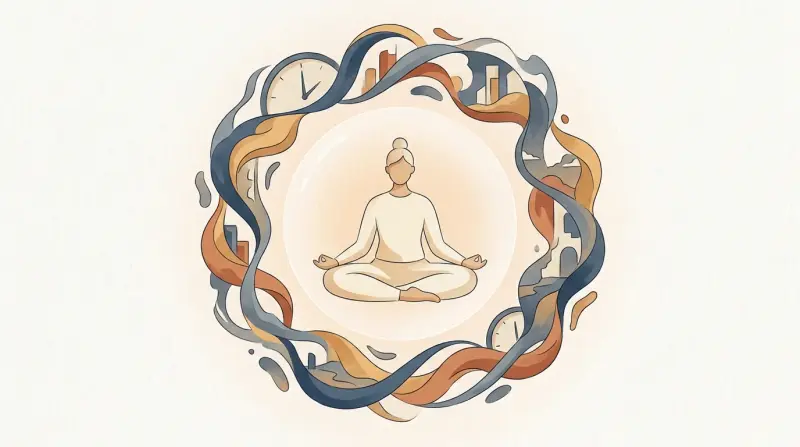
Do you know that feeling when you realize you spent your day functioning more than living? You get things done, you reply, you smile… but a part of you is slightly far away: replaying what has passed, worrying about what’s coming, or chasing an endless to-do list. Mindfulness doesn’t ask you to force your thoughts into silence, nor to become someone else. It’s a gentle invitation to return—maybe for just one minute—to notice your breath, what’s around you, and what’s happening inside you without blame. In this article, we’ll understand why it can be hard to live the present moment, and how to begin practicing mindful presence in realistic, simple steps.
Why Is It Hard for Us to Live the Present Moment?
Our minds are designed to anticipate, plan, and look for danger before it happens—and that’s useful for survival and for organizing life. But when stress intensifies, planning turns into anxiety, and reviewing the past turns into rumination that drains energy. Then the present becomes merely a transit station, not a place we truly live. There’s also the fast-paced rhythm: nonstop notifications, multitasking, and a constant stream of content that makes attention hop around without rest. Over time, we get used to a near-constant state of drifting, so we do things on autopilot—then suddenly realize our days are passing without a clear sense of flavor.
How Does the Mind Pull You Away from the Present Without You Noticing?
This often happens through three gateways: anxiety, rumination, and harsh self-evaluation. Anxiety makes the mind sprint into the future searching for guarantees. Rumination replays the past like a film asking you to re-edit it. And harsh evaluation comments on every moment: Did I say the right thing? Was I enough? These inner voices consume the attention that could have been given to the present.
You may also notice you don’t feel your body until it’s exhausted, and you don’t notice your mood shifting until it bursts. This is where mindfulness matters, because it reconnects what you think with what you feel and what your body needs—without putting yourself on trial for it.
Signs Your Mindful Presence Has Been Weaker These Days
The difficulty may show up in simple but repeated ways, such as:
You read a page, then realize you don’t remember what you read.
You enter a room and forget why you came in, because your mind was elsewhere.
You eat quickly without noticing taste or fullness until after you’re done.
You spend time with someone you love, but feel absent or tense.
Your head sticks to an endless to-do list even during rest.
These signs don’t mean you’re lazy or weak. They may simply mean your psychological system is running above its capacity and needs calming—and retraining.
What Does Mindfulness Actually Mean?
Mindfulness is not an attempt to stop thinking or push feelings away. It is training to notice what is happening now as it is: thoughts passing through, a sensation in the body, a sound in the space, a feeling that rises and then settles. The goal is to notice without being swept away—and to regain your choice in where you place your attention.
NIH explains that focusing on the present is a skill that can be trained, and that mindfulness means noticing what is happening inside you and around you without judgment, and that it can be integrated into daily activities like walking or eating. According to specialists at Tatmeen, what most blocks the start is turning mindfulness into a test for immediate calm. When you expect thoughts to disappear instantly, any drifting becomes “proof” of failure. But in reality, drifting is part of the training—and returning to the present again and again is the essence of the skill.
How Do You Begin Practicing Mindfulness Without Turning It Into a New Pressure?
Start with a small principle: little, but consistent. Choose one moment each day to return to the present, instead of trying to change your whole life all at once. That could be during wudu, while drinking coffee, or before sleep.
Try these simple ways:
A Short Period of Mindful Breathing
Place your attention on the movement of the breath without over-controlling it. Notice the air coming in and going out—and if your mind wanders, bring it back gently. The idea isn’t perfect performance, but repeated return.
The Five Senses Exercise
Notice something you can see, a sound you can hear, a faint scent, a sensation on your skin, and a simple taste. This exercise brings you back from your head into reality quickly and calmly.
Presence in a Daily Activity
Choose a familiar task like washing your hands or making the bed, and try to be present with its details: temperature, texture, movement. These are small practices, but they teach the mind that the present is a livable place.
Finally…
Mindfulness isn’t a luxury, and it isn’t only for “naturally calm” people; it’s a way to retrieve yourself from the daily race of thoughts, one small step at a time. Don’t judge your experience from the first week, and don’t make it a new test of perfection. And if you want flexible, private professional support, you can book a session through Tatmeen so we can help you build a practice that fits your life and your rhythm.
Frequently Asked Questions
Does mindfulness mean emptying the mind of thoughts?
No. Thoughts will continue to appear. The idea is to notice them without clinging to them or immediately believing them, then return to the present through the breath or bodily sensation. Over time, returning becomes easier and gentler.
How long does it take for someone to feel the benefits of mindfulness?
That differs from person to person. Some people notice a small change in calm or attention within days, while others need more time. The best approach is to continue with small, regular “doses” rather than expecting rapid transformation.
What do I do if thoughts or discomfort increase during the exercise?
Soften the practice and make it shorter, and focus on a safe sensation—like your feet on the ground or your natural breathing. If distress is strong or recurring, specialized support can help you choose an appropriate method without forcing yourself.
A writer and researcher specializing in psychiatry, she focuses on mental health and the human emotions we experience but cannot always find the words to name. She writes about us—about humanity and the human experience—and simplifies complex topics to offer content that helps us better understand ourselves and life, ultimately making us feel less alone.
Every Tatmeen article is reviewed by care providers licensed by the Saudi Commission for Health Specialties, so what you read is accurate and trustworthy.
This article builds understanding and does not replace a licensed care provider.
Need someone to talk to?
Tatmeen's licensed care providers are available around the clock, and the app's urgent consultation connects you with one within minutes.
Download Tatmeen to explore care providers and booking options.
Smart matchingFour quick questions suggest the right care provider
Urgent consultationTalk to an available care provider within minutes
Free psychological measuresMore than 20 tests to understand how you are doing
Scan to download
{"data":{"id":"d9e25388-3798-4ae0-bd8a-2dcb7e1227df","slug":"mindfulness-difficulty-living-present-moment","arTitle":"اليقظة الذهنية وصعوبة عيش اللحظة الحالية","enTitle":"Mindfulness and the Difficulty of Living in the Present Moment","thumbnailAltText":"stylized woman figure sitting in a circle representing mindfulness","estimatedReadingTime":5,"likesCount":312,"writer":{"id":"3ab72b74-f26f-4337-9b47-3114b0f90de5","arBio":"كاتبة وباحثة متخصصة في مجال الطب النفسي، تهتم بموضوعات الصحة النفسية وبالمشاعر الإنسانية التي نختبرها ولا نجد دائمًا الكلمات لتسميتها. تكتب عنّا؛ عن الإنسان وتجربته، وتبسّط الموضوعات المعقّدة لتقدّم محتوى يساعدنا على فهم ذواتنا والحياة أكثر، ويجعلنا نشعر بأننا بوحدة أقل.","enBio":"A writer and researcher specializing in psychiatry, she focuses on mental health and the human emotions we experience but cannot always find the words to name. She writes about us—about humanity and the human experience—and simplifies complex topics to offer content that helps us better understand ourselves and life, ultimately making us feel less alone.","user":{"slug":"ayat-alnajar","arFullName":"آيات النجار","enFullName":"Ayat Al-Najjar","publicProfileImageUrl":"https://cdn.tatmeen.sa/public/profile-images/02384455-68fa-40b6-ad05-609fde65cafa/21b9a610dde5dfc6d37af110c23e9c7ab3946be080c281beb000debf4f7d31a6.webp","publicProfileImage96Url":"https://cdn.tatmeen.sa/public/profile-images/02384455-68fa-40b6-ad05-609fde65cafa/21b9a610dde5dfc6d37af110c23e9c7ab3946be080c281beb000debf4f7d31a6-w96.webp","publicProfileImage192Url":"https://cdn.tatmeen.sa/public/profile-images/02384455-68fa-40b6-ad05-609fde65cafa/21b9a610dde5dfc6d37af110c23e9c7ab3946be080c281beb000debf4f7d31a6-w192.webp"}},"arContent":"","enContent":"","productionDocument":{"headings":[{"id":"article-section-why-is-it-hard-for-us-to-live-the-present-moment","text":"Why Is It Hard for Us to Live the Present Moment?"},{"id":"article-section-how-does-the-mind-pull-you-away-from-the-present-without-you-noticing","text":"How Does the Mind Pull You Away from the Present Without You Noticing?"},{"id":"article-section-signs-your-mindful-presence-has-been-weaker-these-days","text":"Signs Your Mindful Presence Has Been Weaker These Days"},{"id":"article-section-what-does-mindfulness-actually-mean","text":"What Does Mindfulness Actually Mean?"},{"id":"article-section-how-do-you-begin-practicing-mindfulness-without-turning-it-into-a-new-pressure","text":"How Do You Begin Practicing Mindfulness Without Turning It Into a New Pressure?"},{"id":"article-section-finally","text":"Finally…"}],"faqs":[{"question":"Does mindfulness mean emptying the mind of thoughts?","answer":"<p><span style=\"color:#000000\">No. Thoughts will continue to appear. The idea is to notice them without clinging to them or immediately believing them, then return to the present through the breath or bodily sensation. Over time, returning becomes easier and gentler.</span></p>"},{"question":"How long does it take for someone to feel the benefits of mindfulness?","answer":"<p><span style=\"color:#000000\">That differs from person to person. Some people notice a small change in calm or attention within days, while others need more time. The best approach is to continue with small, regular “doses” rather than expecting rapid transformation.</span></p>"},{"question":"What do I do if thoughts or discomfort increase during the exercise?","answer":"<p><span style=\"color:#000000\">Soften the practice and make it shorter, and focus on a safe sensation—like your feet on the ground or your natural breathing. If distress is strong or recurring, specialized support can help you choose an appropriate method without forcing yourself.</span></p>"}],"beforeSourcesHtml":"<p></p>","sources":[],"afterSourcesHtml":"","blocks":[{"type":"html","html":"<p><span style=\"color:#000000\">Do you know that feeling when you realize you spent your day <em>functioning</em> more than <em>living</em>? You get things done, you reply, you smile… but a part of you is slightly far away: replaying what has passed, worrying about what’s coming, or chasing an endless to-do list. Mindfulness doesn’t ask you to force your thoughts into silence, nor to become someone else. It’s a gentle invitation to return—maybe for just one minute—to notice your breath, what’s around you, and what’s happening inside you without blame. In this article, we’ll understand why it can be hard to live the present moment, and how to begin practicing mindful presence in realistic, simple steps.</span></p><h2 id=\"article-section-why-is-it-hard-for-us-to-live-the-present-moment\" data-toc-heading tabindex=\"-1\"><span id=\"why-is-it-hard-for-us-to-live-the-present-moment-1\" aria-hidden=\"true\"></span><span style=\"color:#000000\"><strong>Why Is It Hard for Us to Live the Present Moment?</strong></span></h2><p><span style=\"color:#000000\">Our minds are designed to anticipate, plan, and look for danger before it happens—and that’s useful for survival and for organizing life. But when stress intensifies, planning turns into anxiety, and reviewing the past turns into rumination that drains energy. Then the present becomes merely a transit station, not a place we truly live. There’s also the fast-paced rhythm: nonstop notifications, multitasking, and a constant stream of content that makes attention hop around without rest. Over time, we get used to a near-constant state of drifting, so we do things on autopilot—then suddenly realize our days are passing without a clear sense of flavor.</span></p><h2 id=\"article-section-how-does-the-mind-pull-you-away-from-the-present-without-you-noticing\" data-toc-heading tabindex=\"-1\"><span id=\"how-does-the-mind-pull-you-away-from-the-present-without-you-noticing-2\" aria-hidden=\"true\"></span><span style=\"color:#000000\"><strong>How Does the Mind Pull You Away from the Present Without You Noticing?</strong></span></h2><p><span style=\"color:#000000\">This often happens through three gateways: anxiety, rumination, and harsh self-evaluation. Anxiety makes the mind sprint into the future searching for guarantees. Rumination replays the past like a film asking you to re-edit it. And harsh evaluation comments on every moment: Did I say the right thing? Was I enough? These inner voices consume the attention that could have been given to the present.</span></p><p><span style=\"color:#000000\">You may also notice you don’t feel your body until it’s exhausted, and you don’t notice your mood shifting until it bursts. This is where mindfulness matters, because it reconnects what you think with what you feel and what your body needs—without putting yourself on trial for it.</span></p><h2 id=\"article-section-signs-your-mindful-presence-has-been-weaker-these-days\" data-toc-heading tabindex=\"-1\"><span id=\"signs-your-mindful-presence-has-been-weaker-these-days-3\" aria-hidden=\"true\"></span><span style=\"color:#000000\"><strong>Signs Your Mindful Presence Has Been Weaker These Days</strong></span></h2><p><span style=\"color:#000000\">The difficulty may show up in simple but repeated ways, such as:</span></p><ul><li><p><span style=\"color:#000000\">You read a page, then realize you don’t remember what you read.</span></p></li><li><p><span style=\"color:#000000\">You enter a room and forget why you came in, because your mind was elsewhere.</span></p></li><li><p><span style=\"color:#000000\">You eat quickly without noticing taste or fullness until after you’re done.</span></p></li><li><p><span style=\"color:#000000\">You spend time with someone you love, but feel absent or tense.</span></p></li><li><p><span style=\"color:#000000\">Your head sticks to an endless to-do list even during rest.</span></p></li></ul><p><span style=\"color:#000000\">These signs don’t mean you’re lazy or weak. They may simply mean your psychological system is running above its capacity and needs calming—and retraining.</span></p><h2 id=\"article-section-what-does-mindfulness-actually-mean\" data-toc-heading tabindex=\"-1\"><span id=\"what-does-mindfulness-actually-mean-4\" aria-hidden=\"true\"></span><span style=\"color:#000000\"><strong>What Does Mindfulness Actually Mean?</strong></span></h2><p><span style=\"color:#000000\">Mindfulness is not an attempt to stop thinking or push feelings away. It is training to notice what is happening now as it is: thoughts passing through, a sensation in the body, a sound in the space, a feeling that rises and then settles. The goal is to notice without being swept away—and to regain your choice in where you place your attention.</span></p><p><a href=\"https://newsinhealth.nih.gov/2021/06/mindfulness-your-health\" target=\"_blank\" rel=\"nofollow noopener noreferrer\"><span style=\"color:#1155cc\"><u>NIH</u></span></a><span style=\"color:#000000\"> explains that focusing on the present is a skill that can be trained, and that mindfulness means noticing what is happening inside you and around you without judgment, and that it can be integrated into daily activities like walking or eating. According to specialists at <strong>Tatmeen</strong>, what most blocks the start is turning mindfulness into a test for immediate calm. When you expect thoughts to disappear instantly, any drifting becomes “proof” of failure. But in reality, drifting is part of the training—and returning to the present again and again is the essence of the skill.</span></p><h2 id=\"article-section-how-do-you-begin-practicing-mindfulness-without-turning-it-into-a-new-pressure\" data-toc-heading tabindex=\"-1\"><span id=\"how-do-you-begin-practicing-mindfulness-without-turning-it-into-a-new-pressure-5\" aria-hidden=\"true\"></span><span style=\"color:#000000\"><strong>How Do You Begin Practicing Mindfulness Without Turning It Into a New Pressure?</strong></span></h2><p><span style=\"color:#000000\">Start with a small principle: little, but consistent. Choose one moment each day to return to the present, instead of trying to change your whole life all at once. That could be during wudu, while drinking coffee, or before sleep.</span></p><p><span style=\"color:#000000\">Try these simple ways:</span></p><h3><span style=\"color:#000000\"><strong>A Short Period of Mindful Breathing</strong></span></h3><p><span style=\"color:#000000\">Place your attention on the movement of the breath without over-controlling it. Notice the air coming in and going out—and if your mind wanders, bring it back gently. The idea isn’t perfect performance, but repeated return.</span></p><h3><span style=\"color:#000000\"><strong>The Five Senses Exercise</strong></span></h3><p><span style=\"color:#000000\">Notice something you can see, a sound you can hear, a faint scent, a sensation on your skin, and a simple taste. This exercise brings you back from your head into reality quickly and calmly.</span></p><h3><span style=\"color:#000000\"><strong>Presence in a Daily Activity</strong></span></h3><p><span style=\"color:#000000\">Choose a familiar task like washing your hands or making the bed, and try to be present with its details: temperature, texture, movement. These are small practices, but they teach the mind that the present is a livable place.</span></p><h2 id=\"article-section-finally\" data-toc-heading tabindex=\"-1\"><span id=\"finally-6\" aria-hidden=\"true\"></span><span style=\"color:#000000\"><strong>Finally…</strong></span></h2><p><span style=\"color:#000000\">Mindfulness isn’t a luxury, and it isn’t only for “naturally calm” people; it’s a way to retrieve yourself from the daily race of thoughts, one small step at a time. Don’t judge your experience from the first week, and don’t make it a new test of perfection. And if you want flexible, private professional support,<u> you can book a session through </u><strong><u>Tatmeen</u></strong> so we can help you build a practice that fits your life and your rhythm.</span></p>"}],"inlineCtaSignatures":[],"_experienceAliases":{"v":1,"fields":["html","bodyHtml"],"faqs":[0,1,2]}},"createdAt":"2026-04-26T21:00:00.000Z","updatedAt":"2026-06-24T23:51:04.105Z","disorderGroups":[{"id":"d807ea69-44d4-4e81-bee4-0a059fd36645","slug":"self-development","arName":"تنمية الذات","enName":"Self-Development"}],"reviewer":{"arFullName":"فريق تطمين","enFullName":"Tatmeen team","slug":"tatmeen-team","kind":"organization"},"productionArticle":true,"promotionAllowed":true,"preparedCover":{"src":"https://cdn.tatmeen.sa/public/article-lcp/article-lcp-v2/sha256-79faac9136e57ad0d42abe1f0758e8662898c36c88fd5df09fda91eddfeb02cb/800-fb738c2b45f8dd5b0c1dca3b64b2991cde93b70365649b2c858cc4167dd963b4.avif","fallback":"https://cdn.tatmeen.sa/public/article-lcp/article-lcp-v2/sha256-79faac9136e57ad0d42abe1f0758e8662898c36c88fd5df09fda91eddfeb02cb/800-87cf125c7b422a4b2a7d679dddfa898028102b056f30d36339fd4e650df26dc0.webp","directUrl":"https://cdn.tatmeen.sa/blog-cover/Tatmeen-1777306444017.webp","isGolden":true,"avifSrcset":"https://cdn.tatmeen.sa/public/article-lcp/article-lcp-v2/sha256-79faac9136e57ad0d42abe1f0758e8662898c36c88fd5df09fda91eddfeb02cb/400-c8ae8c4d623ae0454e7d47fe793f6ae2da78ec8b250d26e5c874606e0a3fd6a5.avif 400w, https://cdn.tatmeen.sa/public/article-lcp/article-lcp-v2/sha256-79faac9136e57ad0d42abe1f0758e8662898c36c88fd5df09fda91eddfeb02cb/640-82082b360b19e0eeaf2d0bc581950d784a24b8ace39fc0b791dfde60e95b000b.avif 640w, https://cdn.tatmeen.sa/public/article-lcp/article-lcp-v2/sha256-79faac9136e57ad0d42abe1f0758e8662898c36c88fd5df09fda91eddfeb02cb/800-fb738c2b45f8dd5b0c1dca3b64b2991cde93b70365649b2c858cc4167dd963b4.avif 800w, https://cdn.tatmeen.sa/public/article-lcp/article-lcp-v2/sha256-79faac9136e57ad0d42abe1f0758e8662898c36c88fd5df09fda91eddfeb02cb/1200-8ce127fabca6a3129f867f57277f2cc913d0bbdb33bb8daf4834873e04f6aba8.avif 1200w","webpSrcset":"https://cdn.tatmeen.sa/public/article-lcp/article-lcp-v2/sha256-79faac9136e57ad0d42abe1f0758e8662898c36c88fd5df09fda91eddfeb02cb/400-dd17d06e54520e2fa8cf1821117f759d809fec09f844633a18f3471983d972fe.webp 400w, https://cdn.tatmeen.sa/public/article-lcp/article-lcp-v2/sha256-79faac9136e57ad0d42abe1f0758e8662898c36c88fd5df09fda91eddfeb02cb/640-f7c9e5b8739b28188a49a73f60a91108287ee1f264c000af986a3f2e70d5b61d.webp 640w, https://cdn.tatmeen.sa/public/article-lcp/article-lcp-v2/sha256-79faac9136e57ad0d42abe1f0758e8662898c36c88fd5df09fda91eddfeb02cb/800-87cf125c7b422a4b2a7d679dddfa898028102b056f30d36339fd4e650df26dc0.webp 800w, https://cdn.tatmeen.sa/public/article-lcp/article-lcp-v2/sha256-79faac9136e57ad0d42abe1f0758e8662898c36c88fd5df09fda91eddfeb02cb/1200-ca68b638e4a0f631fa0f8220eeaf38cdf1db04995e828ecc7171fbc1a5528d7d.webp 1200w","phoneAvifSrcset":"https://cdn.tatmeen.sa/public/article-lcp/article-lcp-v2/sha256-79faac9136e57ad0d42abe1f0758e8662898c36c88fd5df09fda91eddfeb02cb/400-c8ae8c4d623ae0454e7d47fe793f6ae2da78ec8b250d26e5c874606e0a3fd6a5.avif 400w, https://cdn.tatmeen.sa/public/article-lcp/article-lcp-v2/sha256-79faac9136e57ad0d42abe1f0758e8662898c36c88fd5df09fda91eddfeb02cb/640-82082b360b19e0eeaf2d0bc581950d784a24b8ace39fc0b791dfde60e95b000b.avif 640w, https://cdn.tatmeen.sa/public/article-lcp/article-lcp-v2/sha256-79faac9136e57ad0d42abe1f0758e8662898c36c88fd5df09fda91eddfeb02cb/800-fb738c2b45f8dd5b0c1dca3b64b2991cde93b70365649b2c858cc4167dd963b4.avif 800w","phoneWebpSrcset":"https://cdn.tatmeen.sa/public/article-lcp/article-lcp-v2/sha256-79faac9136e57ad0d42abe1f0758e8662898c36c88fd5df09fda91eddfeb02cb/400-dd17d06e54520e2fa8cf1821117f759d809fec09f844633a18f3471983d972fe.webp 400w, https://cdn.tatmeen.sa/public/article-lcp/article-lcp-v2/sha256-79faac9136e57ad0d42abe1f0758e8662898c36c88fd5df09fda91eddfeb02cb/640-f7c9e5b8739b28188a49a73f60a91108287ee1f264c000af986a3f2e70d5b61d.webp 640w, https://cdn.tatmeen.sa/public/article-lcp/article-lcp-v2/sha256-79faac9136e57ad0d42abe1f0758e8662898c36c88fd5df09fda91eddfeb02cb/800-87cf125c7b422a4b2a7d679dddfa898028102b056f30d36339fd4e650df26dc0.webp 800w","width":800,"height":447},"previewTaxonomy":{"groups":[{"id":"d807ea69-44d4-4e81-bee4-0a059fd36645","slug":"self-development","arName":"تنمية الذات","enName":"Self-Development"}],"topics":[{"id":"12d3f617-fbdf-4a76-9b59-bcf5a6cce447","slug":"mindfulness","arName":"اليقظة الذهنية","enName":"Mindfulness","groupSlug":"self-development","href":"/blog/category/self-development/mindfulness/"}],"tags":[{"id":"c6f3b756-bd7d-4a70-ab6c-fc7a2ce44532","slug":"meditation-mindfulness","arName":"التأمل واليقظة الذهنية","enName":"Meditation & Mindfulness"},{"id":"9d6e68c1-9bb5-4364-a082-963aaf55f77f","slug":"burnout-stress","arName":"الاحتراق والإرهاق والضغط النفسي","enName":"Burnout Fatigue & Stress"},{"id":"c2a6e8d3-de9c-435f-8c95-9727e7db14cc","slug":"explainer-awareness","arName":"دليل توعوي / شرح","enName":"Explainer / Awareness Guide"}]},"previewProviderRecommendations":[{"id":"7771d078-cbd9-4acd-aa51-29cc905753c4","slug":"hatim-jafaari-2902","arFullName":"حاتم جعفرى","enFullName":"Hatim Jafaari","publicProfileImageUrl":"https://cdn.tatmeen.sa/public/profile-images/7771d078-cbd9-4acd-aa51-29cc905753c4/874a489ca72b87dacbde76d8496eef84ca341ee8074b9ec54464cd0a56bbdbe6.webp","publicProfileImage96Url":"https://cdn.tatmeen.sa/public/profile-images/7771d078-cbd9-4acd-aa51-29cc905753c4/874a489ca72b87dacbde76d8496eef84ca341ee8074b9ec54464cd0a56bbdbe6-w96.webp","publicProfileImage192Url":"https://cdn.tatmeen.sa/public/profile-images/7771d078-cbd9-4acd-aa51-29cc905753c4/874a489ca72b87dacbde76d8496eef84ca341ee8074b9ec54464cd0a56bbdbe6-w192.webp","specialization":{"arName":"أخصائي نفسي","enName":"Psychologist"},"profileImageUrl":"https://cdn.tatmeen.sa/public/profile-images/7771d078-cbd9-4acd-aa51-29cc905753c4/874a489ca72b87dacbde76d8496eef84ca341ee8074b9ec54464cd0a56bbdbe6-w192.webp","experienceYears":2,"consultantInfo":{"averageRating":{"average":5},"specialization":{"arGeneralName":"أخصائي نفسي","enGeneralName":"Psychologist"}}},{"id":"5520abac-2d83-4b20-a11d-f63055316699","slug":"maha-alawad-4831","arFullName":"مها العواد","enFullName":"Maha Alawad","publicProfileImageUrl":"","publicProfileImage96Url":"","publicProfileImage192Url":"","specialization":{"arName":"أخصائي نفسي","enName":"Psychologist"},"profileImageUrl":"","experienceYears":13,"consultantInfo":{"averageRating":{"average":4.846153846153846},"specialization":{"arGeneralName":"أخصائي نفسي","enGeneralName":"Psychologist"}}},{"id":"a4a1f8a4-87a7-4447-8667-0bbf3fae006a","slug":"ghadah-alghamdi-2904","arFullName":"غاده الغامدي","enFullName":"Ghadah Alghamdi","publicProfileImageUrl":"","publicProfileImage96Url":"","publicProfileImage192Url":"","specialization":{"arName":"أخصائي نفسي","enName":"Psychologist"},"profileImageUrl":"","experienceYears":18,"consultantInfo":{"averageRating":{"average":0},"specialization":{"arGeneralName":"أخصائي نفسي","enGeneralName":"Psychologist"}}}],"previewCareProviders":[{"id":"09364052-c2a9-4c52-9717-7ce2093b8d0a","slug":"kholoud-alharbi-5221","arFullName":"خلود الحربي","enFullName":"Kholoud Alharbi","publicProfileImageUrl":"https://cdn.tatmeen.sa/public/profile-images/09364052-c2a9-4c52-9717-7ce2093b8d0a/4a0aeb81619e351b77f4323e3605a0a00acc7ca3c82ee7cc5ca2c9e8ef716049.webp","publicProfileImage96Url":"https://cdn.tatmeen.sa/public/profile-images/09364052-c2a9-4c52-9717-7ce2093b8d0a/4a0aeb81619e351b77f4323e3605a0a00acc7ca3c82ee7cc5ca2c9e8ef716049-w96.webp","publicProfileImage192Url":"https://cdn.tatmeen.sa/public/profile-images/09364052-c2a9-4c52-9717-7ce2093b8d0a/4a0aeb81619e351b77f4323e3605a0a00acc7ca3c82ee7cc5ca2c9e8ef716049-w192.webp","gender":"FEMALE","specialization":{"arName":"أخصائي نفسي","enName":"Psychologist"}},{"id":"6f037535-1dca-4b50-a8b2-5974b7323286","slug":"salah-althobaiti-9053","arFullName":"صلاح الثبيتي","enFullName":"Salah Althobaiti","publicProfileImageUrl":"https://cdn.tatmeen.sa/public/profile-images/6f037535-1dca-4b50-a8b2-5974b7323286/35b6bd7fad9b1e004c1835803eb9c1b56dcacd380685ec8bff141f0fb888005c.webp","publicProfileImage96Url":"https://cdn.tatmeen.sa/public/profile-images/6f037535-1dca-4b50-a8b2-5974b7323286/35b6bd7fad9b1e004c1835803eb9c1b56dcacd380685ec8bff141f0fb888005c-w96.webp","publicProfileImage192Url":"https://cdn.tatmeen.sa/public/profile-images/6f037535-1dca-4b50-a8b2-5974b7323286/35b6bd7fad9b1e004c1835803eb9c1b56dcacd380685ec8bff141f0fb888005c-w192.webp","gender":"MALE","specialization":{"arName":"أخصائي نفسي","enName":"Psychologist"}},{"id":"3cc806e8-616b-4884-9f21-a75b378580a2","slug":"aisha-al-hashim-8667","arFullName":"عائشة ال هاشم","enFullName":"Aisha Al Hashim","publicProfileImageUrl":"https://cdn.tatmeen.sa/public/profile-images/3cc806e8-616b-4884-9f21-a75b378580a2/27f523d03be4dcfa1f6a79f70c1773887434e698990d214cd990caec56a44798.webp","publicProfileImage96Url":"https://cdn.tatmeen.sa/public/profile-images/3cc806e8-616b-4884-9f21-a75b378580a2/27f523d03be4dcfa1f6a79f70c1773887434e698990d214cd990caec56a44798-w96.webp","publicProfileImage192Url":"https://cdn.tatmeen.sa/public/profile-images/3cc806e8-616b-4884-9f21-a75b378580a2/27f523d03be4dcfa1f6a79f70c1773887434e698990d214cd990caec56a44798-w192.webp","gender":"FEMALE","specialization":{"arName":"أخصائي نفسي","enName":"Psychologist"}},{"id":"db2ce1a0-9325-4471-b7ce-eb2e811c30a3","slug":"amer-qutub-2441","arFullName":"عامر قطب","enFullName":"Amer Qutub","publicProfileImageUrl":"https://cdn.tatmeen.sa/public/profile-images/db2ce1a0-9325-4471-b7ce-eb2e811c30a3/80580f99bfd7fe2b2a9cf8eed73ab532f5086d1efe053b0aa57358c1ce004261.webp","publicProfileImage96Url":"https://cdn.tatmeen.sa/public/profile-images/db2ce1a0-9325-4471-b7ce-eb2e811c30a3/80580f99bfd7fe2b2a9cf8eed73ab532f5086d1efe053b0aa57358c1ce004261-w96.webp","publicProfileImage192Url":"https://cdn.tatmeen.sa/public/profile-images/db2ce1a0-9325-4471-b7ce-eb2e811c30a3/80580f99bfd7fe2b2a9cf8eed73ab532f5086d1efe053b0aa57358c1ce004261-w192.webp","gender":"MALE","specialization":{"arName":"أخصائي نفسي","enName":"Psychologist"}},{"id":"94765496-dbdf-4631-a01b-7df5f788668d","slug":"abdullrahman-alhamoudi-3045","arFullName":"عبدالرحمن الحمودي","enFullName":"Abdulrahman Alhamoudi","publicProfileImageUrl":"https://cdn.tatmeen.sa/public/profile-images/94765496-dbdf-4631-a01b-7df5f788668d/2d49f6b6493c564afb6f50b6c3634231dff3a5cf8353acfab393d1b2a88037d1.webp","publicProfileImage96Url":"https://cdn.tatmeen.sa/public/profile-images/94765496-dbdf-4631-a01b-7df5f788668d/2d49f6b6493c564afb6f50b6c3634231dff3a5cf8353acfab393d1b2a88037d1-w96.webp","publicProfileImage192Url":"https://cdn.tatmeen.sa/public/profile-images/94765496-dbdf-4631-a01b-7df5f788668d/2d49f6b6493c564afb6f50b6c3634231dff3a5cf8353acfab393d1b2a88037d1-w192.webp","gender":"MALE","specialization":{"arName":"أخصائي نفسي","enName":"Psychologist"}},{"id":"618dba89-5b70-4b46-8304-741b7ac8ecd3","slug":"abdullah-mari-1311","arFullName":"عبدالله مرعي","enFullName":"Abdullah Mari","publicProfileImageUrl":"https://cdn.tatmeen.sa/public/profile-images/618dba89-5b70-4b46-8304-741b7ac8ecd3/6b4a3bfb59f8a304ca79083b32859b46baad2e1d692974a47c02c1f66bd11129.webp","publicProfileImage96Url":"https://cdn.tatmeen.sa/public/profile-images/618dba89-5b70-4b46-8304-741b7ac8ecd3/6b4a3bfb59f8a304ca79083b32859b46baad2e1d692974a47c02c1f66bd11129-w96.webp","publicProfileImage192Url":"https://cdn.tatmeen.sa/public/profile-images/618dba89-5b70-4b46-8304-741b7ac8ecd3/6b4a3bfb59f8a304ca79083b32859b46baad2e1d692974a47c02c1f66bd11129-w192.webp","gender":"MALE","specialization":{"arName":"أخصائي نفسي","enName":"Psychologist"}},{"id":"3b50a5d5-e795-407f-8676-fd7f0e1bb7a0","slug":"abdulaziz-bin-hudayan-4940","arFullName":"عبدالعزيز بن هديان","enFullName":"Abdulaziz Bin Hudayan","publicProfileImageUrl":"https://cdn.tatmeen.sa/public/profile-images/3b50a5d5-e795-407f-8676-fd7f0e1bb7a0/710ff0fe1fb00cdb5042092e27b7910b480a439b02251ecded62d7758eefce95.webp","publicProfileImage96Url":"https://cdn.tatmeen.sa/public/profile-images/3b50a5d5-e795-407f-8676-fd7f0e1bb7a0/710ff0fe1fb00cdb5042092e27b7910b480a439b02251ecded62d7758eefce95-w96.webp","publicProfileImage192Url":"https://cdn.tatmeen.sa/public/profile-images/3b50a5d5-e795-407f-8676-fd7f0e1bb7a0/710ff0fe1fb00cdb5042092e27b7910b480a439b02251ecded62d7758eefce95-w192.webp","gender":"MALE","specialization":{"arName":"أخصائي نفسي","enName":"Psychologist"}},{"id":"d4ffcb6b-90a7-45b6-b941-964866f4564b","slug":"dhaifallah-alhumaidi-1092","arFullName":"ضيف الله الحميدي","enFullName":"Dhaifallah Alhumaidi","publicProfileImageUrl":"https://cdn.tatmeen.sa/public/profile-images/d4ffcb6b-90a7-45b6-b941-964866f4564b/1817171c5828a9b57d6c30d12332cf154e335272548bc90a6e8456d74d356956.webp","publicProfileImage96Url":"https://cdn.tatmeen.sa/public/profile-images/d4ffcb6b-90a7-45b6-b941-964866f4564b/1817171c5828a9b57d6c30d12332cf154e335272548bc90a6e8456d74d356956-w96.webp","publicProfileImage192Url":"https://cdn.tatmeen.sa/public/profile-images/d4ffcb6b-90a7-45b6-b941-964866f4564b/1817171c5828a9b57d6c30d12332cf154e335272548bc90a6e8456d74d356956-w192.webp","gender":"MALE","specialization":{"arName":"أخصائي نفسي","enName":"Psychologist"}}],"previewDownload":{"href":"/download","title":{"ar":"خطوة واحدة لأجلك، ابدأ الآن","en":"One step for you, start now"},"description":{"ar":"حمّل تطبيق تطمين لاستكشاف مقدمي الرعاية وخيارات الحجز.","en":"Download Tatmeen to explore care providers and booking options."},"posterSrc":"/images/home/cta-ar-new-1.webp","videoSrc":"/images/home/cta-ar-new-1.mp4","videoPosterSrc":"/images/home/cta-ar-new-1.webp","videoPosterEnSrc":"/images/home/cta-en-new-1.webp","videoType":"video/mp4","appStoreHref":"https://apps.apple.com/us/app/tatmeen-%D8%AA%D8%B7%D9%85%D9%8A%D9%86/id6473836983","googlePlayHref":"https://play.google.com/store/apps/details?id=com.TatmeenApp.user&hl=en"},"previewRelatedArticles":[{"id":"97910767-5650-4491-838f-c1d6e4495514","slug":"Benefits-of-mindfulness-meditation","route":"/blog/Benefits-of-mindfulness-meditation/","title":{"ar":"التأمل الواعي: ما هي فوائد التأمل الواعي؟","en":"Mindfulness Meditation: What Are Its Benefits?"},"image":"https://cdn.tatmeen.sa/public/article-lcp/article-lcp-v2/sha256-90e787892e6a5fad12ad6a18dc0ab19f3229f729ea19b8ab45da19da2216a7d9/600-d2d7328caabbeb6c658012b1fe4eebd3ae457462ac059759f9ea753c0a6b465e.webp","directImageFallback":"https://cdn.tatmeen.sa/blog-cover/1704731632007-Tatmeen-img-855","arThumbnailAltText":"Person sitting cross-legged with arms extended beside a sunlit lake","thumbnailAltText":"Person sitting cross-legged with arms extended beside a sunlit lake","topic":{"label":{"ar":"تنمية الذات","en":"Self-Development"}},"readingTimeMinutes":5},{"id":"a6b05fc6-1280-4a8a-b60d-f7a9e6dadefb","slug":"Benefits-of-meditation-for-the-mind-and-body","route":"/blog/Benefits-of-meditation-for-the-mind-and-body/","title":{"ar":"فوائد التأمل للعقل والجسم","en":"Benefits of Meditation for the Mind and Body"},"image":"https://cdn.tatmeen.sa/public/article-lcp/article-lcp-v2/sha256-9081a5c8e488f1d98967d3d0f24bb5da1efd9cb8e9708f909f49056e66862cb3/600-c842cdd237e77b9d1f038112b1ee582daf43050c5888db8abcc973e9892c63ae.webp","directImageFallback":"https://cdn.tatmeen.sa/blog-cover/1704731885037-Tatmeen-img-721","arThumbnailAltText":"Person sits cross-legged with one hand resting on a knee beside the sea","thumbnailAltText":"Person sits cross-legged with one hand resting on a knee beside the sea","topic":{"label":{"ar":"تنمية الذات","en":"Self-Development"}},"readingTimeMinutes":5},{"id":"e405107a-ccc4-459f-9fc3-c611e5c2a09e","slug":"porn-addiction-treatment-self-help-specialist","route":"/blog/porn-addiction-treatment-self-help-specialist/","title":{"ar":"علاج إدمان الإباحية: خطوات تساعدك ومتى تحتاج مختصًا؟","en":"Porn Addiction Treatment: Helpful Steps and When to See a Specialist"},"image":"https://cdn.tatmeen.sa/public/article-lcp/article-lcp-v2/sha256-16c581aef7167e6b1c4ad466c039cd2931a6835c287f7108e24fb86edb516c15/800-0fae8acd6469f00a009077aae85fb5e3cee8fa52e8d4854ed9466ba74b70fc03.webp","directImageFallback":"https://cdn.tatmeen.sa/blog-cover/Tatmeen-1780941367354.webp","arThumbnailAltText":"Helping hands reaching across abstract shapes, symbolizing support and addiction recovery.","thumbnailAltText":"Helping hands reaching across abstract shapes, symbolizing support and addiction recovery.","topic":{"label":{"ar":"الإدمان والسلوكيات القهرية","en":"Addictions & Compulsive Behaviors"}},"readingTimeMinutes":5},{"id":"0301e07e-6c8b-4f00-abc2-599192644e12","slug":"difference-between-psychotherapist-and-life-coach","route":"/blog/difference-between-psychotherapist-and-life-coach/","title":{"ar":"الفرق بين المعالج النفسي واللايف كوتش","en":"The Difference Between a Psychotherapist and a Life Coach"},"image":"https://cdn.tatmeen.sa/public/article-lcp/article-lcp-v2/sha256-ab7b0f7151c048b72b2dbef25adfc9193ed7d948b07dfab7fde23681c35dd11b/800-172b8668e37dfd0e109e7b49bf8ac2dcd07ddd4ffddd8ab7e00b690fdfc002b3.webp","directImageFallback":"https://cdn.tatmeen.sa/blog-cover/Tatmeen-1783100322572.webp","arThumbnailAltText":"Two women sit facing each other as blue chaos transforms into warm, calm growth","thumbnailAltText":"Two women sit facing each other as blue chaos transforms into warm, calm growth","topic":{"label":{"ar":"اضطرابات نفسية شائعة","en":"Common Mental Issues"}},"readingTimeMinutes":5}],"previewRelatedReadStates":{}},"locale":"en","device":"desktop","path":"/en/blog/mindfulness-difficulty-living-present-moment/","readingControls":false,"config":{"public":{"BUCKET_URL":"https://cdn.tatmeen.sa/","APP_BASE_URL":"https://tatmeen.sa","intercomAppId":"ppcnu9e3"}}}