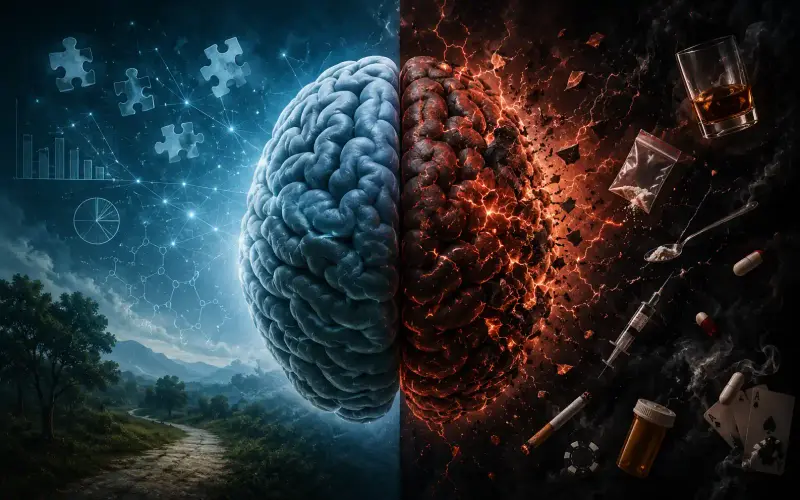
Addiction goes beyond being merely a lack of willpower; it is deeply connected to significant changes within the brain that affect thoughts, emotions, and behaviors. The addicted mind develops neural pathways that create intense cravings for a substance or activity, often beyond conscious control. Without understanding how these changes occur, we risk misunderstanding addiction—and consequently losing direction toward effective solutions.
This article provides a reassuring explanation of how the brain operates under the influence of addiction, and how awareness of these mechanisms can support recovery and help individuals break free from the cycle.
Why Does the Brain Shift Toward Addictive Behavior?
Under normal conditions, the brain works to maintain chemical and neurological balance. However, according to experts, when a person engages excessively with a substance or behavior (such as gambling), the brain begins to rewire its reward system. This leads to continuous reinforcement of immediate pleasure, accompanied by a decline in the ability to control impulses.
The Role of the Reward System
The brain releases dopamine, a neurotransmitter responsible for feelings of pleasure and reward. Typically, dopamine motivates us to perform essential activities like eating or socializing. In addiction, however, dopamine release becomes abnormally elevated, turning the pursuit of pleasure into an obsession—often at the expense of daily responsibilities and healthy activities.
How Does Addiction Take Control of the Brain?
Addiction causes major changes in several key brain regions:
Prefrontal Cortex: Responsible for decision-making and self-control. Its function weakens, reducing the ability to resist urges.
Amygdala: Linked to emotional responses. In addiction, it becomes highly reactive to addiction-related cues while becoming less responsive to other positive stimuli.
Hippocampus: Stores memories associated with pleasurable experiences related to the substance or behavior, intensifying positive feelings when thinking about it.
When these neurological changes combine, quitting the substance or behavior becomes extremely challenging and requires structured psychological and behavioral support.
Decline in Self-Control
Repeated exposure to excessive dopamine reduces the brain’s ability to prioritize and distinguish between real needs and compulsive desires. As a result, individuals continue harmful behaviors despite being fully aware of the negative health and social consequences.
What Drives the Brain to Repeat the Cycle?
Paradoxically, addiction functions like a “clever shortcut” in the brain—offering immediate pleasure or escape from stress. This drives repeated behavior in pursuit of dopamine highs, reinforcing the cycle as if it were a “survival pathway.”
Temporary Euphoria: Addiction creates a false sense of happiness or relief, encouraging repetition.
Psychological Attachment: Over time, addiction becomes a core part of a person’s identity, serving as the primary outlet for emotional expression.
For many, it begins as a casual experiment or form of entertainment, but the brain makes it difficult to step back, turning addiction into a persistent reality unless proper treatment and a supportive environment are introduced.
Can the Addicted Brain Recover?
Some believe addiction is permanent, but experts agree that the brain can rebuild and reshape its neural pathways with the right support and determination. The brain can regain balance after a period of abstinence, especially when supported by therapeutic approaches such as Cognitive Behavioral Therapy (CBT) and, in some cases, medication-assisted treatment.
Self-Compassion: Guilt can hinder recovery, while self-acceptance promotes stability.
Behavioral Replacement: Engaging in healthy activities that naturally boost dopamine, such as exercise or creative hobbies.
Psychological and Environmental Support: Essential to reduce relapse triggers, with family, friends, and support groups playing a crucial role.
The Importance of Ongoing Treatment Programs
Due to the complex nature of the addicted brain, recovery requires a continuous treatment plan rather than a one-time intervention. Monitoring behavior and managing triggers may take months or even years after stopping substance use.
Key components of successful treatment include:
Gradual Progress: Addiction rarely ends overnight; reducing use or modifying behavior is often more realistic.
Follow-Up Sessions: Continuous evaluation and adjustment to maintain progress.
Family Involvement: Educating family members to provide support without judgment.
This alignment of roles strengthens the individual’s resilience, especially during periods of low motivation or increased temptation.
Final Thoughts
This cycle is not the end of the road. With informed treatment, behavioral tools, and a supportive environment, the brain can regain balance and break free from addiction.
Tatmeen offers comprehensive recovery programs—from diagnosis to aftercare—reducing logistical barriers such as distance and time through video, audio, or text-based sessions. This allows individuals to connect instantly with qualified specialists for ongoing support.
Book your psychological consultation today with Tatmeen, and give yourself—and your loved ones—a chance at a better life.
Frequently Asked Questions
Can a person fully recover from addiction, or does the brain remain “addicted” forever?
While addiction may leave long-term imprints on certain neural circuits, the brain has the ability to gradually rewire and adapt. With consistent commitment to treatment and psychological support, the risk of relapse can be significantly reduced over time.
How can I cope with strong urges to return to addictive behavior?
Utilizing techniques such as delay (postponing the action), distraction (shifting attention), and practicing relaxation exercises can help you manage the initial impulse. If stress intensifies, it is advisable to consult a specialized therapist or join a support group.
Do medications help restore balance in a brain affected by addiction?
In certain cases, physicians may prescribe medications to ease withdrawal symptoms or improve overall mood. However, effective treatment always requires combining medication with behavioral changes and ongoing psychological support to ensure successful recovery.
A writer and researcher specializing in psychiatry, she focuses on mental health and the human emotions we experience but cannot always find the words to name. She writes about us—about humanity and the human experience—and simplifies complex topics to offer content that helps us better understand ourselves and life, ultimately making us feel less alone.
Every Tatmeen article is reviewed by care providers licensed by the Saudi Commission for Health Specialties, so what you read is accurate and trustworthy.
This article builds understanding and does not replace a licensed care provider.
Need someone to talk to?
Tatmeen's licensed care providers are available around the clock, and the app's urgent consultation connects you with one within minutes.
Download Tatmeen to explore care providers and booking options.
Smart matchingFour quick questions suggest the right care provider
Urgent consultationTalk to an available care provider within minutes
Free psychological measuresMore than 20 tests to understand how you are doing
Scan to download
{"data":{"id":"a3743355-382b-4308-8c9f-4532676b78d4","slug":"how-addicted-brain-works","arTitle":"كيف يعمل العقل البشري الذي تغلب عليه الإدمان","enTitle":"How the Addicted Brain Works","thumbnailAltText":"an illustration of a human brain split in half one half is healthy and the other half is in shambles due to addiction","estimatedReadingTime":5,"likesCount":327,"writer":{"id":"3ab72b74-f26f-4337-9b47-3114b0f90de5","arBio":"كاتبة وباحثة متخصصة في مجال الطب النفسي، تهتم بموضوعات الصحة النفسية وبالمشاعر الإنسانية التي نختبرها ولا نجد دائمًا الكلمات لتسميتها. تكتب عنّا؛ عن الإنسان وتجربته، وتبسّط الموضوعات المعقّدة لتقدّم محتوى يساعدنا على فهم ذواتنا والحياة أكثر، ويجعلنا نشعر بأننا بوحدة أقل.","enBio":"A writer and researcher specializing in psychiatry, she focuses on mental health and the human emotions we experience but cannot always find the words to name. She writes about us—about humanity and the human experience—and simplifies complex topics to offer content that helps us better understand ourselves and life, ultimately making us feel less alone.","user":{"slug":"ayat-alnajar","arFullName":"آيات النجار","enFullName":"Ayat Al-Najjar","publicProfileImageUrl":"https://cdn.tatmeen.sa/public/profile-images/02384455-68fa-40b6-ad05-609fde65cafa/21b9a610dde5dfc6d37af110c23e9c7ab3946be080c281beb000debf4f7d31a6.webp","publicProfileImage96Url":"https://cdn.tatmeen.sa/public/profile-images/02384455-68fa-40b6-ad05-609fde65cafa/21b9a610dde5dfc6d37af110c23e9c7ab3946be080c281beb000debf4f7d31a6-w96.webp","publicProfileImage192Url":"https://cdn.tatmeen.sa/public/profile-images/02384455-68fa-40b6-ad05-609fde65cafa/21b9a610dde5dfc6d37af110c23e9c7ab3946be080c281beb000debf4f7d31a6-w192.webp"}},"arContent":"","enContent":"","productionDocument":{"headings":[{"id":"article-section-why-does-the-brain-shift-toward-addictive-behavior","text":"Why Does the Brain Shift Toward Addictive Behavior?"},{"id":"article-section-the-role-of-the-reward-system","text":"The Role of the Reward System"},{"id":"article-section-how-does-addiction-take-control-of-the-brain","text":"How Does Addiction Take Control of the Brain?"},{"id":"article-section-decline-in-self-control","text":"Decline in Self-Control"},{"id":"article-section-what-drives-the-brain-to-repeat-the-cycle","text":"What Drives the Brain to Repeat the Cycle?"},{"id":"article-section-can-the-addicted-brain-recover","text":"Can the Addicted Brain Recover?"},{"id":"article-section-the-importance-of-ongoing-treatment-programs","text":"The Importance of Ongoing Treatment Programs"},{"id":"article-section-final-thoughts","text":"Final Thoughts"}],"faqs":[{"question":"Can a person fully recover from addiction, or does the brain remain “addicted” forever?","answer":"<p>While addiction may leave long-term imprints on certain neural circuits, the brain has the ability to gradually rewire and adapt. With consistent commitment to treatment and psychological support, the risk of relapse can be significantly reduced over time.</p>"},{"question":"How can I cope with strong urges to return to addictive behavior?","answer":"<p>Utilizing techniques such as <em>delay</em> (postponing the action), <em>distraction</em> (shifting attention), and practicing relaxation exercises can help you manage the initial impulse. If stress intensifies, it is advisable to consult a specialized therapist or join a support group.</p>"},{"question":"Do medications help restore balance in a brain affected by addiction?","answer":"<p>In certain cases, physicians may prescribe medications to ease withdrawal symptoms or improve overall mood. However, effective treatment always requires combining medication with behavioral changes and ongoing psychological support to ensure successful recovery.</p>"}],"beforeSourcesHtml":"<p></p>","sources":[],"afterSourcesHtml":"","blocks":[{"type":"html","html":"<p>Addiction goes beyond being merely a lack of willpower; it is deeply connected to significant changes within the brain that affect thoughts, emotions, and behaviors. The addicted mind develops neural pathways that create intense cravings for a substance or activity, often beyond conscious control. Without understanding how these changes occur, we risk misunderstanding addiction—and consequently losing direction toward effective solutions.</p><p>This article provides a reassuring explanation of how the brain operates under the influence of addiction, and how awareness of these mechanisms can support recovery and help individuals break free from the cycle.</p><h2 id=\"article-section-why-does-the-brain-shift-toward-addictive-behavior\" data-toc-heading tabindex=\"-1\"><span id=\"why-does-the-brain-shift-toward-addictive-behavior-1\" aria-hidden=\"true\"></span>Why Does the Brain Shift Toward Addictive Behavior?</h2><p>Under normal conditions, the brain works to maintain chemical and neurological balance. However, according to experts, when a person engages excessively with a substance or behavior (such as gambling), the brain begins to rewire its reward system. This leads to continuous reinforcement of immediate pleasure, accompanied by a decline in the ability to control impulses.</p><h2 id=\"article-section-the-role-of-the-reward-system\" data-toc-heading tabindex=\"-1\"><span id=\"the-role-of-the-reward-system-2\" aria-hidden=\"true\"></span>The Role of the Reward System</h2><p>The brain releases dopamine, a neurotransmitter responsible for feelings of pleasure and reward. Typically, dopamine motivates us to perform essential activities like eating or socializing. In addiction, however, dopamine release becomes abnormally elevated, turning the pursuit of pleasure into an obsession—often at the expense of daily responsibilities and healthy activities.</p><h2 id=\"article-section-how-does-addiction-take-control-of-the-brain\" data-toc-heading tabindex=\"-1\"><span id=\"how-does-addiction-take-control-of-the-brain-3\" aria-hidden=\"true\"></span>How Does Addiction Take Control of the Brain?</h2><p>Addiction causes major changes in several key brain regions:</p><ul><li><p><strong>Prefrontal Cortex:</strong> Responsible for decision-making and self-control. Its function weakens, reducing the ability to resist urges.</p></li><li><p><strong>Amygdala:</strong> Linked to emotional responses. In addiction, it becomes highly reactive to addiction-related cues while becoming less responsive to other positive stimuli.</p></li><li><p><strong>Hippocampus:</strong> Stores memories associated with pleasurable experiences related to the substance or behavior, intensifying positive feelings when thinking about it.</p></li></ul><p>When these neurological changes combine, quitting the substance or behavior becomes extremely challenging and requires structured psychological and behavioral support.</p><h2 id=\"article-section-decline-in-self-control\" data-toc-heading tabindex=\"-1\"><span id=\"decline-in-self-control-4\" aria-hidden=\"true\"></span>Decline in Self-Control</h2><p>Repeated exposure to excessive dopamine reduces the brain’s ability to prioritize and distinguish between real needs and compulsive desires. As a result, individuals continue harmful behaviors despite being fully aware of the negative health and social consequences.</p><h2 id=\"article-section-what-drives-the-brain-to-repeat-the-cycle\" data-toc-heading tabindex=\"-1\"><span id=\"what-drives-the-brain-to-repeat-the-cycle-5\" aria-hidden=\"true\"></span>What Drives the Brain to Repeat the Cycle?</h2><p>Paradoxically, addiction functions like a “clever shortcut” in the brain—offering immediate pleasure or escape from stress. This drives repeated behavior in pursuit of dopamine highs, reinforcing the cycle as if it were a “survival pathway.”</p><ul><li><p><strong>Temporary Euphoria:</strong> Addiction creates a false sense of happiness or relief, encouraging repetition.</p></li><li><p><strong>Psychological Attachment:</strong> Over time, addiction becomes a core part of a person’s identity, serving as the primary outlet for emotional expression.</p></li></ul><p>For many, it begins as a casual experiment or form of entertainment, but the brain makes it difficult to step back, turning addiction into a persistent reality unless proper treatment and a supportive environment are introduced.</p><h2 id=\"article-section-can-the-addicted-brain-recover\" data-toc-heading tabindex=\"-1\"><span id=\"can-the-addicted-brain-recover-6\" aria-hidden=\"true\"></span>Can the Addicted Brain Recover?</h2><p>Some believe addiction is permanent, but experts agree that the brain can rebuild and reshape its neural pathways with the right support and determination. The brain can regain balance after a period of abstinence, especially when supported by therapeutic approaches such as Cognitive Behavioral Therapy (CBT) and, in some cases, medication-assisted treatment.</p><ul><li><p><strong>Self-Compassion:</strong> Guilt can hinder recovery, while self-acceptance promotes stability.</p></li><li><p><strong>Behavioral Replacement:</strong> Engaging in healthy activities that naturally boost dopamine, such as exercise or creative hobbies.</p></li><li><p><strong>Psychological and Environmental Support:</strong> Essential to reduce relapse triggers, with family, friends, and support groups playing a crucial role.</p></li></ul><h2 id=\"article-section-the-importance-of-ongoing-treatment-programs\" data-toc-heading tabindex=\"-1\"><span id=\"the-importance-of-ongoing-treatment-programs-7\" aria-hidden=\"true\"></span>The Importance of Ongoing Treatment Programs</h2><p>Due to the complex nature of the addicted brain, recovery requires a continuous treatment plan rather than a one-time intervention. Monitoring behavior and managing triggers may take months or even years after stopping substance use.</p><p>Key components of successful treatment include:</p><ul><li><p><strong>Gradual Progress:</strong> Addiction rarely ends overnight; reducing use or modifying behavior is often more realistic.</p></li><li><p><strong>Follow-Up Sessions:</strong> Continuous evaluation and adjustment to maintain progress.</p></li><li><p><strong>Family Involvement:</strong> Educating family members to provide support without judgment.</p></li></ul><p>This alignment of roles strengthens the individual’s resilience, especially during periods of low motivation or increased temptation.</p><h2 id=\"article-section-final-thoughts\" data-toc-heading tabindex=\"-1\"><span id=\"final-thoughts-8\" aria-hidden=\"true\"></span>Final Thoughts</h2><p>This cycle is not the end of the road. With informed treatment, behavioral tools, and a supportive environment, the brain can regain balance and break free from addiction.</p><p>Tatmeen offers comprehensive recovery programs—from diagnosis to aftercare—reducing logistical barriers such as distance and time through video, audio, or text-based sessions. This allows individuals to connect instantly with qualified specialists for ongoing support.</p><p><strong>Book your psychological consultation today with Tatmeen, and give yourself—and your loved ones—a chance at a better life.</strong></p>"}],"inlineCtaSignatures":[],"_experienceAliases":{"v":1,"fields":["html","bodyHtml"],"faqs":[0,1,2]}},"createdAt":"2026-05-16T21:00:00.000Z","updatedAt":"2026-06-24T23:50:06.007Z","disorderGroups":[{"id":"04bd234d-c176-4ba1-afb3-9e9c05d0e648","slug":"addictions-and-compulsive-behaviors","arName":"الإدمان والسلوكيات القهرية","enName":"Addictions & Compulsive Behaviors"}],"reviewer":{"arFullName":"فريق تطمين","enFullName":"Tatmeen team","slug":"tatmeen-team","kind":"organization"},"productionArticle":true,"promotionAllowed":true,"preparedCover":{"src":"https://cdn.tatmeen.sa/public/article-lcp/article-lcp-v2/sha256-043a51d3cb149bd1cf8002b4d2e9ca7a1fbc529e7909daeeb647bc085812c950/800-485a05d1155501f72b2f863f780f45f39d0708e1de4a4b4578fb7853999040c8.avif","fallback":"https://cdn.tatmeen.sa/public/article-lcp/article-lcp-v2/sha256-043a51d3cb149bd1cf8002b4d2e9ca7a1fbc529e7909daeeb647bc085812c950/800-c9a30e15dbc7527a3e264ea299b55366683b8cb836dcf07402e32d84c6404de7.webp","directUrl":"https://cdn.tatmeen.sa/blog-cover/Tatmeen-1779041583813.webp","isGolden":true,"avifSrcset":"https://cdn.tatmeen.sa/public/article-lcp/article-lcp-v2/sha256-043a51d3cb149bd1cf8002b4d2e9ca7a1fbc529e7909daeeb647bc085812c950/400-0386577628980b3702569df9b278a9cff2117131b00a4f4123d0e95e764196d9.avif 400w, https://cdn.tatmeen.sa/public/article-lcp/article-lcp-v2/sha256-043a51d3cb149bd1cf8002b4d2e9ca7a1fbc529e7909daeeb647bc085812c950/640-77a15856ac53213e3117561a9fcfa17489ad52f9b9496c53cd154949fcda164e.avif 640w, https://cdn.tatmeen.sa/public/article-lcp/article-lcp-v2/sha256-043a51d3cb149bd1cf8002b4d2e9ca7a1fbc529e7909daeeb647bc085812c950/800-485a05d1155501f72b2f863f780f45f39d0708e1de4a4b4578fb7853999040c8.avif 800w, https://cdn.tatmeen.sa/public/article-lcp/article-lcp-v2/sha256-043a51d3cb149bd1cf8002b4d2e9ca7a1fbc529e7909daeeb647bc085812c950/1200-7f9ae42c28da7fd3734cf99784b6bd6b5e8a9c6750db679ee0668a7c48bca6c2.avif 1200w","webpSrcset":"https://cdn.tatmeen.sa/public/article-lcp/article-lcp-v2/sha256-043a51d3cb149bd1cf8002b4d2e9ca7a1fbc529e7909daeeb647bc085812c950/400-5fc864b1b9a4f59b0fd9eed4cea6e1039d8a6daba21656b17a3c6fe089018f75.webp 400w, https://cdn.tatmeen.sa/public/article-lcp/article-lcp-v2/sha256-043a51d3cb149bd1cf8002b4d2e9ca7a1fbc529e7909daeeb647bc085812c950/640-d0950d3deed6de0ab05ec254c41dd4ed1ea7eba5b7d02a86af7fa2c1b546eda9.webp 640w, https://cdn.tatmeen.sa/public/article-lcp/article-lcp-v2/sha256-043a51d3cb149bd1cf8002b4d2e9ca7a1fbc529e7909daeeb647bc085812c950/800-c9a30e15dbc7527a3e264ea299b55366683b8cb836dcf07402e32d84c6404de7.webp 800w, https://cdn.tatmeen.sa/public/article-lcp/article-lcp-v2/sha256-043a51d3cb149bd1cf8002b4d2e9ca7a1fbc529e7909daeeb647bc085812c950/1200-38f006990d06f79faac0fc2698102c4b7433447f0629f5aa7128fd76548feea9.webp 1200w","phoneAvifSrcset":"https://cdn.tatmeen.sa/public/article-lcp/article-lcp-v2/sha256-043a51d3cb149bd1cf8002b4d2e9ca7a1fbc529e7909daeeb647bc085812c950/400-0386577628980b3702569df9b278a9cff2117131b00a4f4123d0e95e764196d9.avif 400w, https://cdn.tatmeen.sa/public/article-lcp/article-lcp-v2/sha256-043a51d3cb149bd1cf8002b4d2e9ca7a1fbc529e7909daeeb647bc085812c950/640-77a15856ac53213e3117561a9fcfa17489ad52f9b9496c53cd154949fcda164e.avif 640w, https://cdn.tatmeen.sa/public/article-lcp/article-lcp-v2/sha256-043a51d3cb149bd1cf8002b4d2e9ca7a1fbc529e7909daeeb647bc085812c950/800-485a05d1155501f72b2f863f780f45f39d0708e1de4a4b4578fb7853999040c8.avif 800w","phoneWebpSrcset":"https://cdn.tatmeen.sa/public/article-lcp/article-lcp-v2/sha256-043a51d3cb149bd1cf8002b4d2e9ca7a1fbc529e7909daeeb647bc085812c950/400-5fc864b1b9a4f59b0fd9eed4cea6e1039d8a6daba21656b17a3c6fe089018f75.webp 400w, https://cdn.tatmeen.sa/public/article-lcp/article-lcp-v2/sha256-043a51d3cb149bd1cf8002b4d2e9ca7a1fbc529e7909daeeb647bc085812c950/640-d0950d3deed6de0ab05ec254c41dd4ed1ea7eba5b7d02a86af7fa2c1b546eda9.webp 640w, https://cdn.tatmeen.sa/public/article-lcp/article-lcp-v2/sha256-043a51d3cb149bd1cf8002b4d2e9ca7a1fbc529e7909daeeb647bc085812c950/800-c9a30e15dbc7527a3e264ea299b55366683b8cb836dcf07402e32d84c6404de7.webp 800w","width":800,"height":500},"previewTaxonomy":{"groups":[{"id":"04bd234d-c176-4ba1-afb3-9e9c05d0e648","slug":"addictions-and-compulsive-behaviors","arName":"الإدمان والسلوكيات القهرية","enName":"Addictions & Compulsive Behaviors"}],"topics":[],"tags":[{"id":"a1d36353-cbcb-4907-b913-3069289a3514","slug":"addiction-recovery","arName":"الإدمان والتعافي","enName":"Addiction & Recovery"},{"id":"c2a6e8d3-de9c-435f-8c95-9727e7db14cc","slug":"explainer-awareness","arName":"دليل توعوي / شرح","enName":"Explainer / Awareness Guide"},{"id":"ed48558e-5694-415a-9234-3044a5c29fe5","slug":"cognitive-patterns","arName":"الأنماط الذهنية والتشوهات الإدراكية","enName":"Thinking Patterns & Distortions"}]},"previewProviderRecommendations":[{"id":"445e4202-3b8e-4a4a-9d66-e4cb6de8c06d","slug":"dr-hassan-alasmari-5437","arFullName":"د. حسن الأسمري","enFullName":"Dr. Hassan Alasmari","publicProfileImageUrl":"https://cdn.tatmeen.sa/public/profile-images/445e4202-3b8e-4a4a-9d66-e4cb6de8c06d/e861463908ecb593816d7861c6d4e71484f7fb828e10765ffed9dafbbd0c26e0.webp","publicProfileImage96Url":"https://cdn.tatmeen.sa/public/profile-images/445e4202-3b8e-4a4a-9d66-e4cb6de8c06d/e861463908ecb593816d7861c6d4e71484f7fb828e10765ffed9dafbbd0c26e0-w96.webp","publicProfileImage192Url":"https://cdn.tatmeen.sa/public/profile-images/445e4202-3b8e-4a4a-9d66-e4cb6de8c06d/e861463908ecb593816d7861c6d4e71484f7fb828e10765ffed9dafbbd0c26e0-w192.webp","specialization":{"arName":"طبيب أسرة","enName":"Family Physician"},"profileImageUrl":"https://cdn.tatmeen.sa/public/profile-images/445e4202-3b8e-4a4a-9d66-e4cb6de8c06d/e861463908ecb593816d7861c6d4e71484f7fb828e10765ffed9dafbbd0c26e0-w192.webp","experienceYears":7,"consultantInfo":{"averageRating":{"average":0},"specialization":{"arGeneralName":"طبيب أسرة","enGeneralName":"Family Physician"}}},{"id":"07982fec-1441-415e-924f-22789d91a6ea","slug":"rayan-mgarry-6315","arFullName":"د. ريان مجري","enFullName":"Dr. Rayan Mgarry","publicProfileImageUrl":"https://cdn.tatmeen.sa/public/profile-images/07982fec-1441-415e-924f-22789d91a6ea/6de515adcc5cfa9a010fc52a7c8f27c06662bae5bc4ab58546e75e2b871813a6.webp","publicProfileImage96Url":"https://cdn.tatmeen.sa/public/profile-images/07982fec-1441-415e-924f-22789d91a6ea/6de515adcc5cfa9a010fc52a7c8f27c06662bae5bc4ab58546e75e2b871813a6-w96.webp","publicProfileImage192Url":"https://cdn.tatmeen.sa/public/profile-images/07982fec-1441-415e-924f-22789d91a6ea/6de515adcc5cfa9a010fc52a7c8f27c06662bae5bc4ab58546e75e2b871813a6-w192.webp","specialization":{"arName":"طبيب أسرة","enName":"Family Physician"},"profileImageUrl":"https://cdn.tatmeen.sa/public/profile-images/07982fec-1441-415e-924f-22789d91a6ea/6de515adcc5cfa9a010fc52a7c8f27c06662bae5bc4ab58546e75e2b871813a6-w192.webp","experienceYears":5,"consultantInfo":{"averageRating":{"average":0},"specialization":{"arGeneralName":"طبيب أسرة","enGeneralName":"Family Physician"}}},{"id":"d15ca13e-7ba5-4a7c-8402-41fe069e628f","slug":"sarah-alsubaie-5965","arFullName":"د. ساره السبيعي","enFullName":"Dr. Sarah Alsubaie","publicProfileImageUrl":"","publicProfileImage96Url":"","publicProfileImage192Url":"","specialization":{"arName":"طبيب أسرة","enName":"Family Physician"},"profileImageUrl":"","experienceYears":8,"consultantInfo":{"averageRating":{"average":0},"specialization":{"arGeneralName":"طبيب أسرة","enGeneralName":"Family Physician"}}}],"previewCareProviders":[{"id":"09364052-c2a9-4c52-9717-7ce2093b8d0a","slug":"kholoud-alharbi-5221","arFullName":"خلود الحربي","enFullName":"Kholoud Alharbi","publicProfileImageUrl":"https://cdn.tatmeen.sa/public/profile-images/09364052-c2a9-4c52-9717-7ce2093b8d0a/4a0aeb81619e351b77f4323e3605a0a00acc7ca3c82ee7cc5ca2c9e8ef716049.webp","publicProfileImage96Url":"https://cdn.tatmeen.sa/public/profile-images/09364052-c2a9-4c52-9717-7ce2093b8d0a/4a0aeb81619e351b77f4323e3605a0a00acc7ca3c82ee7cc5ca2c9e8ef716049-w96.webp","publicProfileImage192Url":"https://cdn.tatmeen.sa/public/profile-images/09364052-c2a9-4c52-9717-7ce2093b8d0a/4a0aeb81619e351b77f4323e3605a0a00acc7ca3c82ee7cc5ca2c9e8ef716049-w192.webp","gender":"FEMALE","specialization":{"arName":"أخصائي نفسي","enName":"Psychologist"}},{"id":"6f037535-1dca-4b50-a8b2-5974b7323286","slug":"salah-althobaiti-9053","arFullName":"صلاح الثبيتي","enFullName":"Salah Althobaiti","publicProfileImageUrl":"https://cdn.tatmeen.sa/public/profile-images/6f037535-1dca-4b50-a8b2-5974b7323286/35b6bd7fad9b1e004c1835803eb9c1b56dcacd380685ec8bff141f0fb888005c.webp","publicProfileImage96Url":"https://cdn.tatmeen.sa/public/profile-images/6f037535-1dca-4b50-a8b2-5974b7323286/35b6bd7fad9b1e004c1835803eb9c1b56dcacd380685ec8bff141f0fb888005c-w96.webp","publicProfileImage192Url":"https://cdn.tatmeen.sa/public/profile-images/6f037535-1dca-4b50-a8b2-5974b7323286/35b6bd7fad9b1e004c1835803eb9c1b56dcacd380685ec8bff141f0fb888005c-w192.webp","gender":"MALE","specialization":{"arName":"أخصائي نفسي","enName":"Psychologist"}},{"id":"3cc806e8-616b-4884-9f21-a75b378580a2","slug":"aisha-al-hashim-8667","arFullName":"عائشة ال هاشم","enFullName":"Aisha Al Hashim","publicProfileImageUrl":"https://cdn.tatmeen.sa/public/profile-images/3cc806e8-616b-4884-9f21-a75b378580a2/27f523d03be4dcfa1f6a79f70c1773887434e698990d214cd990caec56a44798.webp","publicProfileImage96Url":"https://cdn.tatmeen.sa/public/profile-images/3cc806e8-616b-4884-9f21-a75b378580a2/27f523d03be4dcfa1f6a79f70c1773887434e698990d214cd990caec56a44798-w96.webp","publicProfileImage192Url":"https://cdn.tatmeen.sa/public/profile-images/3cc806e8-616b-4884-9f21-a75b378580a2/27f523d03be4dcfa1f6a79f70c1773887434e698990d214cd990caec56a44798-w192.webp","gender":"FEMALE","specialization":{"arName":"أخصائي نفسي","enName":"Psychologist"}},{"id":"db2ce1a0-9325-4471-b7ce-eb2e811c30a3","slug":"amer-qutub-2441","arFullName":"عامر قطب","enFullName":"Amer Qutub","publicProfileImageUrl":"https://cdn.tatmeen.sa/public/profile-images/db2ce1a0-9325-4471-b7ce-eb2e811c30a3/80580f99bfd7fe2b2a9cf8eed73ab532f5086d1efe053b0aa57358c1ce004261.webp","publicProfileImage96Url":"https://cdn.tatmeen.sa/public/profile-images/db2ce1a0-9325-4471-b7ce-eb2e811c30a3/80580f99bfd7fe2b2a9cf8eed73ab532f5086d1efe053b0aa57358c1ce004261-w96.webp","publicProfileImage192Url":"https://cdn.tatmeen.sa/public/profile-images/db2ce1a0-9325-4471-b7ce-eb2e811c30a3/80580f99bfd7fe2b2a9cf8eed73ab532f5086d1efe053b0aa57358c1ce004261-w192.webp","gender":"MALE","specialization":{"arName":"أخصائي نفسي","enName":"Psychologist"}},{"id":"94765496-dbdf-4631-a01b-7df5f788668d","slug":"abdullrahman-alhamoudi-3045","arFullName":"عبدالرحمن الحمودي","enFullName":"Abdulrahman Alhamoudi","publicProfileImageUrl":"https://cdn.tatmeen.sa/public/profile-images/94765496-dbdf-4631-a01b-7df5f788668d/2d49f6b6493c564afb6f50b6c3634231dff3a5cf8353acfab393d1b2a88037d1.webp","publicProfileImage96Url":"https://cdn.tatmeen.sa/public/profile-images/94765496-dbdf-4631-a01b-7df5f788668d/2d49f6b6493c564afb6f50b6c3634231dff3a5cf8353acfab393d1b2a88037d1-w96.webp","publicProfileImage192Url":"https://cdn.tatmeen.sa/public/profile-images/94765496-dbdf-4631-a01b-7df5f788668d/2d49f6b6493c564afb6f50b6c3634231dff3a5cf8353acfab393d1b2a88037d1-w192.webp","gender":"MALE","specialization":{"arName":"أخصائي نفسي","enName":"Psychologist"}},{"id":"618dba89-5b70-4b46-8304-741b7ac8ecd3","slug":"abdullah-mari-1311","arFullName":"عبدالله مرعي","enFullName":"Abdullah Mari","publicProfileImageUrl":"https://cdn.tatmeen.sa/public/profile-images/618dba89-5b70-4b46-8304-741b7ac8ecd3/6b4a3bfb59f8a304ca79083b32859b46baad2e1d692974a47c02c1f66bd11129.webp","publicProfileImage96Url":"https://cdn.tatmeen.sa/public/profile-images/618dba89-5b70-4b46-8304-741b7ac8ecd3/6b4a3bfb59f8a304ca79083b32859b46baad2e1d692974a47c02c1f66bd11129-w96.webp","publicProfileImage192Url":"https://cdn.tatmeen.sa/public/profile-images/618dba89-5b70-4b46-8304-741b7ac8ecd3/6b4a3bfb59f8a304ca79083b32859b46baad2e1d692974a47c02c1f66bd11129-w192.webp","gender":"MALE","specialization":{"arName":"أخصائي نفسي","enName":"Psychologist"}},{"id":"d8fb937b-ad65-4b6f-a65b-276ad8258fed","slug":"azza-alharbi-7286","arFullName":"عزه الحربي","enFullName":"Azza Alharbi","publicProfileImageUrl":"https://cdn.tatmeen.sa/public/profile-images/d8fb937b-ad65-4b6f-a65b-276ad8258fed/378a8ab30f4087833263c41fb2c3102028cbe6bb9655172d7b3439ee1d6b0800.webp","publicProfileImage96Url":"https://cdn.tatmeen.sa/public/profile-images/d8fb937b-ad65-4b6f-a65b-276ad8258fed/378a8ab30f4087833263c41fb2c3102028cbe6bb9655172d7b3439ee1d6b0800-w96.webp","publicProfileImage192Url":"https://cdn.tatmeen.sa/public/profile-images/d8fb937b-ad65-4b6f-a65b-276ad8258fed/378a8ab30f4087833263c41fb2c3102028cbe6bb9655172d7b3439ee1d6b0800-w192.webp","gender":"FEMALE","specialization":{"arName":"أخصائي نفسي","enName":"Psychologist"}},{"id":"d4ffcb6b-90a7-45b6-b941-964866f4564b","slug":"dhaifallah-alhumaidi-1092","arFullName":"ضيف الله الحميدي","enFullName":"Dhaifallah Alhumaidi","publicProfileImageUrl":"https://cdn.tatmeen.sa/public/profile-images/d4ffcb6b-90a7-45b6-b941-964866f4564b/1817171c5828a9b57d6c30d12332cf154e335272548bc90a6e8456d74d356956.webp","publicProfileImage96Url":"https://cdn.tatmeen.sa/public/profile-images/d4ffcb6b-90a7-45b6-b941-964866f4564b/1817171c5828a9b57d6c30d12332cf154e335272548bc90a6e8456d74d356956-w96.webp","publicProfileImage192Url":"https://cdn.tatmeen.sa/public/profile-images/d4ffcb6b-90a7-45b6-b941-964866f4564b/1817171c5828a9b57d6c30d12332cf154e335272548bc90a6e8456d74d356956-w192.webp","gender":"MALE","specialization":{"arName":"أخصائي نفسي","enName":"Psychologist"}}],"previewDownload":{"href":"/download","title":{"ar":"خطوة واحدة لأجلك، ابدأ الآن","en":"One step for you, start now"},"description":{"ar":"حمّل تطبيق تطمين لاستكشاف مقدمي الرعاية وخيارات الحجز.","en":"Download Tatmeen to explore care providers and booking options."},"posterSrc":"/images/home/cta-ar-new-1.webp","videoSrc":"/images/home/cta-ar-new-1.mp4","videoPosterSrc":"/images/home/cta-ar-new-1.webp","videoPosterEnSrc":"/images/home/cta-en-new-1.webp","videoType":"video/mp4","appStoreHref":"https://apps.apple.com/us/app/tatmeen-%D8%AA%D8%B7%D9%85%D9%8A%D9%86/id6473836983","googlePlayHref":"https://play.google.com/store/apps/details?id=com.TatmeenApp.user&hl=en"},"previewRelatedArticles":[{"id":"e6bea74c-deaa-4d2c-9a50-5f831ed35383","slug":"behavioral-addiction-symptoms-you-may-not-know","route":"/blog/behavioral-addiction-symptoms-you-may-not-know/","title":{"ar":"قد تكون مدمنًا دون أن تدرك: الإدمان السلوكي وأعراضه","en":"You May Be Addicted Without Knowing It: Behavioral Addiction and Its Symptoms"},"image":"https://cdn.tatmeen.sa/public/article-lcp/article-lcp-v2/sha256-5ed8c6a3519251428d18dfd80d9898d5ba2b2db4ef7fe189df8737b2f09543b7/800-cea739664ad9cef98996f0e64bdd9ed2c267e045dbd2337c1504754b56f06f72.webp","directImageFallback":"https://cdn.tatmeen.sa/blog-cover/Tatmeen-1776391892780.webp","arThumbnailAltText":"Man suffering from digital addiction","thumbnailAltText":"Man suffering from digital addiction","topic":{"label":{"ar":"الإدمان والسلوكيات القهرية","en":"Addictions & Compulsive Behaviors"}},"readingTimeMinutes":5},{"id":"a17c78b7-03ae-47c0-90aa-ca4598881bf0","slug":"addiction-recovery-motivation-proven-strategies","route":"/blog/addiction-recovery-motivation-proven-strategies/","title":{"ar":"استراتيجيات مثبتة للبقاء متحفزًا خلال رحلة الإقلاع عن الإدمان","en":"Proven Strategies to Stay Motivated on Your Addiction Recovery Journey"},"image":"https://cdn.tatmeen.sa/public/article-lcp/article-lcp-v2/sha256-957b641f4ee4763946e072c889e89952b7ae53f9415bcf97ca6c678f48088f73/800-154027239cdbb8de6ba6d4a913bb20810c6eb5141fbc3f2b72cb681c757a54d5.webp","directImageFallback":"https://cdn.tatmeen.sa/blog-cover/Tatmeen-1775539257444.webp","arThumbnailAltText":"Single figure climbing a misty mountain path toward a ray of golden sunrise light","thumbnailAltText":"Single figure climbing a misty mountain path toward a ray of golden sunrise light","topic":{"label":{"ar":"الإدمان والسلوكيات القهرية","en":"Addictions & Compulsive Behaviors"}},"readingTimeMinutes":5},{"id":"1865687e-765e-4545-b603-c1b1800ed1f8","slug":"porn-addiction-withdrawal-symptoms-coping","route":"/blog/porn-addiction-withdrawal-symptoms-coping/","title":{"ar":"أعراض الانسحاب من إدمان الإباحية وكيف تتعامل معها بمرونة","en":"Pornography Addiction Withdrawal Symptoms and How to Cope Flexibly"},"image":"https://cdn.tatmeen.sa/public/article-lcp/article-lcp-v2/sha256-6087bc2248ab857436c6bbd826657a475a29035fd117e7fccb71df153a44533e/800-62155c66d16747f1b9b5ee2abc09663abda3efe5ef59e9ce3efa853d06220fa7.webp","directImageFallback":"https://cdn.tatmeen.sa/blog-cover/Tatmeen-1779130957177.webp","arThumbnailAltText":"Person sitting on the bed against a wall suffering from pornography addiction withdrawal","thumbnailAltText":"Person sitting on the bed against a wall suffering from pornography addiction withdrawal","topic":{"label":{"ar":"الإدمان والسلوكيات القهرية","en":"Addictions & Compulsive Behaviors"}},"readingTimeMinutes":5},{"id":"347c2811-bc22-475f-bd27-f79863232909","slug":"-effects-of-pornography-on-brain-mood-relationships","route":"/blog/-effects-of-pornography-on-brain-mood-relationships/","title":{"ar":" اختطاف الدوبامين مع الإباحية وكيف تستعيد التوازن","en":" Dopamine Hijacking With Pornography and How to Restore Balance"},"image":"https://cdn.tatmeen.sa/public/article-lcp/article-lcp-v2/sha256-eb5c485471e1880f339c79d43427fef858f66c275dd20cd1bfdf4247cbe11e47/800-96cc3bcc6b007d2ef11fe1d82341a5d9cd58362b3807e25c9e508a7e50a53f8b.webp","directImageFallback":"https://cdn.tatmeen.sa/blog-cover/Tatmeen-1781115344993.webp","arThumbnailAltText":"\"Person chained before a glowing screen, symbolizing compulsive digital reward seeking.\"","thumbnailAltText":"\"Person chained before a glowing screen, symbolizing compulsive digital reward seeking.\"","topic":{"label":{"ar":"الإدمان والسلوكيات القهرية","en":"Addictions & Compulsive Behaviors"}},"readingTimeMinutes":5}],"previewRelatedReadStates":{}},"locale":"en","device":"desktop","path":"/en/blog/how-addicted-brain-works/","readingControls":false,"config":{"public":{"BUCKET_URL":"https://cdn.tatmeen.sa/","APP_BASE_URL":"https://tatmeen.sa","intercomAppId":"ppcnu9e3"}}}