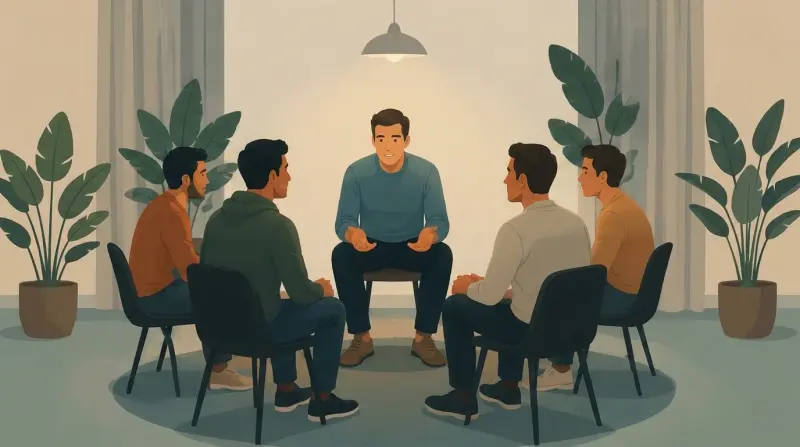
Why does a man hesitate to ask for help? Because society often whispers in his ear from a young age that strength means silent endurance, and that admitting fatigue is a defeat. A man grows up carrying burdens on his shoulders that he isn't supposed to carry alone, believing that endurance is his only available option. From our experience at Tatmeen, we affirm that many men find their comfort and begin to heal as soon as they are given a safe and confidential space to simply say: "I need support right now." This is not a moment of weakness, but the first step of true strength.
The Roots of Hesitation: When Strength is Misinterpreted
The story begins early. Many boys learn that self-reliance means suppressing feelings, and that talking about fear or sadness is not befitting of a man. Over time, these messages turn into convictions that prevent them from seeking help even when pressures accumulate. Psychology research shows that strict adherence to traditional masculinity norms, such as excessive toughness and absolute independence, is linked to a lower willingness to seek psychological support.
The Fear of Weakness and Losing Control
When self-worth is tied to the image of the unshakable strong man, admitting the need for therapy becomes a shattering of that image before it can be a step toward healing. Therefore, some may prefer to withdraw or become excessively busy with work instead of confronting anxiety or depression. What we need here are not lectures on courage, but a redefinition of it: Courage is naming what hurts you and seeking help from someone who is skilled at accompanying you.
The Pressure of Roles: At Home and at Work
Many men bear the role of the provider or the one who reassures others, which makes them postpone taking care of themselves. This is compounded by societal expectations that a man solves his problems alone, which multiplies the isolation. With every postponement, the gap widens between what appears on the surface and what is happening inside.
Why is it Important to Seek Help Early?
This is not a luxury. World Health Organization figures show a worrying reality: the global suicide rate is higher among men compared to women. The2021 WHO report noted that the age-standardized rate was approximately 2.2 times higher in males. These are not numbers to scare you, but to remind you that seeking support can be life-changing.
Despite the grim picture, there is reassuring news: men benefit from psychotherapy when they access it. Reviews show that interventions designed with sensitivity to masculine identity, such as focusing on problem-solving and using practical language, increase adherence and therapeutic outcomes. This means the obstacle is not in the nature of men, but in the bridges we provide for them to cross safely.
Daily Obstacles That Prevent Seeking Help
The first obstacle is self-stigma: "If I ask for help, I am weak." The second is bad past experiences, like a session where the person did not feel respected or that their privacy was maintained, leading them to generalize that impression. The third is practical obstacles: lack of time, distance, or the fear of being seen at a clinic. These obstacles are real, but they are solvable when the therapeutic path is redesigned to be flexible and safe.
Midway, Tatmeen reminds us that the first step does not require grand confessions; it's enough to say to a specialist: "My sleep has changed, my thinking is scattered, and I need a roadmap." A therapist often starts by setting small, measurable goals like improving sleep, reducing stress, or restoring energy, and then slowly builds on them. This practical approach is well-received by many men because it focuses on tangible progress, not just the language of diagnosis.
Why Might Online Therapy Be a Good Fit for Many Men?
Online therapy removes the obstacles of time, distance, and privacy, and gives you a quiet start from your own space. Most importantly, its effectiveness is not a marketing claim. A study inJAMA Psychiatry indicated that therapist-supported online cognitive behavioral therapy was more effective than the unguided version for treating depression, with particular benefit for moderate to severe cases.
Practically, this answers the question: "Where do I start?" Start in the simplest, safest way. A short introductory assessment session, then a short-term plan, and then choosing a pace that suits you. Trusted platforms like Tatmeen provide text, voice, and video tracks, allowing you to choose the method with which you feel the most control. The idea isn't to fix you, but to accompany you smartly and calmly until you take hold of the reins of your life again.
How Can We Redefine Masculinity in a Healthy Way?
Strength is not the absence of feelings, but the ability to regulate them. Responsibility is not solving everything by yourself, but knowing when to seek specialized support. When you reframe these meanings within your family and circles—through an honest conversation with a partner/friend or by being a role model for your colleagues—you are not just protecting yourself; you are making the path shorter for those who come after you.
And finally..
Men's difficulty in asking for help is not a flaw in them, but the result of messages they have learned for a long time. When we redefine strength, stigma decreases and a space for healing emerges. A small step today—like a consultation message, a short call, or an introductory session—can change your quality of life. If you want a safe and flexible start, book your session with us today. Tatmeen is available to accompany you with confidentiality and clear steps that suit you.
Frequently Asked Questions
How can I start talking to a specialist without feeling weak?
Start by describing daily symptoms: your sleep, energy, irritability, concentration. Ask for an initial assessment and a short-term plan. You'll notice the conversation becomes easier when feelings are turned into practical, measurable points.
Is it enough to rely on friends instead of therapy?
Friends are important support, but they are not a substitute for a specialist who has clear diagnostic and treatment tools. Combining a support network with professional therapy provides better protection and speeds up improvement.
I don't have time for sessions; what's the solution?
Choose a short, focused start with flexible online sessions, and set two clear goals for the first month. Experience shows that small, regular steps are superior to waiting a long time for a "perfect" opportunity.
A writer and researcher specializing in psychiatry, she focuses on mental health and the human emotions we experience but cannot always find the words to name. She writes about us—about humanity and the human experience—and simplifies complex topics to offer content that helps us better understand ourselves and life, ultimately making us feel less alone.
Every Tatmeen article is reviewed by care providers licensed by the Saudi Commission for Health Specialties, so what you read is accurate and trustworthy.
This article builds understanding and does not replace a licensed care provider.
Need someone to talk to?
Tatmeen's licensed care providers are available around the clock, and the app's urgent consultation connects you with one within minutes.
Download Tatmeen to explore care providers and booking options.
Smart matchingFour quick questions suggest the right care provider
Urgent consultationTalk to an available care provider within minutes
Free psychological measuresMore than 20 tests to understand how you are doing
Scan to download
{"data":{"id":"1fd49c60-48a1-4ee0-a6ee-7e430358ca8a","slug":"why-men-struggle-seek-help-mental-health","arTitle":"لماذا يجد الرجال صعوبة في طلب المساعدة؟ أسباب وحلول","enTitle":"Why Do Men Find It Hard to Ask for Help? Causes and Solutions","thumbnailAltText":"a group of 5 men sitting together in a room conversing","estimatedReadingTime":5,"likesCount":152,"writer":{"id":"3ab72b74-f26f-4337-9b47-3114b0f90de5","arBio":"كاتبة وباحثة متخصصة في مجال الطب النفسي، تهتم بموضوعات الصحة النفسية وبالمشاعر الإنسانية التي نختبرها ولا نجد دائمًا الكلمات لتسميتها. تكتب عنّا؛ عن الإنسان وتجربته، وتبسّط الموضوعات المعقّدة لتقدّم محتوى يساعدنا على فهم ذواتنا والحياة أكثر، ويجعلنا نشعر بأننا بوحدة أقل.","enBio":"A writer and researcher specializing in psychiatry, she focuses on mental health and the human emotions we experience but cannot always find the words to name. She writes about us—about humanity and the human experience—and simplifies complex topics to offer content that helps us better understand ourselves and life, ultimately making us feel less alone.","user":{"slug":"ayat-alnajar","arFullName":"آيات النجار","enFullName":"Ayat Al-Najjar","publicProfileImageUrl":"https://cdn.tatmeen.sa/public/profile-images/02384455-68fa-40b6-ad05-609fde65cafa/21b9a610dde5dfc6d37af110c23e9c7ab3946be080c281beb000debf4f7d31a6.webp","publicProfileImage96Url":"https://cdn.tatmeen.sa/public/profile-images/02384455-68fa-40b6-ad05-609fde65cafa/21b9a610dde5dfc6d37af110c23e9c7ab3946be080c281beb000debf4f7d31a6-w96.webp","publicProfileImage192Url":"https://cdn.tatmeen.sa/public/profile-images/02384455-68fa-40b6-ad05-609fde65cafa/21b9a610dde5dfc6d37af110c23e9c7ab3946be080c281beb000debf4f7d31a6-w192.webp"}},"arContent":"","enContent":"","productionDocument":{"headings":[{"id":"article-section-the-roots-of-hesitation-when-strength-is-misinterpreted","text":"The Roots of Hesitation: When Strength is Misinterpreted"},{"id":"article-section-why-is-it-important-to-seek-help-early","text":"Why is it Important to Seek Help Early?"},{"id":"article-section-why-might-online-therapy-be-a-good-fit-for-many-men","text":"Why Might Online Therapy Be a Good Fit for Many Men?"},{"id":"article-section-how-can-we-redefine-masculinity-in-a-healthy-way","text":"How Can We Redefine Masculinity in a Healthy Way?"},{"id":"article-section-and-finally","text":"And finally.."}],"faqs":[{"question":"How can I start talking to a specialist without feeling weak?","answer":"<p><span style=\"color:#1b1c1d\">Start by describing daily symptoms: your sleep, energy, irritability, concentration. Ask for an initial assessment and a short-term plan. You'll notice the conversation becomes easier when feelings are turned into practical, measurable points.</span></p>"},{"question":"Is it enough to rely on friends instead of therapy?","answer":"<p><span style=\"color:#1b1c1d\">Friends are important support, but they are not a substitute for a specialist who has clear diagnostic and treatment tools. Combining a support network with professional therapy provides better protection and speeds up improvement.</span></p>"},{"question":"I don't have time for sessions; what's the solution?","answer":"<p><span style=\"color:#1b1c1d\">Choose a short, focused start with flexible online sessions, and set two clear goals for the first month. Experience shows that small, regular steps are superior to waiting a long time for a \"perfect\" opportunity.</span></p>"}],"beforeSourcesHtml":"<p></p>","sources":[],"afterSourcesHtml":"","blocks":[{"type":"html","html":"<p><span style=\"color:#1b1c1d\">Why does a man hesitate to ask for help? Because society often whispers in his ear from a young age that strength means silent endurance, and that admitting fatigue is a defeat. A man grows up carrying burdens on his shoulders that he isn't supposed to carry alone, believing that endurance is his only available option. From our experience at Tatmeen, we affirm that many men find their comfort and begin to heal as soon as they are given a safe and confidential space to simply say: \"I need support right now.\" This is not a moment of weakness, but the first step of true strength.</span></p><h2 id=\"article-section-the-roots-of-hesitation-when-strength-is-misinterpreted\" data-toc-heading tabindex=\"-1\"><span id=\"the-roots-of-hesitation-when-strength-is-misinterpreted-1\" aria-hidden=\"true\"></span><span style=\"color:#1b1c1d\"><strong>The Roots of Hesitation: When Strength is Misinterpreted</strong></span></h2><p><span style=\"color:#1b1c1d\">The story begins early. Many boys learn that self-reliance means suppressing feelings, and that talking about fear or sadness is not befitting of a man. Over time, these messages turn into convictions that prevent them from seeking help even when pressures accumulate. Psychology research shows that strict adherence to traditional masculinity norms, such as excessive toughness and absolute independence, is linked to a lower willingness to seek psychological support.</span></p><h3><span style=\"color:#1b1c1d\"><strong>The Fear of Weakness and Losing Control</strong></span></h3><p><span style=\"color:#1b1c1d\">When self-worth is tied to the image of the unshakable strong man, admitting the need for therapy becomes a shattering of that image before it can be a step toward healing. Therefore, some may prefer to withdraw or become excessively busy with work instead of confronting anxiety or depression. What we need here are not lectures on courage, but a redefinition of it: Courage is naming what hurts you and seeking help from someone who is skilled at accompanying you.</span></p><h3><span style=\"color:#1b1c1d\"><strong>The Pressure of Roles: At Home and at Work</strong></span></h3><p><span style=\"color:#1b1c1d\">Many men bear the role of the provider or the one who reassures others, which makes them postpone taking care of themselves. This is compounded by societal expectations that a man solves his problems alone, which multiplies the isolation. With every postponement, the gap widens between what appears on the surface and what is happening inside.</span></p><h2 id=\"article-section-why-is-it-important-to-seek-help-early\" data-toc-heading tabindex=\"-1\"><span id=\"why-is-it-important-to-seek-help-early-2\" aria-hidden=\"true\"></span><span style=\"color:#1b1c1d\"><strong>Why is it Important to Seek Help Early?</strong></span></h2><p><span style=\"color:#1b1c1d\">This is not a luxury. World Health Organization figures show a worrying reality: the global suicide rate is higher among men compared to women. The</span><a href=\"https://www.who.int/publications/i/item/9789240026643\" target=\"_blank\" rel=\"nofollow noopener noreferrer\"><span style=\"color:#1b1c1d\"> </span><span style=\"color:#0b57d0\"><u>2021 WHO report</u></span></a><span style=\"color:#1b1c1d\"> noted that the age-standardized rate was approximately 2.2 times higher in males. These are not numbers to scare you, but to remind you that seeking support can be life-changing.</span></p><p><span style=\"color:#1b1c1d\">Despite the grim picture, there is reassuring news: men benefit from psychotherapy when they access it. Reviews show that interventions designed with sensitivity to masculine identity, such as focusing on problem-solving and using practical language, increase adherence and therapeutic outcomes. This means the obstacle is not in the nature of men, but in the bridges we provide for them to cross safely.</span></p><h3><span style=\"color:#1b1c1d\"><strong>Daily Obstacles That Prevent Seeking Help</strong></span></h3><p><span style=\"color:#1b1c1d\">The first obstacle is self-stigma: \"If I ask for help, I am weak.\" The second is bad past experiences, like a session where the person did not feel respected or that their privacy was maintained, leading them to generalize that impression. The third is practical obstacles: lack of time, distance, or the fear of being seen at a clinic. These obstacles are real, but they are solvable when the therapeutic path is redesigned to be flexible and safe.</span></p><p><span style=\"color:#1b1c1d\">Midway, Tatmeen reminds us that the first step does not require grand confessions; it's enough to say to a specialist: \"My sleep has changed, my thinking is scattered, and I need a roadmap.\" A therapist often starts by setting small, measurable goals like improving sleep, reducing stress, or restoring energy, and then slowly builds on them. This practical approach is well-received by many men because it focuses on tangible progress, not just the language of diagnosis.</span></p><h2 id=\"article-section-why-might-online-therapy-be-a-good-fit-for-many-men\" data-toc-heading tabindex=\"-1\"><span id=\"why-might-online-therapy-be-a-good-fit-for-many-men-3\" aria-hidden=\"true\"></span><span style=\"color:#1b1c1d\"><strong>Why Might Online Therapy Be a Good Fit for Many Men?</strong></span></h2><p><span style=\"color:#1b1c1d\">Online therapy removes the obstacles of time, distance, and privacy, and gives you a quiet start from your own space. Most importantly, its effectiveness is not a marketing claim. A study in</span><a href=\"https://www.google.com/search?q=https://jamanetwork.com/journals/jamapsychiatry/fullarticle/2765321\" target=\"_blank\" rel=\"nofollow noopener noreferrer\"><span style=\"color:#1b1c1d\"> </span><span style=\"color:#0b57d0\"><em><u>JAMA Psychiatry</u></em></span></a><span style=\"color:#1b1c1d\"> indicated that therapist-supported online cognitive behavioral therapy was more effective than the unguided version for treating depression, with particular benefit for moderate to severe cases.</span></p><p><span style=\"color:#1b1c1d\">Practically, this answers the question: \"Where do I start?\" Start in the simplest, safest way. A short introductory assessment session, then a short-term plan, and then choosing a pace that suits you. Trusted platforms like Tatmeen provide text, voice, and video tracks, allowing you to choose the method with which you feel the most control. The idea isn't to fix you, but to accompany you smartly and calmly until you take hold of the reins of your life again.</span></p><h2 id=\"article-section-how-can-we-redefine-masculinity-in-a-healthy-way\" data-toc-heading tabindex=\"-1\"><span id=\"how-can-we-redefine-masculinity-in-a-healthy-way-4\" aria-hidden=\"true\"></span><span style=\"color:#1b1c1d\"><strong>How Can We Redefine Masculinity in a Healthy Way?</strong></span></h2><p><span style=\"color:#1b1c1d\">Strength is not the absence of feelings, but the ability to regulate them. Responsibility is not solving everything by yourself, but knowing when to seek specialized support. When you reframe these meanings within your family and circles—through an honest conversation with a partner/friend or by being a role model for your colleagues—you are not just protecting yourself; you are making the path shorter for those who come after you.</span></p><h2 id=\"article-section-and-finally\" data-toc-heading tabindex=\"-1\"><span id=\"and-finally-5\" aria-hidden=\"true\"></span><span style=\"color:#1b1c1d\"><strong>And finally..</strong></span></h2><p><span style=\"color:#1b1c1d\">Men's difficulty in asking for help is not a flaw in them, but the result of messages they have learned for a long time. When we redefine strength, stigma decreases and a space for healing emerges. A small step today—like a consultation message, a short call, or an introductory session—can change your quality of life. If you want a safe and flexible start, <u>book your session with us today</u>. Tatmeen is available to accompany you with confidentiality and clear steps that suit you.</span></p>"}],"inlineCtaSignatures":[],"_experienceAliases":{"v":1,"fields":["html","bodyHtml"],"faqs":[0,1,2]}},"createdAt":"2026-05-20T21:00:00.000Z","updatedAt":"2026-06-24T23:49:56.282Z","disorderGroups":[{"id":"5185d423-e92e-4be2-9bc7-85bf0dfcf771","slug":"mens-mental-health","arName":"الصحة النفسية للرجل","enName":"Men’s Mental Health"}],"reviewer":{"arFullName":"فريق تطمين","enFullName":"Tatmeen team","slug":"tatmeen-team","kind":"organization"},"productionArticle":true,"promotionAllowed":true,"preparedCover":{"src":"https://cdn.tatmeen.sa/public/article-lcp/article-lcp-v2/sha256-a7ef9d5fa7af5402ecbbc04e2e431d1e82006a6934fa4dd85741d0546a27cac3/800-a87f345894997cfc72c15510f9741d8ff8d6894e7dd512ce5532c52311a045f2.avif","fallback":"https://cdn.tatmeen.sa/public/article-lcp/article-lcp-v2/sha256-a7ef9d5fa7af5402ecbbc04e2e431d1e82006a6934fa4dd85741d0546a27cac3/800-ff8116a677b26c0986c047e39a37d61c7c23c80508db59c61ae66d43f93208c2.webp","directUrl":"https://cdn.tatmeen.sa/blog-cover/Tatmeen-1779390235301.webp","isGolden":true,"avifSrcset":"https://cdn.tatmeen.sa/public/article-lcp/article-lcp-v2/sha256-a7ef9d5fa7af5402ecbbc04e2e431d1e82006a6934fa4dd85741d0546a27cac3/400-d60ba9b54abc5d759ae26e0ee889433220a950d86bd7b6f1c22e3a2f7f031dfd.avif 400w, https://cdn.tatmeen.sa/public/article-lcp/article-lcp-v2/sha256-a7ef9d5fa7af5402ecbbc04e2e431d1e82006a6934fa4dd85741d0546a27cac3/640-1067e45e15013e5ae5b34b5a5576ca9f949252971faff1c44cea0f8f21111060.avif 640w, https://cdn.tatmeen.sa/public/article-lcp/article-lcp-v2/sha256-a7ef9d5fa7af5402ecbbc04e2e431d1e82006a6934fa4dd85741d0546a27cac3/800-a87f345894997cfc72c15510f9741d8ff8d6894e7dd512ce5532c52311a045f2.avif 800w, https://cdn.tatmeen.sa/public/article-lcp/article-lcp-v2/sha256-a7ef9d5fa7af5402ecbbc04e2e431d1e82006a6934fa4dd85741d0546a27cac3/1200-ac5f6f8bd5ba1e2a96f49f6dadca4f3bffb33a7cb4a2e534e2bb8bb0a59ff296.avif 1200w","webpSrcset":"https://cdn.tatmeen.sa/public/article-lcp/article-lcp-v2/sha256-a7ef9d5fa7af5402ecbbc04e2e431d1e82006a6934fa4dd85741d0546a27cac3/400-b2960fdd6d95ede68baa5c010e14d8bcc447de82b31948bc35db8e6ffea3c6d3.webp 400w, https://cdn.tatmeen.sa/public/article-lcp/article-lcp-v2/sha256-a7ef9d5fa7af5402ecbbc04e2e431d1e82006a6934fa4dd85741d0546a27cac3/640-2f329b901b2d3213d155d2976cd70b45d20cfa934959c77e586685f93f0b840a.webp 640w, https://cdn.tatmeen.sa/public/article-lcp/article-lcp-v2/sha256-a7ef9d5fa7af5402ecbbc04e2e431d1e82006a6934fa4dd85741d0546a27cac3/800-ff8116a677b26c0986c047e39a37d61c7c23c80508db59c61ae66d43f93208c2.webp 800w, https://cdn.tatmeen.sa/public/article-lcp/article-lcp-v2/sha256-a7ef9d5fa7af5402ecbbc04e2e431d1e82006a6934fa4dd85741d0546a27cac3/1200-9fbf420ce8f6f0e756c8330167a24b327c44e10a3531abe5a412a30fd9a2e081.webp 1200w","phoneAvifSrcset":"https://cdn.tatmeen.sa/public/article-lcp/article-lcp-v2/sha256-a7ef9d5fa7af5402ecbbc04e2e431d1e82006a6934fa4dd85741d0546a27cac3/400-d60ba9b54abc5d759ae26e0ee889433220a950d86bd7b6f1c22e3a2f7f031dfd.avif 400w, https://cdn.tatmeen.sa/public/article-lcp/article-lcp-v2/sha256-a7ef9d5fa7af5402ecbbc04e2e431d1e82006a6934fa4dd85741d0546a27cac3/640-1067e45e15013e5ae5b34b5a5576ca9f949252971faff1c44cea0f8f21111060.avif 640w, https://cdn.tatmeen.sa/public/article-lcp/article-lcp-v2/sha256-a7ef9d5fa7af5402ecbbc04e2e431d1e82006a6934fa4dd85741d0546a27cac3/800-a87f345894997cfc72c15510f9741d8ff8d6894e7dd512ce5532c52311a045f2.avif 800w","phoneWebpSrcset":"https://cdn.tatmeen.sa/public/article-lcp/article-lcp-v2/sha256-a7ef9d5fa7af5402ecbbc04e2e431d1e82006a6934fa4dd85741d0546a27cac3/400-b2960fdd6d95ede68baa5c010e14d8bcc447de82b31948bc35db8e6ffea3c6d3.webp 400w, https://cdn.tatmeen.sa/public/article-lcp/article-lcp-v2/sha256-a7ef9d5fa7af5402ecbbc04e2e431d1e82006a6934fa4dd85741d0546a27cac3/640-2f329b901b2d3213d155d2976cd70b45d20cfa934959c77e586685f93f0b840a.webp 640w, https://cdn.tatmeen.sa/public/article-lcp/article-lcp-v2/sha256-a7ef9d5fa7af5402ecbbc04e2e431d1e82006a6934fa4dd85741d0546a27cac3/800-ff8116a677b26c0986c047e39a37d61c7c23c80508db59c61ae66d43f93208c2.webp 800w","width":800,"height":447},"previewTaxonomy":{"groups":[{"id":"5185d423-e92e-4be2-9bc7-85bf0dfcf771","slug":"mens-mental-health","arName":"الصحة النفسية للرجل","enName":"Men’s Mental Health"}],"topics":[{"id":"9567ccad-d575-4333-86ca-b7062837939a","slug":"fear-of-weakness","arName":"الخوف من إظهار الضعف","enName":"Fear of Weakness","groupSlug":"mens-mental-health","href":"/blog/category/mens-mental-health/fear-of-weakness/"},{"id":"69e53338-0937-49ce-9708-5d45f3918d9b","slug":"expressing-emotions","arName":"صعوبة التعبير العاطفي","enName":"Expressing Emotions","groupSlug":"mens-mental-health","href":"/blog/category/mens-mental-health/expressing-emotions/"}],"tags":[{"id":"50a7bc5d-7fbd-43f1-9cf5-da4f55791d53","slug":"men","arName":"الرجال","enName":"Men"},{"id":"1ad76cf4-ae2a-43ad-b868-152d6e093624","slug":"self-esteem-self-worth","arName":"تقدير الذات والثقة بالنفس","enName":"Self-Esteem & Self-Worth"},{"id":"c2a6e8d3-de9c-435f-8c95-9727e7db14cc","slug":"explainer-awareness","arName":"دليل توعوي / شرح","enName":"Explainer / Awareness Guide"}]},"previewProviderRecommendations":[{"id":"94765496-dbdf-4631-a01b-7df5f788668d","slug":"abdullrahman-alhamoudi-3045","arFullName":"عبدالرحمن الحمودي","enFullName":"Abdulrahman Alhamoudi","publicProfileImageUrl":"https://cdn.tatmeen.sa/public/profile-images/94765496-dbdf-4631-a01b-7df5f788668d/2d49f6b6493c564afb6f50b6c3634231dff3a5cf8353acfab393d1b2a88037d1.webp","publicProfileImage96Url":"https://cdn.tatmeen.sa/public/profile-images/94765496-dbdf-4631-a01b-7df5f788668d/2d49f6b6493c564afb6f50b6c3634231dff3a5cf8353acfab393d1b2a88037d1-w96.webp","publicProfileImage192Url":"https://cdn.tatmeen.sa/public/profile-images/94765496-dbdf-4631-a01b-7df5f788668d/2d49f6b6493c564afb6f50b6c3634231dff3a5cf8353acfab393d1b2a88037d1-w192.webp","specialization":{"arName":"أخصائي نفسي","enName":"Psychologist"},"profileImageUrl":"https://cdn.tatmeen.sa/public/profile-images/94765496-dbdf-4631-a01b-7df5f788668d/2d49f6b6493c564afb6f50b6c3634231dff3a5cf8353acfab393d1b2a88037d1-w192.webp","experienceYears":9,"consultantInfo":{"averageRating":{"average":5},"specialization":{"arGeneralName":"أخصائي نفسي","enGeneralName":"Psychologist"}}},{"id":"09364052-c2a9-4c52-9717-7ce2093b8d0a","slug":"kholoud-alharbi-5221","arFullName":"خلود الحربي","enFullName":"Kholoud Alharbi","publicProfileImageUrl":"https://cdn.tatmeen.sa/public/profile-images/09364052-c2a9-4c52-9717-7ce2093b8d0a/4a0aeb81619e351b77f4323e3605a0a00acc7ca3c82ee7cc5ca2c9e8ef716049.webp","publicProfileImage96Url":"https://cdn.tatmeen.sa/public/profile-images/09364052-c2a9-4c52-9717-7ce2093b8d0a/4a0aeb81619e351b77f4323e3605a0a00acc7ca3c82ee7cc5ca2c9e8ef716049-w96.webp","publicProfileImage192Url":"https://cdn.tatmeen.sa/public/profile-images/09364052-c2a9-4c52-9717-7ce2093b8d0a/4a0aeb81619e351b77f4323e3605a0a00acc7ca3c82ee7cc5ca2c9e8ef716049-w192.webp","specialization":{"arName":"أخصائي نفسي","enName":"Psychologist"},"profileImageUrl":"https://cdn.tatmeen.sa/public/profile-images/09364052-c2a9-4c52-9717-7ce2093b8d0a/4a0aeb81619e351b77f4323e3605a0a00acc7ca3c82ee7cc5ca2c9e8ef716049-w192.webp","experienceYears":10,"consultantInfo":{"averageRating":{"average":5},"specialization":{"arGeneralName":"أخصائي نفسي","enGeneralName":"Psychologist"}}},{"id":"6f037535-1dca-4b50-a8b2-5974b7323286","slug":"salah-althobaiti-9053","arFullName":"صلاح الثبيتي","enFullName":"Salah Althobaiti","publicProfileImageUrl":"https://cdn.tatmeen.sa/public/profile-images/6f037535-1dca-4b50-a8b2-5974b7323286/35b6bd7fad9b1e004c1835803eb9c1b56dcacd380685ec8bff141f0fb888005c.webp","publicProfileImage96Url":"https://cdn.tatmeen.sa/public/profile-images/6f037535-1dca-4b50-a8b2-5974b7323286/35b6bd7fad9b1e004c1835803eb9c1b56dcacd380685ec8bff141f0fb888005c-w96.webp","publicProfileImage192Url":"https://cdn.tatmeen.sa/public/profile-images/6f037535-1dca-4b50-a8b2-5974b7323286/35b6bd7fad9b1e004c1835803eb9c1b56dcacd380685ec8bff141f0fb888005c-w192.webp","specialization":{"arName":"أخصائي نفسي","enName":"Psychologist"},"profileImageUrl":"https://cdn.tatmeen.sa/public/profile-images/6f037535-1dca-4b50-a8b2-5974b7323286/35b6bd7fad9b1e004c1835803eb9c1b56dcacd380685ec8bff141f0fb888005c-w192.webp","experienceYears":6,"consultantInfo":{"averageRating":{"average":4.98876404494382},"specialization":{"arGeneralName":"أخصائي نفسي","enGeneralName":"Psychologist"}}}],"previewCareProviders":[{"id":"09364052-c2a9-4c52-9717-7ce2093b8d0a","slug":"kholoud-alharbi-5221","arFullName":"خلود الحربي","enFullName":"Kholoud Alharbi","publicProfileImageUrl":"https://cdn.tatmeen.sa/public/profile-images/09364052-c2a9-4c52-9717-7ce2093b8d0a/4a0aeb81619e351b77f4323e3605a0a00acc7ca3c82ee7cc5ca2c9e8ef716049.webp","publicProfileImage96Url":"https://cdn.tatmeen.sa/public/profile-images/09364052-c2a9-4c52-9717-7ce2093b8d0a/4a0aeb81619e351b77f4323e3605a0a00acc7ca3c82ee7cc5ca2c9e8ef716049-w96.webp","publicProfileImage192Url":"https://cdn.tatmeen.sa/public/profile-images/09364052-c2a9-4c52-9717-7ce2093b8d0a/4a0aeb81619e351b77f4323e3605a0a00acc7ca3c82ee7cc5ca2c9e8ef716049-w192.webp","gender":"FEMALE","specialization":{"arName":"أخصائي نفسي","enName":"Psychologist"}},{"id":"6f037535-1dca-4b50-a8b2-5974b7323286","slug":"salah-althobaiti-9053","arFullName":"صلاح الثبيتي","enFullName":"Salah Althobaiti","publicProfileImageUrl":"https://cdn.tatmeen.sa/public/profile-images/6f037535-1dca-4b50-a8b2-5974b7323286/35b6bd7fad9b1e004c1835803eb9c1b56dcacd380685ec8bff141f0fb888005c.webp","publicProfileImage96Url":"https://cdn.tatmeen.sa/public/profile-images/6f037535-1dca-4b50-a8b2-5974b7323286/35b6bd7fad9b1e004c1835803eb9c1b56dcacd380685ec8bff141f0fb888005c-w96.webp","publicProfileImage192Url":"https://cdn.tatmeen.sa/public/profile-images/6f037535-1dca-4b50-a8b2-5974b7323286/35b6bd7fad9b1e004c1835803eb9c1b56dcacd380685ec8bff141f0fb888005c-w192.webp","gender":"MALE","specialization":{"arName":"أخصائي نفسي","enName":"Psychologist"}},{"id":"3cc806e8-616b-4884-9f21-a75b378580a2","slug":"aisha-al-hashim-8667","arFullName":"عائشة ال هاشم","enFullName":"Aisha Al Hashim","publicProfileImageUrl":"https://cdn.tatmeen.sa/public/profile-images/3cc806e8-616b-4884-9f21-a75b378580a2/27f523d03be4dcfa1f6a79f70c1773887434e698990d214cd990caec56a44798.webp","publicProfileImage96Url":"https://cdn.tatmeen.sa/public/profile-images/3cc806e8-616b-4884-9f21-a75b378580a2/27f523d03be4dcfa1f6a79f70c1773887434e698990d214cd990caec56a44798-w96.webp","publicProfileImage192Url":"https://cdn.tatmeen.sa/public/profile-images/3cc806e8-616b-4884-9f21-a75b378580a2/27f523d03be4dcfa1f6a79f70c1773887434e698990d214cd990caec56a44798-w192.webp","gender":"FEMALE","specialization":{"arName":"أخصائي نفسي","enName":"Psychologist"}},{"id":"db2ce1a0-9325-4471-b7ce-eb2e811c30a3","slug":"amer-qutub-2441","arFullName":"عامر قطب","enFullName":"Amer Qutub","publicProfileImageUrl":"https://cdn.tatmeen.sa/public/profile-images/db2ce1a0-9325-4471-b7ce-eb2e811c30a3/80580f99bfd7fe2b2a9cf8eed73ab532f5086d1efe053b0aa57358c1ce004261.webp","publicProfileImage96Url":"https://cdn.tatmeen.sa/public/profile-images/db2ce1a0-9325-4471-b7ce-eb2e811c30a3/80580f99bfd7fe2b2a9cf8eed73ab532f5086d1efe053b0aa57358c1ce004261-w96.webp","publicProfileImage192Url":"https://cdn.tatmeen.sa/public/profile-images/db2ce1a0-9325-4471-b7ce-eb2e811c30a3/80580f99bfd7fe2b2a9cf8eed73ab532f5086d1efe053b0aa57358c1ce004261-w192.webp","gender":"MALE","specialization":{"arName":"أخصائي نفسي","enName":"Psychologist"}},{"id":"94765496-dbdf-4631-a01b-7df5f788668d","slug":"abdullrahman-alhamoudi-3045","arFullName":"عبدالرحمن الحمودي","enFullName":"Abdulrahman Alhamoudi","publicProfileImageUrl":"https://cdn.tatmeen.sa/public/profile-images/94765496-dbdf-4631-a01b-7df5f788668d/2d49f6b6493c564afb6f50b6c3634231dff3a5cf8353acfab393d1b2a88037d1.webp","publicProfileImage96Url":"https://cdn.tatmeen.sa/public/profile-images/94765496-dbdf-4631-a01b-7df5f788668d/2d49f6b6493c564afb6f50b6c3634231dff3a5cf8353acfab393d1b2a88037d1-w96.webp","publicProfileImage192Url":"https://cdn.tatmeen.sa/public/profile-images/94765496-dbdf-4631-a01b-7df5f788668d/2d49f6b6493c564afb6f50b6c3634231dff3a5cf8353acfab393d1b2a88037d1-w192.webp","gender":"MALE","specialization":{"arName":"أخصائي نفسي","enName":"Psychologist"}},{"id":"618dba89-5b70-4b46-8304-741b7ac8ecd3","slug":"abdullah-mari-1311","arFullName":"عبدالله مرعي","enFullName":"Abdullah Mari","publicProfileImageUrl":"https://cdn.tatmeen.sa/public/profile-images/618dba89-5b70-4b46-8304-741b7ac8ecd3/6b4a3bfb59f8a304ca79083b32859b46baad2e1d692974a47c02c1f66bd11129.webp","publicProfileImage96Url":"https://cdn.tatmeen.sa/public/profile-images/618dba89-5b70-4b46-8304-741b7ac8ecd3/6b4a3bfb59f8a304ca79083b32859b46baad2e1d692974a47c02c1f66bd11129-w96.webp","publicProfileImage192Url":"https://cdn.tatmeen.sa/public/profile-images/618dba89-5b70-4b46-8304-741b7ac8ecd3/6b4a3bfb59f8a304ca79083b32859b46baad2e1d692974a47c02c1f66bd11129-w192.webp","gender":"MALE","specialization":{"arName":"أخصائي نفسي","enName":"Psychologist"}},{"id":"3b50a5d5-e795-407f-8676-fd7f0e1bb7a0","slug":"abdulaziz-bin-hudayan-4940","arFullName":"عبدالعزيز بن هديان","enFullName":"Abdulaziz Bin Hudayan","publicProfileImageUrl":"https://cdn.tatmeen.sa/public/profile-images/3b50a5d5-e795-407f-8676-fd7f0e1bb7a0/710ff0fe1fb00cdb5042092e27b7910b480a439b02251ecded62d7758eefce95.webp","publicProfileImage96Url":"https://cdn.tatmeen.sa/public/profile-images/3b50a5d5-e795-407f-8676-fd7f0e1bb7a0/710ff0fe1fb00cdb5042092e27b7910b480a439b02251ecded62d7758eefce95-w96.webp","publicProfileImage192Url":"https://cdn.tatmeen.sa/public/profile-images/3b50a5d5-e795-407f-8676-fd7f0e1bb7a0/710ff0fe1fb00cdb5042092e27b7910b480a439b02251ecded62d7758eefce95-w192.webp","gender":"MALE","specialization":{"arName":"أخصائي نفسي","enName":"Psychologist"}}],"previewDownload":{"href":"/download","title":{"ar":"خطوة واحدة لأجلك، ابدأ الآن","en":"One step for you, start now"},"description":{"ar":"حمّل تطبيق تطمين لاستكشاف مقدمي الرعاية وخيارات الحجز.","en":"Download Tatmeen to explore care providers and booking options."},"posterSrc":"/images/home/cta-ar-new-1.webp","videoSrc":"/images/home/cta-ar-new-1.mp4","videoPosterSrc":"/images/home/cta-ar-new-1.webp","videoPosterEnSrc":"/images/home/cta-en-new-1.webp","videoType":"video/mp4","appStoreHref":"https://apps.apple.com/us/app/tatmeen-%D8%AA%D8%B7%D9%85%D9%8A%D9%86/id6473836983","googlePlayHref":"https://play.google.com/store/apps/details?id=com.TatmeenApp.user&hl=en"},"previewRelatedArticles":[{"id":"cee09577-16ab-45c8-a461-6c80308c02a0","slug":"What-is-the-true-meaning-of-masculinity","route":"/blog/What-is-the-true-meaning-of-masculinity/","title":{"ar":"الرجولة - ما المعنى الحقيقي للرجولة؟","en":"Masculinity: What Is Its True Meaning?"},"image":"https://cdn.tatmeen.sa/public/article-lcp/article-lcp-v2/sha256-c14226b80e17ebe7b27c1ba8c87008ea80fccfe391bd0db9dda1f8e8b66eae11/600-7f93c06bbbca5fa3529b589c08f02fcb85e967c5895bdef49cbb1881cb71b515.webp","directImageFallback":"https://cdn.tatmeen.sa/blog-cover/1706455769414-Tatmeen-707.jpg","arThumbnailAltText":"Person flexing both arms in front of chalk-drawn muscular arms on a blackboard","thumbnailAltText":"Person flexing both arms in front of chalk-drawn muscular arms on a blackboard","topic":{"label":{"ar":"الصحة النفسية للرجل","en":"Men’s Mental Health"}},"readingTimeMinutes":5},{"id":"b45b1df6-1f37-48a4-9139-37bfbe49e584","slug":"breaking-stigma-men-not-expressing-emotions","route":"/blog/breaking-stigma-men-not-expressing-emotions/","title":{"ar":"كسر الوصمة المجتمعية عن عدم إفصاح الرجال عن مشاعرهم","en":"Breaking the Social Stigma Around Men Not Expressing Their Emotions"},"image":"https://cdn.tatmeen.sa/public/article-lcp/article-lcp-v2/sha256-f2449b64c731232dcce7cb8ebb845219020c416a58d82462d85c8d295e6da7d7/800-7b02eb9c201bddc002bd1909e0f9c6fbda444bddbc28085a29c5a22c9d6ec8ca.webp","directImageFallback":"https://cdn.tatmeen.sa/blog-cover/Tatmeen-1779388906109.webp","arThumbnailAltText":"a group of 5 men sitting together watching the sunset","thumbnailAltText":"a group of 5 men sitting together watching the sunset","topic":{"label":{"ar":"الصحة النفسية للرجل","en":"Men’s Mental Health"}},"readingTimeMinutes":5},{"id":"11093a40-e568-4766-b128-7dd60bd1c533","slug":"father-wound-men-breaking-emotional-suppression","route":"/blog/father-wound-men-breaking-emotional-suppression/","title":{"ar":"جرح الأب لدى الذكور: كسر حلقة الكبت العاطفي","en":"Father Wound in Men: Breaking the Cycle of Emotional Suppression"},"image":"https://cdn.tatmeen.sa/public/article-lcp/article-lcp-v2/sha256-d114cc7f6f15fe72fda91b47990186e5522f56e24cbd2e904d47c2f8ea96618c/800-8d4fb6c04391c2c4fb3a42731715740b2416a95d28b7d4420418a8a5b377a6da.webp","directImageFallback":"https://cdn.tatmeen.sa/blog-cover/Tatmeen-1779211868384.webp","arThumbnailAltText":"ظلان لأب وابن يفصل بينهما نور ذهبي يرمز لجرح الأب والتعافي العاطفي","thumbnailAltText":"ظلان لأب وابن يفصل بينهما نور ذهبي يرمز لجرح الأب والتعافي العاطفي","topic":{"label":{"ar":"اضطرابات نفسية شائعة","en":"Common Mental Issues"}},"readingTimeMinutes":5},{"id":"632e0968-cb63-4ef1-a052-8c790e6e2bc5","slug":"mother-wound-men-enmeshment-absent-maternal-support","route":"/blog/mother-wound-men-enmeshment-absent-maternal-support/","title":{"ar":"جرح الأم لدى الذكور: تجاوز التعلّق المفرط وغياب الدعم الأمومي","en":"Mother Wound in Men: Overcoming Enmeshment and Absent Maternal Support"},"image":"https://cdn.tatmeen.sa/public/article-lcp/article-lcp-v2/sha256-68d0d7ef8edfc686b975f67b48c9d891a461201ff20d77cc7accd90e77e42a50/800-49d012167fe993d1e567e50d73721181f9e23e16554b071e2fdc767f40dd1b09.webp","directImageFallback":"https://cdn.tatmeen.sa/blog-cover/Tatmeen-1777382972280.webp","arThumbnailAltText":"a man looking forward and behind him is the shadow of his mother","thumbnailAltText":"a man looking forward and behind him is the shadow of his mother","topic":{"label":{"ar":"اضطرابات نفسية شائعة","en":"Common Mental Issues"}},"readingTimeMinutes":5}],"previewRelatedReadStates":{}},"locale":"en","device":"desktop","path":"/en/blog/why-men-struggle-seek-help-mental-health/","readingControls":false,"config":{"public":{"BUCKET_URL":"https://cdn.tatmeen.sa/","APP_BASE_URL":"https://tatmeen.sa","intercomAppId":"ppcnu9e3"}}}