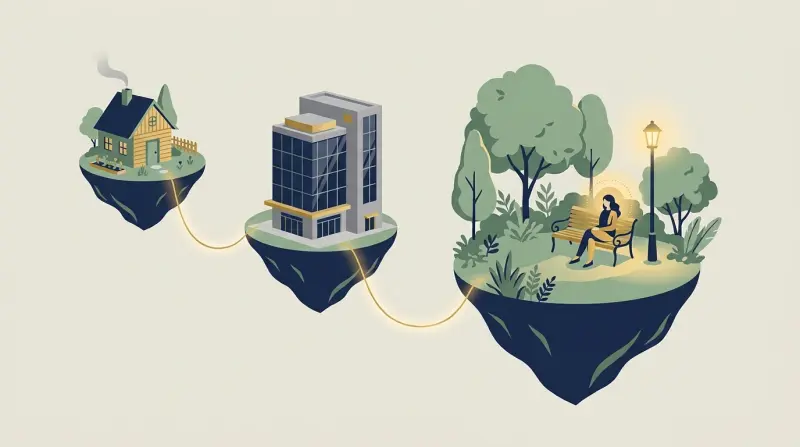
American sociologist Ray Oldenburg coined the term to describe neutral social spaces where you can set aside your usual roles as parent, employee, or partner and simply be yourself. Such places combine a sense of welcome with an absence of formality, creating an environment that nurtures dialogue and connection. A third place need not be physical – it might be a shaded evening walking path or an online book club that meets via video. The essence is belonging without steep costs or rigid commitments.
Why Does the Mind Need a Space Outside the Home-Work Loop?
Your brain works like a muscle: using the same muscle in one repetitive motion leads to strain. Likewise, constantly toggling between family duties and job demands keeps the nervous system on perpetual alert. A third place signals “rest break,” lowering cortisol levels and restoring internal balance. Beyond biochemical benefits, a third place offers horizontal relationships free of hierarchy or expectations, boosting psychological safety. Chatting with strangers who gradually become café acquaintances or gym buddies builds a small reservoir of social support – a proven protective factor against depression. Finally, the third place reminds us that our identity is broader than our job title or family role. There we may discover new interests or rekindle an old passion for music, art, or sport, giving our brains the cognitive flexibility that shields them from burnout.
Traits of an Ideal Third Place for Mental Health
Neutrality & Low Cost Entry and exit should require no hefty fees or long-term contracts, so the place never becomes another burden.
Welcome & Equality A good third space treats visitors like old friends—no elitist membership cards, rigid language barriers, or cultural gatekeepers.
Repeatability Regular visits turn a spot into a safe haven, so choose somewhere you can drop by two or three times a week: a nearby park, an early-opening café, or even a long hang-out with trusted friends.
Practical Steps to Find Your Third Place
Map empty moments in your schedule – carve out 30 minutes free of home or work tasks.
Experiment for two weeks – sit in a library, join a yoga workshop, volunteer; notice where your body tension drops.
Build a micro-routine – order the same drink, claim the same table; repetition plants a sense of familiarity.
Aim to be rather than do – don’t force extra achievements there; enjoy quiet sitting or casual chat without pressure.
When a Physical Third Place Is Out of Reach … Create One with Tatmeen
Some live in crowded cities or face physical limits that keep them from cafés and community centers. Here, supportive virtual spaces shine. Through Tatmeen you can craft a safe zone with a licensed therapist via online sessions—free from family judgment and workplace stress. Book now and feel secure knowing the specialists are certified by Saudi Arabia’s Ministry of Health.
Frequently Asked Questions
Is a virtual third place enough if I’m introverted?
Yes. Online interaction lowers the stress of face-to-face meetings and lets you control social doses. Over time it may encourage you to try a small physical space, but the digital start is perfectly safe.
How often should I visit my third place to feel benefits?
Studies show that two visits a week can lower stress indicators. Consistency matters more than session length—just thirty minutes can make a noticeable difference.
Can the gym or the mosque count as a third place?
Absolutely, as long as the atmosphere gives you belonging without extra performance demands. Focus on the sense of comfort and acceptance rather than the venue itself.
A writer and researcher specializing in psychiatry, she focuses on mental health and the human emotions we experience but cannot always find the words to name. She writes about us—about humanity and the human experience—and simplifies complex topics to offer content that helps us better understand ourselves and life, ultimately making us feel less alone.
Every Tatmeen article is reviewed by care providers licensed by the Saudi Commission for Health Specialties, so what you read is accurate and trustworthy.
This article builds understanding and does not replace a licensed care provider.
Need someone to talk to?
Tatmeen's licensed care providers are available around the clock, and the app's urgent consultation connects you with one within minutes.
Download Tatmeen to explore care providers and booking options.
Smart matchingFour quick questions suggest the right care provider
Urgent consultationTalk to an available care provider within minutes
Free psychological measuresMore than 20 tests to understand how you are doing
Scan to download
{"data":{"id":"abdfba46-60a7-4815-8117-cd5a66f7bc8c","slug":"third-place-concept-beyond-home-work","arTitle":"مفهوم المكان الثالث: لماذا تحتاج إلى مساحة نفسية تتجاوز المنزل والعمل؟","enTitle":"The Third Place Concept: Why You Need a Space Beyond Home and Work","thumbnailAltText":"a woman sitting at a park away from home and work","estimatedReadingTime":5,"likesCount":375,"writer":{"id":"3ab72b74-f26f-4337-9b47-3114b0f90de5","arBio":"كاتبة وباحثة متخصصة في مجال الطب النفسي، تهتم بموضوعات الصحة النفسية وبالمشاعر الإنسانية التي نختبرها ولا نجد دائمًا الكلمات لتسميتها. تكتب عنّا؛ عن الإنسان وتجربته، وتبسّط الموضوعات المعقّدة لتقدّم محتوى يساعدنا على فهم ذواتنا والحياة أكثر، ويجعلنا نشعر بأننا بوحدة أقل.","enBio":"A writer and researcher specializing in psychiatry, she focuses on mental health and the human emotions we experience but cannot always find the words to name. She writes about us—about humanity and the human experience—and simplifies complex topics to offer content that helps us better understand ourselves and life, ultimately making us feel less alone.","user":{"slug":"ayat-alnajar","arFullName":"آيات النجار","enFullName":"Ayat Al-Najjar","publicProfileImageUrl":"https://cdn.tatmeen.sa/public/profile-images/02384455-68fa-40b6-ad05-609fde65cafa/21b9a610dde5dfc6d37af110c23e9c7ab3946be080c281beb000debf4f7d31a6.webp","publicProfileImage96Url":"https://cdn.tatmeen.sa/public/profile-images/02384455-68fa-40b6-ad05-609fde65cafa/21b9a610dde5dfc6d37af110c23e9c7ab3946be080c281beb000debf4f7d31a6-w96.webp","publicProfileImage192Url":"https://cdn.tatmeen.sa/public/profile-images/02384455-68fa-40b6-ad05-609fde65cafa/21b9a610dde5dfc6d37af110c23e9c7ab3946be080c281beb000debf4f7d31a6-w192.webp"}},"arContent":"","enContent":"","productionDocument":{"headings":[{"id":"article-section-what-is-the-third-place-concept","text":"What Is the Third Place Concept?"},{"id":"article-section-why-does-the-mind-need-a-space-outside-the-home-work-loop","text":"Why Does the Mind Need a Space Outside the Home-Work Loop?"},{"id":"article-section-traits-of-an-ideal-third-place-for-mental-health","text":"Traits of an Ideal Third Place for Mental Health"},{"id":"article-section-practical-steps-to-find-your-third-place","text":"Practical Steps to Find Your Third Place"},{"id":"article-section-when-a-physical-third-place-is-out-of-reach-create-one-with-tatmeen","text":"When a Physical Third Place Is Out of Reach … Create One with Tatmeen"}],"faqs":[{"question":"Is a virtual third place enough if I’m introverted?","answer":"<p><span style=\"color:#000000\">Yes. Online interaction lowers the stress of face-to-face meetings and lets you control social doses. Over time it may encourage you to try a small physical space, but the digital start is perfectly safe.</span></p>"},{"question":"How often should I visit my third place to feel benefits?","answer":"<p><span style=\"color:#000000\">Studies show that two visits a week can lower stress indicators. Consistency matters more than session length—just thirty minutes can make a noticeable difference.</span></p>"},{"question":"Can the gym or the mosque count as a third place?","answer":"<p><span style=\"color:#000000\">Absolutely, as long as the atmosphere gives you belonging without extra performance demands. Focus on the sense of comfort and acceptance rather than the venue itself.</span></p>"}],"beforeSourcesHtml":"<p></p>","sources":[],"afterSourcesHtml":"","blocks":[{"type":"html","html":"<h2 id=\"article-section-what-is-the-third-place-concept\" data-toc-heading tabindex=\"-1\"><span id=\"what-is-the-third-place-concept-1\" aria-hidden=\"true\"></span><span style=\"color:#000000\"><strong>What Is the Third Place Concept?</strong></span></h2><p><span style=\"color:#000000\">American sociologist <strong>Ray Oldenburg</strong> coined the term to describe neutral social spaces where you can set aside your usual roles as parent, employee, or partner and simply be yourself. Such places combine a sense of welcome with an absence of formality, creating an environment that nurtures dialogue and connection.<br /> A third place need not be physical – it might be a shaded evening walking path or an online book club that meets via video. The essence is <strong>belonging without steep costs or rigid commitments</strong>.</span></p><h2 id=\"article-section-why-does-the-mind-need-a-space-outside-the-home-work-loop\" data-toc-heading tabindex=\"-1\"><span id=\"why-does-the-mind-need-a-space-outside-the-home-work-loop-2\" aria-hidden=\"true\"></span><span style=\"color:#000000\"><strong>Why Does the Mind Need a Space Outside the Home-Work Loop?</strong></span></h2><p><span style=\"color:#000000\">Your brain works like a muscle: using the same muscle in one repetitive motion leads to strain. Likewise, constantly toggling between family duties and job demands keeps the nervous system on perpetual alert. A third place signals “rest break,” lowering cortisol levels and restoring internal balance.<br /> Beyond biochemical benefits, a third place offers <strong>horizontal relationships</strong> free of hierarchy or expectations, boosting psychological safety. Chatting with strangers who gradually become café acquaintances or gym buddies builds a small reservoir of social support – a proven protective factor against depression.<br /> Finally, the third place reminds us that our identity is broader than our job title or family role. There we may discover new interests or rekindle an old passion for music, art, or sport, giving our brains the cognitive flexibility that shields them from burnout.</span></p><h2 id=\"article-section-traits-of-an-ideal-third-place-for-mental-health\" data-toc-heading tabindex=\"-1\"><span id=\"traits-of-an-ideal-third-place-for-mental-health-3\" aria-hidden=\"true\"></span><span style=\"color:#000000\"><strong>Traits of an Ideal Third Place for Mental Health</strong></span></h2><ul><li><p><span style=\"color:#000000\"><strong>Neutrality & Low Cost<br /></strong> Entry and exit should require no hefty fees or long-term contracts, so the place never becomes another burden.<br /></span></p></li><li><p><span style=\"color:#000000\"><strong>Welcome & Equality<br /></strong> A good third space treats visitors like old friends—no elitist membership cards, rigid language barriers, or cultural gatekeepers.<br /></span></p></li><li><p><span style=\"color:#000000\"><strong>Repeatability<br /></strong> Regular visits turn a spot into a safe haven, so choose somewhere you can drop by two or three times a week: a nearby park, an early-opening café, or even a long hang-out with trusted friends.</span></p></li></ul><h2 id=\"article-section-practical-steps-to-find-your-third-place\" data-toc-heading tabindex=\"-1\"><span id=\"practical-steps-to-find-your-third-place-4\" aria-hidden=\"true\"></span><span style=\"color:#000000\"><strong>Practical Steps to Find <em>Your</em> Third Place</strong></span></h2><ol><li><p><span style=\"color:#000000\"><strong>Map empty moments in your schedule</strong> – carve out 30 minutes free of home or work tasks.<br /></span></p></li><li><p><span style=\"color:#000000\"><strong>Experiment for two weeks</strong> – sit in a library, join a yoga workshop, volunteer; notice where your body tension drops.<br /></span></p></li><li><p><span style=\"color:#000000\"><strong>Build a micro-routine</strong> – order the same drink, claim the same table; repetition plants a sense of familiarity.<br /></span></p></li><li><p><span style=\"color:#000000\"><strong>Aim to <em>be</em> rather than <em>do</em></strong> – don’t force extra achievements there; enjoy quiet sitting or casual chat without pressure.</span></p></li></ol><h2 id=\"article-section-when-a-physical-third-place-is-out-of-reach-create-one-with-tatmeen\" data-toc-heading tabindex=\"-1\"><span id=\"when-a-physical-third-place-is-out-of-reach-create-one-with-tatmeen-5\" aria-hidden=\"true\"></span><span style=\"color:#000000\"><strong>When a Physical Third Place Is Out of Reach … Create One with Tatmeen</strong></span></h2><p><span style=\"color:#000000\">Some live in crowded cities or face physical limits that keep them from cafés and community centers. Here, supportive virtual spaces shine. Through <strong>Tatmeen</strong> you can craft a safe zone with a licensed therapist via online sessions—free from family judgment and workplace stress. <u>Book now and feel secure </u>knowing the specialists are certified by Saudi Arabia’s Ministry of Health.</span></p>"}],"inlineCtaSignatures":[],"_experienceAliases":{"v":1,"fields":["html","bodyHtml"],"faqs":[0,1,2]}},"createdAt":"2026-04-23T22:00:00.000Z","updatedAt":"2026-06-24T23:51:11.930Z","disorderGroups":[{"id":"4499a52a-06f8-4022-a64d-304e5eca51cc","slug":"life-challenges-and-stress","arName":"تحديات الحياة والضغوط","enName":"Life Challenges & Stress"},{"id":"d807ea69-44d4-4e81-bee4-0a059fd36645","slug":"self-development","arName":"تنمية الذات","enName":"Self-Development"}],"reviewer":{"arFullName":"فريق تطمين","enFullName":"Tatmeen team","slug":"tatmeen-team","kind":"organization"},"productionArticle":true,"promotionAllowed":true,"preparedCover":{"src":"https://cdn.tatmeen.sa/public/article-lcp/article-lcp-v2/sha256-79b16e0f1b899278ba1a09616eb3807efeb1331aebb7da1b0bab73ff0215b950/800-7a1d3267bdb990bae7bbbaca5209a2c8e39c9b54ee3ceaae37b30a26454a3aeb.avif","fallback":"https://cdn.tatmeen.sa/public/article-lcp/article-lcp-v2/sha256-79b16e0f1b899278ba1a09616eb3807efeb1331aebb7da1b0bab73ff0215b950/800-479857d69c56c29532913de15cd6396b52696f42a35301b1b15f49dd8419c369.webp","directUrl":"https://cdn.tatmeen.sa/blog-cover/Tatmeen-1777051944862.webp","isGolden":true,"avifSrcset":"https://cdn.tatmeen.sa/public/article-lcp/article-lcp-v2/sha256-79b16e0f1b899278ba1a09616eb3807efeb1331aebb7da1b0bab73ff0215b950/400-a37f10596fc385623c081c09556fb496a10ad513b9907351530ffcbad898267d.avif 400w, https://cdn.tatmeen.sa/public/article-lcp/article-lcp-v2/sha256-79b16e0f1b899278ba1a09616eb3807efeb1331aebb7da1b0bab73ff0215b950/640-994001f734174542471949d69ba520ee388d869b32a9fa35aaaec29efd3cbe18.avif 640w, https://cdn.tatmeen.sa/public/article-lcp/article-lcp-v2/sha256-79b16e0f1b899278ba1a09616eb3807efeb1331aebb7da1b0bab73ff0215b950/800-7a1d3267bdb990bae7bbbaca5209a2c8e39c9b54ee3ceaae37b30a26454a3aeb.avif 800w, https://cdn.tatmeen.sa/public/article-lcp/article-lcp-v2/sha256-79b16e0f1b899278ba1a09616eb3807efeb1331aebb7da1b0bab73ff0215b950/1200-5fa88c8dc520197be066546918c2740fb5246839578ef25d9fcb6c9c1c63476d.avif 1200w","webpSrcset":"https://cdn.tatmeen.sa/public/article-lcp/article-lcp-v2/sha256-79b16e0f1b899278ba1a09616eb3807efeb1331aebb7da1b0bab73ff0215b950/400-33be63d3ca1a4c194e0a619d7da3e766e7e17b70cad6508ed41aa87a12085fbf.webp 400w, https://cdn.tatmeen.sa/public/article-lcp/article-lcp-v2/sha256-79b16e0f1b899278ba1a09616eb3807efeb1331aebb7da1b0bab73ff0215b950/640-5e90a19581f4fb4cf4b4d22b1a82af76fd103a929ebefc63b31d178e0d4767e5.webp 640w, https://cdn.tatmeen.sa/public/article-lcp/article-lcp-v2/sha256-79b16e0f1b899278ba1a09616eb3807efeb1331aebb7da1b0bab73ff0215b950/800-479857d69c56c29532913de15cd6396b52696f42a35301b1b15f49dd8419c369.webp 800w, https://cdn.tatmeen.sa/public/article-lcp/article-lcp-v2/sha256-79b16e0f1b899278ba1a09616eb3807efeb1331aebb7da1b0bab73ff0215b950/1200-ca20d5868648683d1526c06563d6eca077ebb79eed164c6069f21d358764bb88.webp 1200w","phoneAvifSrcset":"https://cdn.tatmeen.sa/public/article-lcp/article-lcp-v2/sha256-79b16e0f1b899278ba1a09616eb3807efeb1331aebb7da1b0bab73ff0215b950/400-a37f10596fc385623c081c09556fb496a10ad513b9907351530ffcbad898267d.avif 400w, https://cdn.tatmeen.sa/public/article-lcp/article-lcp-v2/sha256-79b16e0f1b899278ba1a09616eb3807efeb1331aebb7da1b0bab73ff0215b950/640-994001f734174542471949d69ba520ee388d869b32a9fa35aaaec29efd3cbe18.avif 640w, https://cdn.tatmeen.sa/public/article-lcp/article-lcp-v2/sha256-79b16e0f1b899278ba1a09616eb3807efeb1331aebb7da1b0bab73ff0215b950/800-7a1d3267bdb990bae7bbbaca5209a2c8e39c9b54ee3ceaae37b30a26454a3aeb.avif 800w","phoneWebpSrcset":"https://cdn.tatmeen.sa/public/article-lcp/article-lcp-v2/sha256-79b16e0f1b899278ba1a09616eb3807efeb1331aebb7da1b0bab73ff0215b950/400-33be63d3ca1a4c194e0a619d7da3e766e7e17b70cad6508ed41aa87a12085fbf.webp 400w, https://cdn.tatmeen.sa/public/article-lcp/article-lcp-v2/sha256-79b16e0f1b899278ba1a09616eb3807efeb1331aebb7da1b0bab73ff0215b950/640-5e90a19581f4fb4cf4b4d22b1a82af76fd103a929ebefc63b31d178e0d4767e5.webp 640w, https://cdn.tatmeen.sa/public/article-lcp/article-lcp-v2/sha256-79b16e0f1b899278ba1a09616eb3807efeb1331aebb7da1b0bab73ff0215b950/800-479857d69c56c29532913de15cd6396b52696f42a35301b1b15f49dd8419c369.webp 800w","width":800,"height":447},"previewTaxonomy":{"groups":[{"id":"4499a52a-06f8-4022-a64d-304e5eca51cc","slug":"life-challenges-and-stress","arName":"تحديات الحياة والضغوط","enName":"Life Challenges & Stress"},{"id":"d807ea69-44d4-4e81-bee4-0a059fd36645","slug":"self-development","arName":"تنمية الذات","enName":"Self-Development"}],"topics":[],"tags":[{"id":"29ff4315-af95-4bb6-85d0-ccad177f83de","slug":"loneliness-belonging","arName":"الوحدة والانتماء","enName":"Loneliness & Belonging"},{"id":"9d6e68c1-9bb5-4364-a082-963aaf55f77f","slug":"burnout-stress","arName":"الاحتراق والإرهاق والضغط النفسي","enName":"Burnout Fatigue & Stress"},{"id":"c2a6e8d3-de9c-435f-8c95-9727e7db14cc","slug":"explainer-awareness","arName":"دليل توعوي / شرح","enName":"Explainer / Awareness Guide"}]},"previewProviderRecommendations":[{"id":"6df31339-a6f5-4131-a603-3a7c7a34c143","slug":"joud-alodhayyani-9014","arFullName":"جود العتيبي","enFullName":"Joud Alotaibi","publicProfileImageUrl":"https://cdn.tatmeen.sa/public/profile-images/6df31339-a6f5-4131-a603-3a7c7a34c143/7bb005ef9d4315296aad2a7d142fb2af2cf89920a40b474fc5139b9530269282.webp","publicProfileImage96Url":"https://cdn.tatmeen.sa/public/profile-images/6df31339-a6f5-4131-a603-3a7c7a34c143/7bb005ef9d4315296aad2a7d142fb2af2cf89920a40b474fc5139b9530269282-w96.webp","publicProfileImage192Url":"https://cdn.tatmeen.sa/public/profile-images/6df31339-a6f5-4131-a603-3a7c7a34c143/7bb005ef9d4315296aad2a7d142fb2af2cf89920a40b474fc5139b9530269282-w192.webp","specialization":{"arName":"أخصائي نفسي","enName":"Psychologist"},"profileImageUrl":"https://cdn.tatmeen.sa/public/profile-images/6df31339-a6f5-4131-a603-3a7c7a34c143/7bb005ef9d4315296aad2a7d142fb2af2cf89920a40b474fc5139b9530269282-w192.webp","experienceYears":2,"consultantInfo":{"averageRating":{"average":3.5},"specialization":{"arGeneralName":"أخصائي نفسي","enGeneralName":"Psychologist"}}},{"id":"7771d078-cbd9-4acd-aa51-29cc905753c4","slug":"hatim-jafaari-2902","arFullName":"حاتم جعفرى","enFullName":"Hatim Jafaari","publicProfileImageUrl":"https://cdn.tatmeen.sa/public/profile-images/7771d078-cbd9-4acd-aa51-29cc905753c4/874a489ca72b87dacbde76d8496eef84ca341ee8074b9ec54464cd0a56bbdbe6.webp","publicProfileImage96Url":"https://cdn.tatmeen.sa/public/profile-images/7771d078-cbd9-4acd-aa51-29cc905753c4/874a489ca72b87dacbde76d8496eef84ca341ee8074b9ec54464cd0a56bbdbe6-w96.webp","publicProfileImage192Url":"https://cdn.tatmeen.sa/public/profile-images/7771d078-cbd9-4acd-aa51-29cc905753c4/874a489ca72b87dacbde76d8496eef84ca341ee8074b9ec54464cd0a56bbdbe6-w192.webp","specialization":{"arName":"أخصائي نفسي","enName":"Psychologist"},"profileImageUrl":"https://cdn.tatmeen.sa/public/profile-images/7771d078-cbd9-4acd-aa51-29cc905753c4/874a489ca72b87dacbde76d8496eef84ca341ee8074b9ec54464cd0a56bbdbe6-w192.webp","experienceYears":2,"consultantInfo":{"averageRating":{"average":5},"specialization":{"arGeneralName":"أخصائي نفسي","enGeneralName":"Psychologist"}}},{"id":"5520abac-2d83-4b20-a11d-f63055316699","slug":"maha-alawad-4831","arFullName":"مها العواد","enFullName":"Maha Alawad","publicProfileImageUrl":"","publicProfileImage96Url":"","publicProfileImage192Url":"","specialization":{"arName":"أخصائي نفسي","enName":"Psychologist"},"profileImageUrl":"","experienceYears":13,"consultantInfo":{"averageRating":{"average":4.846153846153846},"specialization":{"arGeneralName":"أخصائي نفسي","enGeneralName":"Psychologist"}}}],"previewCareProviders":[{"id":"09364052-c2a9-4c52-9717-7ce2093b8d0a","slug":"kholoud-alharbi-5221","arFullName":"خلود الحربي","enFullName":"Kholoud Alharbi","publicProfileImageUrl":"https://cdn.tatmeen.sa/public/profile-images/09364052-c2a9-4c52-9717-7ce2093b8d0a/4a0aeb81619e351b77f4323e3605a0a00acc7ca3c82ee7cc5ca2c9e8ef716049.webp","publicProfileImage96Url":"https://cdn.tatmeen.sa/public/profile-images/09364052-c2a9-4c52-9717-7ce2093b8d0a/4a0aeb81619e351b77f4323e3605a0a00acc7ca3c82ee7cc5ca2c9e8ef716049-w96.webp","publicProfileImage192Url":"https://cdn.tatmeen.sa/public/profile-images/09364052-c2a9-4c52-9717-7ce2093b8d0a/4a0aeb81619e351b77f4323e3605a0a00acc7ca3c82ee7cc5ca2c9e8ef716049-w192.webp","gender":"FEMALE","specialization":{"arName":"أخصائي نفسي","enName":"Psychologist"}},{"id":"6f037535-1dca-4b50-a8b2-5974b7323286","slug":"salah-althobaiti-9053","arFullName":"صلاح الثبيتي","enFullName":"Salah Althobaiti","publicProfileImageUrl":"https://cdn.tatmeen.sa/public/profile-images/6f037535-1dca-4b50-a8b2-5974b7323286/35b6bd7fad9b1e004c1835803eb9c1b56dcacd380685ec8bff141f0fb888005c.webp","publicProfileImage96Url":"https://cdn.tatmeen.sa/public/profile-images/6f037535-1dca-4b50-a8b2-5974b7323286/35b6bd7fad9b1e004c1835803eb9c1b56dcacd380685ec8bff141f0fb888005c-w96.webp","publicProfileImage192Url":"https://cdn.tatmeen.sa/public/profile-images/6f037535-1dca-4b50-a8b2-5974b7323286/35b6bd7fad9b1e004c1835803eb9c1b56dcacd380685ec8bff141f0fb888005c-w192.webp","gender":"MALE","specialization":{"arName":"أخصائي نفسي","enName":"Psychologist"}},{"id":"3cc806e8-616b-4884-9f21-a75b378580a2","slug":"aisha-al-hashim-8667","arFullName":"عائشة ال هاشم","enFullName":"Aisha Al Hashim","publicProfileImageUrl":"https://cdn.tatmeen.sa/public/profile-images/3cc806e8-616b-4884-9f21-a75b378580a2/27f523d03be4dcfa1f6a79f70c1773887434e698990d214cd990caec56a44798.webp","publicProfileImage96Url":"https://cdn.tatmeen.sa/public/profile-images/3cc806e8-616b-4884-9f21-a75b378580a2/27f523d03be4dcfa1f6a79f70c1773887434e698990d214cd990caec56a44798-w96.webp","publicProfileImage192Url":"https://cdn.tatmeen.sa/public/profile-images/3cc806e8-616b-4884-9f21-a75b378580a2/27f523d03be4dcfa1f6a79f70c1773887434e698990d214cd990caec56a44798-w192.webp","gender":"FEMALE","specialization":{"arName":"أخصائي نفسي","enName":"Psychologist"}},{"id":"94765496-dbdf-4631-a01b-7df5f788668d","slug":"abdullrahman-alhamoudi-3045","arFullName":"عبدالرحمن الحمودي","enFullName":"Abdulrahman Alhamoudi","publicProfileImageUrl":"https://cdn.tatmeen.sa/public/profile-images/94765496-dbdf-4631-a01b-7df5f788668d/2d49f6b6493c564afb6f50b6c3634231dff3a5cf8353acfab393d1b2a88037d1.webp","publicProfileImage96Url":"https://cdn.tatmeen.sa/public/profile-images/94765496-dbdf-4631-a01b-7df5f788668d/2d49f6b6493c564afb6f50b6c3634231dff3a5cf8353acfab393d1b2a88037d1-w96.webp","publicProfileImage192Url":"https://cdn.tatmeen.sa/public/profile-images/94765496-dbdf-4631-a01b-7df5f788668d/2d49f6b6493c564afb6f50b6c3634231dff3a5cf8353acfab393d1b2a88037d1-w192.webp","gender":"MALE","specialization":{"arName":"أخصائي نفسي","enName":"Psychologist"}},{"id":"618dba89-5b70-4b46-8304-741b7ac8ecd3","slug":"abdullah-mari-1311","arFullName":"عبدالله مرعي","enFullName":"Abdullah Mari","publicProfileImageUrl":"https://cdn.tatmeen.sa/public/profile-images/618dba89-5b70-4b46-8304-741b7ac8ecd3/6b4a3bfb59f8a304ca79083b32859b46baad2e1d692974a47c02c1f66bd11129.webp","publicProfileImage96Url":"https://cdn.tatmeen.sa/public/profile-images/618dba89-5b70-4b46-8304-741b7ac8ecd3/6b4a3bfb59f8a304ca79083b32859b46baad2e1d692974a47c02c1f66bd11129-w96.webp","publicProfileImage192Url":"https://cdn.tatmeen.sa/public/profile-images/618dba89-5b70-4b46-8304-741b7ac8ecd3/6b4a3bfb59f8a304ca79083b32859b46baad2e1d692974a47c02c1f66bd11129-w192.webp","gender":"MALE","specialization":{"arName":"أخصائي نفسي","enName":"Psychologist"}},{"id":"d4ffcb6b-90a7-45b6-b941-964866f4564b","slug":"dhaifallah-alhumaidi-1092","arFullName":"ضيف الله الحميدي","enFullName":"Dhaifallah Alhumaidi","publicProfileImageUrl":"https://cdn.tatmeen.sa/public/profile-images/d4ffcb6b-90a7-45b6-b941-964866f4564b/1817171c5828a9b57d6c30d12332cf154e335272548bc90a6e8456d74d356956.webp","publicProfileImage96Url":"https://cdn.tatmeen.sa/public/profile-images/d4ffcb6b-90a7-45b6-b941-964866f4564b/1817171c5828a9b57d6c30d12332cf154e335272548bc90a6e8456d74d356956-w96.webp","publicProfileImage192Url":"https://cdn.tatmeen.sa/public/profile-images/d4ffcb6b-90a7-45b6-b941-964866f4564b/1817171c5828a9b57d6c30d12332cf154e335272548bc90a6e8456d74d356956-w192.webp","gender":"MALE","specialization":{"arName":"أخصائي نفسي","enName":"Psychologist"}},{"id":"d8fb937b-ad65-4b6f-a65b-276ad8258fed","slug":"azza-alharbi-7286","arFullName":"عزه الحربي","enFullName":"Azza Alharbi","publicProfileImageUrl":"https://cdn.tatmeen.sa/public/profile-images/d8fb937b-ad65-4b6f-a65b-276ad8258fed/378a8ab30f4087833263c41fb2c3102028cbe6bb9655172d7b3439ee1d6b0800.webp","publicProfileImage96Url":"https://cdn.tatmeen.sa/public/profile-images/d8fb937b-ad65-4b6f-a65b-276ad8258fed/378a8ab30f4087833263c41fb2c3102028cbe6bb9655172d7b3439ee1d6b0800-w96.webp","publicProfileImage192Url":"https://cdn.tatmeen.sa/public/profile-images/d8fb937b-ad65-4b6f-a65b-276ad8258fed/378a8ab30f4087833263c41fb2c3102028cbe6bb9655172d7b3439ee1d6b0800-w192.webp","gender":"FEMALE","specialization":{"arName":"أخصائي نفسي","enName":"Psychologist"}},{"id":"025d770d-f6d4-405b-be1c-d45dde63fbf7","slug":"akila-alomran-7545","arFullName":"عقيله العمران","enFullName":"Akila Alomran","publicProfileImageUrl":"https://cdn.tatmeen.sa/public/profile-images/025d770d-f6d4-405b-be1c-d45dde63fbf7/44a990b9294f02c9810c69a68b8913a6afac0eb30d1b7494155f31b6dde9378b.webp","publicProfileImage96Url":"https://cdn.tatmeen.sa/public/profile-images/025d770d-f6d4-405b-be1c-d45dde63fbf7/44a990b9294f02c9810c69a68b8913a6afac0eb30d1b7494155f31b6dde9378b-w96.webp","publicProfileImage192Url":"https://cdn.tatmeen.sa/public/profile-images/025d770d-f6d4-405b-be1c-d45dde63fbf7/44a990b9294f02c9810c69a68b8913a6afac0eb30d1b7494155f31b6dde9378b-w192.webp","gender":"FEMALE","specialization":{"arName":"أخصائي نفسي","enName":"Psychologist"}}],"previewDownload":{"href":"/download","title":{"ar":"خطوة واحدة لأجلك، ابدأ الآن","en":"One step for you, start now"},"description":{"ar":"حمّل تطبيق تطمين لاستكشاف مقدمي الرعاية وخيارات الحجز.","en":"Download Tatmeen to explore care providers and booking options."},"posterSrc":"/images/home/cta-ar-new-1.webp","videoSrc":"/images/home/cta-ar-new-1.mp4","videoPosterSrc":"/images/home/cta-ar-new-1.webp","videoPosterEnSrc":"/images/home/cta-en-new-1.webp","videoType":"video/mp4","appStoreHref":"https://apps.apple.com/us/app/tatmeen-%D8%AA%D8%B7%D9%85%D9%8A%D9%86/id6473836983","googlePlayHref":"https://play.google.com/store/apps/details?id=com.TatmeenApp.user&hl=en"},"previewRelatedArticles":[{"id":"6626c3f2-369a-4838-8dd4-d939962a763c","slug":"Am-I-an-introverted-person","route":"/blog/Am-I-an-introverted-person/","title":{"ar":"هل أنا شخص انطوائي؟","en":"Am I an Introvert?"},"image":"https://cdn.tatmeen.sa/public/article-lcp/article-lcp-v2/sha256-bccbd295821f7e19adf21acc8385e76e0afafce0f69fe0e4fea52c83d390c90c/780-b92a997e767656659b78dcbc7586375f31f00aa4c48d6db40f813b98dd8eeca0.webp","directImageFallback":"https://cdn.tatmeen.sa/blog-cover/1705167823313-Tatmeen-img-978","arThumbnailAltText":"Person sits at a café table with several people blurred in the background","thumbnailAltText":"Person sits at a café table with several people blurred in the background","topic":{"label":{"ar":"تنمية الذات","en":"Self-Development"}},"readingTimeMinutes":5},{"id":"4f06c2f1-9b65-400a-8783-e22f05d9a934","slug":"cognitive_distortions_is_your_brain_deceiving_you","route":"/blog/cognitive_distortions_is_your_brain_deceiving_you/","title":{"ar":"التشوهات الإدراكية – هل يخدعك دماغك؟","en":"Cognitive Distortions: Is Your Brain Deceiving You?"},"image":"https://cdn.tatmeen.sa/public/article-lcp/article-lcp-v2/sha256-28520901c71d09a04c09cfaae8294b3f40ba214551c9241bd145ffd63e03f631/300-2300a0f05097309e43b3af1fd2a616c3742a6d24492a2e0fea396248dda03c00.webp","directImageFallback":"https://cdn.tatmeen.sa/blog-cover/1704129446435-2101-300x250.jpeg","arThumbnailAltText":"Crumpled paper shaped like a brain surrounded by speech bubbles with light bulbs","thumbnailAltText":"Crumpled paper shaped like a brain surrounded by speech bubbles with light bulbs","topic":{"label":{"ar":"تنمية الذات","en":"Self-Development"}},"readingTimeMinutes":5},{"id":"e6a1b7e1-a6c3-4e18-8bce-fba04a4bf7de","slug":"repeating-negative-patterns-positive-side","route":"/blog/repeating-negative-patterns-positive-side/","title":{"ar":"هل لتكرار الأنماط السلبية جانب إيجابي؟","en":"Is There a Positive Side to Repeating Negative Patterns?"},"image":"https://cdn.tatmeen.sa/public/article-lcp/article-lcp-v2/sha256-2429b805ed3b1823b668e352fea8a4272255c8ad83f19bd253c63ad58e2d5030/800-6df9bf6a5968054c8bd1a535fef55e56aa863b539622d6ba5700ae3beaf026c7.webp","directImageFallback":"https://cdn.tatmeen.sa/blog-cover/Tatmeen-1777143281008.webp","arThumbnailAltText":"a person repeating a cycle of positive\\negative patterns","thumbnailAltText":"a person repeating a cycle of positive\\negative patterns","topic":{"label":{"ar":"تنمية الذات","en":"Self-Development"}},"readingTimeMinutes":5},{"id":"99a610d9-a140-46ab-95d3-68629dd90256","slug":"connect-with-core-emotions-courage","route":"/blog/connect-with-core-emotions-courage/","title":{"ar":"رحلة للداخل: كيف تتصل بمشاعرك الأساسية بشجاعة","en":"A Journey Inward: How to Connect with Your Core Emotions with Courage"},"image":"https://cdn.tatmeen.sa/public/article-lcp/article-lcp-v2/sha256-872511414b0c0e3382c14f801313e7e95b68050a3ccbc5e601bb917c68813207/800-dcd68d47bc086b7ede6df7cac5dae8926dda78999fff39cf88a8b9f44be81907.webp","directImageFallback":"https://cdn.tatmeen.sa/blog-cover/Tatmeen-1781363378013.webp","arThumbnailAltText":"Meditative silhouette reflected in watercolor hues, symbolizing inner exploration and emotional courage.","thumbnailAltText":"Meditative silhouette reflected in watercolor hues, symbolizing inner exploration and emotional courage.","topic":{"label":{"ar":"تنمية الذات","en":"Self-Development"}},"readingTimeMinutes":5}],"previewRelatedReadStates":{}},"locale":"en","device":"desktop","path":"/en/blog/third-place-concept-beyond-home-work/","readingControls":false,"config":{"public":{"BUCKET_URL":"https://cdn.tatmeen.sa/","APP_BASE_URL":"https://tatmeen.sa","intercomAppId":"ppcnu9e3"}}}