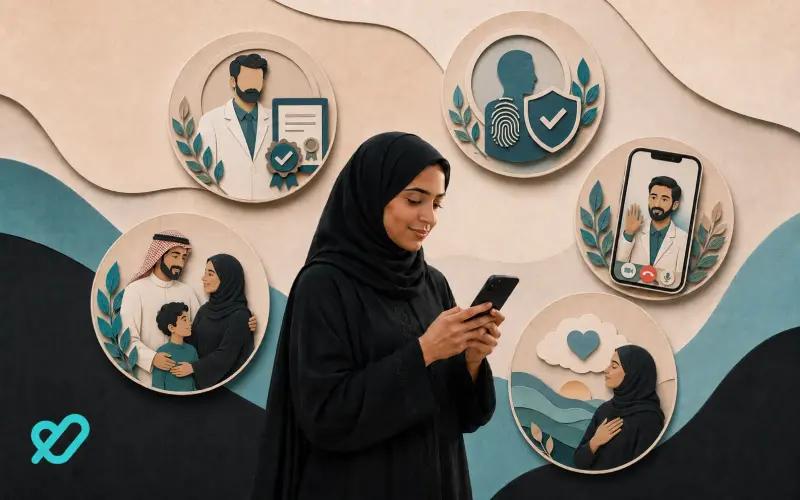
Tatmeen's model aligns with Saudi Vision 2030 because the Vision itself no longer treats health as delayed treatment only, and it does not treat quality of life as a luxury separated from psychological wellbeing. At the heart of the Vision, health, psychological, and social wellbeing move forward as priorities. Alongside them comes a clear objective: healthcare that is easier to access, higher in quality, and more capable of genuinely improving people's lives. This is exactly where Tatmeen operates: a licensed Saudi platform, specialized, digital, and built to turn mental health support from a postponed idea into care that people can access and continue.
The relationship here is not a slogan attached to the Vision. It is an operating model. The Health Sector Transformation Program works to make health services easier to access, improve their quality, and strengthen prevention. The Ministry of Health treats digital health as a vital enabler that includes remote consultations, secure systems, clinical and administrative support, and improved efficiency. Tatmeen does not stop at booking a session. It builds a connected care chain: discovery, matching, booking, session delivery, assessments, reports, follow-up, and professional operations for providers. That is why its alignment with Vision targets is not decorative wording. It is the logical result of the product's structure itself.
The Vision Does Not Separate Mental Wellbeing from Quality of Life
One of the most important shifts reinforced by Vision 2030 is that quality of life in Saudi Arabia no longer means only environment, services, and opportunities. It also means the completeness of physical, psychological, and social health. Even at the level of Vision Realization Programs, this meaning appears more clearly: the Health Sector Transformation Program is not limited to traditional medical infrastructure. It includes mental health within performance-development areas and treats access, quality, and prevention as connected elements, not separate goals. This matters because it moves mental health from the margins into the center of the national idea of a good life.
This is where the strength of Tatmeen's model appears. The platform does not present mental health as a broad and abstract title. It presents it as real needs that live inside the details of daily life: work, family, study, scholarship journeys, women's health, men's health, self-development, sleep disorders and exhaustion, relationships, and other entry points that reflect how distress actually appears in people's lives. This expansion matters because the Vision itself speaks about a vibrant society, not only a treatment system that reacts after symptoms have worsened. Tatmeen translates that meaning into clinics and pathways that a user can enter according to their reality, not according to a complicated clinical term.
Easy Access to Care Is Not a Technical Feature; It Is a National Goal
If there is one direct line between Tatmeen and the Vision, it is removing friction from the path to care. The Health Sector Transformation Program states that its goal is to make health services easier to access and improve their quality everywhere. The 2024 Health Transformation Report expresses this shift very clearly: consultation at the press of a button, about 51 million appointments and virtual consultations, and more than 246,000 beneficiaries of Seha Virtual Hospital since its establishment. This means digital care in Saudi Arabia is no longer an experimental margin. It has become an essential part of the country's view of healthcare that is closer, faster, and more widespread.
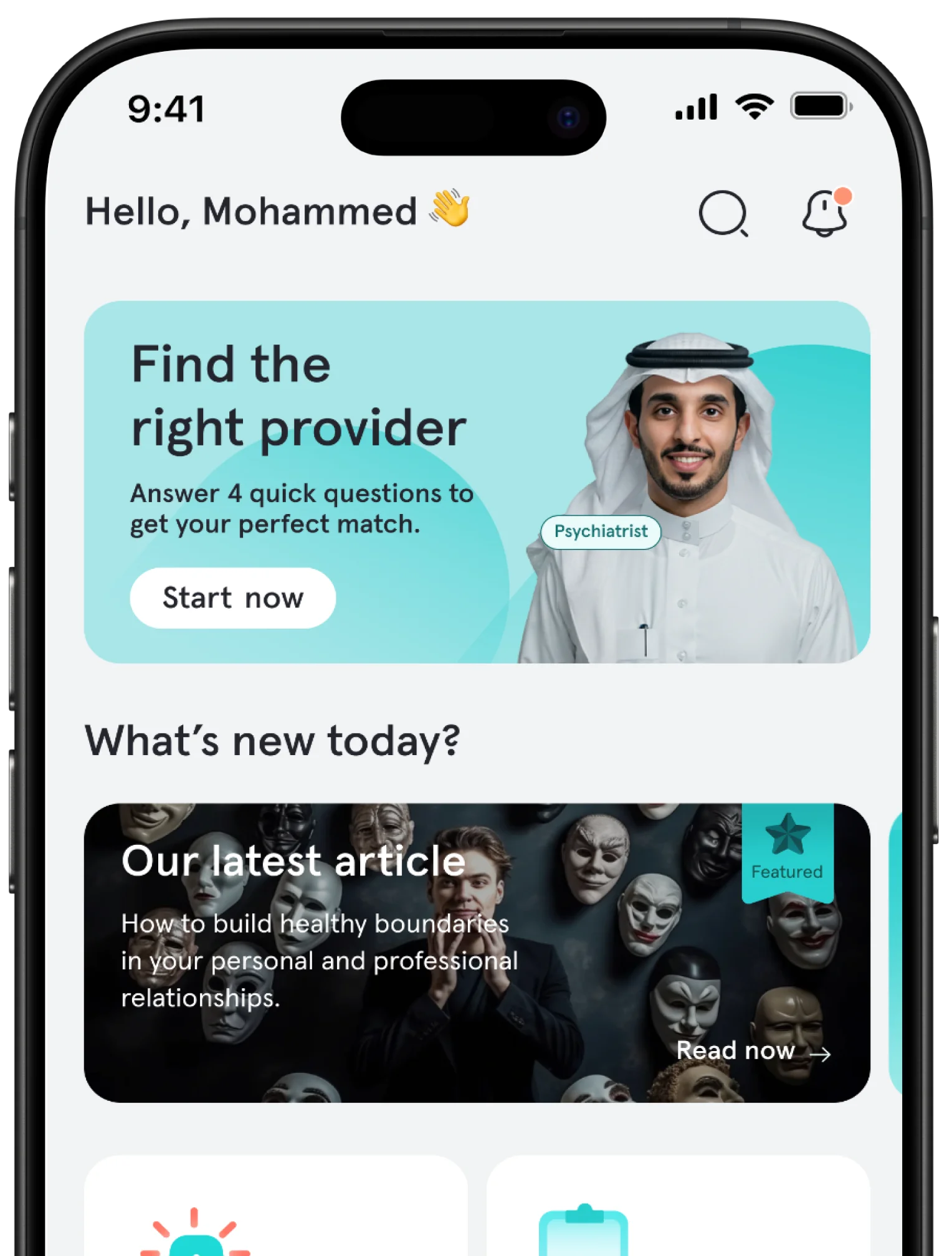
Tatmeen aligns with this goal because it begins with the first barrier and removes it. Entry is through a mobile number. Users can browse as guests. Search can begin with the feeling itself, not with a diagnosis. There is quick matching that recommends providers according to the need, preferences, budget, and availability, alongside scheduled and urgent sessions and support for text, audio, and video sessions. These are not interface improvements. They are exactly how ease of access turns from a goal in a document into a service that can be used in a moment of hesitation, pressure, or urgent need.
More importantly, this access does not come at the expense of informed choice. Tatmeen's provider cards show the professional role, experience, Saudi Commission for Health Specialties classification number, language, session formats, price, ratings, and available appointments. In other words, Tatmeen does not only make access easier. It makes the right access easier. In mental health, this is a fundamental difference, because delay does not always come from the absence of service. Very often, it comes from confusion about whom to choose and how to begin.
Digital Health in the Vision Means a System, Not Just a Booking Channel
The Ministry of Health describes e-health within digital transformation as a vital enabler of comprehensive transformation. It focuses on building a secure information ecosystem, making services easier to obtain, improving quality and efficiency, enabling remote consultations, and providing clinical and administrative support and decision-support tools. This description matters because it defines the real standard for any digital model aligned with the Vision: it should not merely open a communication window. It should build a complete, secure, and connected care structure.
Tatmeen's model clearly follows this logic. The service is not run only from an informational website. It is built on three connected operational layers: an app for the beneficiary, an app for the provider, and an operational and administrative dashboard. Inside this ecosystem are tools for discovery, matching, booking, payment, a secure session room, a treatment file, assessments, therapeutic homework, reports, prescriptions, lab and imaging requests, and follow-up records. When the national goal is for digital health to become more efficient and closer to the patient, this kind of integrated build is more aligned with the Vision than any app that only acts as an intermediary between two people.
This is what makes Tatmeen close to the spirit of Saudi health transformation: digitizing care itself, not only digitizing booking. The provider can manage schedules and availability, receive urgent cases, request assessments before the appointment, document the session, send homework, create reports, review results, while the beneficiary sees everything related to the care journey in one place. This kind of connection between clinical decision-making and digital experience is what genuinely raises service efficiency, and it is exactly what official digital health direction in the Kingdom points toward.
Quality of Care Is Not Achieved by Access Alone; It Requires Trust and Continuity
The Vision does not speak only about availability. It speaks about quality and efficiency. The Health Sector Transformation Program places both dimensions at the center of its objectives. In mental healthcare especially, real quality cannot exist without professional trust, clear privacy, and measurable continuity. Tatmeen is strong here because quality begins before the session: a platform licensed by the Ministry of Health, providers licensed by the Saudi Commission for Health Specialties, and onboarding, operations, and documentation mechanisms that keep the platform professional, not merely an open digital space.
Then comes the trust layer that this kind of care specifically needs. On Tatmeen, the user can use an alias. The user's official identity, when verified for billing and tax-exemption purposes, is not visible to the care provider. The session is not recorded by default. The appointment room is private to the patient and provider. The user also has the right to delete the appointment room and its content. This matters because quality in mental healthcare is not measured only by what is said inside the session, but also by whether the person can begin at all without fear of exposure or embarrassment.
Continuity on Tatmeen is not a vague promise. It is part of the product itself. The platform supports more than 20 psychological assessments, therapeutic homework and progress follow-up, more than 15 structured report templates, along with prescriptions, lab and imaging requests, multiple-session packages, and a clear record of what happened in each appointment. This structure moves care from "one session" to "a therapeutic path," and from a temporary feeling of relief to progress that can be reviewed and tracked. That is exactly what quality means when translated digitally.
From Individual Wellbeing to Workplace Productivity: Where Tatmeen's Wider Alignment with the Vision Appears
Vision 2030 does not view health only as a human file, but also as an economic and social lever. The Vision clearly presents investment in healthy life as something that not only reduces care costs, but also strengthens workforce productivity and raises quality of life. In parallel, the National Transformation Program emphasizes creating an enabling environment for the public, private, and nonprofit sectors, while the Vision emphasizes enabling the private sector to play its vital role. This framework opens a clear space for specialized Saudi models that do not only respond to demand, but expand national capacity to deliver care intelligently and efficiently.
From here, Tatmeen Business appears as an important part of the model's alignment with the Vision. Its dedicated page links mental health in the workplace with reducing exhaustion and burnout, increasing loyalty, reducing absence, and improving work-life balance, with tracks for leaders, interactive workshops, and confidential psychological support for employees. This is not a marketing extension outside the product. It is a direct translation of the idea that quality of life and quality of care affect employee retention, productivity, organizational sustainability, and the health of the labor market itself.
This alignment becomes complete when we see that Tatmeen is not aimed at an isolated individual only. It is designed for the Saudi context as a whole: an Arabic-first experience with English support, locally familiar payment methods, identity verification for tax purposes when needed, an organized treatment file, professional operations for providers, and support for individuals and organizations at the same time. So the model does not align with the Vision because it repeats its vocabulary. It aligns because it takes the Vision's major pathways - quality of life, access, digital health, prevention, and private-sector enablement - and turns them into a service whose effect can be felt in the ordinary day of a Saudi user.
In short, Tatmeen aligns with the targets of Saudi Vision 2030 because the Vision wants more than expanded health services. It wants care that is closer, smarter, higher in quality, and more connected to people's real lives. Tatmeen supports this through a specialized Saudi model that links mental wellbeing with quality of life, turns digital transformation into a real care experience, and expands the impact of mental health from the individual to the family to the workplace. That is why the relationship between Tatmeen and the Vision is not merely a pleasant overlap in language. It is a clear alignment in direction, tools, and the type of impact required.
In emergencies or when there is immediate danger, the priority is not booking inside the app. The priority is emergency care, going to the nearest health facility, or calling the relevant numbers inside Saudi Arabia such as 999, 997, or 937.
Frequently Asked Questions
Does Saudi Vision 2030 actually talk about psychological wellbeing, or only general health?
Yes. The official Vision language explicitly speaks about physical, psychological, and social wellbeing and places it within the priorities of building a vibrant society. The Vision document also links the happiness and fulfillment of citizens and residents to the promotion of physical, psychological, and social wellbeing.
What makes Tatmeen aligned with health transformation rather than just being a session app?
Because the model is not limited to booking or communication. It includes access, matching, assessments, the session itself, reports, follow-up, provider operations, and an administrative dashboard. This matches the Ministry of Health's understanding of digital health as a secure system that includes remote consultations, clinical and administrative support, and efficiency improvement.
Where does prevention appear in Tatmeen's model?
It appears on more than one level: early psychological assessments, topic-based entry points such as work, sleep, and relationship clinics, organized follow-up between sessions, and Tatmeen Business programs focused on reducing exhaustion, improving preventive care, and creating a healthy work environment. This directly aligns with the Vision's goal of strengthening prevention before problems worsen.
Is Tatmeen's impact limited to individuals only?
No. Tatmeen serves individuals, but it also extends to workplaces through Tatmeen Business by supporting employees psychologically and family-wise, reducing exhaustion and absence, and improving loyalty and work-life balance. This aligns with the Vision's view that health and quality of life are also connected to economic productivity and the quality of work environments.
Does Tatmeen align with the Vision only because it is Saudi?
Not because it is Saudi in identity only, but because it is Saudi in operation: licensed, working within the local regulatory framework, serving realistic patterns of need inside Saudi society, and supporting a user experience suited to the local market from language to payment methods to pathways for individuals and organizations. That is the real alignment with the Vision: a local product that understands transformation priorities and translates them into a service that can be used daily.
A writer and researcher specializing in psychiatry, she focuses on mental health and the human emotions we experience but cannot always find the words to name. She writes about us—about humanity and the human experience—and simplifies complex topics to offer content that helps us better understand ourselves and life, ultimately making us feel less alone.
Every Tatmeen article is reviewed by care providers licensed by the Saudi Commission for Health Specialties, so what you read is accurate and trustworthy.
This article builds understanding and does not replace a licensed care provider.
Need someone to talk to?
Tatmeen's licensed care providers are available around the clock, and the app's urgent consultation connects you with one within minutes.
Download Tatmeen to explore care providers and booking options.
Smart matchingFour quick questions suggest the right care provider
Urgent consultationTalk to an available care provider within minutes
Free psychological measuresMore than 20 tests to understand how you are doing
Scan to download
{"data":{"id":"7c799856-fd7e-449b-81d1-8ae7328e4029","slug":"tatmeen-quality-of-care-vision-2030","arTitle":"من جودة الحياة إلى جودة الرعاية: لماذا ينسجم نموذج تطمين مع مستهدفات الرؤية؟","enTitle":"Quality of Life to Quality of Care: Why Tatmeen's Model Aligns with Vision 2030","thumbnailAltText":"Doctor holding glowing Tatmeen logo with digital care and security icons","estimatedReadingTime":5,"likesCount":248,"writer":{"id":"3ab72b74-f26f-4337-9b47-3114b0f90de5","arBio":"كاتبة وباحثة متخصصة في مجال الطب النفسي، تهتم بموضوعات الصحة النفسية وبالمشاعر الإنسانية التي نختبرها ولا نجد دائمًا الكلمات لتسميتها. تكتب عنّا؛ عن الإنسان وتجربته، وتبسّط الموضوعات المعقّدة لتقدّم محتوى يساعدنا على فهم ذواتنا والحياة أكثر، ويجعلنا نشعر بأننا بوحدة أقل.","enBio":"A writer and researcher specializing in psychiatry, she focuses on mental health and the human emotions we experience but cannot always find the words to name. She writes about us—about humanity and the human experience—and simplifies complex topics to offer content that helps us better understand ourselves and life, ultimately making us feel less alone.","user":{"slug":"ayat-alnajar","arFullName":"آيات النجار","enFullName":"Ayat Al-Najjar","publicProfileImageUrl":"https://cdn.tatmeen.sa/public/profile-images/02384455-68fa-40b6-ad05-609fde65cafa/21b9a610dde5dfc6d37af110c23e9c7ab3946be080c281beb000debf4f7d31a6.webp","publicProfileImage96Url":"https://cdn.tatmeen.sa/public/profile-images/02384455-68fa-40b6-ad05-609fde65cafa/21b9a610dde5dfc6d37af110c23e9c7ab3946be080c281beb000debf4f7d31a6-w96.webp","publicProfileImage192Url":"https://cdn.tatmeen.sa/public/profile-images/02384455-68fa-40b6-ad05-609fde65cafa/21b9a610dde5dfc6d37af110c23e9c7ab3946be080c281beb000debf4f7d31a6-w192.webp"}},"arContent":"","enContent":"","productionDocument":{"headings":[{"id":"article-section-the-vision-does-not-separate-mental-wellbeing-from-quality-of-life","text":"The Vision Does Not Separate Mental Wellbeing from Quality of Life"},{"id":"article-section-easy-access-to-care-is-not-a-technical-feature-it-is-a-national-goal","text":"Easy Access to Care Is Not a Technical Feature; It Is a National Goal"},{"id":"article-section-digital-health-in-the-vision-means-a-system-not-just-a-booking-channel","text":"Digital Health in the Vision Means a System, Not Just a Booking Channel"},{"id":"article-section-quality-of-care-is-not-achieved-by-access-alone-it-requires-trust-and-continuity","text":"Quality of Care Is Not Achieved by Access Alone; It Requires Trust and Continuity"},{"id":"article-section-from-individual-wellbeing-to-workplace-productivity-where-tatmeen-s-wider-alignment-with-the-vision-appears","text":"From Individual Wellbeing to Workplace Productivity: Where Tatmeen's Wider Alignment with the Vision Appears"}],"faqs":[{"question":"Does Saudi Vision 2030 actually talk about psychological wellbeing, or only general health?","answer":"<p><span style=\"color:#000000\">Yes. The official Vision language explicitly speaks about physical, psychological, and social wellbeing and places it within the priorities of building a vibrant society. The Vision document also links the happiness and fulfillment of citizens and residents to the promotion of physical, psychological, and social wellbeing.</span></p>"},{"question":"What makes Tatmeen aligned with health transformation rather than just being a session app?","answer":"<p><span style=\"color:#000000\">Because the model is not limited to booking or communication. It includes access, matching, assessments, the session itself, reports, follow-up, provider operations, and an administrative dashboard. This matches the Ministry of Health's understanding of digital health as a secure system that includes remote consultations, clinical and administrative support, and efficiency improvement.</span></p>"},{"question":"Where does prevention appear in Tatmeen's model?","answer":"<p><span style=\"color:#000000\">It appears on more than one level: early psychological assessments, topic-based entry points such as work, sleep, and relationship clinics, organized follow-up between sessions, and Tatmeen Business programs focused on reducing exhaustion, improving preventive care, and creating a healthy work environment. This directly aligns with the Vision's goal of strengthening prevention before problems worsen.</span></p>"},{"question":"Is Tatmeen's impact limited to individuals only?","answer":"<p><span style=\"color:#000000\">No. Tatmeen serves individuals, but it also extends to workplaces through Tatmeen Business by supporting employees psychologically and family-wise, reducing exhaustion and absence, and improving loyalty and work-life balance. This aligns with the Vision's view that health and quality of life are also connected to economic productivity and the quality of work environments.</span></p>"},{"question":"Does Tatmeen align with the Vision only because it is Saudi?","answer":"<p><span style=\"color:#000000\">Not because it is Saudi in identity only, but because it is Saudi in operation: licensed, working within the local regulatory framework, serving realistic patterns of need inside Saudi society, and supporting a user experience suited to the local market from language to payment methods to pathways for individuals and organizations. That is the real alignment with the Vision: a local product that understands transformation priorities and translates them into a service that can be used daily.</span></p>"}],"beforeSourcesHtml":"","sources":[{"title":"Saudi Vision 2030 - Vision Document","href":"https://www.vision2030.gov.sa/media/rc0b5oy1/saudi_vision203.pdf","hostname":"vision2030.gov.sa"},{"title":"Saudi Vision 2030 - 2024 Annual Report","href":"https://www.vision2030.gov.sa/media/25042025ev1/En-Annual%20Report-Vision2030-2024.pdf","hostname":"vision2030.gov.sa"},{"title":"Health Sector Transformation Program - Delivery Plan 2021-2025","href":"https://www.vision2030.gov.sa/media/x3jbf45y/2021-2025-health-sector-transformation-program-delivery-plan-en.pdf","hostname":"vision2030.gov.sa"},{"title":"Health Sector Transformation Program - Health Transformation Report 2024","href":"https://www.vision2030.gov.sa/media/h0yb5d03/health-sector-transformation-report-2024.pdf","hostname":"vision2030.gov.sa"},{"title":"Saudi Ministry of Health - National E-Health Strategy","href":"https://www.moh.gov.sa/en/ministry/nehs/pages/default.aspx","hostname":"moh.gov.sa"},{"title":"Saudi Ministry of Health - Telemedicine","href":"https://www.moh.gov.sa/en/ministry/information-and-services/pages/telemedicine.aspx","hostname":"moh.gov.sa"},{"title":"Saudi Ministry of Health - 937 Services","href":"https://www.moh.gov.sa/en/937/pages/default.aspx","hostname":"moh.gov.sa"},{"title":"Communications, Space and Technology Commission - Numbering","href":"https://www.cst.gov.sa/en/about/Numbering","hostname":"cst.gov.sa"},{"title":"World Health Organization - Mental Health","href":"https://www.who.int/health-topics/mental-health","hostname":"who.int"}],"afterSourcesHtml":"","blocks":[{"type":"html","html":"<p><span style=\"color:#000000\">Tatmeen's model aligns with Saudi Vision 2030 because the Vision itself no longer treats health as delayed treatment only, and it does not treat quality of life as a luxury separated from psychological wellbeing. At the heart of the Vision, health, psychological, and social wellbeing move forward as priorities. Alongside them comes a clear objective: healthcare that is easier to access, higher in quality, and more capable of genuinely improving people's lives. This is exactly where Tatmeen operates: a licensed Saudi platform, specialized, digital, and built to turn mental health support from a postponed idea into care that people can access and continue.</span></p><p><span style=\"color:#000000\">The relationship here is not a slogan attached to the Vision. It is an operating model. The Health Sector Transformation Program works to make health services easier to access, improve their quality, and strengthen prevention. The Ministry of Health treats digital health as a vital enabler that includes remote consultations, secure systems, clinical and administrative support, and improved efficiency. Tatmeen does not stop at booking a session. It builds a connected care chain: discovery, matching, booking, session delivery, assessments, reports, follow-up, and professional operations for providers. That is why its alignment with Vision targets is not decorative wording. It is the logical result of the product's structure itself.</span></p><h2 id=\"article-section-the-vision-does-not-separate-mental-wellbeing-from-quality-of-life\" data-toc-heading tabindex=\"-1\"><span id=\"the-vision-does-not-separate-mental-wellbeing-from-quality-of-life-1\" aria-hidden=\"true\"></span><span style=\"color:#000000\"><strong>The Vision Does Not Separate Mental Wellbeing from Quality of Life</strong></span></h2><p><span style=\"color:#000000\">One of the most important shifts reinforced by Vision 2030 is that quality of life in Saudi Arabia no longer means only environment, services, and opportunities. It also means the completeness of physical, psychological, and social health. Even at the level of Vision Realization Programs, this meaning appears more clearly: the Health Sector Transformation Program is not limited to traditional medical infrastructure. It includes mental health within performance-development areas and treats access, quality, and prevention as connected elements, not separate goals. This matters because it moves mental health from the margins into the center of the national idea of a good life.</span></p><p><span style=\"color:#000000\">This is where the strength of Tatmeen's model appears. The platform does not present mental health as a broad and abstract title. It presents it as real needs that live inside the details of daily life: work, family, study, scholarship journeys, women's health, men's health, self-development, sleep disorders and exhaustion, relationships, and other entry points that reflect how distress actually appears in people's lives. This expansion matters because the Vision itself speaks about a vibrant society, not only a treatment system that reacts after symptoms have worsened. Tatmeen translates that meaning into clinics and pathways that a user can enter according to their reality, not according to a complicated clinical term.</span></p><h2 id=\"article-section-easy-access-to-care-is-not-a-technical-feature-it-is-a-national-goal\" data-toc-heading tabindex=\"-1\"><span id=\"easy-access-to-care-is-not-a-technical-feature-it-is-a-national-goal-2\" aria-hidden=\"true\"></span><span style=\"color:#000000\"><strong>Easy Access to Care Is Not a Technical Feature; It Is a National Goal</strong></span></h2><p><span style=\"color:#000000\">If there is one direct line between Tatmeen and the Vision, it is removing friction from the path to care. The Health Sector Transformation Program states that its goal is to make health services easier to access and improve their quality everywhere. The 2024 Health Transformation Report expresses this shift very clearly: consultation at the press of a button, about 51 million appointments and virtual consultations, and more than 246,000 beneficiaries of Seha Virtual Hospital since its establishment. This means digital care in Saudi Arabia is no longer an experimental margin. It has become an essential part of the country's view of healthcare that is closer, faster, and more widespread.</span></p><p><span style=\"color:#000000\">Tatmeen aligns with this goal because it begins with the first barrier and removes it. Entry is through a mobile number. Users can browse as guests. Search can begin with the feeling itself, not with a diagnosis. There is quick matching that recommends providers according to the need, preferences, budget, and availability, alongside scheduled and urgent sessions and support for text, audio, and video sessions. These are not interface improvements. They are exactly how ease of access turns from a goal in a document into a service that can be used in a moment of hesitation, pressure, or urgent need.</span></p><p><span style=\"color:#000000\">More importantly, this access does not come at the expense of informed choice. Tatmeen's provider cards show the professional role, experience, Saudi Commission for Health Specialties classification number, language, session formats, price, ratings, and available appointments. In other words, Tatmeen does not only make access easier. It makes the right access easier. In mental health, this is a fundamental difference, because delay does not always come from the absence of service. Very often, it comes from confusion about whom to choose and how to begin.</span></p><h2 id=\"article-section-digital-health-in-the-vision-means-a-system-not-just-a-booking-channel\" data-toc-heading tabindex=\"-1\"><span id=\"digital-health-in-the-vision-means-a-system-not-just-a-booking-channel-3\" aria-hidden=\"true\"></span><span style=\"color:#000000\"><strong>Digital Health in the Vision Means a System, Not Just a Booking Channel</strong></span></h2><p><span style=\"color:#000000\">The Ministry of Health describes e-health within digital transformation as a vital enabler of comprehensive transformation. It focuses on building a secure information ecosystem, making services easier to obtain, improving quality and efficiency, enabling remote consultations, and providing clinical and administrative support and decision-support tools. This description matters because it defines the real standard for any digital model aligned with the Vision: it should not merely open a communication window. It should build a complete, secure, and connected care structure.</span></p><p><span style=\"color:#000000\">Tatmeen's model clearly follows this logic. The service is not run only from an informational website. It is built on three connected operational layers: an app for the beneficiary, an app for the provider, and an operational and administrative dashboard. Inside this ecosystem are tools for discovery, matching, booking, payment, a secure session room, a treatment file, assessments, therapeutic homework, reports, prescriptions, lab and imaging requests, and follow-up records. When the national goal is for digital health to become more efficient and closer to the patient, this kind of integrated build is more aligned with the Vision than any app that only acts as an intermediary between two people.</span></p><p><span style=\"color:#000000\">This is what makes Tatmeen close to the spirit of Saudi health transformation: digitizing care itself, not only digitizing booking. The provider can manage schedules and availability, receive urgent cases, request assessments before the appointment, document the session, send homework, create reports, review results, while the beneficiary sees everything related to the care journey in one place. This kind of connection between clinical decision-making and digital experience is what genuinely raises service efficiency, and it is exactly what official digital health direction in the Kingdom points toward.</span></p><h2 id=\"article-section-quality-of-care-is-not-achieved-by-access-alone-it-requires-trust-and-continuity\" data-toc-heading tabindex=\"-1\"><span id=\"quality-of-care-is-not-achieved-by-access-alone-it-requires-trust-and-continuity-4\" aria-hidden=\"true\"></span><span style=\"color:#000000\"><strong>Quality of Care Is Not Achieved by Access Alone; It Requires Trust and Continuity</strong></span></h2><p><span style=\"color:#000000\">The Vision does not speak only about availability. It speaks about quality and efficiency. The Health Sector Transformation Program places both dimensions at the center of its objectives. In mental healthcare especially, real quality cannot exist without professional trust, clear privacy, and measurable continuity. Tatmeen is strong here because quality begins before the session: a platform licensed by the Ministry of Health, providers licensed by the Saudi Commission for Health Specialties, and onboarding, operations, and documentation mechanisms that keep the platform professional, not merely an open digital space.</span></p><p><span style=\"color:#000000\">Then comes the trust layer that this kind of care specifically needs. On Tatmeen, the user can use an alias. The user's official identity, when verified for billing and tax-exemption purposes, is not visible to the care provider. The session is not recorded by default. The appointment room is private to the patient and provider. The user also has the right to delete the appointment room and its content. This matters because quality in mental healthcare is not measured only by what is said inside the session, but also by whether the person can begin at all without fear of exposure or embarrassment.</span></p><p><span style=\"color:#000000\">Continuity on Tatmeen is not a vague promise. It is part of the product itself. The platform supports more than 20 psychological assessments, therapeutic homework and progress follow-up, more than 15 structured report templates, along with prescriptions, lab and imaging requests, multiple-session packages, and a clear record of what happened in each appointment. This structure moves care from \"one session\" to \"a therapeutic path,\" and from a temporary feeling of relief to progress that can be reviewed and tracked. That is exactly what quality means when translated digitally.</span></p><h2 id=\"article-section-from-individual-wellbeing-to-workplace-productivity-where-tatmeen-s-wider-alignment-with-the-vision-appears\" data-toc-heading tabindex=\"-1\"><span id=\"from-individual-wellbeing-to-workplace-productivity-where-tatmeen-s-wider-alignment-with-the-vision-appears-5\" aria-hidden=\"true\"></span><span style=\"color:#000000\"><strong>From Individual Wellbeing to Workplace Productivity: Where Tatmeen's Wider Alignment with the Vision Appears</strong></span></h2><p><span style=\"color:#000000\">Vision 2030 does not view health only as a human file, but also as an economic and social lever. The Vision clearly presents investment in healthy life as something that not only reduces care costs, but also strengthens workforce productivity and raises quality of life. In parallel, the National Transformation Program emphasizes creating an enabling environment for the public, private, and nonprofit sectors, while the Vision emphasizes enabling the private sector to play its vital role. This framework opens a clear space for specialized Saudi models that do not only respond to demand, but expand national capacity to deliver care intelligently and efficiently.</span></p><p><span style=\"color:#000000\">From here, Tatmeen Business appears as an important part of the model's alignment with the Vision. Its dedicated page links mental health in the workplace with reducing exhaustion and burnout, increasing loyalty, reducing absence, and improving work-life balance, with tracks for leaders, interactive workshops, and confidential psychological support for employees. This is not a marketing extension outside the product. It is a direct translation of the idea that quality of life and quality of care affect employee retention, productivity, organizational sustainability, and the health of the labor market itself.</span></p><p><span style=\"color:#000000\">This alignment becomes complete when we see that Tatmeen is not aimed at an isolated individual only. It is designed for the Saudi context as a whole: an Arabic-first experience with English support, locally familiar payment methods, identity verification for tax purposes when needed, an organized treatment file, professional operations for providers, and support for individuals and organizations at the same time. So the model does not align with the Vision because it repeats its vocabulary. It aligns because it takes the Vision's major pathways - quality of life, access, digital health, prevention, and private-sector enablement - and turns them into a service whose effect can be felt in the ordinary day of a Saudi user.</span></p><p><span style=\"color:#000000\">In short, Tatmeen aligns with the targets of Saudi Vision 2030 because the Vision wants more than expanded health services. It wants care that is closer, smarter, higher in quality, and more connected to people's real lives. Tatmeen supports this through a specialized Saudi model that links mental wellbeing with quality of life, turns digital transformation into a real care experience, and expands the impact of mental health from the individual to the family to the workplace. That is why the relationship between Tatmeen and the Vision is not merely a pleasant overlap in language. It is a clear alignment in direction, tools, and the type of impact required.</span></p><p><span style=\"color:#000000\">In emergencies or when there is immediate danger, the priority is not booking inside the app. The priority is emergency care, going to the nearest health facility, or calling the relevant numbers inside Saudi Arabia such as 999, 997, or 937.</span></p>"}],"inlineCtaSignatures":[],"_experienceAliases":{"v":1,"fields":["html","bodyHtml"],"faqs":[0,1,2,3,4]}},"createdAt":"2026-06-23T21:00:00.000Z","updatedAt":"2026-06-26T14:14:30.936Z","disorderGroups":[{"id":"1e82772d-a1a7-4d29-b475-be9d6b67ae02","slug":"common-mental-issues","arName":"اضطرابات نفسية شائعة","enName":"Common Mental Issues"}],"reviewer":{"arFullName":"فريق تطمين","enFullName":"Tatmeen team","slug":"tatmeen-team","kind":"organization"},"productionArticle":true,"promotionAllowed":true,"preparedCover":{"src":"https://cdn.tatmeen.sa/public/article-lcp/article-lcp-v2/sha256-a20c7aa7552859e38242644c9a55766630516d4cb62401b2133e3a0da74db78a/800-8a95987920cacc30d52aa43dbf47408f49d53fc1eca517b68a1bae3a4cfc782a.avif","fallback":"https://cdn.tatmeen.sa/public/article-lcp/article-lcp-v2/sha256-a20c7aa7552859e38242644c9a55766630516d4cb62401b2133e3a0da74db78a/800-717b79743163833ff79372831b2dff30dbdc03ff28cdf23fb1508da8b53682c3.webp","directUrl":"https://cdn.tatmeen.sa/blog-cover/Tatmeen-1782322117906.webp","isGolden":true,"avifSrcset":"https://cdn.tatmeen.sa/public/article-lcp/article-lcp-v2/sha256-a20c7aa7552859e38242644c9a55766630516d4cb62401b2133e3a0da74db78a/400-f6ea447e09fc95f697521db0a1baf62deb0b31968c5c368156d1114152d73195.avif 400w, https://cdn.tatmeen.sa/public/article-lcp/article-lcp-v2/sha256-a20c7aa7552859e38242644c9a55766630516d4cb62401b2133e3a0da74db78a/640-c34a92bad2ed2a752b1d791bcc2a697566196d530dce163a4f98bd0b1c22248c.avif 640w, https://cdn.tatmeen.sa/public/article-lcp/article-lcp-v2/sha256-a20c7aa7552859e38242644c9a55766630516d4cb62401b2133e3a0da74db78a/800-8a95987920cacc30d52aa43dbf47408f49d53fc1eca517b68a1bae3a4cfc782a.avif 800w, https://cdn.tatmeen.sa/public/article-lcp/article-lcp-v2/sha256-a20c7aa7552859e38242644c9a55766630516d4cb62401b2133e3a0da74db78a/1200-b021f58cd53966650b2fda7336c5f56f509169aa20c1543ce29822136337c777.avif 1200w","webpSrcset":"https://cdn.tatmeen.sa/public/article-lcp/article-lcp-v2/sha256-a20c7aa7552859e38242644c9a55766630516d4cb62401b2133e3a0da74db78a/400-2cc103a6bc3109d9b532c35b54680cdbf5bdeff2126297b28c0627102f00b41c.webp 400w, https://cdn.tatmeen.sa/public/article-lcp/article-lcp-v2/sha256-a20c7aa7552859e38242644c9a55766630516d4cb62401b2133e3a0da74db78a/640-68146fade2fb780d451da45fa90ad98bc623912eff062b499c365d84d8052365.webp 640w, https://cdn.tatmeen.sa/public/article-lcp/article-lcp-v2/sha256-a20c7aa7552859e38242644c9a55766630516d4cb62401b2133e3a0da74db78a/800-717b79743163833ff79372831b2dff30dbdc03ff28cdf23fb1508da8b53682c3.webp 800w, https://cdn.tatmeen.sa/public/article-lcp/article-lcp-v2/sha256-a20c7aa7552859e38242644c9a55766630516d4cb62401b2133e3a0da74db78a/1200-8f69e44bb297b1a23d6bce847e4662a6a0b702246af5b85c6f1a7049dc24e4f3.webp 1200w","phoneAvifSrcset":"https://cdn.tatmeen.sa/public/article-lcp/article-lcp-v2/sha256-a20c7aa7552859e38242644c9a55766630516d4cb62401b2133e3a0da74db78a/400-f6ea447e09fc95f697521db0a1baf62deb0b31968c5c368156d1114152d73195.avif 400w, https://cdn.tatmeen.sa/public/article-lcp/article-lcp-v2/sha256-a20c7aa7552859e38242644c9a55766630516d4cb62401b2133e3a0da74db78a/640-c34a92bad2ed2a752b1d791bcc2a697566196d530dce163a4f98bd0b1c22248c.avif 640w, https://cdn.tatmeen.sa/public/article-lcp/article-lcp-v2/sha256-a20c7aa7552859e38242644c9a55766630516d4cb62401b2133e3a0da74db78a/800-8a95987920cacc30d52aa43dbf47408f49d53fc1eca517b68a1bae3a4cfc782a.avif 800w","phoneWebpSrcset":"https://cdn.tatmeen.sa/public/article-lcp/article-lcp-v2/sha256-a20c7aa7552859e38242644c9a55766630516d4cb62401b2133e3a0da74db78a/400-2cc103a6bc3109d9b532c35b54680cdbf5bdeff2126297b28c0627102f00b41c.webp 400w, https://cdn.tatmeen.sa/public/article-lcp/article-lcp-v2/sha256-a20c7aa7552859e38242644c9a55766630516d4cb62401b2133e3a0da74db78a/640-68146fade2fb780d451da45fa90ad98bc623912eff062b499c365d84d8052365.webp 640w, https://cdn.tatmeen.sa/public/article-lcp/article-lcp-v2/sha256-a20c7aa7552859e38242644c9a55766630516d4cb62401b2133e3a0da74db78a/800-717b79743163833ff79372831b2dff30dbdc03ff28cdf23fb1508da8b53682c3.webp 800w","width":800,"height":450},"previewTaxonomy":{"groups":[{"id":"1e82772d-a1a7-4d29-b475-be9d6b67ae02","slug":"common-mental-issues","arName":"اضطرابات نفسية شائعة","enName":"Common Mental Issues"}],"topics":[],"tags":[{"id":"0a7fb6ee-560f-4ee0-b5f5-a8af3b1bb1da","slug":"tatmeen","arName":"تطمين","enName":"Tatmeen"},{"id":"7d4166fa-470f-4055-99cd-90ae10e2ecea","slug":"saudi-vision-2030","arName":"رؤية السعودية 2030","enName":"Saudi Vision 2030"},{"id":"300cd66c-9540-4ed3-8eae-47386be32d60","slug":"digital-health-telehealth","arName":"الصحة الرقمية والعلاج عن بُعد","enName":"Digital Health & Telehealth"},{"id":"c2a6e8d3-de9c-435f-8c95-9727e7db14cc","slug":"explainer-awareness","arName":"دليل توعوي / شرح","enName":"Explainer / Awareness Guide"}]},"previewProviderRecommendations":[{"id":"6866c238-0223-4d20-b182-6bf8929dccca","slug":"bushra-alluhaibi-4189","arFullName":"بشرى اللهيبي","enFullName":"Bushra Alluhaibi","publicProfileImageUrl":"","publicProfileImage96Url":"","publicProfileImage192Url":"","specialization":{"arName":"أخصائي نفسي","enName":"Psychologist"},"profileImageUrl":"","experienceYears":12,"consultantInfo":{"averageRating":{"average":0},"specialization":{"arGeneralName":"أخصائي نفسي","enGeneralName":"Psychologist"}}},{"id":"23ba62b8-9679-46a2-9439-b2801cafc59b","slug":"dr-mohammed-alanazi-4132","arFullName":"د. محمد العنزي","enFullName":"Dr. Mohammed ALANAZI","publicProfileImageUrl":"https://cdn.tatmeen.sa/public/profile-images/23ba62b8-9679-46a2-9439-b2801cafc59b/233e70d98cd910633553abf60e5ee8dd305797b64c4172746ab379f3b91a1461.webp","publicProfileImage96Url":"https://cdn.tatmeen.sa/public/profile-images/23ba62b8-9679-46a2-9439-b2801cafc59b/233e70d98cd910633553abf60e5ee8dd305797b64c4172746ab379f3b91a1461-w96.webp","publicProfileImage192Url":"https://cdn.tatmeen.sa/public/profile-images/23ba62b8-9679-46a2-9439-b2801cafc59b/233e70d98cd910633553abf60e5ee8dd305797b64c4172746ab379f3b91a1461-w192.webp","specialization":{"arName":"طبيب أسرة","enName":"Family Physician"},"profileImageUrl":"https://cdn.tatmeen.sa/public/profile-images/23ba62b8-9679-46a2-9439-b2801cafc59b/233e70d98cd910633553abf60e5ee8dd305797b64c4172746ab379f3b91a1461-w192.webp","experienceYears":3,"consultantInfo":{"averageRating":{"average":0},"specialization":{"arGeneralName":"طبيب أسرة","enGeneralName":"Family Physician"}}},{"id":"4bcf0531-d58c-4284-aeed-b2563c966ee3","slug":"dr-sultan-albalawi-9701","arFullName":"د. سلطان البلوي","enFullName":"Dr. Sultan Albalawi","publicProfileImageUrl":"https://cdn.tatmeen.sa/public/profile-images/4bcf0531-d58c-4284-aeed-b2563c966ee3/7038797eec8398a3d17eebf66394b26366409d9a9faece56515311203b0600b2.webp","publicProfileImage96Url":"https://cdn.tatmeen.sa/public/profile-images/4bcf0531-d58c-4284-aeed-b2563c966ee3/7038797eec8398a3d17eebf66394b26366409d9a9faece56515311203b0600b2-w96.webp","publicProfileImage192Url":"https://cdn.tatmeen.sa/public/profile-images/4bcf0531-d58c-4284-aeed-b2563c966ee3/7038797eec8398a3d17eebf66394b26366409d9a9faece56515311203b0600b2-w192.webp","specialization":{"arName":"طبيب أسرة","enName":"Family Physician"},"profileImageUrl":"https://cdn.tatmeen.sa/public/profile-images/4bcf0531-d58c-4284-aeed-b2563c966ee3/7038797eec8398a3d17eebf66394b26366409d9a9faece56515311203b0600b2-w192.webp","experienceYears":3,"consultantInfo":{"averageRating":{"average":0},"specialization":{"arGeneralName":"طبيب أسرة","enGeneralName":"Family Physician"}}}],"previewCareProviders":[{"id":"09364052-c2a9-4c52-9717-7ce2093b8d0a","slug":"kholoud-alharbi-5221","arFullName":"خلود الحربي","enFullName":"Kholoud Alharbi","publicProfileImageUrl":"https://cdn.tatmeen.sa/public/profile-images/09364052-c2a9-4c52-9717-7ce2093b8d0a/4a0aeb81619e351b77f4323e3605a0a00acc7ca3c82ee7cc5ca2c9e8ef716049.webp","publicProfileImage96Url":"https://cdn.tatmeen.sa/public/profile-images/09364052-c2a9-4c52-9717-7ce2093b8d0a/4a0aeb81619e351b77f4323e3605a0a00acc7ca3c82ee7cc5ca2c9e8ef716049-w96.webp","publicProfileImage192Url":"https://cdn.tatmeen.sa/public/profile-images/09364052-c2a9-4c52-9717-7ce2093b8d0a/4a0aeb81619e351b77f4323e3605a0a00acc7ca3c82ee7cc5ca2c9e8ef716049-w192.webp","gender":"FEMALE","specialization":{"arName":"أخصائي نفسي","enName":"Psychologist"}},{"id":"6f037535-1dca-4b50-a8b2-5974b7323286","slug":"salah-althobaiti-9053","arFullName":"صلاح الثبيتي","enFullName":"Salah Althobaiti","publicProfileImageUrl":"https://cdn.tatmeen.sa/public/profile-images/6f037535-1dca-4b50-a8b2-5974b7323286/35b6bd7fad9b1e004c1835803eb9c1b56dcacd380685ec8bff141f0fb888005c.webp","publicProfileImage96Url":"https://cdn.tatmeen.sa/public/profile-images/6f037535-1dca-4b50-a8b2-5974b7323286/35b6bd7fad9b1e004c1835803eb9c1b56dcacd380685ec8bff141f0fb888005c-w96.webp","publicProfileImage192Url":"https://cdn.tatmeen.sa/public/profile-images/6f037535-1dca-4b50-a8b2-5974b7323286/35b6bd7fad9b1e004c1835803eb9c1b56dcacd380685ec8bff141f0fb888005c-w192.webp","gender":"MALE","specialization":{"arName":"أخصائي نفسي","enName":"Psychologist"}},{"id":"3cc806e8-616b-4884-9f21-a75b378580a2","slug":"aisha-al-hashim-8667","arFullName":"عائشة ال هاشم","enFullName":"Aisha Al Hashim","publicProfileImageUrl":"https://cdn.tatmeen.sa/public/profile-images/3cc806e8-616b-4884-9f21-a75b378580a2/27f523d03be4dcfa1f6a79f70c1773887434e698990d214cd990caec56a44798.webp","publicProfileImage96Url":"https://cdn.tatmeen.sa/public/profile-images/3cc806e8-616b-4884-9f21-a75b378580a2/27f523d03be4dcfa1f6a79f70c1773887434e698990d214cd990caec56a44798-w96.webp","publicProfileImage192Url":"https://cdn.tatmeen.sa/public/profile-images/3cc806e8-616b-4884-9f21-a75b378580a2/27f523d03be4dcfa1f6a79f70c1773887434e698990d214cd990caec56a44798-w192.webp","gender":"FEMALE","specialization":{"arName":"أخصائي نفسي","enName":"Psychologist"}},{"id":"db2ce1a0-9325-4471-b7ce-eb2e811c30a3","slug":"amer-qutub-2441","arFullName":"عامر قطب","enFullName":"Amer Qutub","publicProfileImageUrl":"https://cdn.tatmeen.sa/public/profile-images/db2ce1a0-9325-4471-b7ce-eb2e811c30a3/80580f99bfd7fe2b2a9cf8eed73ab532f5086d1efe053b0aa57358c1ce004261.webp","publicProfileImage96Url":"https://cdn.tatmeen.sa/public/profile-images/db2ce1a0-9325-4471-b7ce-eb2e811c30a3/80580f99bfd7fe2b2a9cf8eed73ab532f5086d1efe053b0aa57358c1ce004261-w96.webp","publicProfileImage192Url":"https://cdn.tatmeen.sa/public/profile-images/db2ce1a0-9325-4471-b7ce-eb2e811c30a3/80580f99bfd7fe2b2a9cf8eed73ab532f5086d1efe053b0aa57358c1ce004261-w192.webp","gender":"MALE","specialization":{"arName":"أخصائي نفسي","enName":"Psychologist"}},{"id":"94765496-dbdf-4631-a01b-7df5f788668d","slug":"abdullrahman-alhamoudi-3045","arFullName":"عبدالرحمن الحمودي","enFullName":"Abdulrahman Alhamoudi","publicProfileImageUrl":"https://cdn.tatmeen.sa/public/profile-images/94765496-dbdf-4631-a01b-7df5f788668d/2d49f6b6493c564afb6f50b6c3634231dff3a5cf8353acfab393d1b2a88037d1.webp","publicProfileImage96Url":"https://cdn.tatmeen.sa/public/profile-images/94765496-dbdf-4631-a01b-7df5f788668d/2d49f6b6493c564afb6f50b6c3634231dff3a5cf8353acfab393d1b2a88037d1-w96.webp","publicProfileImage192Url":"https://cdn.tatmeen.sa/public/profile-images/94765496-dbdf-4631-a01b-7df5f788668d/2d49f6b6493c564afb6f50b6c3634231dff3a5cf8353acfab393d1b2a88037d1-w192.webp","gender":"MALE","specialization":{"arName":"أخصائي نفسي","enName":"Psychologist"}},{"id":"618dba89-5b70-4b46-8304-741b7ac8ecd3","slug":"abdullah-mari-1311","arFullName":"عبدالله مرعي","enFullName":"Abdullah Mari","publicProfileImageUrl":"https://cdn.tatmeen.sa/public/profile-images/618dba89-5b70-4b46-8304-741b7ac8ecd3/6b4a3bfb59f8a304ca79083b32859b46baad2e1d692974a47c02c1f66bd11129.webp","publicProfileImage96Url":"https://cdn.tatmeen.sa/public/profile-images/618dba89-5b70-4b46-8304-741b7ac8ecd3/6b4a3bfb59f8a304ca79083b32859b46baad2e1d692974a47c02c1f66bd11129-w96.webp","publicProfileImage192Url":"https://cdn.tatmeen.sa/public/profile-images/618dba89-5b70-4b46-8304-741b7ac8ecd3/6b4a3bfb59f8a304ca79083b32859b46baad2e1d692974a47c02c1f66bd11129-w192.webp","gender":"MALE","specialization":{"arName":"أخصائي نفسي","enName":"Psychologist"}},{"id":"3b50a5d5-e795-407f-8676-fd7f0e1bb7a0","slug":"abdulaziz-bin-hudayan-4940","arFullName":"عبدالعزيز بن هديان","enFullName":"Abdulaziz Bin Hudayan","publicProfileImageUrl":"https://cdn.tatmeen.sa/public/profile-images/3b50a5d5-e795-407f-8676-fd7f0e1bb7a0/710ff0fe1fb00cdb5042092e27b7910b480a439b02251ecded62d7758eefce95.webp","publicProfileImage96Url":"https://cdn.tatmeen.sa/public/profile-images/3b50a5d5-e795-407f-8676-fd7f0e1bb7a0/710ff0fe1fb00cdb5042092e27b7910b480a439b02251ecded62d7758eefce95-w96.webp","publicProfileImage192Url":"https://cdn.tatmeen.sa/public/profile-images/3b50a5d5-e795-407f-8676-fd7f0e1bb7a0/710ff0fe1fb00cdb5042092e27b7910b480a439b02251ecded62d7758eefce95-w192.webp","gender":"MALE","specialization":{"arName":"أخصائي نفسي","enName":"Psychologist"}}],"previewDownload":{"href":"/download","title":{"ar":"خطوة واحدة لأجلك، ابدأ الآن","en":"One step for you, start now"},"description":{"ar":"حمّل تطبيق تطمين لاستكشاف مقدمي الرعاية وخيارات الحجز.","en":"Download Tatmeen to explore care providers and booking options."},"posterSrc":"/images/home/cta-ar-new-1.webp","videoSrc":"/images/home/cta-ar-new-1.mp4","videoPosterSrc":"/images/home/cta-ar-new-1.webp","videoPosterEnSrc":"/images/home/cta-en-new-1.webp","videoType":"video/mp4","appStoreHref":"https://apps.apple.com/us/app/tatmeen-%D8%AA%D8%B7%D9%85%D9%8A%D9%86/id6473836983","googlePlayHref":"https://play.google.com/store/apps/details?id=com.TatmeenApp.user&hl=en"},"previewRelatedArticles":[{"id":"e54a1760-4d9f-4ebc-aa47-f526aef44e31","slug":"hypervigilance-hidden-impact-constant-alert-state","route":"/blog/hypervigilance-hidden-impact-constant-alert-state/","title":{"ar":"فرط اليقظة: الأثر الخفي للبقاء في حالة تأهّب مستمر","en":"Hypervigilance: The Hidden Impact of Being in a State of Constant Alert"},"image":"https://cdn.tatmeen.sa/public/article-lcp/article-lcp-v2/sha256-4e8efe5813cdf1650ce6408d3fc082d1e43c5c56f4f1afe4fb6a97740e840ed7/800-73cb3297694a7fe482c37b789c944c3999c6a6dc13b2ca0b9785b67543fb2ce6.webp","directImageFallback":"https://cdn.tatmeen.sa/blog-cover/Tatmeen-1777480042034.webp","arThumbnailAltText":"فرط اليقظة وتأثيره على الصحة النفسية عند البقاء في حالة تأهب دائم","thumbnailAltText":"فرط اليقظة وتأثيره على الصحة النفسية عند البقاء في حالة تأهب دائم","topic":{"label":{"ar":"اضطرابات نفسية شائعة","en":"Common Mental Issues"}},"readingTimeMinutes":5},{"id":"0cc46812-ec85-4177-a366-bf963a49d437","slug":"How-to-deal-with-loss-of-passion-and-interest","route":"/blog/How-to-deal-with-loss-of-passion-and-interest/","title":{"ar":"التعامل مع فقدان الشغف والاهتمام بطريقة واقعية","en":"Dealing with the Loss of Passion and Interest in a Realistic Way"},"image":"https://cdn.tatmeen.sa/public/article-lcp/article-lcp-v2/sha256-d840b4cccfd8a680d47b4d303763ff53cfce04bd352489ef2e8a6165dade49c5/800-663ff5759f77c2e280a456c0f3fb3dc5491a23783957585fe7888ccbecf65fd3.webp","directImageFallback":"https://cdn.tatmeen.sa/blog-cover/Tatmeen-1783528462641.webp","arThumbnailAltText":"Pensive artist sits at cluttered desk, surrounded by paints in soft window light.","thumbnailAltText":"Pensive artist sits at cluttered desk, surrounded by paints in soft window light.","topic":{"label":{"ar":"اضطرابات نفسية شائعة","en":"Common Mental Issues"}},"readingTimeMinutes":5},{"id":"a7b62173-1789-46bf-a7ce-f440f8a811b1","slug":"psychologically-shattered-when-to-seek-help","route":"/blog/psychologically-shattered-when-to-seek-help/","title":{"ar":"هل تشعر أنك مدمر نفسيًا وتحتاج إلى المساعدة؟","en":"Do You Feel Psychologically Shattered and in Need of Help?"},"image":"https://cdn.tatmeen.sa/public/article-lcp/article-lcp-v2/sha256-d7dcaa60188f389a65e1bce5c02e26f792f6822cdb952d88f177fa0d6b4ccd84/800-cd8aa8b15efa341d1ea33a7a5bb6aa43fb9b1d017372d6afefe8ebac2204a406.webp","directImageFallback":"https://cdn.tatmeen.sa/blog-cover/Tatmeen-1783442237081.webp","arThumbnailAltText":"Person curled up, surrounded by chaotic scribbles and storm-like thoughts closing in","thumbnailAltText":"Person curled up, surrounded by chaotic scribbles and storm-like thoughts closing in","topic":{"label":{"ar":"اضطرابات نفسية شائعة","en":"Common Mental Issues"}},"readingTimeMinutes":5},{"id":"4412cfc3-8c2a-4361-831a-e9cf33faa8eb","slug":"best-saudi-mental-health-app-tatmeen","route":"/blog/best-saudi-mental-health-app-tatmeen/","title":{"ar":"٥ أسباب تجعل تطبيق تطمين أفضل تطبيق سعودي للصحة النفسية","en":"5 Reasons Tatmeen Is the Best Saudi Mental Health App"},"image":"https://cdn.tatmeen.sa/public/article-lcp/article-lcp-v2/sha256-f5c71ca183b9cbb47191402bd7cef7ec445c9e3bd02188ee9b485d55e11cfbee/800-a8605868fa88dd92c58779c3c783d476c04b6912d67c2394db94586b18389a47.webp","directImageFallback":"https://cdn.tatmeen.sa/blog-cover/Tatmeen-1778978032442.webp","arThumbnailAltText":"5 reasons to choose tatmeen","thumbnailAltText":"5 reasons to choose tatmeen","topic":{"label":{"ar":"اضطرابات نفسية شائعة","en":"Common Mental Issues"}},"readingTimeMinutes":5}],"previewRelatedReadStates":{}},"locale":"en","device":"desktop","path":"/en/blog/tatmeen-quality-of-care-vision-2030/","readingControls":false,"config":{"public":{"BUCKET_URL":"https://cdn.tatmeen.sa/","APP_BASE_URL":"https://tatmeen.sa","intercomAppId":"ppcnu9e3"}}}