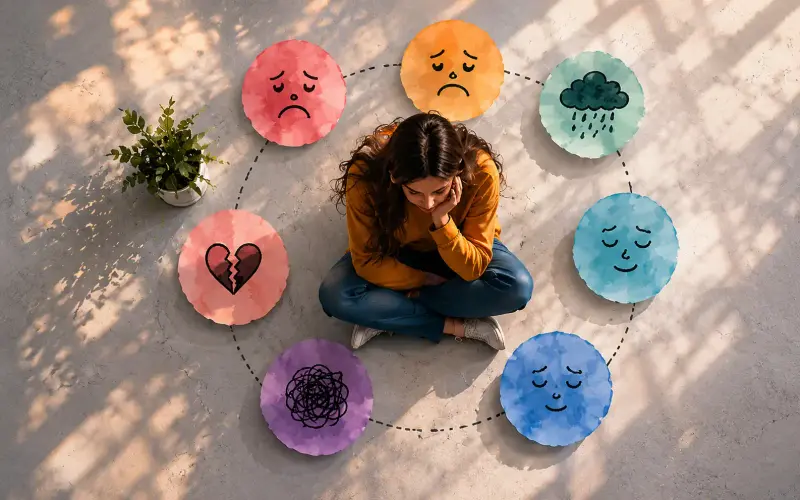
Sadness is a feeling that visits everyone, but sometimes it transforms from a fleeting emotion to a persistent weight in the chest, especially when we feel it without any clear reason and with much loneliness. Many people describe this sensation with a single sentence: "Everything in my life seems fine... but inside, I'm not okay." In this article, we will try to understand the different types of sadness, why we may feel sad without a clear reason, what that has to do with loneliness, and then move on to practical steps that can help you alleviate these feelings.
What is Sadness? And When Does It Become a Problem?
Sadness is a natural human emotion that helps us cope with loss, disappointment, and change. According to Better Health, sadness may appear alongside other feelings like anger or anxiety and can manifest physically in the form of headaches, poor sleep, or a desire for isolation. However, it is important to distinguish between sadness as an emotion and depression as a mental health disorder. Sadness is usually temporary and linked to an event, while depression is a persistent low mood that affects sleep, appetite, and energy, lasting for more than two weeks. The National Institute of Mental Health (NIMH) defines depression as a mood disorder that causes a continuous feeling of sadness or loss of interest, interfering with daily life. It confirms that its duration requires evaluation and treatment, not just endurance.
Types of Sadness: It’s Not One Feeling
Natural and Situational Sadness
This type of sadness is usually tied to a clear event: the loss of a loved one, failure in a task, a disagreement with someone close, or even a major life change. Here, the person can say, "I am sad because...". This sadness often eases with time, social support, and the ability to express oneself, cry, and talk about it. It is a painful wave but a healthy part of the process of adaptation and healing.
Long-term Sadness or Depression-Related Sadness
Sometimes, sadness lasts for a long time, accompanied by a loss of pleasure in activities that once brought joy, physical and mental exhaustion, and difficulty focusing or completing daily tasks. Here, we are closer to a depressive state than just passing sadness, even if we don’t label it as such.
Sadness Without a Clear Reason
This is the most confusing type: you wake up on a normal day, with no bad news, no specific problem, but you feel an internal weight, a desire to cry, or a void you cannot name. This feeling may be related to factors like chronic stress, hormonal changes, poor sleep, unconscious pressures, or the onset of depression that has not yet become clear.
Why Do I Feel Sad Without a Reason?
Physical and Biological Reasons
Thyroid disorders or hormonal imbalances.
Lack of certain vitamins or anemia.
Chronic or irregular sleep patterns.
Unresolved Psychological Stress
You might be strong throughout the day, pushing through situations silently, telling yourself, "I shouldn’t be upset", but emotions don’t disappear; they are stored internally. Over time, they may manifest as vague sadness or a general sense of burnout.
Loneliness and Isolation
Loneliness is not just being alone, but deeply feeling that no one truly sees you. Studies show that repeated loneliness is associated with a higher likelihood of depression, sleep problems, and increased physical stress. Tatmeen observes that many people who complain of sadness without a clear cause also describe a strong feeling of internal isolation, even when surrounded by people. They feel they have no safe space to express themselves honestly without judgment.
The Relationship Between Sadness and Loneliness: A Self-Feeding Cycle
Loneliness can be fertile ground for sadness to persist; sadness, in turn, may drive us to withdraw even more, leading to a closed loop:
We feel sad = We lose the desire to go out or talk.
We isolate further = The feeling of loneliness deepens.
Loneliness increases = Sadness grows heavier, and the days become harder.
Reports on the epidemic of loneliness and social isolation describe chronic loneliness as a genuine health risk factor, linked to an increased risk of heart disease, depression, and even premature death, comparable to the impact of daily smoking. These findings confirm that loneliness is not just a simple feeling to ignore but a state that deserves serious attention and care, requiring us to look for small ways to rebuild bridges with others and with ourselves.
Treating Sadness and Feelings of Sadness Without a Clear Reason
First: Gentle Steps You Can Start Today
Name the Feeling Instead of Avoiding It
Instead of just saying "I don't feel like it", try being more specific:
"I feel sad"
"I feel lonely"
"I feel empty"
Naming the feeling doesn’t solve the problem, but it opens the door to awareness and lightens the sense that what you are experiencing is something mysterious and frightening.
Revitalize the Body
Research indicates that light movement, like daily walking, can help improve mood and reduce mild to moderate depression symptoms. You don’t need to do strenuous exercises; 10–15 minutes of walking in a place you enjoy might be a good start to send a kind message to your body that you care for it.
A Small Routine for Self-Care
Try to sleep at consistent times.
Reduce stimulants at night.
Eat regular meals, even if it's simple.
Cut down on endless scrolling on your phone, especially before bed.
These details might seem basic, but they actually form an important background for any psychological improvement.
Second: Breaking the Cycle of Loneliness
Sadness related to loneliness requires, in part, reversing the direction: a small step toward a safe human connection, even if it’s through a message to an old friend or a sincere sharing with someone you trust. Having a weekly or biweekly space to talk with a professional can lessen the feeling of "I’m alone in this" and give you a chance to view your thoughts and feelings from a different perspective, creating a realistic plan for dealing with sadness and loneliness without pressure or judgment.
And Finally...
Sadness is a deep human emotion, but feeling sad without a clear reason, combined with much loneliness, might be a message from your body and heart that you need to slow down, reorganize, and perhaps receive professional help. Understanding the types of sadness, paying attention to your relationship with loneliness, and taking small steps to care for yourself can significantly ease the heaviness of the days. And if you find yourself stuck in this cycle despite your attempts, booking a session with a professional on Tatmeen is a true gift you can give yourself—not a sign of weakness, but a courageous step toward recovery.
Frequently Asked Questions
Does feeling sad without a reason mean I’m depressed?
Not always, but if the sadness lasts for more than two weeks and is accompanied by noticeable fatigue, loss of interest, or difficulty performing daily tasks, it’s important to consult a professional to evaluate the situation and distinguish between transient sadness and depression.
How can I distinguish between sadness and loneliness?
Sadness is an internal feeling of heaviness or emotional pain, while loneliness is the sense that there’s no one who truly understands or shares what you’re going through, even if you're surrounded by people. They often overlap—loneliness can feed sadness, and sadness can lead to further withdrawal.
Can I break free from the cycle of sadness and loneliness on my own?
Some people can improve by modifying their lifestyle, strengthening their relationships, and talking to those they trust. However, if you find that your efforts are not enough or the sadness returns with intensity, psychological therapy is not a luxury; it is an opportunity to receive both scientific and human support at the same time.
A writer and researcher specializing in psychiatry, she focuses on mental health and the human emotions we experience but cannot always find the words to name. She writes about us—about humanity and the human experience—and simplifies complex topics to offer content that helps us better understand ourselves and life, ultimately making us feel less alone.
Every Tatmeen article is reviewed by care providers licensed by the Saudi Commission for Health Specialties, so what you read is accurate and trustworthy.
This article builds understanding and does not replace a licensed care provider.
Need someone to talk to?
Tatmeen's licensed care providers are available around the clock, and the app's urgent consultation connects you with one within minutes.
Download Tatmeen to explore care providers and booking options.
Smart matchingFour quick questions suggest the right care provider
Urgent consultationTalk to an available care provider within minutes
Free psychological measuresMore than 20 tests to understand how you are doing
Scan to download
{"data":{"id":"d4941994-e199-4eae-ba3e-9bfb75f0172c","slug":"sadness-without-reason-loneliness","arTitle":"الحزن: أنواعه وعلاج الشعور بالحزن دون سبب وعلاقته بالوحدة","enTitle":"Sadness: Types, Coping with Sadness Without a Clear Reason, and Its Link to Lone","thumbnailAltText":"a person sitting down feeling sad surrounded by drawing that represent different causes of sadness","estimatedReadingTime":5,"likesCount":131,"writer":{"id":"3ab72b74-f26f-4337-9b47-3114b0f90de5","arBio":"كاتبة وباحثة متخصصة في مجال الطب النفسي، تهتم بموضوعات الصحة النفسية وبالمشاعر الإنسانية التي نختبرها ولا نجد دائمًا الكلمات لتسميتها. تكتب عنّا؛ عن الإنسان وتجربته، وتبسّط الموضوعات المعقّدة لتقدّم محتوى يساعدنا على فهم ذواتنا والحياة أكثر، ويجعلنا نشعر بأننا بوحدة أقل.","enBio":"A writer and researcher specializing in psychiatry, she focuses on mental health and the human emotions we experience but cannot always find the words to name. She writes about us—about humanity and the human experience—and simplifies complex topics to offer content that helps us better understand ourselves and life, ultimately making us feel less alone.","user":{"slug":"ayat-alnajar","arFullName":"آيات النجار","enFullName":"Ayat Al-Najjar","publicProfileImageUrl":"https://cdn.tatmeen.sa/public/profile-images/02384455-68fa-40b6-ad05-609fde65cafa/21b9a610dde5dfc6d37af110c23e9c7ab3946be080c281beb000debf4f7d31a6.webp","publicProfileImage96Url":"https://cdn.tatmeen.sa/public/profile-images/02384455-68fa-40b6-ad05-609fde65cafa/21b9a610dde5dfc6d37af110c23e9c7ab3946be080c281beb000debf4f7d31a6-w96.webp","publicProfileImage192Url":"https://cdn.tatmeen.sa/public/profile-images/02384455-68fa-40b6-ad05-609fde65cafa/21b9a610dde5dfc6d37af110c23e9c7ab3946be080c281beb000debf4f7d31a6-w192.webp"}},"arContent":"","enContent":"","productionDocument":{"headings":[],"faqs":[{"question":"Does feeling sad without a reason mean I’m depressed?","answer":"<p><span style=\"color:#000000\">Not always, but if the sadness lasts for more than two weeks and is accompanied by noticeable fatigue, loss of interest, or difficulty performing daily tasks, it’s important to consult a professional to evaluate the situation and distinguish between transient sadness and depression.</span></p>"},{"question":"How can I distinguish between sadness and loneliness?","answer":"<p><span style=\"color:#000000\">Sadness is an internal feeling of heaviness or emotional pain, while loneliness is the sense that there’s no one who truly understands or shares what you’re going through, even if you're surrounded by people. They often overlap—loneliness can feed sadness, and sadness can lead to further withdrawal.</span></p>"},{"question":"Can I break free from the cycle of sadness and loneliness on my own?","answer":"<p><span style=\"color:#000000\">Some people can improve by modifying their lifestyle, strengthening their relationships, and talking to those they trust. However, if you find that your efforts are not enough or the sadness returns with intensity, psychological therapy is not a luxury; it is an opportunity to receive both scientific and human support at the same time.</span></p>"}],"beforeSourcesHtml":"<p></p>","sources":[],"afterSourcesHtml":"","blocks":[{"type":"html","html":"<p><span style=\"color:#000000\">Sadness is a feeling that visits everyone, but sometimes it transforms from a fleeting emotion to a persistent weight in the chest, especially when we feel it without any clear reason and with much loneliness. Many people describe this sensation with a single sentence: <em>\"Everything in my life seems fine... but inside, I'm not okay.\"</em> In this article, we will try to understand the different types of sadness, why we may feel sad without a clear reason, what that has to do with loneliness, and then move on to practical steps that can help you alleviate these feelings.</span></p><h3><span style=\"color:#000000\"><strong>What is Sadness? And When Does It Become a Problem?</strong></span></h3><p><span style=\"color:#000000\">Sadness is a natural human emotion that helps us cope with loss, disappointment, and change. According to </span><a href=\"https://www.betterhealth.vic.gov.au/health/healthyliving/its-okay-to-feel-sad\" target=\"_blank\" rel=\"nofollow noopener noreferrer\"><span style=\"color:#1155cc\"><u>Better Health</u></span></a><span style=\"color:#000000\">, sadness may appear alongside other feelings like anger or anxiety and can manifest physically in the form of headaches, poor sleep, or a desire for isolation. However, it is important to distinguish between sadness as an emotion and depression as a mental health disorder. Sadness is usually temporary and linked to an event, while depression is a persistent low mood that affects sleep, appetite, and energy, lasting for more than two weeks. </span><a href=\"https://www.nimh.nih.gov/health/publications/depression\" target=\"_blank\" rel=\"nofollow noopener noreferrer\"><span style=\"color:#1155cc\"><u>The National Institute of Mental Health</u></span></a><span style=\"color:#000000\"> (NIMH) defines depression as a mood disorder that causes a continuous feeling of sadness or loss of interest, interfering with daily life. It confirms that its duration requires evaluation and treatment, not just endurance.</span></p><h3><span style=\"color:#000000\"><strong>Types of Sadness: It’s Not One Feeling</strong></span></h3><h4><span style=\"color:#000000\"><strong>Natural and Situational Sadness</strong></span></h4><p><span style=\"color:#000000\">This type of sadness is usually tied to a clear event: the loss of a loved one, failure in a task, a disagreement with someone close, or even a major life change. Here, the person can say, \"I am sad because...\". This sadness often eases with time, social support, and the ability to express oneself, cry, and talk about it. It is a painful wave but a healthy part of the process of adaptation and healing.</span></p><h4><span style=\"color:#000000\"><strong>Long-term Sadness or Depression-Related Sadness</strong></span></h4><p><span style=\"color:#000000\">Sometimes, sadness lasts for a long time, accompanied by a loss of pleasure in activities that once brought joy, physical and mental exhaustion, and difficulty focusing or completing daily tasks. Here, we are closer to a depressive state than just passing sadness, even if we don’t label it as such.</span></p><h4><span style=\"color:#000000\"><strong>Sadness Without a Clear Reason</strong></span></h4><p><span style=\"color:#000000\">This is the most confusing type: you wake up on a normal day, with no bad news, no specific problem, but you feel an internal weight, a desire to cry, or a void you cannot name. This feeling may be related to factors like chronic stress, hormonal changes, poor sleep, unconscious pressures, or the onset of depression that has not yet become clear.</span></p><h3><span style=\"color:#000000\"><strong>Why Do I Feel Sad Without a Reason?</strong></span></h3><ol><li><p><span style=\"color:#000000\"><strong>Physical and Biological Reasons</strong></span></p><ul><li><p><span style=\"color:#000000\">Thyroid disorders or hormonal imbalances.</span></p></li><li><p><span style=\"color:#000000\">Lack of certain vitamins or anemia.</span></p></li><li><p><span style=\"color:#000000\">Chronic or irregular sleep patterns.</span></p></li></ul></li><li><p><span style=\"color:#000000\"><strong>Unresolved Psychological Stress</strong></span></p><ul><li><p><span style=\"color:#000000\">You might be strong throughout the day, pushing through situations silently, telling yourself, <em>\"I shouldn’t be upset\"</em>, but emotions don’t disappear; they are stored internally. Over time, they may manifest as vague sadness or a general sense of burnout.</span></p></li></ul></li><li><p><span style=\"color:#000000\"><strong>Loneliness and Isolation</strong></span></p><ul><li><p><span style=\"color:#000000\">Loneliness is not just being alone, but deeply feeling that no one truly sees you. Studies show that repeated loneliness is associated with a higher likelihood of depression, sleep problems, and increased physical stress. Tatmeen observes that many people who complain of sadness without a clear cause also describe a strong feeling of internal isolation, even when surrounded by people. They feel they have no safe space to express themselves honestly without judgment.</span></p></li></ul></li></ol><h3><span style=\"color:#000000\"><strong>The Relationship Between Sadness and Loneliness: A Self-Feeding Cycle</strong></span></h3><p><span style=\"color:#000000\">Loneliness can be fertile ground for sadness to persist; sadness, in turn, may drive us to withdraw even more, leading to a closed loop:</span></p><ul><li><p><span style=\"color:#000000\">We feel sad = We lose the desire to go out or talk.</span></p></li><li><p><span style=\"color:#000000\">We isolate further = The feeling of loneliness deepens.</span></p></li><li><p><span style=\"color:#000000\">Loneliness increases = Sadness grows heavier, and the days become harder.</span></p></li></ul><p><span style=\"color:#000000\">Reports on the epidemic of loneliness and social isolation </span><a href=\"https://www.hhs.gov/sites/default/files/surgeon-general-social-connection-advisory.pdf\" target=\"_blank\" rel=\"nofollow noopener noreferrer\"><span style=\"color:#1155cc\"><u>describe</u></span></a><span style=\"color:#000000\"> chronic loneliness as a genuine health risk factor, linked to an increased risk of heart disease, depression, and even premature death, comparable to the impact of daily smoking. These findings confirm that loneliness is not just a simple feeling to ignore but a state that deserves serious attention and care, requiring us to look for small ways to rebuild bridges with others and with ourselves.</span></p><h3><span style=\"color:#000000\"><strong>Treating Sadness and Feelings of Sadness Without a Clear Reason</strong></span></h3><h4><span style=\"color:#000000\"><strong>First: Gentle Steps You Can Start Today</strong></span></h4><ol><li><p><span style=\"color:#000000\"><strong>Name the Feeling Instead of Avoiding It</strong></span></p><ul><li><p><span style=\"color:#000000\">Instead of just saying <em>\"I don't feel like it\"</em>, try being more specific:</span></p><ul><li><p><span style=\"color:#000000\"><em>\"I feel sad\"</em></span></p></li><li><p><span style=\"color:#000000\"><em>\"I feel lonely\"</em></span></p></li><li><p><span style=\"color:#000000\"><em>\"I feel empty\"</em></span></p></li></ul></li></ul></li><li><p><span style=\"color:#000000\">Naming the feeling doesn’t solve the problem, but it opens the door to awareness and lightens the sense that what you are experiencing is something mysterious and frightening.</span></p></li><li><p><span style=\"color:#000000\"><strong>Revitalize the Body</strong></span></p><ul><li><p><span style=\"color:#000000\">Research indicates that light movement, like daily walking, can help improve mood and reduce mild to moderate depression symptoms. You don’t need to do strenuous exercises; 10–15 minutes of walking in a place you enjoy might be a good start to send a kind message to your body that you care for it.</span></p></li></ul></li><li><p><span style=\"color:#000000\"><strong>A Small Routine for Self-Care</strong></span></p><ul><li><p><span style=\"color:#000000\">Try to sleep at consistent times.</span></p></li><li><p><span style=\"color:#000000\">Reduce stimulants at night.</span></p></li><li><p><span style=\"color:#000000\">Eat regular meals, even if it's simple.</span></p></li><li><p><span style=\"color:#000000\">Cut down on endless scrolling on your phone, especially before bed.</span></p></li></ul></li><li><p><span style=\"color:#000000\">These details might seem basic, but they actually form an important background for any psychological improvement.</span></p></li></ol><h4><span style=\"color:#000000\"><strong>Second: Breaking the Cycle of Loneliness</strong></span></h4><p><span style=\"color:#000000\">Sadness related to loneliness requires, in part, reversing the direction: a small step toward a safe human connection, even if it’s through a message to an old friend or a sincere sharing with someone you trust. Having a weekly or biweekly space to talk with a professional can lessen the feeling of <em>\"I’m alone in this\"</em> and give you a chance to view your thoughts and feelings from a different perspective, creating a realistic plan for dealing with sadness and loneliness without pressure or judgment.</span></p><h3><span style=\"color:#000000\"><strong>And Finally...</strong></span></h3><p><span style=\"color:#000000\">Sadness is a deep human emotion, but feeling sad without a clear reason, combined with much loneliness, might be a message from your body and heart that you need to slow down, reorganize, and perhaps receive professional help. Understanding the types of sadness, paying attention to your relationship with loneliness, and taking small steps to care for yourself can significantly ease the heaviness of the days. And if you find yourself stuck in this cycle despite your attempts, <u>booking a session </u>with a professional on Tatmeen is a true gift you can give yourself—not a sign of weakness, but a courageous step toward recovery.</span></p>"}],"inlineCtaSignatures":[],"_experienceAliases":{"v":1,"fields":["html","bodyHtml"],"faqs":[0,1,2]}},"createdAt":"2026-05-27T21:00:00.000Z","updatedAt":"2026-08-31T12:35:14.194Z","disorderGroups":[{"id":"1e82772d-a1a7-4d29-b475-be9d6b67ae02","slug":"common-mental-issues","arName":"اضطرابات نفسية شائعة","enName":"Common Mental Issues"},{"id":"4499a52a-06f8-4022-a64d-304e5eca51cc","slug":"life-challenges-and-stress","arName":"تحديات الحياة والضغوط","enName":"Life Challenges & Stress"}],"reviewer":{"arFullName":"فريق تطمين","enFullName":"Tatmeen team","slug":"tatmeen-team","kind":"organization"},"productionArticle":true,"promotionAllowed":true,"preparedCover":{"src":"https://cdn.tatmeen.sa/public/article-lcp/article-lcp-v2/sha256-9b669713f9c2b1c516e18526ab484b47dda93df60ea65f8a97346a0043e77a50/800-b97e1fad6fabc23daf8a6a4630ea85a9f529ddfa0dc4658bbf505e4990a80b78.avif","fallback":"https://cdn.tatmeen.sa/public/article-lcp/article-lcp-v2/sha256-9b669713f9c2b1c516e18526ab484b47dda93df60ea65f8a97346a0043e77a50/800-065351059cb1b35df54ceb09118ef5816c49601276f104c1f91b6f3e6026a937.webp","directUrl":"https://cdn.tatmeen.sa/blog-cover/Tatmeen-1779977766390.webp","isGolden":true,"avifSrcset":"https://cdn.tatmeen.sa/public/article-lcp/article-lcp-v2/sha256-9b669713f9c2b1c516e18526ab484b47dda93df60ea65f8a97346a0043e77a50/400-9364fba51213229dafc26ac27471c51f44c32ef0471bc05bf150bd71df427170.avif 400w, https://cdn.tatmeen.sa/public/article-lcp/article-lcp-v2/sha256-9b669713f9c2b1c516e18526ab484b47dda93df60ea65f8a97346a0043e77a50/640-7dc01c8ffe2cc5f69f57a395db87ccd42ce86ccc813c7dc362d2eccc4a53422a.avif 640w, https://cdn.tatmeen.sa/public/article-lcp/article-lcp-v2/sha256-9b669713f9c2b1c516e18526ab484b47dda93df60ea65f8a97346a0043e77a50/800-b97e1fad6fabc23daf8a6a4630ea85a9f529ddfa0dc4658bbf505e4990a80b78.avif 800w, https://cdn.tatmeen.sa/public/article-lcp/article-lcp-v2/sha256-9b669713f9c2b1c516e18526ab484b47dda93df60ea65f8a97346a0043e77a50/1200-0dd328080975a96af6dbac8de5e816ff89a2237bc6069d6eddabe0dcf98a19d4.avif 1200w","webpSrcset":"https://cdn.tatmeen.sa/public/article-lcp/article-lcp-v2/sha256-9b669713f9c2b1c516e18526ab484b47dda93df60ea65f8a97346a0043e77a50/400-99e6f63e7f1503e930165bada0c52911a5434fab2477c7b2889edafc3c56f88a.webp 400w, https://cdn.tatmeen.sa/public/article-lcp/article-lcp-v2/sha256-9b669713f9c2b1c516e18526ab484b47dda93df60ea65f8a97346a0043e77a50/640-90c1eced54fcecd043304324519481e0a952dcf95665131bb63073678e159811.webp 640w, https://cdn.tatmeen.sa/public/article-lcp/article-lcp-v2/sha256-9b669713f9c2b1c516e18526ab484b47dda93df60ea65f8a97346a0043e77a50/800-065351059cb1b35df54ceb09118ef5816c49601276f104c1f91b6f3e6026a937.webp 800w, https://cdn.tatmeen.sa/public/article-lcp/article-lcp-v2/sha256-9b669713f9c2b1c516e18526ab484b47dda93df60ea65f8a97346a0043e77a50/1200-64677fffe64d29b8f62c30e38a6b3db7e845ce310841e809ca7f5fc960d66d63.webp 1200w","phoneAvifSrcset":"https://cdn.tatmeen.sa/public/article-lcp/article-lcp-v2/sha256-9b669713f9c2b1c516e18526ab484b47dda93df60ea65f8a97346a0043e77a50/400-9364fba51213229dafc26ac27471c51f44c32ef0471bc05bf150bd71df427170.avif 400w, https://cdn.tatmeen.sa/public/article-lcp/article-lcp-v2/sha256-9b669713f9c2b1c516e18526ab484b47dda93df60ea65f8a97346a0043e77a50/640-7dc01c8ffe2cc5f69f57a395db87ccd42ce86ccc813c7dc362d2eccc4a53422a.avif 640w, https://cdn.tatmeen.sa/public/article-lcp/article-lcp-v2/sha256-9b669713f9c2b1c516e18526ab484b47dda93df60ea65f8a97346a0043e77a50/800-b97e1fad6fabc23daf8a6a4630ea85a9f529ddfa0dc4658bbf505e4990a80b78.avif 800w","phoneWebpSrcset":"https://cdn.tatmeen.sa/public/article-lcp/article-lcp-v2/sha256-9b669713f9c2b1c516e18526ab484b47dda93df60ea65f8a97346a0043e77a50/400-99e6f63e7f1503e930165bada0c52911a5434fab2477c7b2889edafc3c56f88a.webp 400w, https://cdn.tatmeen.sa/public/article-lcp/article-lcp-v2/sha256-9b669713f9c2b1c516e18526ab484b47dda93df60ea65f8a97346a0043e77a50/640-90c1eced54fcecd043304324519481e0a952dcf95665131bb63073678e159811.webp 640w, https://cdn.tatmeen.sa/public/article-lcp/article-lcp-v2/sha256-9b669713f9c2b1c516e18526ab484b47dda93df60ea65f8a97346a0043e77a50/800-065351059cb1b35df54ceb09118ef5816c49601276f104c1f91b6f3e6026a937.webp 800w","width":800,"height":500},"previewTaxonomy":{"groups":[{"id":"1e82772d-a1a7-4d29-b475-be9d6b67ae02","slug":"common-mental-issues","arName":"اضطرابات نفسية شائعة","enName":"Common Mental Issues"},{"id":"4499a52a-06f8-4022-a64d-304e5eca51cc","slug":"life-challenges-and-stress","arName":"تحديات الحياة والضغوط","enName":"Life Challenges & Stress"}],"topics":[{"id":"dbfa7d2b-f7dc-46d0-ac4b-3bb5b99a2b94","slug":"grief-and-loss","arName":"التعامل مع الحزن","enName":"Grief & Loss","groupSlug":"life-challenges-and-stress","href":"/blog/category/life-challenges-and-stress/grief-and-loss/"},{"id":"279dbfbb-dda2-465a-93a1-e9b181574318","slug":"depression","arName":"اكتئاب","enName":"Depression","groupSlug":"common-mental-issues","href":"/blog/category/common-mental-issues/depression/"}],"tags":[{"id":"8208dc52-de2b-485d-aa6d-e06ec0bf5e98","slug":"depression","arName":"الاكتئاب","enName":"Depression"},{"id":"29ff4315-af95-4bb6-85d0-ccad177f83de","slug":"loneliness-belonging","arName":"الوحدة والانتماء","enName":"Loneliness & Belonging"},{"id":"c2a6e8d3-de9c-435f-8c95-9727e7db14cc","slug":"explainer-awareness","arName":"دليل توعوي / شرح","enName":"Explainer / Awareness Guide"}]},"previewProviderRecommendations":[{"id":"7771d078-cbd9-4acd-aa51-29cc905753c4","slug":"hatim-jafaari-2902","arFullName":"حاتم جعفرى","enFullName":"Hatim Jafaari","publicProfileImageUrl":"https://cdn.tatmeen.sa/public/profile-images/7771d078-cbd9-4acd-aa51-29cc905753c4/874a489ca72b87dacbde76d8496eef84ca341ee8074b9ec54464cd0a56bbdbe6.webp","publicProfileImage96Url":"https://cdn.tatmeen.sa/public/profile-images/7771d078-cbd9-4acd-aa51-29cc905753c4/874a489ca72b87dacbde76d8496eef84ca341ee8074b9ec54464cd0a56bbdbe6-w96.webp","publicProfileImage192Url":"https://cdn.tatmeen.sa/public/profile-images/7771d078-cbd9-4acd-aa51-29cc905753c4/874a489ca72b87dacbde76d8496eef84ca341ee8074b9ec54464cd0a56bbdbe6-w192.webp","specialization":{"arName":"أخصائي نفسي","enName":"Psychologist"},"profileImageUrl":"https://cdn.tatmeen.sa/public/profile-images/7771d078-cbd9-4acd-aa51-29cc905753c4/874a489ca72b87dacbde76d8496eef84ca341ee8074b9ec54464cd0a56bbdbe6-w192.webp","experienceYears":2,"consultantInfo":{"averageRating":{"average":5},"specialization":{"arGeneralName":"أخصائي نفسي","enGeneralName":"Psychologist"}}},{"id":"5520abac-2d83-4b20-a11d-f63055316699","slug":"maha-alawad-4831","arFullName":"مها العواد","enFullName":"Maha Alawad","publicProfileImageUrl":"","publicProfileImage96Url":"","publicProfileImage192Url":"","specialization":{"arName":"أخصائي نفسي","enName":"Psychologist"},"profileImageUrl":"","experienceYears":13,"consultantInfo":{"averageRating":{"average":4.846153846153846},"specialization":{"arGeneralName":"أخصائي نفسي","enGeneralName":"Psychologist"}}},{"id":"d754a189-f8c9-4aad-b4aa-a5dbd26c0bd7","slug":"talal-alshowaier-8694","arFullName":"طلال الشويعر","enFullName":"Talal Alshowaier","publicProfileImageUrl":"https://cdn.tatmeen.sa/public/profile-images/d754a189-f8c9-4aad-b4aa-a5dbd26c0bd7/74feb27848a47cf43189f6b5951e06a9b87b08269021d5bab765092fc65fce42.webp","publicProfileImage96Url":"https://cdn.tatmeen.sa/public/profile-images/d754a189-f8c9-4aad-b4aa-a5dbd26c0bd7/74feb27848a47cf43189f6b5951e06a9b87b08269021d5bab765092fc65fce42-w96.webp","publicProfileImage192Url":"https://cdn.tatmeen.sa/public/profile-images/d754a189-f8c9-4aad-b4aa-a5dbd26c0bd7/74feb27848a47cf43189f6b5951e06a9b87b08269021d5bab765092fc65fce42-w192.webp","specialization":{"arName":"أخصائي نفسي","enName":"Psychologist"},"profileImageUrl":"https://cdn.tatmeen.sa/public/profile-images/d754a189-f8c9-4aad-b4aa-a5dbd26c0bd7/74feb27848a47cf43189f6b5951e06a9b87b08269021d5bab765092fc65fce42-w192.webp","experienceYears":3,"consultantInfo":{"averageRating":{"average":5},"specialization":{"arGeneralName":"أخصائي نفسي","enGeneralName":"Psychologist"}}}],"previewCareProviders":[{"id":"09364052-c2a9-4c52-9717-7ce2093b8d0a","slug":"kholoud-alharbi-5221","arFullName":"خلود الحربي","enFullName":"Kholoud Alharbi","publicProfileImageUrl":"https://cdn.tatmeen.sa/public/profile-images/09364052-c2a9-4c52-9717-7ce2093b8d0a/4a0aeb81619e351b77f4323e3605a0a00acc7ca3c82ee7cc5ca2c9e8ef716049.webp","publicProfileImage96Url":"https://cdn.tatmeen.sa/public/profile-images/09364052-c2a9-4c52-9717-7ce2093b8d0a/4a0aeb81619e351b77f4323e3605a0a00acc7ca3c82ee7cc5ca2c9e8ef716049-w96.webp","publicProfileImage192Url":"https://cdn.tatmeen.sa/public/profile-images/09364052-c2a9-4c52-9717-7ce2093b8d0a/4a0aeb81619e351b77f4323e3605a0a00acc7ca3c82ee7cc5ca2c9e8ef716049-w192.webp","gender":"FEMALE","specialization":{"arName":"أخصائي نفسي","enName":"Psychologist"}},{"id":"6f037535-1dca-4b50-a8b2-5974b7323286","slug":"salah-althobaiti-9053","arFullName":"صلاح الثبيتي","enFullName":"Salah Althobaiti","publicProfileImageUrl":"https://cdn.tatmeen.sa/public/profile-images/6f037535-1dca-4b50-a8b2-5974b7323286/35b6bd7fad9b1e004c1835803eb9c1b56dcacd380685ec8bff141f0fb888005c.webp","publicProfileImage96Url":"https://cdn.tatmeen.sa/public/profile-images/6f037535-1dca-4b50-a8b2-5974b7323286/35b6bd7fad9b1e004c1835803eb9c1b56dcacd380685ec8bff141f0fb888005c-w96.webp","publicProfileImage192Url":"https://cdn.tatmeen.sa/public/profile-images/6f037535-1dca-4b50-a8b2-5974b7323286/35b6bd7fad9b1e004c1835803eb9c1b56dcacd380685ec8bff141f0fb888005c-w192.webp","gender":"MALE","specialization":{"arName":"أخصائي نفسي","enName":"Psychologist"}},{"id":"3cc806e8-616b-4884-9f21-a75b378580a2","slug":"aisha-al-hashim-8667","arFullName":"عائشة ال هاشم","enFullName":"Aisha Al Hashim","publicProfileImageUrl":"https://cdn.tatmeen.sa/public/profile-images/3cc806e8-616b-4884-9f21-a75b378580a2/27f523d03be4dcfa1f6a79f70c1773887434e698990d214cd990caec56a44798.webp","publicProfileImage96Url":"https://cdn.tatmeen.sa/public/profile-images/3cc806e8-616b-4884-9f21-a75b378580a2/27f523d03be4dcfa1f6a79f70c1773887434e698990d214cd990caec56a44798-w96.webp","publicProfileImage192Url":"https://cdn.tatmeen.sa/public/profile-images/3cc806e8-616b-4884-9f21-a75b378580a2/27f523d03be4dcfa1f6a79f70c1773887434e698990d214cd990caec56a44798-w192.webp","gender":"FEMALE","specialization":{"arName":"أخصائي نفسي","enName":"Psychologist"}},{"id":"db2ce1a0-9325-4471-b7ce-eb2e811c30a3","slug":"amer-qutub-2441","arFullName":"عامر قطب","enFullName":"Amer Qutub","publicProfileImageUrl":"https://cdn.tatmeen.sa/public/profile-images/db2ce1a0-9325-4471-b7ce-eb2e811c30a3/80580f99bfd7fe2b2a9cf8eed73ab532f5086d1efe053b0aa57358c1ce004261.webp","publicProfileImage96Url":"https://cdn.tatmeen.sa/public/profile-images/db2ce1a0-9325-4471-b7ce-eb2e811c30a3/80580f99bfd7fe2b2a9cf8eed73ab532f5086d1efe053b0aa57358c1ce004261-w96.webp","publicProfileImage192Url":"https://cdn.tatmeen.sa/public/profile-images/db2ce1a0-9325-4471-b7ce-eb2e811c30a3/80580f99bfd7fe2b2a9cf8eed73ab532f5086d1efe053b0aa57358c1ce004261-w192.webp","gender":"MALE","specialization":{"arName":"أخصائي نفسي","enName":"Psychologist"}},{"id":"94765496-dbdf-4631-a01b-7df5f788668d","slug":"abdullrahman-alhamoudi-3045","arFullName":"عبدالرحمن الحمودي","enFullName":"Abdulrahman Alhamoudi","publicProfileImageUrl":"https://cdn.tatmeen.sa/public/profile-images/94765496-dbdf-4631-a01b-7df5f788668d/2d49f6b6493c564afb6f50b6c3634231dff3a5cf8353acfab393d1b2a88037d1.webp","publicProfileImage96Url":"https://cdn.tatmeen.sa/public/profile-images/94765496-dbdf-4631-a01b-7df5f788668d/2d49f6b6493c564afb6f50b6c3634231dff3a5cf8353acfab393d1b2a88037d1-w96.webp","publicProfileImage192Url":"https://cdn.tatmeen.sa/public/profile-images/94765496-dbdf-4631-a01b-7df5f788668d/2d49f6b6493c564afb6f50b6c3634231dff3a5cf8353acfab393d1b2a88037d1-w192.webp","gender":"MALE","specialization":{"arName":"أخصائي نفسي","enName":"Psychologist"}},{"id":"618dba89-5b70-4b46-8304-741b7ac8ecd3","slug":"abdullah-mari-1311","arFullName":"عبدالله مرعي","enFullName":"Abdullah Mari","publicProfileImageUrl":"https://cdn.tatmeen.sa/public/profile-images/618dba89-5b70-4b46-8304-741b7ac8ecd3/6b4a3bfb59f8a304ca79083b32859b46baad2e1d692974a47c02c1f66bd11129.webp","publicProfileImage96Url":"https://cdn.tatmeen.sa/public/profile-images/618dba89-5b70-4b46-8304-741b7ac8ecd3/6b4a3bfb59f8a304ca79083b32859b46baad2e1d692974a47c02c1f66bd11129-w96.webp","publicProfileImage192Url":"https://cdn.tatmeen.sa/public/profile-images/618dba89-5b70-4b46-8304-741b7ac8ecd3/6b4a3bfb59f8a304ca79083b32859b46baad2e1d692974a47c02c1f66bd11129-w192.webp","gender":"MALE","specialization":{"arName":"أخصائي نفسي","enName":"Psychologist"}},{"id":"3b50a5d5-e795-407f-8676-fd7f0e1bb7a0","slug":"abdulaziz-bin-hudayan-4940","arFullName":"عبدالعزيز بن هديان","enFullName":"Abdulaziz Bin Hudayan","publicProfileImageUrl":"https://cdn.tatmeen.sa/public/profile-images/3b50a5d5-e795-407f-8676-fd7f0e1bb7a0/710ff0fe1fb00cdb5042092e27b7910b480a439b02251ecded62d7758eefce95.webp","publicProfileImage96Url":"https://cdn.tatmeen.sa/public/profile-images/3b50a5d5-e795-407f-8676-fd7f0e1bb7a0/710ff0fe1fb00cdb5042092e27b7910b480a439b02251ecded62d7758eefce95-w96.webp","publicProfileImage192Url":"https://cdn.tatmeen.sa/public/profile-images/3b50a5d5-e795-407f-8676-fd7f0e1bb7a0/710ff0fe1fb00cdb5042092e27b7910b480a439b02251ecded62d7758eefce95-w192.webp","gender":"MALE","specialization":{"arName":"أخصائي نفسي","enName":"Psychologist"}},{"id":"d4ffcb6b-90a7-45b6-b941-964866f4564b","slug":"dhaifallah-alhumaidi-1092","arFullName":"ضيف الله الحميدي","enFullName":"Dhaifallah Alhumaidi","publicProfileImageUrl":"https://cdn.tatmeen.sa/public/profile-images/d4ffcb6b-90a7-45b6-b941-964866f4564b/1817171c5828a9b57d6c30d12332cf154e335272548bc90a6e8456d74d356956.webp","publicProfileImage96Url":"https://cdn.tatmeen.sa/public/profile-images/d4ffcb6b-90a7-45b6-b941-964866f4564b/1817171c5828a9b57d6c30d12332cf154e335272548bc90a6e8456d74d356956-w96.webp","publicProfileImage192Url":"https://cdn.tatmeen.sa/public/profile-images/d4ffcb6b-90a7-45b6-b941-964866f4564b/1817171c5828a9b57d6c30d12332cf154e335272548bc90a6e8456d74d356956-w192.webp","gender":"MALE","specialization":{"arName":"أخصائي نفسي","enName":"Psychologist"}}],"previewDownload":{"href":"/download","title":{"ar":"خطوة واحدة لأجلك، ابدأ الآن","en":"One step for you, start now"},"description":{"ar":"حمّل تطبيق تطمين لاستكشاف مقدمي الرعاية وخيارات الحجز.","en":"Download Tatmeen to explore care providers and booking options."},"posterSrc":"/images/home/cta-ar-new-1.webp","videoSrc":"/images/home/cta-ar-new-1.mp4","videoPosterSrc":"/images/home/cta-ar-new-1.webp","videoPosterEnSrc":"/images/home/cta-en-new-1.webp","videoType":"video/mp4","appStoreHref":"https://apps.apple.com/us/app/tatmeen-%D8%AA%D8%B7%D9%85%D9%8A%D9%86/id6473836983","googlePlayHref":"https://play.google.com/store/apps/details?id=com.TatmeenApp.user&hl=en"},"previewRelatedArticles":[{"id":"9e83401b-cd7b-46f2-ad2b-3e1ca44e2e9b","slug":"grieving-old-self-returning-to-life","route":"/blog/grieving-old-self-returning-to-life/","title":{"ar":"الحزن على النسخة القديمة منك والعودة للحياة","en":"Grieving the Old Version of Yourself and Returning to Life"},"image":"https://cdn.tatmeen.sa/public/article-lcp/article-lcp-v2/sha256-51216dcacc5e48e4674d7416ed2b4a9a5dc377230c867ccadb0fdef4ee959c7e/800-141ddd05f0130ebaa4944df11f7d4381a750a1435efcd85bd9ab91add47e034a.webp","directImageFallback":"https://cdn.tatmeen.sa/blog-cover/Tatmeen-1780505207726.webp","arThumbnailAltText":"a woman embracing her new self and returning to life","thumbnailAltText":"a woman embracing her new self and returning to life","topic":{"label":{"ar":"تحديات الحياة والضغوط","en":"Life Challenges & Stress"}},"readingTimeMinutes":5},{"id":"876ffcde-57de-4760-9a82-cef8b5b4ffcf","slug":"comfort-in-sadness-addiction-psychology","route":"/blog/comfort-in-sadness-addiction-psychology/","title":{"ar":"لماذا قد نجد في الحزن شعوراً بالراحة؟ وهل يمكن أن يصبح إدماناً؟","en":"Why Do We Find Comfort in Sadness? And Can It Become an Addiction?"},"image":"https://cdn.tatmeen.sa/public/article-lcp/article-lcp-v2/sha256-4e77aa23bb09deff22861e8fee56b95b8083d809ebe81f09a34052b8587e291c/800-63964c4bd21dddd255d08ef44b96caf3be05994948f40d6f063677445fd1f23b.webp","directImageFallback":"https://cdn.tatmeen.sa/blog-cover/Tatmeen-1777642777693.webp","arThumbnailAltText":"Person wrapped in a blanket by a rainy window looking peaceful in a moment of quiet sadness","thumbnailAltText":"Person wrapped in a blanket by a rainy window looking peaceful in a moment of quiet sadness","topic":{"label":{"ar":"تحديات الحياة والضغوط","en":"Life Challenges & Stress"}},"readingTimeMinutes":5},{"id":"b4f62a54-5f31-4ae2-b91f-4e4b77bafac3","slug":"prolonged-grief-disorder-vs-normal-grief","route":"/blog/prolonged-grief-disorder-vs-normal-grief/","title":{"ar":" اضطراب الحداد المطوّل والفرق عن الحزن الطبيعي","en":" Prolonged Grief Disorder and How It Differs From Normal Grief"},"image":"https://cdn.tatmeen.sa/public/article-lcp/article-lcp-v2/sha256-0bafede2c393f45fe47f82790fe4f6618c529df75743a253c703fa6a153261fb/800-fc1dc3c02cb38609a1201847fa5a6682c8a87cd64fac3613f7a29c032328c41c.webp","directImageFallback":"https://cdn.tatmeen.sa/blog-cover/Tatmeen-1780667885025.webp","arThumbnailAltText":"Watercolor portrait contrasting prolonged grief and healing through light and shadow.","thumbnailAltText":"Watercolor portrait contrasting prolonged grief and healing through light and shadow.","topic":{"label":{"ar":"تحديات الحياة والضغوط","en":"Life Challenges & Stress"}},"readingTimeMinutes":5},{"id":"91080d8b-a416-403e-bc53-bbc1957a1549","slug":"Self-treatment-of-depression-How-to-treat-yourself","route":"/blog/Self-treatment-of-depression-How-to-treat-yourself/","title":{"ar":"كيف تعالج نفسك بنفسك من الاكتئاب؟","en":"How Can You Treat Depression Yourself?"},"image":"https://cdn.tatmeen.sa/public/article-lcp/article-lcp-v2/sha256-4669d0908f4dcb9487be025cc14b2c3904ab5bd7d0c4645829a41563d1e733b1/600-67e80ae7577b2a92e3119a8c0fa9e02df1faa513da333c1a05bb7e590349b688.webp","directImageFallback":"https://cdn.tatmeen.sa/blog-cover/1706456076897-Tatmeen-152.jpg","arThumbnailAltText":"Silhouetted person sitting with a hand to their face against a low sun","thumbnailAltText":"Silhouetted person sitting with a hand to their face against a low sun","topic":{"label":{"ar":"اضطرابات نفسية شائعة","en":"Common Mental Issues"}},"readingTimeMinutes":5}],"previewRelatedReadStates":{}},"locale":"en","device":"desktop","path":"/en/blog/sadness-without-reason-loneliness/","readingControls":false,"config":{"public":{"BUCKET_URL":"https://cdn.tatmeen.sa/","APP_BASE_URL":"https://tatmeen.sa","intercomAppId":"ppcnu9e3"}}}