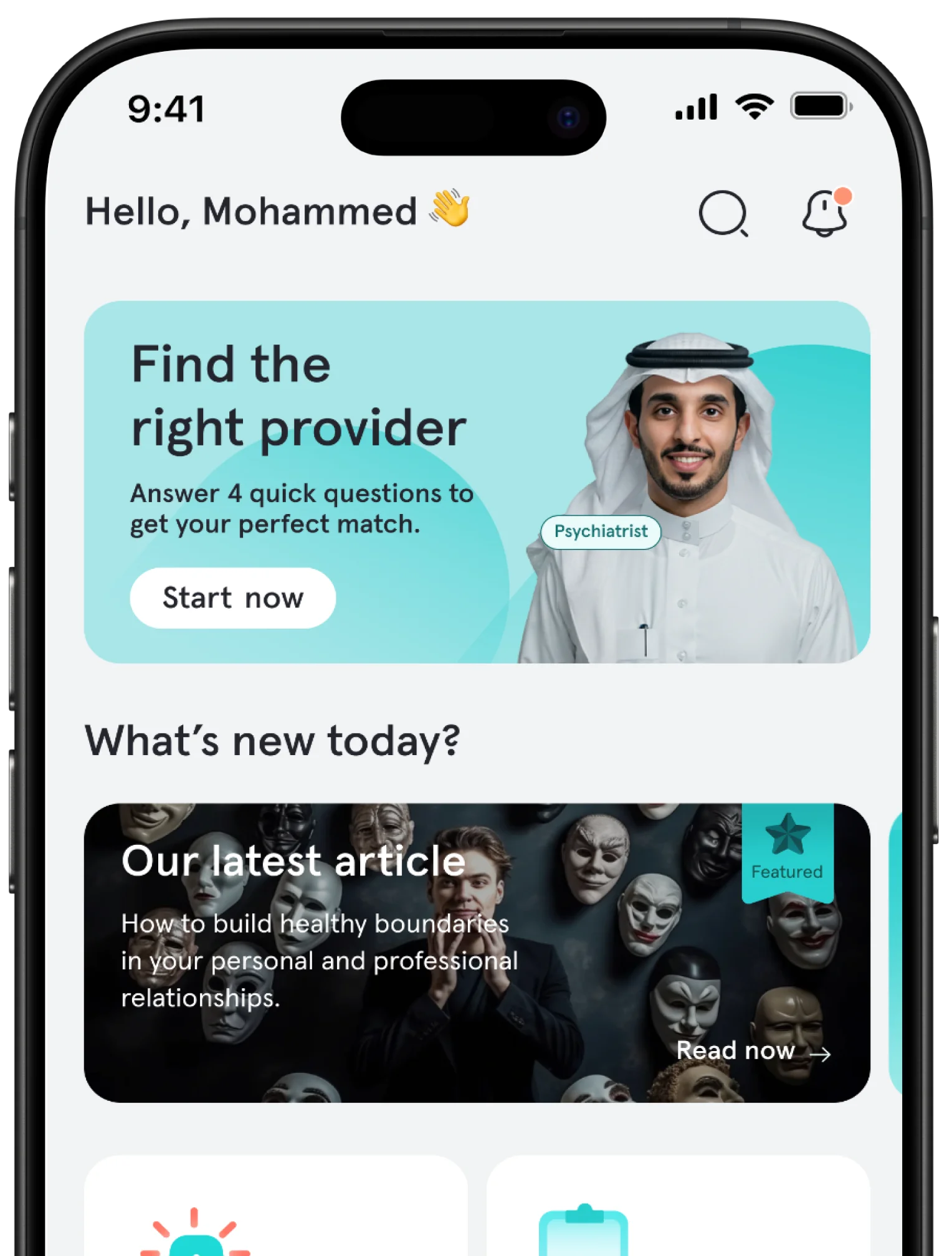
Choosing between a psychiatrist, psychologist, and social worker is not a cosmetic question. It shapes the kind of care you receive from the first session. The short rule is clear: choose a psychiatrist when your need looks closer to medical assessment or medication, choose a psychologist when your goal is structured psychotherapy and a deeper understanding of emotions and behavior, and choose a social worker when the problem is strongly connected to family, relationships, or social pressures. In Tatmeen, these differences do not remain vague. The platform brings these roles together in a clearer decision experience, showing each provider's professional classification, experience, way of working, and areas of focus.
The reason the question feels confusing is that all three titles work in the same broad space: mental health. But the real difference is not who is better in general. It is what kind of help you need now. Tatmeen makes that decision more practical: you can start from the feeling itself, the problem, or the provider, then use quick matching, filters, and care-provider cards until you reach the person who fits better instead of booking while unsure.
The Choice Starts with the Need, Not the Title
A psychiatrist is a medical doctor specializing in mental health, which means they look at the condition through both a medical and psychological lens and can prescribe medication when needed. A psychologist focuses on psychotherapy, psychological assessments, and structured therapeutic work on thoughts, behavior, and emotions, but is not the medication path. A clinical social worker works with psychological distress as it appears inside family, relationship, social, and life circumstances, and may provide individual, family, and group therapy, especially when the problem is linked to the surrounding context rather than the symptom alone.
This is why it is not useful to see these roles as steps on one ladder. The point is not that the psychiatrist is always higher, the psychologist is a lighter alternative, or the social worker is a secondary option. Each role answers a different kind of need. The right decision is not about the biggest title. It is about the professional angle that fits your situation now. In Tatmeen, these angles appear clearly through topic-based clinics and provider cards instead of remaining broad labels.
When Is a Psychiatrist the Right Choice?
Start with a psychiatrist when you feel the situation needs medical assessment, not only a space to talk. This includes cases with severe or complex symptoms, a history of psychiatric medication, or an early expectation that a prescription, medication follow-up, or a medically guided treatment plan may be needed. In Tatmeen, this point is clear: only the doctor can issue a prescription when necessary, which removes much of the confusion around the first booking.
Choosing a psychiatrist does not mean you are going only for medication. A psychiatrist can also provide talk therapy within a wider approach that combines medical assessment with psychotherapy when appropriate. This makes the psychiatrist the right choice when you want someone who can see the picture from two angles at once: body and mind, medical history and emotional state, medication plan and therapy plan. In Tatmeen, the provider profile helps you see this before booking through professional classification, experience, language, session format, and availability.
When Is a Psychologist the Smarter Starting Point?
Start with a psychologist when your main goal is structured psychotherapy: understanding anxiety, depression, obsessive thoughts, trauma, sleep disturbance, relationship patterns, and the way thoughts, behavior, and emotions interact. This is the better path when you want to understand what is happening inside you, build tools for dealing with it, and move through a treatment plan that develops from one session to the next. A psychologist is not a stage before the psychiatrist, but a complete therapeutic option when the main need is not medication.
In Tatmeen, this option becomes stronger because the platform does not reduce psychotherapy to a call that ends and disappears. The psychologist can send psychological assessments before or during the session, follow results, assign therapeutic homework, and document the plan and progress inside reports. The platform supports more than 20 psychological measures, therapeutic homework, and an organized record of results and follow-up. That makes choosing a psychologist through Tatmeen closer to a full treatment path, not a temporary venting session.
When Is a Social Worker Closest to Your Problem?
Start with a social worker when your psychological difficulty is strongly connected to family, relationships, social roles, or everyday life pressures. If your distress moves through marital conflict, family difficulties, parenting challenges, work pressure, loss, or a sense that the balance between you and your surroundings is collapsing, the social worker may be the closest fit because they read the condition inside its context, not away from it. This is real therapeutic work, not an administrative or coordination role as some people assume.
This matters in Tatmeen because the platform does not present the social worker as a generic title. It places the role within clear clinics such as relationships and family, workplace mental health, and other entry points connected to daily life. Some provider cards also show precise experience in family and marital therapy, resolving family conflict, and building tailored counseling and treatment plans. If the problem is in your relationship with the world around you as much as it is inside you, the social worker can be a very intelligent choice.
How to Choose Through Tatmeen Without Guessing
1. Start with what you feel, not the professional title
In Tatmeen, you do not need to know the diagnosis or even the specialty name from the beginning. You can write something like "I feel anxious," search by a topic such as "depression," or enter the provider's name if you already know it. This matters because many people stop before booking only because they do not know the difference between professional titles, while the better way is to begin with what is bothering you now.
2. Use quick matching if you are unsure
If you are not sure which type of professional you need, Tatmeen's quick matching does the logical work for you. The tool uses only four questions to build a recommended list of providers based on the reason for the visit, preferences, budget, and availability. The confusion changes from "Who should I choose?" to "Which of these candidates is closer to me?" That is a major difference in the first booking decision.
3. Enter through the right clinic
Sometimes choosing the entry point that expresses your problem is easier than choosing the professional title. In Tatmeen, there are topic-based clinics such as common mental disorders, sleep disorders and fatigue, addiction and compulsive behaviors, relationships and family, mental health for women, men, children, and adolescents, and workplace mental health. When you start from the clinic, the most suitable type of provider becomes much clearer.
4. Read the provider card before booking
The care-provider card in Tatmeen is not just a photo and a name. It shows the professional role, years of experience, Saudi Commission for Health Specialties classification number, language, session price, session format, whether text, audio, or video, in addition to reviews, ratings, and available appointments. This means you are not choosing from a quick impression, but from practical information that is enough to make the decision comfortably.
5. If the need is urgent, choose the fast path
If you need urgent support, Tatmeen offers urgent sessions alongside scheduled sessions. You can enter a quick summary of the problem by text, voice, or attachments to reach an available provider. But if there is direct danger or a medical emergency, the priority is not a normal booking. It is emergency care or calling local numbers in Saudi Arabia such as 999, 997, or 937.
Sometimes the Right Choice Is Not One Person, But a Path
In some cases, the answer is not "psychiatrist, psychologist, or social worker?" but "Who do I start with first, and where do I move later?" You may start with a psychologist because you need structured therapy, then discover that a medical or medication assessment is needed and a psychiatrist becomes part of the path. You may start with a social worker because the problem is family-based or life-based, then later need deeper psychotherapy with a psychologist. This is not confusion or a failed choice. It is the natural development that happens when the condition becomes better understood. What makes Tatmeen strong here is that movement between these paths happens inside one system that keeps your record, assessments, reports, and follow-up instead of making you start from zero each time.
The result is simple: choose the psychiatrist when you need a medical decision, choose the psychologist when you need structured psychotherapy, and choose the social worker when the problem is connected to family, relationships, or social context. If you are not sure, do not let the professional title stop you. Start from your feeling or your problem, and let Tatmeen turn that uncertainty into a clearer, more informed choice.
FAQs
Should I start with a psychiatrist if I do not know my diagnosis?
Not necessarily. If you are not sure about the diagnosis, start with what you feel or with the problem itself inside Tatmeen, then use quick matching or topic-based clinics. Start with a psychiatrist when the need seems closer to medical assessment or possible medication. Start with a psychologist or social worker when the need is mainly therapeutic, family-related, or social.
Can a psychologist prescribe medication?
In Tatmeen, only a doctor can issue a prescription when needed. A psychologist provides psychotherapy, assessments, and therapeutic follow-up, but is not the medication path. This makes the difference very practical during the first booking.
Is a social worker suitable for marital and family problems?
Yes. A social worker is often one of the best options when the problem is connected to relationships, family, social pressure, or adapting to life circumstances. In Tatmeen, this appears clearly in the relationships and family clinic and workplace mental health clinic, and some professional profiles show direct experience in family and marital therapy and resolving family conflict.
What if I start with one specialist and then discover that I need another type of care?
That is very normal. Sometimes the first sessions reveal that the condition needs an integrated path or a different type of care. In Tatmeen, you can book again, keep your reports, and continue assessments, homework, and the treatment record inside the same platform, which makes movement between roles easier and more mature.
How do I choose quickly if I am unsure or in a hurry?
The fastest way is to write your feeling or problem, try quick matching, then review the provider card for professional role, experience, price, language, and session format. If your need is urgent, use an urgent session. If there is direct danger or a medical emergency, go to emergency care or call 999, 997, or 937 inside Saudi Arabia.
A writer and researcher specializing in psychiatry, she focuses on mental health and the human emotions we experience but cannot always find the words to name. She writes about us—about humanity and the human experience—and simplifies complex topics to offer content that helps us better understand ourselves and life, ultimately making us feel less alone.
Every Tatmeen article is reviewed by care providers licensed by the Saudi Commission for Health Specialties, so what you read is accurate and trustworthy.
This article builds understanding and does not replace a licensed care provider.
Need someone to talk to?
Tatmeen's licensed care providers are available around the clock, and the app's urgent consultation connects you with one within minutes.
Download Tatmeen to explore care providers and booking options.
Smart matchingFour quick questions suggest the right care provider
Urgent consultationTalk to an available care provider within minutes
Free psychological measuresMore than 20 tests to understand how you are doing
Scan to download
{"data":{"id":"318f6f4b-b728-4ea6-88f8-8f29a74bb545","slug":"psychiatrist-psychologist-social-worker-tatmeen","arTitle":"طبيب نفسي أم أخصائي نفسي أم أخصائي اجتماعي؟ كيف تختار عبر تطمين","enTitle":"Psychiatrist, Psychologist, or Social Worker? How to Choose Through Tatmeen","thumbnailAltText":"which therapist is most suitable for me","estimatedReadingTime":5,"likesCount":376,"writer":{"id":"3ab72b74-f26f-4337-9b47-3114b0f90de5","arBio":"كاتبة وباحثة متخصصة في مجال الطب النفسي، تهتم بموضوعات الصحة النفسية وبالمشاعر الإنسانية التي نختبرها ولا نجد دائمًا الكلمات لتسميتها. تكتب عنّا؛ عن الإنسان وتجربته، وتبسّط الموضوعات المعقّدة لتقدّم محتوى يساعدنا على فهم ذواتنا والحياة أكثر، ويجعلنا نشعر بأننا بوحدة أقل.","enBio":"A writer and researcher specializing in psychiatry, she focuses on mental health and the human emotions we experience but cannot always find the words to name. She writes about us—about humanity and the human experience—and simplifies complex topics to offer content that helps us better understand ourselves and life, ultimately making us feel less alone.","user":{"slug":"ayat-alnajar","arFullName":"آيات النجار","enFullName":"Ayat Al-Najjar","publicProfileImageUrl":"https://cdn.tatmeen.sa/public/profile-images/02384455-68fa-40b6-ad05-609fde65cafa/21b9a610dde5dfc6d37af110c23e9c7ab3946be080c281beb000debf4f7d31a6.webp","publicProfileImage96Url":"https://cdn.tatmeen.sa/public/profile-images/02384455-68fa-40b6-ad05-609fde65cafa/21b9a610dde5dfc6d37af110c23e9c7ab3946be080c281beb000debf4f7d31a6-w96.webp","publicProfileImage192Url":"https://cdn.tatmeen.sa/public/profile-images/02384455-68fa-40b6-ad05-609fde65cafa/21b9a610dde5dfc6d37af110c23e9c7ab3946be080c281beb000debf4f7d31a6-w192.webp"}},"arContent":"","enContent":"","productionDocument":{"headings":[{"id":"article-section-the-choice-starts-with-the-need-not-the-title","text":"The Choice Starts with the Need, Not the Title"},{"id":"article-section-when-is-a-psychiatrist-the-right-choice","text":"When Is a Psychiatrist the Right Choice?"},{"id":"article-section-when-is-a-psychologist-the-smarter-starting-point","text":"When Is a Psychologist the Smarter Starting Point?"},{"id":"article-section-when-is-a-social-worker-closest-to-your-problem","text":"When Is a Social Worker Closest to Your Problem?"},{"id":"article-section-how-to-choose-through-tatmeen-without-guessing","text":"How to Choose Through Tatmeen Without Guessing"},{"id":"article-section-sometimes-the-right-choice-is-not-one-person-but-a-path","text":"Sometimes the Right Choice Is Not One Person, But a Path"},{"id":"article-section-faqs","text":"FAQs"}],"faqs":[],"beforeSourcesHtml":"","sources":[{"title":"SCFHS - Checking Health Practitioner's Registration Validity","href":"https://scfhs.org.sa/en/E-Services/regvaliddescription","hostname":"scfhs.org.sa"},{"title":"MOH - Mental Health and Psychiatric Patient","href":"https://www.moh.gov.sa/en/ministry/information-and-services/pages/psychiatry.aspx","hostname":"moh.gov.sa"},{"title":"NIMH - Psychotherapies","href":"https://www.nimh.nih.gov/health/topics/psychotherapies","hostname":"nimh.nih.gov"},{"title":"NIMH - Mental Health Medications","href":"https://www.nimh.nih.gov/health/topics/mental-health-medications","hostname":"nimh.nih.gov"},{"title":"American Psychiatric Association - What Is Psychiatry?","href":"https://www.psychiatry.org/patients-families/what-is-psychiatry","hostname":"psychiatry.org"},{"title":"American Psychological Association - Understanding Psychotherapy","href":"https://www.apa.org/topics/psychotherapy/understanding","hostname":"apa.org"},{"title":"NASW - Clinical Social Work","href":"https://www.socialworkers.org/Practice/Clinical-Social-Work","hostname":"socialworkers.org"},{"title":"Telehealth.HHS.gov","href":"http://telehealth.hhs.gov/","hostname":"telehealth.hhs.gov"},{"title":"- Behavioral Health Care","href":"https://telehealth.hhs.gov/patients/additional-resources/telehealth-and-behavioral-health","hostname":"telehealth.hhs.gov"}],"afterSourcesHtml":"","blocks":[{"type":"html","html":"<p><span style=\"color:#000000\">Choosing between a psychiatrist, psychologist, and social worker is not a cosmetic question. It shapes the kind of care you receive from the first session. The short rule is clear: choose a psychiatrist when your need looks closer to medical assessment or medication, choose a psychologist when your goal is structured psychotherapy and a deeper understanding of emotions and behavior, and choose a social worker when the problem is strongly connected to family, relationships, or social pressures. In Tatmeen, these differences do not remain vague. The platform brings these roles together in a clearer decision experience, showing each provider's professional classification, experience, way of working, and areas of focus.</span></p><p><span style=\"color:#000000\">The reason the question feels confusing is that all three titles work in the same broad space: mental health. But the real difference is not who is better in general. It is what kind of help you need now. Tatmeen makes that decision more practical: you can start from the feeling itself, the problem, or the provider, then use quick matching, filters, and care-provider cards until you reach the person who fits better instead of booking while unsure.</span></p><h2 id=\"article-section-the-choice-starts-with-the-need-not-the-title\" data-toc-heading tabindex=\"-1\"><span id=\"the-choice-starts-with-the-need-not-the-title-1\" aria-hidden=\"true\"></span><span style=\"color:#000000\"><strong>The Choice Starts with the Need, Not the Title</strong></span></h2><p><span style=\"color:#000000\">A psychiatrist is a medical doctor specializing in mental health, which means they look at the condition through both a medical and psychological lens and can prescribe medication when needed. A psychologist focuses on psychotherapy, psychological assessments, and structured therapeutic work on thoughts, behavior, and emotions, but is not the medication path. A clinical social worker works with psychological distress as it appears inside family, relationship, social, and life circumstances, and may provide individual, family, and group therapy, especially when the problem is linked to the surrounding context rather than the symptom alone.</span></p><p><span style=\"color:#000000\">This is why it is not useful to see these roles as steps on one ladder. The point is not that the psychiatrist is always higher, the psychologist is a lighter alternative, or the social worker is a secondary option. Each role answers a different kind of need. The right decision is not about the biggest title. It is about the professional angle that fits your situation now. In Tatmeen, these angles appear clearly through topic-based clinics and provider cards instead of remaining broad labels.</span></p><h2 id=\"article-section-when-is-a-psychiatrist-the-right-choice\" data-toc-heading tabindex=\"-1\"><span id=\"when-is-a-psychiatrist-the-right-choice-2\" aria-hidden=\"true\"></span><span style=\"color:#000000\"><strong>When Is a Psychiatrist the Right Choice?</strong></span></h2><p><span style=\"color:#000000\">Start with a psychiatrist when you feel the situation needs medical assessment, not only a space to talk. This includes cases with severe or complex symptoms, a history of psychiatric medication, or an early expectation that a prescription, medication follow-up, or a medically guided treatment plan may be needed. In Tatmeen, this point is clear: only the doctor can issue a prescription when necessary, which removes much of the confusion around the first booking.</span></p><p><span style=\"color:#000000\">Choosing a psychiatrist does not mean you are going only for medication. A psychiatrist can also provide talk therapy within a wider approach that combines medical assessment with psychotherapy when appropriate. This makes the psychiatrist the right choice when you want someone who can see the picture from two angles at once: body and mind, medical history and emotional state, medication plan and therapy plan. In Tatmeen, the provider profile helps you see this before booking through professional classification, experience, language, session format, and availability.</span></p><h2 id=\"article-section-when-is-a-psychologist-the-smarter-starting-point\" data-toc-heading tabindex=\"-1\"><span id=\"when-is-a-psychologist-the-smarter-starting-point-3\" aria-hidden=\"true\"></span><span style=\"color:#000000\"><strong>When Is a Psychologist the Smarter Starting Point?</strong></span></h2><p><span style=\"color:#000000\">Start with a psychologist when your main goal is structured psychotherapy: understanding anxiety, depression, obsessive thoughts, trauma, sleep disturbance, relationship patterns, and the way thoughts, behavior, and emotions interact. This is the better path when you want to understand what is happening inside you, build tools for dealing with it, and move through a treatment plan that develops from one session to the next. A psychologist is not a stage before the psychiatrist, but a complete therapeutic option when the main need is not medication.</span></p><p><span style=\"color:#000000\">In Tatmeen, this option becomes stronger because the platform does not reduce psychotherapy to a call that ends and disappears. The psychologist can send psychological assessments before or during the session, follow results, assign therapeutic homework, and document the plan and progress inside reports. The platform supports more than 20 psychological measures, therapeutic homework, and an organized record of results and follow-up. That makes choosing a psychologist through Tatmeen closer to a full treatment path, not a temporary venting session.</span></p><h2 id=\"article-section-when-is-a-social-worker-closest-to-your-problem\" data-toc-heading tabindex=\"-1\"><span id=\"when-is-a-social-worker-closest-to-your-problem-4\" aria-hidden=\"true\"></span><span style=\"color:#000000\"><strong>When Is a Social Worker Closest to Your Problem?</strong></span></h2><p><span style=\"color:#000000\">Start with a social worker when your psychological difficulty is strongly connected to family, relationships, social roles, or everyday life pressures. If your distress moves through marital conflict, family difficulties, parenting challenges, work pressure, loss, or a sense that the balance between you and your surroundings is collapsing, the social worker may be the closest fit because they read the condition inside its context, not away from it. This is real therapeutic work, not an administrative or coordination role as some people assume.</span></p><p><span style=\"color:#000000\">This matters in Tatmeen because the platform does not present the social worker as a generic title. It places the role within clear clinics such as relationships and family, workplace mental health, and other entry points connected to daily life. Some provider cards also show precise experience in family and marital therapy, resolving family conflict, and building tailored counseling and treatment plans. If the problem is in your relationship with the world around you as much as it is inside you, the social worker can be a very intelligent choice.</span></p><h2 id=\"article-section-how-to-choose-through-tatmeen-without-guessing\" data-toc-heading tabindex=\"-1\"><span id=\"how-to-choose-through-tatmeen-without-guessing-5\" aria-hidden=\"true\"></span><span style=\"color:#000000\"><strong>How to Choose Through Tatmeen Without Guessing</strong></span></h2><h3><span style=\"color:#434343\"><strong>1. Start with what you feel, not the professional title</strong></span></h3><p><span style=\"color:#000000\">In Tatmeen, you do not need to know the diagnosis or even the specialty name from the beginning. You can write something like \"I feel anxious,\" search by a topic such as \"depression,\" or enter the provider's name if you already know it. This matters because many people stop before booking only because they do not know the difference between professional titles, while the better way is to begin with what is bothering you now.</span></p><h3><span style=\"color:#434343\"><strong>2. Use quick matching if you are unsure</strong></span></h3><p><span style=\"color:#000000\">If you are not sure which type of professional you need, Tatmeen's quick matching does the logical work for you. The tool uses only four questions to build a recommended list of providers based on the reason for the visit, preferences, budget, and availability. The confusion changes from \"Who should I choose?\" to \"Which of these candidates is closer to me?\" That is a major difference in the first booking decision.</span></p><h3><span style=\"color:#434343\"><strong>3. Enter through the right clinic</strong></span></h3><p><span style=\"color:#000000\">Sometimes choosing the entry point that expresses your problem is easier than choosing the professional title. In Tatmeen, there are topic-based clinics such as common mental disorders, sleep disorders and fatigue, addiction and compulsive behaviors, relationships and family, mental health for women, men, children, and adolescents, and workplace mental health. When you start from the clinic, the most suitable type of provider becomes much clearer.</span></p><h3><span style=\"color:#434343\"><strong>4. Read the provider card before booking</strong></span></h3><p><span style=\"color:#000000\">The care-provider card in Tatmeen is not just a photo and a name. It shows the professional role, years of experience, Saudi Commission for Health Specialties classification number, language, session price, session format, whether text, audio, or video, in addition to reviews, ratings, and available appointments. This means you are not choosing from a quick impression, but from practical information that is enough to make the decision comfortably.</span></p><h3><span style=\"color:#434343\"><strong>5. If the need is urgent, choose the fast path</strong></span></h3><p><span style=\"color:#000000\">If you need urgent support, Tatmeen offers urgent sessions alongside scheduled sessions. You can enter a quick summary of the problem by text, voice, or attachments to reach an available provider. But if there is direct danger or a medical emergency, the priority is not a normal booking. It is emergency care or calling local numbers in Saudi Arabia such as 999, 997, or 937.</span></p><h2 id=\"article-section-sometimes-the-right-choice-is-not-one-person-but-a-path\" data-toc-heading tabindex=\"-1\"><span id=\"sometimes-the-right-choice-is-not-one-person-but-a-path-6\" aria-hidden=\"true\"></span><span style=\"color:#000000\"><strong>Sometimes the Right Choice Is Not One Person, But a Path</strong></span></h2><p><span style=\"color:#000000\">In some cases, the answer is not \"psychiatrist, psychologist, or social worker?\" but \"Who do I start with first, and where do I move later?\" You may start with a psychologist because you need structured therapy, then discover that a medical or medication assessment is needed and a psychiatrist becomes part of the path. You may start with a social worker because the problem is family-based or life-based, then later need deeper psychotherapy with a psychologist. This is not confusion or a failed choice. It is the natural development that happens when the condition becomes better understood. What makes Tatmeen strong here is that movement between these paths happens inside one system that keeps your record, assessments, reports, and follow-up instead of making you start from zero each time.</span></p><p><span style=\"color:#000000\">The result is simple: choose the psychiatrist when you need a medical decision, choose the psychologist when you need structured psychotherapy, and choose the social worker when the problem is connected to family, relationships, or social context. If you are not sure, do not let the professional title stop you. Start from your feeling or your problem, and let Tatmeen turn that uncertainty into a clearer, more informed choice.</span></p><h2 id=\"article-section-faqs\" data-toc-heading tabindex=\"-1\"><span id=\"faqs-7\" aria-hidden=\"true\"></span><span style=\"color:#000000\"><strong>FAQs</strong></span></h2><p><span style=\"color:#000000\"><strong>Should I start with a psychiatrist if I do not know my diagnosis?</strong></span></p><p><span style=\"color:#000000\">Not necessarily. If you are not sure about the diagnosis, start with what you feel or with the problem itself inside Tatmeen, then use quick matching or topic-based clinics. Start with a psychiatrist when the need seems closer to medical assessment or possible medication. Start with a psychologist or social worker when the need is mainly therapeutic, family-related, or social.</span></p><p><span style=\"color:#000000\"><strong>Can a psychologist prescribe medication?</strong></span></p><p><span style=\"color:#000000\">In Tatmeen, only a doctor can issue a prescription when needed. A psychologist provides psychotherapy, assessments, and therapeutic follow-up, but is not the medication path. This makes the difference very practical during the first booking.</span></p><p><span style=\"color:#000000\"><strong>Is a social worker suitable for marital and family problems?</strong></span></p><p><span style=\"color:#000000\">Yes. A social worker is often one of the best options when the problem is connected to relationships, family, social pressure, or adapting to life circumstances. In Tatmeen, this appears clearly in the relationships and family clinic and workplace mental health clinic, and some professional profiles show direct experience in family and marital therapy and resolving family conflict.</span></p><p><span style=\"color:#000000\"><strong>What if I start with one specialist and then discover that I need another type of care?</strong></span></p><p><span style=\"color:#000000\">That is very normal. Sometimes the first sessions reveal that the condition needs an integrated path or a different type of care. In Tatmeen, you can book again, keep your reports, and continue assessments, homework, and the treatment record inside the same platform, which makes movement between roles easier and more mature.</span></p><p><span style=\"color:#000000\"><strong>How do I choose quickly if I am unsure or in a hurry?</strong></span></p><p><span style=\"color:#000000\">The fastest way is to write your feeling or problem, try quick matching, then review the provider card for professional role, experience, price, language, and session format. If your need is urgent, use an urgent session. If there is direct danger or a medical emergency, go to emergency care or call 999, 997, or 937 inside Saudi Arabia.</span></p>"}],"inlineCtaSignatures":[],"_experienceAliases":{"v":1,"fields":["html","bodyHtml"]}},"createdAt":"2026-05-16T21:00:00.000Z","updatedAt":"2026-06-24T23:50:14.844Z","disorderGroups":[{"id":"1e82772d-a1a7-4d29-b475-be9d6b67ae02","slug":"common-mental-issues","arName":"اضطرابات نفسية شائعة","enName":"Common Mental Issues"}],"reviewer":{"arFullName":"فريق تطمين","enFullName":"Tatmeen team","slug":"tatmeen-team","kind":"organization"},"productionArticle":true,"promotionAllowed":true,"preparedCover":{"src":"https://cdn.tatmeen.sa/public/article-lcp/article-lcp-v1/sha256-e2c267939f11c530672f3d37905d02cf2c2cff69252979ec7839ab6f0e1b04be/800-51018bd4f3f5b80ede26f073a1b6cfd1a37e35a84ed80399efd7ff34222bfdbb.avif","fallback":"https://cdn.tatmeen.sa/public/article-lcp/article-lcp-v1/sha256-e2c267939f11c530672f3d37905d02cf2c2cff69252979ec7839ab6f0e1b04be/800-605da63eaba6dffb31be26d085eba56f7efd41e1b34734046a29871029ac9277.webp","directUrl":"https://cdn.tatmeen.sa/blog-cover/Tatmeen-1778982983896.webp","isGolden":true,"avifSrcset":"https://cdn.tatmeen.sa/public/article-lcp/article-lcp-v1/sha256-e2c267939f11c530672f3d37905d02cf2c2cff69252979ec7839ab6f0e1b04be/400-c92fa8a43ac79730daf8a0d352ac16daaaa8ef4882586e309919b51cd6f576aa.avif 400w, https://cdn.tatmeen.sa/public/article-lcp/article-lcp-v1/sha256-e2c267939f11c530672f3d37905d02cf2c2cff69252979ec7839ab6f0e1b04be/640-64aa4c6afd30d02fa4812021936a65ed6462b112e2e9491238864a711cd4120e.avif 640w, https://cdn.tatmeen.sa/public/article-lcp/article-lcp-v1/sha256-e2c267939f11c530672f3d37905d02cf2c2cff69252979ec7839ab6f0e1b04be/800-51018bd4f3f5b80ede26f073a1b6cfd1a37e35a84ed80399efd7ff34222bfdbb.avif 800w, https://cdn.tatmeen.sa/public/article-lcp/article-lcp-v1/sha256-e2c267939f11c530672f3d37905d02cf2c2cff69252979ec7839ab6f0e1b04be/1200-d4d0b3d0c2f2ea86e2848b026eb35b2451fb97f36ceefc8cb6750e5bb2243e79.avif 1200w","webpSrcset":"https://cdn.tatmeen.sa/public/article-lcp/article-lcp-v1/sha256-e2c267939f11c530672f3d37905d02cf2c2cff69252979ec7839ab6f0e1b04be/400-df295528ea0ce22bd05f06252a7791bfe8919c044e28ccb5ded5149865dd8611.webp 400w, https://cdn.tatmeen.sa/public/article-lcp/article-lcp-v1/sha256-e2c267939f11c530672f3d37905d02cf2c2cff69252979ec7839ab6f0e1b04be/640-4a30fc7cecd8f21ebb20e6be3c5e0bf1843e24417afd4188e910b682d21fc60b.webp 640w, https://cdn.tatmeen.sa/public/article-lcp/article-lcp-v1/sha256-e2c267939f11c530672f3d37905d02cf2c2cff69252979ec7839ab6f0e1b04be/800-605da63eaba6dffb31be26d085eba56f7efd41e1b34734046a29871029ac9277.webp 800w, https://cdn.tatmeen.sa/public/article-lcp/article-lcp-v1/sha256-e2c267939f11c530672f3d37905d02cf2c2cff69252979ec7839ab6f0e1b04be/1200-196176e5b6271671a3444b7ecfda0fc12b1f53bb5c4ad0992c23187637d70f26.webp 1200w","phoneAvifSrcset":"https://cdn.tatmeen.sa/public/article-lcp/article-lcp-v1/sha256-e2c267939f11c530672f3d37905d02cf2c2cff69252979ec7839ab6f0e1b04be/400-c92fa8a43ac79730daf8a0d352ac16daaaa8ef4882586e309919b51cd6f576aa.avif 400w, https://cdn.tatmeen.sa/public/article-lcp/article-lcp-v1/sha256-e2c267939f11c530672f3d37905d02cf2c2cff69252979ec7839ab6f0e1b04be/640-64aa4c6afd30d02fa4812021936a65ed6462b112e2e9491238864a711cd4120e.avif 640w, https://cdn.tatmeen.sa/public/article-lcp/article-lcp-v1/sha256-e2c267939f11c530672f3d37905d02cf2c2cff69252979ec7839ab6f0e1b04be/800-51018bd4f3f5b80ede26f073a1b6cfd1a37e35a84ed80399efd7ff34222bfdbb.avif 800w","phoneWebpSrcset":"https://cdn.tatmeen.sa/public/article-lcp/article-lcp-v1/sha256-e2c267939f11c530672f3d37905d02cf2c2cff69252979ec7839ab6f0e1b04be/400-df295528ea0ce22bd05f06252a7791bfe8919c044e28ccb5ded5149865dd8611.webp 400w, https://cdn.tatmeen.sa/public/article-lcp/article-lcp-v1/sha256-e2c267939f11c530672f3d37905d02cf2c2cff69252979ec7839ab6f0e1b04be/640-4a30fc7cecd8f21ebb20e6be3c5e0bf1843e24417afd4188e910b682d21fc60b.webp 640w, https://cdn.tatmeen.sa/public/article-lcp/article-lcp-v1/sha256-e2c267939f11c530672f3d37905d02cf2c2cff69252979ec7839ab6f0e1b04be/800-605da63eaba6dffb31be26d085eba56f7efd41e1b34734046a29871029ac9277.webp 800w","width":800,"height":450},"previewTaxonomy":{"groups":[{"id":"1e82772d-a1a7-4d29-b475-be9d6b67ae02","slug":"common-mental-issues","arName":"اضطرابات نفسية شائعة","enName":"Common Mental Issues"}],"topics":[],"tags":[{"id":"0a7fb6ee-560f-4ee0-b5f5-a8af3b1bb1da","slug":"tatmeen","arName":"تطمين","enName":"Tatmeen"},{"id":"07738784-6495-42b7-819f-22706a2e5ad3","slug":"specialist-diagnosis","arName":"اختيار المختص والتشخيص","enName":"Choosing a Specialist & Diagnosis"},{"id":"8f632a07-06ba-44f3-afe9-d7cef3e09698","slug":"product-howto","arName":"دليل المنتج / كيفية الاستخدام","enName":"Product Explainer / How-To-Use"}]},"previewProviderRecommendations":[{"id":"6866c238-0223-4d20-b182-6bf8929dccca","slug":"bushra-alluhaibi-4189","arFullName":"بشرى اللهيبي","enFullName":"Bushra Alluhaibi","publicProfileImageUrl":"","publicProfileImage96Url":"","publicProfileImage192Url":"","specialization":{"arName":"أخصائي نفسي","enName":"Psychologist"},"profileImageUrl":"","experienceYears":12,"consultantInfo":{"averageRating":{"average":0},"specialization":{"arGeneralName":"أخصائي نفسي","enGeneralName":"Psychologist"}}},{"id":"23ba62b8-9679-46a2-9439-b2801cafc59b","slug":"dr-mohammed-alanazi-4132","arFullName":"د. محمد العنزي","enFullName":"Dr. Mohammed ALANAZI","publicProfileImageUrl":"https://cdn.tatmeen.sa/public/profile-images/23ba62b8-9679-46a2-9439-b2801cafc59b/233e70d98cd910633553abf60e5ee8dd305797b64c4172746ab379f3b91a1461.webp","publicProfileImage96Url":"https://cdn.tatmeen.sa/public/profile-images/23ba62b8-9679-46a2-9439-b2801cafc59b/233e70d98cd910633553abf60e5ee8dd305797b64c4172746ab379f3b91a1461-w96.webp","publicProfileImage192Url":"https://cdn.tatmeen.sa/public/profile-images/23ba62b8-9679-46a2-9439-b2801cafc59b/233e70d98cd910633553abf60e5ee8dd305797b64c4172746ab379f3b91a1461-w192.webp","specialization":{"arName":"طبيب أسرة","enName":"Family Physician"},"profileImageUrl":"https://cdn.tatmeen.sa/public/profile-images/23ba62b8-9679-46a2-9439-b2801cafc59b/233e70d98cd910633553abf60e5ee8dd305797b64c4172746ab379f3b91a1461-w192.webp","experienceYears":3,"consultantInfo":{"averageRating":{"average":0},"specialization":{"arGeneralName":"طبيب أسرة","enGeneralName":"Family Physician"}}},{"id":"4bcf0531-d58c-4284-aeed-b2563c966ee3","slug":"dr-sultan-albalawi-9701","arFullName":"د. سلطان البلوي","enFullName":"Dr. Sultan Albalawi","publicProfileImageUrl":"https://cdn.tatmeen.sa/public/profile-images/4bcf0531-d58c-4284-aeed-b2563c966ee3/7038797eec8398a3d17eebf66394b26366409d9a9faece56515311203b0600b2.webp","publicProfileImage96Url":"https://cdn.tatmeen.sa/public/profile-images/4bcf0531-d58c-4284-aeed-b2563c966ee3/7038797eec8398a3d17eebf66394b26366409d9a9faece56515311203b0600b2-w96.webp","publicProfileImage192Url":"https://cdn.tatmeen.sa/public/profile-images/4bcf0531-d58c-4284-aeed-b2563c966ee3/7038797eec8398a3d17eebf66394b26366409d9a9faece56515311203b0600b2-w192.webp","specialization":{"arName":"طبيب أسرة","enName":"Family Physician"},"profileImageUrl":"https://cdn.tatmeen.sa/public/profile-images/4bcf0531-d58c-4284-aeed-b2563c966ee3/7038797eec8398a3d17eebf66394b26366409d9a9faece56515311203b0600b2-w192.webp","experienceYears":3,"consultantInfo":{"averageRating":{"average":0},"specialization":{"arGeneralName":"طبيب أسرة","enGeneralName":"Family Physician"}}}],"previewCareProviders":[{"id":"09364052-c2a9-4c52-9717-7ce2093b8d0a","slug":"kholoud-alharbi-5221","arFullName":"خلود الحربي","enFullName":"Kholoud Alharbi","publicProfileImageUrl":"https://cdn.tatmeen.sa/public/profile-images/09364052-c2a9-4c52-9717-7ce2093b8d0a/4a0aeb81619e351b77f4323e3605a0a00acc7ca3c82ee7cc5ca2c9e8ef716049.webp","publicProfileImage96Url":"https://cdn.tatmeen.sa/public/profile-images/09364052-c2a9-4c52-9717-7ce2093b8d0a/4a0aeb81619e351b77f4323e3605a0a00acc7ca3c82ee7cc5ca2c9e8ef716049-w96.webp","publicProfileImage192Url":"https://cdn.tatmeen.sa/public/profile-images/09364052-c2a9-4c52-9717-7ce2093b8d0a/4a0aeb81619e351b77f4323e3605a0a00acc7ca3c82ee7cc5ca2c9e8ef716049-w192.webp","gender":"FEMALE","specialization":{"arName":"أخصائي نفسي","enName":"Psychologist"}},{"id":"6f037535-1dca-4b50-a8b2-5974b7323286","slug":"salah-althobaiti-9053","arFullName":"صلاح الثبيتي","enFullName":"Salah Althobaiti","publicProfileImageUrl":"https://cdn.tatmeen.sa/public/profile-images/6f037535-1dca-4b50-a8b2-5974b7323286/35b6bd7fad9b1e004c1835803eb9c1b56dcacd380685ec8bff141f0fb888005c.webp","publicProfileImage96Url":"https://cdn.tatmeen.sa/public/profile-images/6f037535-1dca-4b50-a8b2-5974b7323286/35b6bd7fad9b1e004c1835803eb9c1b56dcacd380685ec8bff141f0fb888005c-w96.webp","publicProfileImage192Url":"https://cdn.tatmeen.sa/public/profile-images/6f037535-1dca-4b50-a8b2-5974b7323286/35b6bd7fad9b1e004c1835803eb9c1b56dcacd380685ec8bff141f0fb888005c-w192.webp","gender":"MALE","specialization":{"arName":"أخصائي نفسي","enName":"Psychologist"}},{"id":"3cc806e8-616b-4884-9f21-a75b378580a2","slug":"aisha-al-hashim-8667","arFullName":"عائشة ال هاشم","enFullName":"Aisha Al Hashim","publicProfileImageUrl":"https://cdn.tatmeen.sa/public/profile-images/3cc806e8-616b-4884-9f21-a75b378580a2/27f523d03be4dcfa1f6a79f70c1773887434e698990d214cd990caec56a44798.webp","publicProfileImage96Url":"https://cdn.tatmeen.sa/public/profile-images/3cc806e8-616b-4884-9f21-a75b378580a2/27f523d03be4dcfa1f6a79f70c1773887434e698990d214cd990caec56a44798-w96.webp","publicProfileImage192Url":"https://cdn.tatmeen.sa/public/profile-images/3cc806e8-616b-4884-9f21-a75b378580a2/27f523d03be4dcfa1f6a79f70c1773887434e698990d214cd990caec56a44798-w192.webp","gender":"FEMALE","specialization":{"arName":"أخصائي نفسي","enName":"Psychologist"}},{"id":"db2ce1a0-9325-4471-b7ce-eb2e811c30a3","slug":"amer-qutub-2441","arFullName":"عامر قطب","enFullName":"Amer Qutub","publicProfileImageUrl":"https://cdn.tatmeen.sa/public/profile-images/db2ce1a0-9325-4471-b7ce-eb2e811c30a3/80580f99bfd7fe2b2a9cf8eed73ab532f5086d1efe053b0aa57358c1ce004261.webp","publicProfileImage96Url":"https://cdn.tatmeen.sa/public/profile-images/db2ce1a0-9325-4471-b7ce-eb2e811c30a3/80580f99bfd7fe2b2a9cf8eed73ab532f5086d1efe053b0aa57358c1ce004261-w96.webp","publicProfileImage192Url":"https://cdn.tatmeen.sa/public/profile-images/db2ce1a0-9325-4471-b7ce-eb2e811c30a3/80580f99bfd7fe2b2a9cf8eed73ab532f5086d1efe053b0aa57358c1ce004261-w192.webp","gender":"MALE","specialization":{"arName":"أخصائي نفسي","enName":"Psychologist"}},{"id":"94765496-dbdf-4631-a01b-7df5f788668d","slug":"abdullrahman-alhamoudi-3045","arFullName":"عبدالرحمن الحمودي","enFullName":"Abdulrahman Alhamoudi","publicProfileImageUrl":"https://cdn.tatmeen.sa/public/profile-images/94765496-dbdf-4631-a01b-7df5f788668d/2d49f6b6493c564afb6f50b6c3634231dff3a5cf8353acfab393d1b2a88037d1.webp","publicProfileImage96Url":"https://cdn.tatmeen.sa/public/profile-images/94765496-dbdf-4631-a01b-7df5f788668d/2d49f6b6493c564afb6f50b6c3634231dff3a5cf8353acfab393d1b2a88037d1-w96.webp","publicProfileImage192Url":"https://cdn.tatmeen.sa/public/profile-images/94765496-dbdf-4631-a01b-7df5f788668d/2d49f6b6493c564afb6f50b6c3634231dff3a5cf8353acfab393d1b2a88037d1-w192.webp","gender":"MALE","specialization":{"arName":"أخصائي نفسي","enName":"Psychologist"}},{"id":"618dba89-5b70-4b46-8304-741b7ac8ecd3","slug":"abdullah-mari-1311","arFullName":"عبدالله مرعي","enFullName":"Abdullah Mari","publicProfileImageUrl":"https://cdn.tatmeen.sa/public/profile-images/618dba89-5b70-4b46-8304-741b7ac8ecd3/6b4a3bfb59f8a304ca79083b32859b46baad2e1d692974a47c02c1f66bd11129.webp","publicProfileImage96Url":"https://cdn.tatmeen.sa/public/profile-images/618dba89-5b70-4b46-8304-741b7ac8ecd3/6b4a3bfb59f8a304ca79083b32859b46baad2e1d692974a47c02c1f66bd11129-w96.webp","publicProfileImage192Url":"https://cdn.tatmeen.sa/public/profile-images/618dba89-5b70-4b46-8304-741b7ac8ecd3/6b4a3bfb59f8a304ca79083b32859b46baad2e1d692974a47c02c1f66bd11129-w192.webp","gender":"MALE","specialization":{"arName":"أخصائي نفسي","enName":"Psychologist"}},{"id":"3b50a5d5-e795-407f-8676-fd7f0e1bb7a0","slug":"abdulaziz-bin-hudayan-4940","arFullName":"عبدالعزيز بن هديان","enFullName":"Abdulaziz Bin Hudayan","publicProfileImageUrl":"https://cdn.tatmeen.sa/public/profile-images/3b50a5d5-e795-407f-8676-fd7f0e1bb7a0/710ff0fe1fb00cdb5042092e27b7910b480a439b02251ecded62d7758eefce95.webp","publicProfileImage96Url":"https://cdn.tatmeen.sa/public/profile-images/3b50a5d5-e795-407f-8676-fd7f0e1bb7a0/710ff0fe1fb00cdb5042092e27b7910b480a439b02251ecded62d7758eefce95-w96.webp","publicProfileImage192Url":"https://cdn.tatmeen.sa/public/profile-images/3b50a5d5-e795-407f-8676-fd7f0e1bb7a0/710ff0fe1fb00cdb5042092e27b7910b480a439b02251ecded62d7758eefce95-w192.webp","gender":"MALE","specialization":{"arName":"أخصائي نفسي","enName":"Psychologist"}}],"previewDownload":{"href":"/download","title":{"ar":"خطوة واحدة لأجلك، ابدأ الآن","en":"One step for you, start now"},"description":{"ar":"حمّل تطبيق تطمين لاستكشاف مقدمي الرعاية وخيارات الحجز.","en":"Download Tatmeen to explore care providers and booking options."},"posterSrc":"/images/home/cta-ar-new-1.webp","videoSrc":"/images/home/cta-ar-new-1.mp4","videoPosterSrc":"/images/home/cta-ar-new-1.webp","videoPosterEnSrc":"/images/home/cta-en-new-1.webp","videoType":"video/mp4","appStoreHref":"https://apps.apple.com/us/app/tatmeen-%D8%AA%D8%B7%D9%85%D9%8A%D9%86/id6473836983","googlePlayHref":"https://play.google.com/store/apps/details?id=com.TatmeenApp.user&hl=en"},"previewRelatedArticles":[{"id":"183c0c76-1f36-400c-bd02-3aab78bce145","slug":"Psychiatric-Illness-Relationship-to-Mental-illness","route":"/blog/Psychiatric-Illness-Relationship-to-Mental-illness/","title":{"ar":"المرض النفسي – علاج و أعراض وأسباب وعلاقته بالمرض العقلي","en":"Psychological Illness: Symptoms, Causes, Treatment, and Mental Illness"},"image":"https://cdn.tatmeen.sa/public/article-lcp/article-lcp-v2/sha256-d30fa57439910b10b1764f8d491e7b00f96927c57d556450e2935f7758c6ad2c/599-8567e6e62bfe8feb0ddbabbc46481b10da57eeb96d71424fa9b2612093f72d16.webp","directImageFallback":"https://cdn.tatmeen.sa/blog-cover/1706456221900-Tatmeen-20.jpg","arThumbnailAltText":"Seated figure with knees drawn up beneath a glowing brain graphic","thumbnailAltText":"Seated figure with knees drawn up beneath a glowing brain graphic","topic":{"label":{"ar":"اضطرابات نفسية شائعة","en":"Common Mental Issues"}},"readingTimeMinutes":5},{"id":"106115de-0737-410a-ac46-e8a93834723f","slug":"breaking-mental-health-stigma-awareness-saudi-arabia","route":"/blog/breaking-mental-health-stigma-awareness-saudi-arabia/","title":{"ar":"كسر الوصمة: التوعية بالصحة النفسية في المملكة العربية السعودية","en":"Breaking the Stigma: Mental Health Awareness in Saudi Arabia"},"image":"https://cdn.tatmeen.sa/public/article-lcp/article-lcp-v2/sha256-480d1a146193d8424029b6386c81797032fcf534eac86f95fd1e33c24411e8cb/800-469a5c589550e824696cf25f45cf2e31f643211ab4d76b91f6a76c3e3a953a55.webp","directImageFallback":"https://cdn.tatmeen.sa/blog-cover/Tatmeen-1776901266992.webp","arThumbnailAltText":"كسر وصمة الصحة النفسية وتعزيز الوعي بها في المملكة العربية السعودية","thumbnailAltText":"كسر وصمة الصحة النفسية وتعزيز الوعي بها في المملكة العربية السعودية","topic":{"label":{"ar":"اضطرابات نفسية شائعة","en":"Common Mental Issues"}},"readingTimeMinutes":5},{"id":"cbe2e28d-11b9-4cbe-918f-0cc3b0d3a6ef","slug":"tatmeen-vision-2030-mental-health","route":"/blog/tatmeen-vision-2030-mental-health/","title":{"ar":"تجربة عربية محلية لمستقبل العلاج النفسي: لماذا ينسجم تطمين مع رؤية 2030؟","en":"A Local Arabic Experience for the Future of Mental Health Care: Why Tatmeen Fits"},"image":"https://cdn.tatmeen.sa/public/article-lcp/article-lcp-v2/sha256-0895b168ab817cd67296a1eb6a04d2121940b105ed1bc906c73bc268e0a8d0a0/800-9c829a653b5daec869e34a688770d05c262f1dfb8089fa4dd1109c0208c411f7.webp","directImageFallback":"https://cdn.tatmeen.sa/blog-cover/Tatmeen-1782319724380.webp","arThumbnailAltText":"Teal infographic with Tatmeen logo, connected icons, and Vision 2030 branding on gradient background","thumbnailAltText":"Teal infographic with Tatmeen logo, connected icons, and Vision 2030 branding on gradient background","topic":{"label":{"ar":"اضطرابات نفسية شائعة","en":"Common Mental Issues"}},"readingTimeMinutes":5},{"id":"7c799856-fd7e-449b-81d1-8ae7328e4029","slug":"tatmeen-quality-of-care-vision-2030","route":"/blog/tatmeen-quality-of-care-vision-2030/","title":{"ar":"من جودة الحياة إلى جودة الرعاية: لماذا ينسجم نموذج تطمين مع مستهدفات الرؤية؟","en":"Quality of Life to Quality of Care: Why Tatmeen's Model Aligns with Vision 2030"},"image":"https://cdn.tatmeen.sa/public/article-lcp/article-lcp-v2/sha256-a20c7aa7552859e38242644c9a55766630516d4cb62401b2133e3a0da74db78a/800-717b79743163833ff79372831b2dff30dbdc03ff28cdf23fb1508da8b53682c3.webp","directImageFallback":"https://cdn.tatmeen.sa/blog-cover/Tatmeen-1782322117906.webp","arThumbnailAltText":"Doctor holding glowing Tatmeen logo with digital care and security icons","thumbnailAltText":"Doctor holding glowing Tatmeen logo with digital care and security icons","topic":{"label":{"ar":"اضطرابات نفسية شائعة","en":"Common Mental Issues"}},"readingTimeMinutes":5}],"previewRelatedReadStates":{}},"locale":"en","device":"desktop","path":"/en/blog/psychiatrist-psychologist-social-worker-tatmeen/","readingControls":false,"config":{"public":{"BUCKET_URL":"https://cdn.tatmeen.sa/","APP_BASE_URL":"https://tatmeen.sa","intercomAppId":"ppcnu9e3"}}}