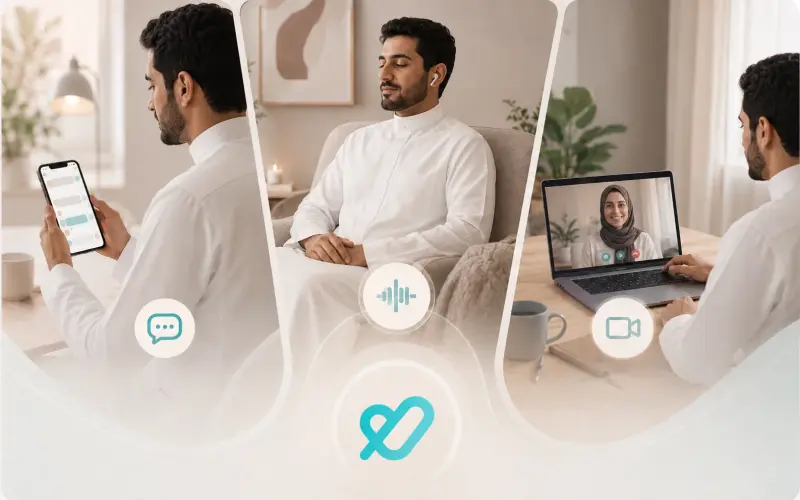
On Tatmeen, no session type is better than another; one is simply more suitable for you right now. Choose a text session if the biggest barrier is starting to speak in the first place. Choose an audio session if you want live human contact without a camera. Choose video if you want the closest experience to an in-person session and a wider visual interaction with the specialist. This flexibility is not a small detail. It is part of how Tatmeen works: a licensed Saudi digital mental health platform that offers consultations by text, audio, and video, with scheduled and urgent sessions and strong privacy from the start.
Video is not always the best option. Audio is not an incomplete version. Text is not a secondary choice. Remote mental health care can be effective, widen access, increase privacy and comfort, and reduce some of the barriers created by stigma and clinic visits. So the smarter question is not: which format looks more formal? It is: which format will help me speak honestly and keep going?
The Right Type Is Not the Most Formal One
The right type is the one that lowers your resistance and improves the quality of what you disclose. If the camera will make you delete half of what you want to say, video is not your best option today. If writing will make the session slower than you need, text is not the best option either. The strength of Tatmeen is that it does not leave you choosing in the dark: each specialist profile shows the available session type, professional role, experience, ratings, and nearby appointments. You can also search by what you feel, such as "I feel anxious," or use quick matching if you are unsure.
The short rule that makes the decision easier on Tatmeen is simple: if the block is speaking, start with writing. If the block is the camera, choose audio. If the block is the depth of interaction, choose video. This is not a slogan. It is a practical way to choose the channel that increases honesty and reduces friction from the first appointment.
When Is Writing Smarter Than Speaking?
A text session is often the smartest starting point when the problem is beginning to speak, not understanding the problem. If you are shy, afraid of being judged, need a few seconds to organize your thoughts, or carry a topic that feels sensitive and hard to say out loud, writing may open the door faster than any other channel. Research supports this direction: real-time text-based therapeutic communication shows promising early effectiveness and can be especially attractive to people who worry about stigma, confidentiality, or reaching support in a more flexible and less intimidating way.
On Tatmeen, a text session is not a scattered messaging space. It is a secure session room between you and the specialist only, supporting writing, attachments, and voice notes, without default recording. You can also delete the appointment room and its contents from the session details whenever you want. If privacy is what has been delaying you, the app allows guest browsing and the use of an alias. National ID verification is optional for billing and tax-exemption purposes only, and it does not appear to the care provider. Tatmeen's privacy policy also states that personal information is not disclosed to the specialist and that access is restricted to Tatmeen management within the regulatory framework.
There is another feature that makes text especially strong on Tatmeen: the session record stays organized inside the appointment history. The text conversation itself, attachments, voice notes, assessment results, therapeutic homework, and reports all remain available for later review. That makes text sessions excellent for people who know they need to return to what was said rather than rely only on a general impression after the appointment ends.
Why Is an Audio Session the Most Balanced Type?
An audio session is the best balance when you want live presence and human warmth without the pressure of a camera. It is deeper than text in terms of immediate tone, emotion, and conversational flow, yet lighter than video in terms of visual pressure, self-consciousness, background, or camera angle. For that reason, audio is often the smartest option for someone who speaks easily when not being seen, wants direct support during a busy day, or feels that writing is too slow while video feels stressful.
Most importantly, audio is not a weaker clinical solution by default. U.S. health guidance recognizes individual teletherapy as a service that may be delivered through video or audio-only telehealth, and research reviews have found that both audio and video can help reduce symptoms related to mood disorders. Telephone-based interventions for anxiety have also shown meaningful benefit compared with no treatment or usual care. This matters because many people assume that not turning on the camera automatically means the session has less value. That assumption is simply not accurate.
On Tatmeen, you do not lose the depth of care because you choose audio. The same session room supports live clinical tools: psychological assessments, therapeutic homework, reports, prescriptions, and lab or imaging requests when needed. More precisely, what changes is the communication channel, not the seriousness of care. This is one of Tatmeen's strongest design choices: it does not penalize you for choosing the channel that feels easier and more honest for you.
When Does Video Become the Strongest Choice?
Video is the strongest choice when you need a richer session with more signals and a feeling closer to an in-person visit. Not because it looks more professional on the surface, but because it gives the specialist what text and audio cannot fully carry: facial expressions, pacing, attention, and shared visual presence. In practice, this is what makes video the closest option to an in-person session, and research reviews have found no meaningful difference in effectiveness between videoconferencing and face-to-face care for some mood disorders.
Video is especially suitable if your story is complex and you need broader interaction from the first session, if you are looking for a therapeutic relationship that feels as close to a clinic as possible, or if the session is for a couple or family and the specialist needs to observe the direct interaction between people. But video is not always the mature choice. If the camera will make you tense, guarded, and brief, video loses its main advantage: it should give a wider picture, not a more artificial one. On Tatmeen, the session formats appear clearly on each specialist profile. Some providers offer text and audio only, while others offer text, audio, and video together. This means your choice can be based on the specialist's style and your actual need, not on a general assumption.
On Tatmeen, the Channel Changes but the Care Remains Complete
This is what separates Tatmeen from many shallow digital experiences: choosing text, audio, or video does not mean choosing a complete session versus an incomplete one. On Tatmeen, the therapeutic structure remains coherent: a secure session room, psychological assessments sent during or after the session, therapeutic homework with progress tracking, organized reports, prescriptions, and lab or imaging requests when needed, with a clear record for every appointment and its content.
This changes the whole way you choose. Instead of asking, "Which session type looks more serious?" the better question becomes: "Which session type will help me start today with the least resistance while keeping all the elements of care available later?" This is where Tatmeen's practical intelligence becomes clear. It does not force you through a single door. It builds a flexible care path around the way you can actually express yourself.
How Do You Decide in Less Than a Minute?
Ask yourself only three questions. What is blocking me most right now: the embarrassment of speaking, the discomfort of being on camera, or the need for a session richer in signals? Do I need space to form the thought before responding, or do I need live and immediate interaction? Is my goal to start with the least possible resistance, or does the case need broader visual presence from the beginning? If your first answer is the embarrassment of speaking, start with text. If it is discomfort with the camera, audio is the smartest point of balance. If you need the deepest interaction from the first session, video is the strongest option.
On Tatmeen, even reaching that decision is not complicated. You can search in natural language based on what you feel, not on the clinical terms you have memorized. You can also use quick matching if you are unsure, and in urgent cases you can send a text summary, voice note, or attachments to reach an available specialist quickly. This is a real product strength: even before the session starts, Tatmeen lets you express yourself in the way that suits you now, not in the way that sounds ideal in theory.
In the end, the best session on Tatmeen is not the most common one. It is the one that feels most honest for you. If speaking is difficult, start with text. If you want warmth without pressure, choose audio. If you are ready for something closer to a clinic visit, choose video. The important thing is not to delay mental health support because you are searching for the perfect format. Tatmeen was built to help you begin through the channel that feels like you, then continue your care with confidence, privacy, and clarity.
Frequently Asked Questions
Is a text session less valuable than audio or video?
No. A text session is not automatically a lesser option; its value depends on how well it fits you. Research points to promising early effectiveness for live text-based therapeutic communication, especially for people who care about confidentiality and reducing stigma. Tatmeen also gives the text session the same basic structure: a secure room, attachments, voice notes, assessments, homework, and reports.
Is an audio session enough if I do not like turning on the camera?
Yes, and it is often the smartest option in that case. Individual teletherapy can be delivered by video or audio-only telehealth, and research reviews have found that both audio and video can reduce symptoms related to mood disorders, with meaningful benefit for telephone-based interventions for anxiety as well.
Is video always better for the first session?
No. A first session is not a test of maturity; it is a starting point. If the camera will make you guarded or tense, an audio or text session may be better than a video session that stops you from telling the full truth. Video is stronger when you need broader visual presence and interaction closer to an in-person session, not simply because it looks more formal.
Can I choose the type based on the specialist inside Tatmeen?
Yes. Session formats appear clearly on the specialist profile. Some care providers offer text and audio only, while others offer text, audio, and video. This makes the decision clear from the beginning: you are not only choosing the platform; you are seeing how this specific specialist works.
What if I do not know which specialist or session type I need?
This is where Tatmeen's practical strength appears. You can search in your natural language based on what you feel, or use quick matching to receive options based on need, preferences, budget, and availability. If your case is urgent, you can send an urgent request with a text summary, voice note, or attachments to reach an available specialist.
What should I do if my situation is an emergency or there is immediate danger?
If you or someone else is in immediate danger or facing a health emergency, do not wait for an in-app session. Go immediately to the nearest emergency department, or call 999 for emergency/police support, 997 for ambulance services, or 937 for the Saudi Ministry of Health while inside Saudi Arabia.
A writer and researcher specializing in psychiatry, she focuses on mental health and the human emotions we experience but cannot always find the words to name. She writes about us—about humanity and the human experience—and simplifies complex topics to offer content that helps us better understand ourselves and life, ultimately making us feel less alone.
Every Tatmeen article is reviewed by care providers licensed by the Saudi Commission for Health Specialties, so what you read is accurate and trustworthy.
This article builds understanding and does not replace a licensed care provider.
Need someone to talk to?
Tatmeen's licensed care providers are available around the clock, and the app's urgent consultation connects you with one within minutes.
Download Tatmeen to explore care providers and booking options.
Smart matchingFour quick questions suggest the right care provider
Urgent consultationTalk to an available care provider within minutes
Free psychological measuresMore than 20 tests to understand how you are doing
Scan to download
{"data":{"id":"f13ffb7a-d34b-4a04-8dad-1932d2f7f4a9","slug":"online-therapy-session-text-audio-video-tatmeen","arTitle":"جلسة نصية أم صوتية أم فيديو على تطمين؟ متى تختار كل نوع حسب احتياجك","enTitle":"Text, Audio, or Video Session on Tatmeen? When to Choose Each","thumbnailAltText":"Text vs audio vs video telehealth mental health appointment","estimatedReadingTime":5,"likesCount":376,"writer":{"id":"3ab72b74-f26f-4337-9b47-3114b0f90de5","arBio":"كاتبة وباحثة متخصصة في مجال الطب النفسي، تهتم بموضوعات الصحة النفسية وبالمشاعر الإنسانية التي نختبرها ولا نجد دائمًا الكلمات لتسميتها. تكتب عنّا؛ عن الإنسان وتجربته، وتبسّط الموضوعات المعقّدة لتقدّم محتوى يساعدنا على فهم ذواتنا والحياة أكثر، ويجعلنا نشعر بأننا بوحدة أقل.","enBio":"A writer and researcher specializing in psychiatry, she focuses on mental health and the human emotions we experience but cannot always find the words to name. She writes about us—about humanity and the human experience—and simplifies complex topics to offer content that helps us better understand ourselves and life, ultimately making us feel less alone.","user":{"slug":"ayat-alnajar","arFullName":"آيات النجار","enFullName":"Ayat Al-Najjar","publicProfileImageUrl":"https://cdn.tatmeen.sa/public/profile-images/02384455-68fa-40b6-ad05-609fde65cafa/21b9a610dde5dfc6d37af110c23e9c7ab3946be080c281beb000debf4f7d31a6.webp","publicProfileImage96Url":"https://cdn.tatmeen.sa/public/profile-images/02384455-68fa-40b6-ad05-609fde65cafa/21b9a610dde5dfc6d37af110c23e9c7ab3946be080c281beb000debf4f7d31a6-w96.webp","publicProfileImage192Url":"https://cdn.tatmeen.sa/public/profile-images/02384455-68fa-40b6-ad05-609fde65cafa/21b9a610dde5dfc6d37af110c23e9c7ab3946be080c281beb000debf4f7d31a6-w192.webp"}},"arContent":"","enContent":"","productionDocument":{"headings":[{"id":"article-section-the-right-type-is-not-the-most-formal-one","text":"The Right Type Is Not the Most Formal One"},{"id":"article-section-when-is-writing-smarter-than-speaking","text":"When Is Writing Smarter Than Speaking?"},{"id":"article-section-why-is-an-audio-session-the-most-balanced-type","text":"Why Is an Audio Session the Most Balanced Type?"},{"id":"article-section-when-does-video-become-the-strongest-choice","text":"When Does Video Become the Strongest Choice?"},{"id":"article-section-on-tatmeen-the-channel-changes-but-the-care-remains-complete","text":"On Tatmeen, the Channel Changes but the Care Remains Complete"},{"id":"article-section-how-do-you-decide-in-less-than-a-minute","text":"How Do You Decide in Less Than a Minute?"},{"id":"article-section-frequently-asked-questions","text":"Frequently Asked Questions"}],"faqs":[],"beforeSourcesHtml":"","sources":[{"title":"Saudi Ministry of Health - Telemedicine","href":"https://www.moh.gov.sa/en/ministry/information-and-services/pages/telemedicine.aspx","hostname":"moh.gov.sa"},{"title":"National Institute of Mental Health - Getting Mental Health Support Virtually","href":"https://www.nimh.nih.gov/health/publications/what-is-telemental-health","hostname":"nimh.nih.gov"},{"title":"HHS Telehealth - Telehealth and Behavioral Health","href":"https://telehealth.hhs.gov/patients/additional-resources/telehealth-and-behavioral-health","hostname":"telehealth.hhs.gov"},{"title":"HHS Telehealth - Expanding Access to Behavioral Health Services","href":"https://telehealth.hhs.gov/patients/expanding-access-behavioral-health-services-through-telehealth","hostname":"telehealth.hhs.gov"},{"title":"JMIR Mental Health - Text-Based Communication for Psychological Services","href":"https://mental.jmir.org/2021/2/e19478","hostname":"mental.jmir.org"},{"title":"NCBI Bookshelf - Virtual Mental Health Counselling","href":"https://www.ncbi.nlm.nih.gov/books/NBK612163/","hostname":"ncbi.nlm.nih.gov"},{"title":"Telepsychiatry versus face-to-face treatment - Systematic Review and Meta-analysis","href":"https://pmc.ncbi.nlm.nih.gov/articles/PMC9789439/","hostname":"pmc.ncbi.nlm.nih.gov"},{"title":"HHS - Audio-Only Telehealth Privacy Guidance","href":"https://www.hhs.gov/hipaa/for-professionals/privacy/guidance/hipaa-audio-telehealth/index.html","hostname":"hhs.gov"},{"title":"Communications, Space & Technology Commission - Numbering","href":"https://www.cst.gov.sa/en/about/Numbering","hostname":"cst.gov.sa"}],"afterSourcesHtml":"<p><br /></p>","blocks":[{"type":"html","html":"<p><span style=\"color:#000000\">On Tatmeen, no session type is better than another; one is simply more suitable for you right now. Choose a text session if the biggest barrier is starting to speak in the first place. Choose an audio session if you want live human contact without a camera. Choose video if you want the closest experience to an in-person session and a wider visual interaction with the specialist. This flexibility is not a small detail. It is part of how Tatmeen works: a licensed Saudi digital mental health platform that offers consultations by text, audio, and video, with scheduled and urgent sessions and strong privacy from the start.</span></p><p><span style=\"color:#000000\">Video is not always the best option. Audio is not an incomplete version. Text is not a secondary choice. Remote mental health care can be effective, widen access, increase privacy and comfort, and reduce some of the barriers created by stigma and clinic visits. So the smarter question is not: which format looks more formal? It is: which format will help me speak honestly and keep going?</span></p><h2 id=\"article-section-the-right-type-is-not-the-most-formal-one\" data-toc-heading tabindex=\"-1\"><span id=\"the-right-type-is-not-the-most-formal-one-1\" aria-hidden=\"true\"></span><span style=\"color:#000000\"><strong>The Right Type Is Not the Most Formal One</strong></span></h2><p><span style=\"color:#000000\">The right type is the one that lowers your resistance and improves the quality of what you disclose. If the camera will make you delete half of what you want to say, video is not your best option today. If writing will make the session slower than you need, text is not the best option either. The strength of Tatmeen is that it does not leave you choosing in the dark: each specialist profile shows the available session type, professional role, experience, ratings, and nearby appointments. You can also search by what you feel, such as \"I feel anxious,\" or use quick matching if you are unsure.</span></p><p><span style=\"color:#000000\">The short rule that makes the decision easier on Tatmeen is simple: if the block is speaking, start with writing. If the block is the camera, choose audio. If the block is the depth of interaction, choose video. This is not a slogan. It is a practical way to choose the channel that increases honesty and reduces friction from the first appointment.</span></p><h2 id=\"article-section-when-is-writing-smarter-than-speaking\" data-toc-heading tabindex=\"-1\"><span id=\"when-is-writing-smarter-than-speaking-2\" aria-hidden=\"true\"></span><span style=\"color:#000000\"><strong>When Is Writing Smarter Than Speaking?</strong></span></h2><p><span style=\"color:#000000\">A text session is often the smartest starting point when the problem is beginning to speak, not understanding the problem. If you are shy, afraid of being judged, need a few seconds to organize your thoughts, or carry a topic that feels sensitive and hard to say out loud, writing may open the door faster than any other channel. Research supports this direction: real-time text-based therapeutic communication shows promising early effectiveness and can be especially attractive to people who worry about stigma, confidentiality, or reaching support in a more flexible and less intimidating way.</span></p><p><span style=\"color:#000000\">On Tatmeen, a text session is not a scattered messaging space. It is a secure session room between you and the specialist only, supporting writing, attachments, and voice notes, without default recording. You can also delete the appointment room and its contents from the session details whenever you want. If privacy is what has been delaying you, the app allows guest browsing and the use of an alias. National ID verification is optional for billing and tax-exemption purposes only, and it does not appear to the care provider. Tatmeen's privacy policy also states that personal information is not disclosed to the specialist and that access is restricted to Tatmeen management within the regulatory framework.</span></p><p><span style=\"color:#000000\">There is another feature that makes text especially strong on Tatmeen: the session record stays organized inside the appointment history. The text conversation itself, attachments, voice notes, assessment results, therapeutic homework, and reports all remain available for later review. That makes text sessions excellent for people who know they need to return to what was said rather than rely only on a general impression after the appointment ends.</span></p><h2 id=\"article-section-why-is-an-audio-session-the-most-balanced-type\" data-toc-heading tabindex=\"-1\"><span id=\"why-is-an-audio-session-the-most-balanced-type-3\" aria-hidden=\"true\"></span><span style=\"color:#000000\"><strong>Why Is an Audio Session the Most Balanced Type?</strong></span></h2><p><span style=\"color:#000000\">An audio session is the best balance when you want live presence and human warmth without the pressure of a camera. It is deeper than text in terms of immediate tone, emotion, and conversational flow, yet lighter than video in terms of visual pressure, self-consciousness, background, or camera angle. For that reason, audio is often the smartest option for someone who speaks easily when not being seen, wants direct support during a busy day, or feels that writing is too slow while video feels stressful.</span></p><p><span style=\"color:#000000\">Most importantly, audio is not a weaker clinical solution by default. U.S. health guidance recognizes individual teletherapy as a service that may be delivered through video or audio-only telehealth, and research reviews have found that both audio and video can help reduce symptoms related to mood disorders. Telephone-based interventions for anxiety have also shown meaningful benefit compared with no treatment or usual care. This matters because many people assume that not turning on the camera automatically means the session has less value. That assumption is simply not accurate.</span></p><p><span style=\"color:#000000\">On Tatmeen, you do not lose the depth of care because you choose audio. The same session room supports live clinical tools: psychological assessments, therapeutic homework, reports, prescriptions, and lab or imaging requests when needed. More precisely, what changes is the communication channel, not the seriousness of care. This is one of Tatmeen's strongest design choices: it does not penalize you for choosing the channel that feels easier and more honest for you.</span></p><h2 id=\"article-section-when-does-video-become-the-strongest-choice\" data-toc-heading tabindex=\"-1\"><span id=\"when-does-video-become-the-strongest-choice-4\" aria-hidden=\"true\"></span><span style=\"color:#000000\"><strong>When Does Video Become the Strongest Choice?</strong></span></h2><p><span style=\"color:#000000\">Video is the strongest choice when you need a richer session with more signals and a feeling closer to an in-person visit. Not because it looks more professional on the surface, but because it gives the specialist what text and audio cannot fully carry: facial expressions, pacing, attention, and shared visual presence. In practice, this is what makes video the closest option to an in-person session, and research reviews have found no meaningful difference in effectiveness between videoconferencing and face-to-face care for some mood disorders.</span></p><p><span style=\"color:#000000\">Video is especially suitable if your story is complex and you need broader interaction from the first session, if you are looking for a therapeutic relationship that feels as close to a clinic as possible, or if the session is for a couple or family and the specialist needs to observe the direct interaction between people. But video is not always the mature choice. If the camera will make you tense, guarded, and brief, video loses its main advantage: it should give a wider picture, not a more artificial one. On Tatmeen, the session formats appear clearly on each specialist profile. Some providers offer text and audio only, while others offer text, audio, and video together. This means your choice can be based on the specialist's style and your actual need, not on a general assumption.</span></p><h2 id=\"article-section-on-tatmeen-the-channel-changes-but-the-care-remains-complete\" data-toc-heading tabindex=\"-1\"><span id=\"on-tatmeen-the-channel-changes-but-the-care-remains-complete-5\" aria-hidden=\"true\"></span><span style=\"color:#000000\"><strong>On Tatmeen, the Channel Changes but the Care Remains Complete</strong></span></h2><p><span style=\"color:#000000\">This is what separates Tatmeen from many shallow digital experiences: choosing text, audio, or video does not mean choosing a complete session versus an incomplete one. On Tatmeen, the therapeutic structure remains coherent: a secure session room, psychological assessments sent during or after the session, therapeutic homework with progress tracking, organized reports, prescriptions, and lab or imaging requests when needed, with a clear record for every appointment and its content.</span></p><p><span style=\"color:#000000\">This changes the whole way you choose. Instead of asking, \"Which session type looks more serious?\" the better question becomes: \"Which session type will help me start today with the least resistance while keeping all the elements of care available later?\" This is where Tatmeen's practical intelligence becomes clear. It does not force you through a single door. It builds a flexible care path around the way you can actually express yourself.</span></p><h2 id=\"article-section-how-do-you-decide-in-less-than-a-minute\" data-toc-heading tabindex=\"-1\"><span id=\"how-do-you-decide-in-less-than-a-minute-6\" aria-hidden=\"true\"></span><span style=\"color:#000000\"><strong>How Do You Decide in Less Than a Minute?</strong></span></h2><p><span style=\"color:#000000\">Ask yourself only three questions. What is blocking me most right now: the embarrassment of speaking, the discomfort of being on camera, or the need for a session richer in signals? Do I need space to form the thought before responding, or do I need live and immediate interaction? Is my goal to start with the least possible resistance, or does the case need broader visual presence from the beginning? If your first answer is the embarrassment of speaking, start with text. If it is discomfort with the camera, audio is the smartest point of balance. If you need the deepest interaction from the first session, video is the strongest option.</span></p><p><span style=\"color:#000000\">On Tatmeen, even reaching that decision is not complicated. You can search in natural language based on what you feel, not on the clinical terms you have memorized. You can also use quick matching if you are unsure, and in urgent cases you can send a text summary, voice note, or attachments to reach an available specialist quickly. This is a real product strength: even before the session starts, Tatmeen lets you express yourself in the way that suits you now, not in the way that sounds ideal in theory.</span></p><p><span style=\"color:#000000\">In the end, the best session on Tatmeen is not the most common one. It is the one that feels most honest for you. If speaking is difficult, start with text. If you want warmth without pressure, choose audio. If you are ready for something closer to a clinic visit, choose video. The important thing is not to delay mental health support because you are searching for the perfect format. Tatmeen was built to help you begin through the channel that feels like you, then continue your care with confidence, privacy, and clarity.</span></p><h2 id=\"article-section-frequently-asked-questions\" data-toc-heading tabindex=\"-1\"><span id=\"frequently-asked-questions-7\" aria-hidden=\"true\"></span><span style=\"color:#000000\"><strong>Frequently Asked Questions</strong></span></h2><p><span style=\"color:#000000\"><strong>Is a text session less valuable than audio or video?</strong></span></p><p><span style=\"color:#000000\">No. A text session is not automatically a lesser option; its value depends on how well it fits you. Research points to promising early effectiveness for live text-based therapeutic communication, especially for people who care about confidentiality and reducing stigma. Tatmeen also gives the text session the same basic structure: a secure room, attachments, voice notes, assessments, homework, and reports.</span></p><p><span style=\"color:#000000\"><strong>Is an audio session enough if I do not like turning on the camera?</strong></span></p><p><span style=\"color:#000000\">Yes, and it is often the smartest option in that case. Individual teletherapy can be delivered by video or audio-only telehealth, and research reviews have found that both audio and video can reduce symptoms related to mood disorders, with meaningful benefit for telephone-based interventions for anxiety as well.</span></p><p><span style=\"color:#000000\"><strong>Is video always better for the first session?</strong></span></p><p><span style=\"color:#000000\">No. A first session is not a test of maturity; it is a starting point. If the camera will make you guarded or tense, an audio or text session may be better than a video session that stops you from telling the full truth. Video is stronger when you need broader visual presence and interaction closer to an in-person session, not simply because it looks more formal.</span></p><p><span style=\"color:#000000\"><strong>Can I choose the type based on the specialist inside Tatmeen?</strong></span></p><p><span style=\"color:#000000\">Yes. Session formats appear clearly on the specialist profile. Some care providers offer text and audio only, while others offer text, audio, and video. This makes the decision clear from the beginning: you are not only choosing the platform; you are seeing how this specific specialist works.</span></p><p><span style=\"color:#000000\"><strong>What if I do not know which specialist or session type I need?</strong></span></p><p><span style=\"color:#000000\">This is where Tatmeen's practical strength appears. You can search in your natural language based on what you feel, or use quick matching to receive options based on need, preferences, budget, and availability. If your case is urgent, you can send an urgent request with a text summary, voice note, or attachments to reach an available specialist.</span></p><p><span style=\"color:#000000\"><strong>What should I do if my situation is an emergency or there is immediate danger?</strong></span></p><p><span style=\"color:#000000\">If you or someone else is in immediate danger or facing a health emergency, do not wait for an in-app session. Go immediately to the nearest emergency department, or call 999 for emergency/police support, 997 for ambulance services, or 937 for the Saudi Ministry of Health while inside Saudi Arabia.</span></p>"}],"inlineCtaSignatures":[],"_experienceAliases":{"v":1,"fields":["html","bodyHtml"]}},"createdAt":"2026-05-16T21:00:00.000Z","updatedAt":"2026-06-24T23:50:04.918Z","disorderGroups":[{"id":"1e82772d-a1a7-4d29-b475-be9d6b67ae02","slug":"common-mental-issues","arName":"اضطرابات نفسية شائعة","enName":"Common Mental Issues"}],"reviewer":{"arFullName":"فريق تطمين","enFullName":"Tatmeen team","slug":"tatmeen-team","kind":"organization"},"productionArticle":true,"promotionAllowed":true,"preparedCover":{"src":"https://cdn.tatmeen.sa/public/article-lcp/article-lcp-v2/sha256-38a074c7c65e7115254f83a4b161dae1ce0bd0e0009300fd0b3227acbdcdfb81/800-7179c8f897089947cacd6b50cf0b1b827d29e836eec611f9673a64c8f72be6e2.avif","fallback":"https://cdn.tatmeen.sa/public/article-lcp/article-lcp-v2/sha256-38a074c7c65e7115254f83a4b161dae1ce0bd0e0009300fd0b3227acbdcdfb81/800-1f755098bcff7db9dc72a3e79220fa40ae810ec7994a2e1c3edf5b0e35024bea.webp","directUrl":"https://cdn.tatmeen.sa/blog-cover/Tatmeen-1778980247753.webp","isGolden":true,"avifSrcset":"https://cdn.tatmeen.sa/public/article-lcp/article-lcp-v2/sha256-38a074c7c65e7115254f83a4b161dae1ce0bd0e0009300fd0b3227acbdcdfb81/400-b098f86a29576a054cd75bc9d1983c8522b04f7c14fdd5762a6c24634e88f3f0.avif 400w, https://cdn.tatmeen.sa/public/article-lcp/article-lcp-v2/sha256-38a074c7c65e7115254f83a4b161dae1ce0bd0e0009300fd0b3227acbdcdfb81/640-9ee6834c0b681a81a04f5fd9844213c0f983da302fed23c2ad682b486dafd4dc.avif 640w, https://cdn.tatmeen.sa/public/article-lcp/article-lcp-v2/sha256-38a074c7c65e7115254f83a4b161dae1ce0bd0e0009300fd0b3227acbdcdfb81/800-7179c8f897089947cacd6b50cf0b1b827d29e836eec611f9673a64c8f72be6e2.avif 800w, https://cdn.tatmeen.sa/public/article-lcp/article-lcp-v2/sha256-38a074c7c65e7115254f83a4b161dae1ce0bd0e0009300fd0b3227acbdcdfb81/1200-e72f341d7534cd9fbbbed4fa7b94ddf31b1f04edf6579f55cd22e8a5236e8c6b.avif 1200w","webpSrcset":"https://cdn.tatmeen.sa/public/article-lcp/article-lcp-v2/sha256-38a074c7c65e7115254f83a4b161dae1ce0bd0e0009300fd0b3227acbdcdfb81/400-cf92812e96648e5ed92ecd5a27e8da66a3bc76987c57b3977978b5c457af2460.webp 400w, https://cdn.tatmeen.sa/public/article-lcp/article-lcp-v2/sha256-38a074c7c65e7115254f83a4b161dae1ce0bd0e0009300fd0b3227acbdcdfb81/640-86c2a5e3f3f018de9ac677cc57b8e3f38fda355a0e0b640d1640755ce7420497.webp 640w, https://cdn.tatmeen.sa/public/article-lcp/article-lcp-v2/sha256-38a074c7c65e7115254f83a4b161dae1ce0bd0e0009300fd0b3227acbdcdfb81/800-1f755098bcff7db9dc72a3e79220fa40ae810ec7994a2e1c3edf5b0e35024bea.webp 800w, https://cdn.tatmeen.sa/public/article-lcp/article-lcp-v2/sha256-38a074c7c65e7115254f83a4b161dae1ce0bd0e0009300fd0b3227acbdcdfb81/1200-cd7d5d45f5e94c38c398d97782b3c7d90e57be110203298195e296247e8086ba.webp 1200w","phoneAvifSrcset":"https://cdn.tatmeen.sa/public/article-lcp/article-lcp-v2/sha256-38a074c7c65e7115254f83a4b161dae1ce0bd0e0009300fd0b3227acbdcdfb81/400-b098f86a29576a054cd75bc9d1983c8522b04f7c14fdd5762a6c24634e88f3f0.avif 400w, https://cdn.tatmeen.sa/public/article-lcp/article-lcp-v2/sha256-38a074c7c65e7115254f83a4b161dae1ce0bd0e0009300fd0b3227acbdcdfb81/640-9ee6834c0b681a81a04f5fd9844213c0f983da302fed23c2ad682b486dafd4dc.avif 640w, https://cdn.tatmeen.sa/public/article-lcp/article-lcp-v2/sha256-38a074c7c65e7115254f83a4b161dae1ce0bd0e0009300fd0b3227acbdcdfb81/800-7179c8f897089947cacd6b50cf0b1b827d29e836eec611f9673a64c8f72be6e2.avif 800w","phoneWebpSrcset":"https://cdn.tatmeen.sa/public/article-lcp/article-lcp-v2/sha256-38a074c7c65e7115254f83a4b161dae1ce0bd0e0009300fd0b3227acbdcdfb81/400-cf92812e96648e5ed92ecd5a27e8da66a3bc76987c57b3977978b5c457af2460.webp 400w, https://cdn.tatmeen.sa/public/article-lcp/article-lcp-v2/sha256-38a074c7c65e7115254f83a4b161dae1ce0bd0e0009300fd0b3227acbdcdfb81/640-86c2a5e3f3f018de9ac677cc57b8e3f38fda355a0e0b640d1640755ce7420497.webp 640w, https://cdn.tatmeen.sa/public/article-lcp/article-lcp-v2/sha256-38a074c7c65e7115254f83a4b161dae1ce0bd0e0009300fd0b3227acbdcdfb81/800-1f755098bcff7db9dc72a3e79220fa40ae810ec7994a2e1c3edf5b0e35024bea.webp 800w","width":800,"height":500},"previewTaxonomy":{"groups":[{"id":"1e82772d-a1a7-4d29-b475-be9d6b67ae02","slug":"common-mental-issues","arName":"اضطرابات نفسية شائعة","enName":"Common Mental Issues"}],"topics":[],"tags":[{"id":"0a7fb6ee-560f-4ee0-b5f5-a8af3b1bb1da","slug":"tatmeen","arName":"تطمين","enName":"Tatmeen"},{"id":"300cd66c-9540-4ed3-8eae-47386be32d60","slug":"digital-health-telehealth","arName":"الصحة الرقمية والعلاج عن بُعد","enName":"Digital Health & Telehealth"},{"id":"8f632a07-06ba-44f3-afe9-d7cef3e09698","slug":"product-howto","arName":"دليل المنتج / كيفية الاستخدام","enName":"Product Explainer / How-To-Use"}]},"previewProviderRecommendations":[{"id":"6866c238-0223-4d20-b182-6bf8929dccca","slug":"bushra-alluhaibi-4189","arFullName":"بشرى اللهيبي","enFullName":"Bushra Alluhaibi","publicProfileImageUrl":"","publicProfileImage96Url":"","publicProfileImage192Url":"","specialization":{"arName":"أخصائي نفسي","enName":"Psychologist"},"profileImageUrl":"","experienceYears":12,"consultantInfo":{"averageRating":{"average":0},"specialization":{"arGeneralName":"أخصائي نفسي","enGeneralName":"Psychologist"}}},{"id":"23ba62b8-9679-46a2-9439-b2801cafc59b","slug":"dr-mohammed-alanazi-4132","arFullName":"د. محمد العنزي","enFullName":"Dr. Mohammed ALANAZI","publicProfileImageUrl":"https://cdn.tatmeen.sa/public/profile-images/23ba62b8-9679-46a2-9439-b2801cafc59b/233e70d98cd910633553abf60e5ee8dd305797b64c4172746ab379f3b91a1461.webp","publicProfileImage96Url":"https://cdn.tatmeen.sa/public/profile-images/23ba62b8-9679-46a2-9439-b2801cafc59b/233e70d98cd910633553abf60e5ee8dd305797b64c4172746ab379f3b91a1461-w96.webp","publicProfileImage192Url":"https://cdn.tatmeen.sa/public/profile-images/23ba62b8-9679-46a2-9439-b2801cafc59b/233e70d98cd910633553abf60e5ee8dd305797b64c4172746ab379f3b91a1461-w192.webp","specialization":{"arName":"طبيب أسرة","enName":"Family Physician"},"profileImageUrl":"https://cdn.tatmeen.sa/public/profile-images/23ba62b8-9679-46a2-9439-b2801cafc59b/233e70d98cd910633553abf60e5ee8dd305797b64c4172746ab379f3b91a1461-w192.webp","experienceYears":3,"consultantInfo":{"averageRating":{"average":0},"specialization":{"arGeneralName":"طبيب أسرة","enGeneralName":"Family Physician"}}},{"id":"4bcf0531-d58c-4284-aeed-b2563c966ee3","slug":"dr-sultan-albalawi-9701","arFullName":"د. سلطان البلوي","enFullName":"Dr. Sultan Albalawi","publicProfileImageUrl":"https://cdn.tatmeen.sa/public/profile-images/4bcf0531-d58c-4284-aeed-b2563c966ee3/7038797eec8398a3d17eebf66394b26366409d9a9faece56515311203b0600b2.webp","publicProfileImage96Url":"https://cdn.tatmeen.sa/public/profile-images/4bcf0531-d58c-4284-aeed-b2563c966ee3/7038797eec8398a3d17eebf66394b26366409d9a9faece56515311203b0600b2-w96.webp","publicProfileImage192Url":"https://cdn.tatmeen.sa/public/profile-images/4bcf0531-d58c-4284-aeed-b2563c966ee3/7038797eec8398a3d17eebf66394b26366409d9a9faece56515311203b0600b2-w192.webp","specialization":{"arName":"طبيب أسرة","enName":"Family Physician"},"profileImageUrl":"https://cdn.tatmeen.sa/public/profile-images/4bcf0531-d58c-4284-aeed-b2563c966ee3/7038797eec8398a3d17eebf66394b26366409d9a9faece56515311203b0600b2-w192.webp","experienceYears":3,"consultantInfo":{"averageRating":{"average":0},"specialization":{"arGeneralName":"طبيب أسرة","enGeneralName":"Family Physician"}}}],"previewCareProviders":[{"id":"09364052-c2a9-4c52-9717-7ce2093b8d0a","slug":"kholoud-alharbi-5221","arFullName":"خلود الحربي","enFullName":"Kholoud Alharbi","publicProfileImageUrl":"https://cdn.tatmeen.sa/public/profile-images/09364052-c2a9-4c52-9717-7ce2093b8d0a/4a0aeb81619e351b77f4323e3605a0a00acc7ca3c82ee7cc5ca2c9e8ef716049.webp","publicProfileImage96Url":"https://cdn.tatmeen.sa/public/profile-images/09364052-c2a9-4c52-9717-7ce2093b8d0a/4a0aeb81619e351b77f4323e3605a0a00acc7ca3c82ee7cc5ca2c9e8ef716049-w96.webp","publicProfileImage192Url":"https://cdn.tatmeen.sa/public/profile-images/09364052-c2a9-4c52-9717-7ce2093b8d0a/4a0aeb81619e351b77f4323e3605a0a00acc7ca3c82ee7cc5ca2c9e8ef716049-w192.webp","gender":"FEMALE","specialization":{"arName":"أخصائي نفسي","enName":"Psychologist"}},{"id":"6f037535-1dca-4b50-a8b2-5974b7323286","slug":"salah-althobaiti-9053","arFullName":"صلاح الثبيتي","enFullName":"Salah Althobaiti","publicProfileImageUrl":"https://cdn.tatmeen.sa/public/profile-images/6f037535-1dca-4b50-a8b2-5974b7323286/35b6bd7fad9b1e004c1835803eb9c1b56dcacd380685ec8bff141f0fb888005c.webp","publicProfileImage96Url":"https://cdn.tatmeen.sa/public/profile-images/6f037535-1dca-4b50-a8b2-5974b7323286/35b6bd7fad9b1e004c1835803eb9c1b56dcacd380685ec8bff141f0fb888005c-w96.webp","publicProfileImage192Url":"https://cdn.tatmeen.sa/public/profile-images/6f037535-1dca-4b50-a8b2-5974b7323286/35b6bd7fad9b1e004c1835803eb9c1b56dcacd380685ec8bff141f0fb888005c-w192.webp","gender":"MALE","specialization":{"arName":"أخصائي نفسي","enName":"Psychologist"}},{"id":"3cc806e8-616b-4884-9f21-a75b378580a2","slug":"aisha-al-hashim-8667","arFullName":"عائشة ال هاشم","enFullName":"Aisha Al Hashim","publicProfileImageUrl":"https://cdn.tatmeen.sa/public/profile-images/3cc806e8-616b-4884-9f21-a75b378580a2/27f523d03be4dcfa1f6a79f70c1773887434e698990d214cd990caec56a44798.webp","publicProfileImage96Url":"https://cdn.tatmeen.sa/public/profile-images/3cc806e8-616b-4884-9f21-a75b378580a2/27f523d03be4dcfa1f6a79f70c1773887434e698990d214cd990caec56a44798-w96.webp","publicProfileImage192Url":"https://cdn.tatmeen.sa/public/profile-images/3cc806e8-616b-4884-9f21-a75b378580a2/27f523d03be4dcfa1f6a79f70c1773887434e698990d214cd990caec56a44798-w192.webp","gender":"FEMALE","specialization":{"arName":"أخصائي نفسي","enName":"Psychologist"}},{"id":"db2ce1a0-9325-4471-b7ce-eb2e811c30a3","slug":"amer-qutub-2441","arFullName":"عامر قطب","enFullName":"Amer Qutub","publicProfileImageUrl":"https://cdn.tatmeen.sa/public/profile-images/db2ce1a0-9325-4471-b7ce-eb2e811c30a3/80580f99bfd7fe2b2a9cf8eed73ab532f5086d1efe053b0aa57358c1ce004261.webp","publicProfileImage96Url":"https://cdn.tatmeen.sa/public/profile-images/db2ce1a0-9325-4471-b7ce-eb2e811c30a3/80580f99bfd7fe2b2a9cf8eed73ab532f5086d1efe053b0aa57358c1ce004261-w96.webp","publicProfileImage192Url":"https://cdn.tatmeen.sa/public/profile-images/db2ce1a0-9325-4471-b7ce-eb2e811c30a3/80580f99bfd7fe2b2a9cf8eed73ab532f5086d1efe053b0aa57358c1ce004261-w192.webp","gender":"MALE","specialization":{"arName":"أخصائي نفسي","enName":"Psychologist"}},{"id":"94765496-dbdf-4631-a01b-7df5f788668d","slug":"abdullrahman-alhamoudi-3045","arFullName":"عبدالرحمن الحمودي","enFullName":"Abdulrahman Alhamoudi","publicProfileImageUrl":"https://cdn.tatmeen.sa/public/profile-images/94765496-dbdf-4631-a01b-7df5f788668d/2d49f6b6493c564afb6f50b6c3634231dff3a5cf8353acfab393d1b2a88037d1.webp","publicProfileImage96Url":"https://cdn.tatmeen.sa/public/profile-images/94765496-dbdf-4631-a01b-7df5f788668d/2d49f6b6493c564afb6f50b6c3634231dff3a5cf8353acfab393d1b2a88037d1-w96.webp","publicProfileImage192Url":"https://cdn.tatmeen.sa/public/profile-images/94765496-dbdf-4631-a01b-7df5f788668d/2d49f6b6493c564afb6f50b6c3634231dff3a5cf8353acfab393d1b2a88037d1-w192.webp","gender":"MALE","specialization":{"arName":"أخصائي نفسي","enName":"Psychologist"}},{"id":"618dba89-5b70-4b46-8304-741b7ac8ecd3","slug":"abdullah-mari-1311","arFullName":"عبدالله مرعي","enFullName":"Abdullah Mari","publicProfileImageUrl":"https://cdn.tatmeen.sa/public/profile-images/618dba89-5b70-4b46-8304-741b7ac8ecd3/6b4a3bfb59f8a304ca79083b32859b46baad2e1d692974a47c02c1f66bd11129.webp","publicProfileImage96Url":"https://cdn.tatmeen.sa/public/profile-images/618dba89-5b70-4b46-8304-741b7ac8ecd3/6b4a3bfb59f8a304ca79083b32859b46baad2e1d692974a47c02c1f66bd11129-w96.webp","publicProfileImage192Url":"https://cdn.tatmeen.sa/public/profile-images/618dba89-5b70-4b46-8304-741b7ac8ecd3/6b4a3bfb59f8a304ca79083b32859b46baad2e1d692974a47c02c1f66bd11129-w192.webp","gender":"MALE","specialization":{"arName":"أخصائي نفسي","enName":"Psychologist"}},{"id":"3b50a5d5-e795-407f-8676-fd7f0e1bb7a0","slug":"abdulaziz-bin-hudayan-4940","arFullName":"عبدالعزيز بن هديان","enFullName":"Abdulaziz Bin Hudayan","publicProfileImageUrl":"https://cdn.tatmeen.sa/public/profile-images/3b50a5d5-e795-407f-8676-fd7f0e1bb7a0/710ff0fe1fb00cdb5042092e27b7910b480a439b02251ecded62d7758eefce95.webp","publicProfileImage96Url":"https://cdn.tatmeen.sa/public/profile-images/3b50a5d5-e795-407f-8676-fd7f0e1bb7a0/710ff0fe1fb00cdb5042092e27b7910b480a439b02251ecded62d7758eefce95-w96.webp","publicProfileImage192Url":"https://cdn.tatmeen.sa/public/profile-images/3b50a5d5-e795-407f-8676-fd7f0e1bb7a0/710ff0fe1fb00cdb5042092e27b7910b480a439b02251ecded62d7758eefce95-w192.webp","gender":"MALE","specialization":{"arName":"أخصائي نفسي","enName":"Psychologist"}}],"previewDownload":{"href":"/download","title":{"ar":"خطوة واحدة لأجلك، ابدأ الآن","en":"One step for you, start now"},"description":{"ar":"حمّل تطبيق تطمين لاستكشاف مقدمي الرعاية وخيارات الحجز.","en":"Download Tatmeen to explore care providers and booking options."},"posterSrc":"/images/home/cta-ar-new-1.webp","videoSrc":"/images/home/cta-ar-new-1.mp4","videoPosterSrc":"/images/home/cta-ar-new-1.webp","videoPosterEnSrc":"/images/home/cta-en-new-1.webp","videoType":"video/mp4","appStoreHref":"https://apps.apple.com/us/app/tatmeen-%D8%AA%D8%B7%D9%85%D9%8A%D9%86/id6473836983","googlePlayHref":"https://play.google.com/store/apps/details?id=com.TatmeenApp.user&hl=en"},"previewRelatedArticles":[{"id":"d2681a0b-6811-47aa-bcfb-b7f4d6f0d66c","slug":"The-Blue-Horse-Symbol-of-freedom-in-psychiatry","route":"/blog/The-Blue-Horse-Symbol-of-freedom-in-psychiatry/","title":{"ar":"الحصان الأزرق: رمز الحرية والانفتاح في الطب النفسي","en":"The Blue Horse: A Symbol of Freedom in Psychiatry"},"image":"https://cdn.tatmeen.sa/public/article-lcp/article-lcp-v2/sha256-bb351edead4bc76ec8804d168a260ea86e68920812f59c8daa1402918b6a751b/600-593d6beb0e32b7879031d246cd18f288414a66d6b383c0436300654017e35b53.webp","directImageFallback":"https://cdn.tatmeen.sa/blog-cover/1704999910011-Tatmeen-img-289","arThumbnailAltText":"People walk beside a tall blue horse sculpture on a wooded path","thumbnailAltText":"People walk beside a tall blue horse sculpture on a wooded path","topic":{"label":{"ar":"اضطرابات نفسية شائعة","en":"Common Mental Issues"}},"readingTimeMinutes":5},{"id":"1877b1fa-3fac-4ea5-93f8-93a09d2fd0d2","slug":"Psychotropic-medications-When-and-how-effective","route":"/blog/Psychotropic-medications-When-and-how-effective/","title":{"ar":"متى يلجأ الأطباء لاستخدام الأدوية النفسية وما مدى فعاليتها؟","en":"When Doctors Use Psychiatric Medications and How Effective They Are"},"image":"https://cdn.tatmeen.sa/public/article-lcp/article-lcp-v2/sha256-93b936f688f728ffa408883ceff6160beadcd0497cf83086ead369aabe678f14/600-c5d46d2fd977dd41ad05fcc192e5602f9f505843afd553d73585f1a71a72c304.webp","directImageFallback":"https://cdn.tatmeen.sa/blog-cover/1704729572625-Tatmeen-img-304","arThumbnailAltText":"Person writing on a form attached to a clipboard","thumbnailAltText":"Person writing on a form attached to a clipboard","topic":{"label":{"ar":"اضطرابات نفسية شائعة","en":"Common Mental Issues"}},"readingTimeMinutes":5},{"id":"902e8652-7a14-4650-a5d4-77e1619c1c37","slug":"Investing-in-mental-health","route":"/blog/Investing-in-mental-health/","title":{"ar":"الاستثمار في الصحة النفسية","en":"Investing in Mental Health"},"image":"https://cdn.tatmeen.sa/public/article-lcp/article-lcp-v2/sha256-f1e11819edaebdd8f4d5b35ce003bafeda5408f16aa1c93af802b2e94319f332/800-8472e8a13090baf7e9d27110627b3a0f79fca7cd4c2564a3a94a2014610406d7.webp","directImageFallback":"https://cdn.tatmeen.sa/blog-cover/1704822504238-Tatmeen-img-564","arThumbnailAltText":"Globe encircled by Arabic text for World Mental Health Day, 10 October","thumbnailAltText":"Globe encircled by Arabic text for World Mental Health Day, 10 October","topic":{"label":{"ar":"اضطرابات نفسية شائعة","en":"Common Mental Issues"}},"readingTimeMinutes":5},{"id":"183c0c76-1f36-400c-bd02-3aab78bce145","slug":"Psychiatric-Illness-Relationship-to-Mental-illness","route":"/blog/Psychiatric-Illness-Relationship-to-Mental-illness/","title":{"ar":"المرض النفسي – علاج و أعراض وأسباب وعلاقته بالمرض العقلي","en":"Psychological Illness: Symptoms, Causes, Treatment, and Mental Illness"},"image":"https://cdn.tatmeen.sa/public/article-lcp/article-lcp-v2/sha256-d30fa57439910b10b1764f8d491e7b00f96927c57d556450e2935f7758c6ad2c/599-8567e6e62bfe8feb0ddbabbc46481b10da57eeb96d71424fa9b2612093f72d16.webp","directImageFallback":"https://cdn.tatmeen.sa/blog-cover/1706456221900-Tatmeen-20.jpg","arThumbnailAltText":"Seated figure with knees drawn up beneath a glowing brain graphic","thumbnailAltText":"Seated figure with knees drawn up beneath a glowing brain graphic","topic":{"label":{"ar":"اضطرابات نفسية شائعة","en":"Common Mental Issues"}},"readingTimeMinutes":5}],"previewRelatedReadStates":{}},"locale":"en","device":"desktop","path":"/en/blog/online-therapy-session-text-audio-video-tatmeen/","readingControls":false,"config":{"public":{"BUCKET_URL":"https://cdn.tatmeen.sa/","APP_BASE_URL":"https://tatmeen.sa","intercomAppId":"ppcnu9e3"}}}