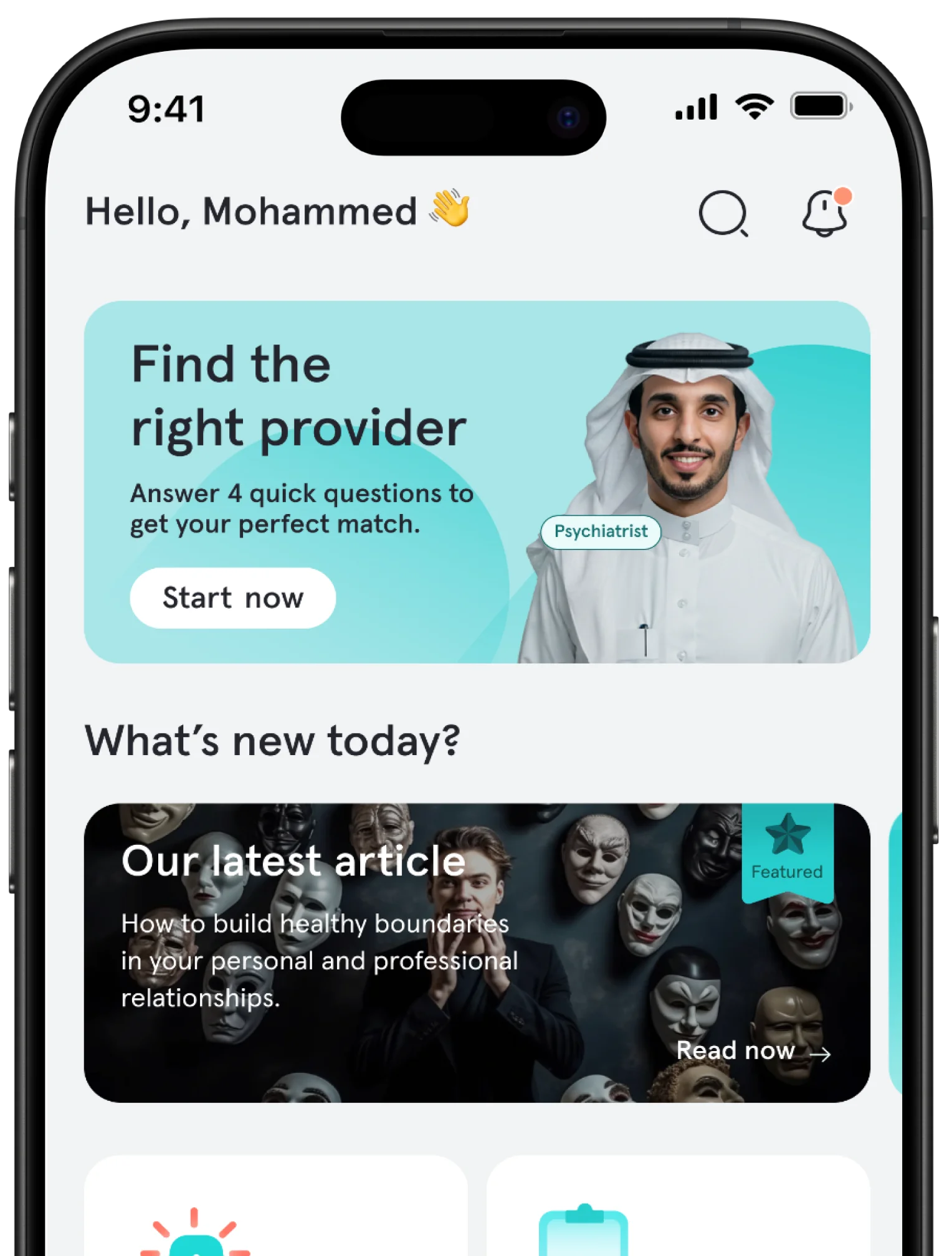
Mental health care becomes truly accessible only when the path from need to support feels possible. Tatmeen does not treat access as a simple online booking problem. It treats it as a complete journey with real barriers: How do I begin? Who should I choose? Can I find a time that fits my day? Will my privacy be protected? What happens after the session ends? These are the questions that often decide whether someone asks for help now or keeps postponing it.
That is why Tatmeen's model fits naturally with the direction of Saudi Arabia's health transformation. Vision 2030 is not only about adding digital services; it is about making care easier to reach, more efficient to use, and more responsive to people's actual lives. In mental health, this matters even more, because the barrier is rarely medical alone. It can also be social, emotional, logistical, and deeply personal.
Access problems in mental health are not always caused by a lack of specialists. Sometimes the harder problem is the friction that appears before a person reaches one. Someone may delay support because they do not know how to describe what they are feeling, because they worry about privacy, or because an in-person appointment feels too heavy as a first step. A strong digital platform does more than move the appointment online. It reduces the pressure before the appointment, clarifies the choice, and keeps support organized after the session.
The First Step: When You Do Not Know What to Call What You Feel
One of Tatmeen's strongest access points is that it does not force users to begin with a ready-made diagnosis. Many people do not start by saying, "I have anxiety," "I have depression," or "I need couples therapy." They start with something more human: I cannot sleep. I feel exhausted. I am overwhelmed. I am grieving. I am scared about the future. I do not know why I feel this way.
Tatmeen brings care closer to that language. It lets users begin from emotions, experiences, and mental states, then explore specialized clinics covering areas such as sleep disorders and fatigue, trauma, loss and grief, relationships and family, workplace mental health, and student mental health. This is not a cosmetic detail. It lowers the threshold for asking for help by allowing the user to begin from lived experience, not from a clinical vocabulary they may not yet understand.
The entry point is also lighter from a privacy and procedure perspective. Tatmeen presents quick registration, the use of a nickname, and a private session experience as part of the user's first steps. That matters because hesitation around mental health often begins with a quiet question: Can I ask for help without feeling exposed? When the first step feels less intimidating, support becomes more likely to happen earlier.
Choosing the Right Specialist: From Confusion to a Clearer Decision
Real access is not just finding any specialist. It is finding the right specialist. A person who is already overwhelmed should not have to guess blindly between professional roles, session types, budgets, and personal preferences. The decision should become clearer, not heavier.
Tatmeen addresses this through smart matching and through a searchable provider experience. The Tatmeen care providers page lets users browse and filter by profession, gender, and ranking, while provider profiles show practical decision-making details such as professional role, rating, language, and profile information. This kind of transparency reduces the chance that a user will leave the process before booking the first session.
The platform also clarifies a distinction many people miss: doctors and therapists can both assess the case and recommend suitable solutions, but only a physician can issue a prescription when medication is needed. This small clarification prevents unrealistic expectations and makes choosing the right type of specialist part of the access journey, rather than another obstacle after registration.
The Appointment Itself: Flexible in Timing and Format
Access changes meaning when care becomes available at a time and in a format the user can actually manage. Tatmeen offers flexible consultation options, urgent-session pathways when needed, and session formats that include text, voice, and video. It also presents different session lengths so users can choose what fits their time and comfort level.
In practice, this does more than remove travel distance. It reduces the emotional and logistical effort of rearranging an entire day around one consultation. For some users, a written session may feel safer as a first step. For others, voice or video may feel more direct. For someone under pressure, the difference between waiting days and finding a near-term appointment may determine whether they seek support at all.
So access is not simply the existence of a digital service. It is whether the service is usable in real life: a close appointment, a suitable format, a manageable duration, and enough flexibility for people who cannot easily attend in person or who are not ready to begin face to face.
Trust: Practical Privacy, Not Just a Promise
In mental health care, privacy is not an optional feature. It is often the condition that makes the therapeutic relationship possible in the first place. Users need to know what information is required, who can see it, how it is protected, and what rights they have over it.
Tatmeen builds this trust through several visible layers: quick registration, the ability to use a nickname, and a clear emphasis on private and confidential sessions. The Tatmeen Privacy Policy also describes practices around protecting user information, limiting disclosure, and giving users rights related to access, correction, and deletion of stored data.
This matters because real trust is not built by the word "confidential" alone. It is built through operational clarity. A platform becomes more reassuring when privacy is presented as something the user can understand and exercise, not just as a general promise. For mental health services, that clarity can be the difference between silent hesitation and a first conversation with a specialist.
After the Session: Because Access Does Not End When the Call Ends
Many digital services succeed at making the first appointment easier, but the real test is whether care continues in an organized way after that. Tatmeen's model is stronger because it connects the session to what follows: medical, psychological, and social reports, treatment plans, prescriptions when appropriate, lab and imaging requests, sick leaves, psychological assessments, and therapeutic homework.
That continuity matters. Mental health care is rarely a single moment. It is a process of understanding, follow-up, adjustment, and practice between sessions. When reports, treatment steps, and follow-up tools remain organized inside the platform, the user is not left to remember everything alone or rebuild the story from the beginning each time.
Tatmeen also presents follow-up after the appointment. That detail supports the idea that care should not disappear when the call ends. It keeps the path open, especially for users who need clarification, reassurance, or a next step after the first consultation.
In this sense, easier access is not just reaching someone once. It is finding a place where the effects of care are preserved: the assessment, the report, the treatment plan, the prescription when medically appropriate, and the next steps. Tatmeen therefore functions less like a call screen and more like a care pathway.
Why This Matters on the Road to 2030
The Health Sector Transformation Program places access, quality, and digital enablement at the center of health reform. This is important because technology is not valuable simply because it is digital. It is valuable when it makes care easier to reach, easier to use, and more consistent for the people who need it.
From that perspective, Tatmeen is not merely an app for booking sessions. It is a practical example of how a national direction can become a user experience: a lighter first step, a clearer specialist choice, flexible session formats, calmer privacy, and continuity after the appointment. These are exactly the kinds of details that matter in mental health, where the barriers are often emotional and social as much as practical.
The same idea extends beyond individuals. Tatmeen for Business offers organizations programs, activities, and consultations that support employee mental health. This expands access from a personal decision made by one person alone into a supportive structure that can begin inside the workplace. As Saudi Arabia moves toward 2030, that connection between mental health, quality of life, and productivity will only become more important.
Finally
Simplifying access to mental health care does not begin with talking more about mental health. It begins with reducing the exhausting steps between the need and the specialist. Tatmeen succeeds when it makes that distance shorter and calmer: users can begin from what they feel, see who may suit them, book in a way that fits their life, and receive follow-up that turns the session into part of a path rather than an isolated event.
If this is the kind of access Saudi Arabia is working toward by 2030, the real measure will not be the number of digital platforms alone. It will be whether those platforms make care genuinely closer to people, more respectful of their time, and more protective of their privacy.
Frequently Asked Questions
How do I begin if I do not know exactly what the problem is?
You do not need to begin with a formal diagnosis. Tatmeen lets users start from emotions, experiences, and mental states, then explore specialized clinics that may fit what they are actually going through.
Can I use Tatmeen without revealing my real name?
Yes. Tatmeen presents quick registration and the option to communicate using a nickname, which can make the first step feel more comfortable for users who are hesitant about privacy.
How do I choose between a psychiatrist, psychologist, or social specialist?
Start with your need and the type of support you expect. Tatmeen's provider profiles help users compare professional role, language, session type, ratings, and profile details. The platform also clarifies that both doctors and therapists can assess and recommend suitable solutions, while prescriptions require a physician when medication is needed.
Are urgent sessions available, and what session formats can I choose?
Tatmeen presents urgent and scheduled consultation options, along with several communication formats, including text, voice, and video. It also offers different session lengths, which helps users choose what fits their time and comfort level.
What should I do if the situation is urgent or there is immediate danger?
If there is immediate danger or an acute crisis, do not wait for a regular session and do not rely on the app alone. Seek immediate help from emergency services or local crisis support right away.
A writer and researcher specializing in psychiatry, she focuses on mental health and the human emotions we experience but cannot always find the words to name. She writes about us—about humanity and the human experience—and simplifies complex topics to offer content that helps us better understand ourselves and life, ultimately making us feel less alone.
Every Tatmeen article is reviewed by care providers licensed by the Saudi Commission for Health Specialties, so what you read is accurate and trustworthy.
This article builds understanding and does not replace a licensed care provider.
Need someone to talk to?
Tatmeen's licensed care providers are available around the clock, and the app's urgent consultation connects you with one within minutes.
Download Tatmeen to explore care providers and booking options.
Smart matchingFour quick questions suggest the right care provider
Urgent consultationTalk to an available care provider within minutes
Free psychological measuresMore than 20 tests to understand how you are doing
Scan to download
{"data":{"id":"935f14bf-8b90-4de0-a129-0de95420872a","slug":"online-mental-health-care-saudi-arabia-2030-tatmeen","arTitle":"الوصول بلا تعقيد: كيف يسهّل تطمين الحصول على الرعاية النفسية في المملكة حتى 2030","enTitle":"How Tatmeen Makes Mental Health Care Easier to Reach in Saudi Arabia by 2030","thumbnailAltText":"women mental health telehealth saudi arabia vision 2030 transformation tatmeen","estimatedReadingTime":5,"likesCount":374,"writer":{"id":"3ab72b74-f26f-4337-9b47-3114b0f90de5","arBio":"كاتبة وباحثة متخصصة في مجال الطب النفسي، تهتم بموضوعات الصحة النفسية وبالمشاعر الإنسانية التي نختبرها ولا نجد دائمًا الكلمات لتسميتها. تكتب عنّا؛ عن الإنسان وتجربته، وتبسّط الموضوعات المعقّدة لتقدّم محتوى يساعدنا على فهم ذواتنا والحياة أكثر، ويجعلنا نشعر بأننا بوحدة أقل.","enBio":"A writer and researcher specializing in psychiatry, she focuses on mental health and the human emotions we experience but cannot always find the words to name. She writes about us—about humanity and the human experience—and simplifies complex topics to offer content that helps us better understand ourselves and life, ultimately making us feel less alone.","user":{"slug":"ayat-alnajar","arFullName":"آيات النجار","enFullName":"Ayat Al-Najjar","publicProfileImageUrl":"https://cdn.tatmeen.sa/public/profile-images/02384455-68fa-40b6-ad05-609fde65cafa/21b9a610dde5dfc6d37af110c23e9c7ab3946be080c281beb000debf4f7d31a6.webp","publicProfileImage96Url":"https://cdn.tatmeen.sa/public/profile-images/02384455-68fa-40b6-ad05-609fde65cafa/21b9a610dde5dfc6d37af110c23e9c7ab3946be080c281beb000debf4f7d31a6-w96.webp","publicProfileImage192Url":"https://cdn.tatmeen.sa/public/profile-images/02384455-68fa-40b6-ad05-609fde65cafa/21b9a610dde5dfc6d37af110c23e9c7ab3946be080c281beb000debf4f7d31a6-w192.webp"}},"arContent":"","enContent":"","productionDocument":{"headings":[{"id":"article-section-the-first-step-when-you-do-not-know-what-to-call-what-you-feel","text":"The First Step: When You Do Not Know What to Call What You Feel"},{"id":"article-section-choosing-the-right-specialist-from-confusion-to-a-clearer-decision","text":"Choosing the Right Specialist: From Confusion to a Clearer Decision"},{"id":"article-section-the-appointment-itself-flexible-in-timing-and-format","text":"The Appointment Itself: Flexible in Timing and Format"},{"id":"article-section-trust-practical-privacy-not-just-a-promise","text":"Trust: Practical Privacy, Not Just a Promise"},{"id":"article-section-after-the-session-because-access-does-not-end-when-the-call-ends","text":"After the Session: Because Access Does Not End When the Call Ends"},{"id":"article-section-why-this-matters-on-the-road-to-2030","text":"Why This Matters on the Road to 2030"},{"id":"article-section-finally","text":"Finally"},{"id":"article-section-frequently-asked-questions","text":"Frequently Asked Questions"}],"faqs":[],"beforeSourcesHtml":"","sources":[{"title":"Saudi Ministry of Health - Health Transformation goals","href":"https://www.moh.gov.sa/en/Ministry/MediaCenter/News/Pages/News-2024-11-03-001.aspx","hostname":"moh.gov.sa"},{"title":"Saudi Ministry of Health - E-Health Initiative in Digital Transformation","href":"https://www.moh.gov.sa/en/Ministry/nehs/Pages/vision2030.aspx","hostname":"moh.gov.sa"},{"title":"World Health Organization - World mental health report","href":"https://www.who.int/publications-detail-redirect/9789240049338","hostname":"who.int"},{"title":"World Health Organization - Recommendations on digital interventions for health system strengthening","href":"https://www.who.int/publications/i/item/9789241550505","hostname":"who.int"},{"title":"SDAIA - Guide to the Saudi Personal Data Protection Law","href":"https://dgp.sdaia.gov.sa/wps/wcm/connect/85a664fd-6e4e-4edb-bab4-1cbdb02ba6d5/Guide%2Bto%2Bthe%2Bsaudi%2BPDP%2Blaw%2BHANDBOOK__%D9%90EN.pdf?CACHEID=ROOTWORKSPACE-85a664fd-6e4e-4edb-bab4-1cbdb02ba6d5-pELOjbE&CONVERT_TO=url&MOD=AJPERES","hostname":"dgp.sdaia.gov.sa"},{"title":"World Health Organization - Mental health at work","href":"https://www.who.int/news-room/fact-sheets/detail/mental-health-at-work","hostname":"who.int"}],"afterSourcesHtml":"<p><br /></p>","blocks":[{"type":"html","html":"<p><span style=\"color:#000000\">Mental health care becomes truly accessible only when the path from need to support feels possible. Tatmeen does not treat access as a simple online booking problem. It treats it as a complete journey with real barriers: How do I begin? Who should I choose? Can I find a time that fits my day? Will my privacy be protected? What happens after the session ends? These are the questions that often decide whether someone asks for help now or keeps postponing it.</span></p><p><span style=\"color:#000000\">That is why Tatmeen's model fits naturally with the direction of Saudi Arabia's health transformation. Vision 2030 is not only about adding digital services; it is about making care easier to reach, more efficient to use, and more responsive to people's actual lives. In mental health, this matters even more, because the barrier is rarely medical alone. It can also be social, emotional, logistical, and deeply personal.</span></p><p><span style=\"color:#000000\">Access problems in mental health are not always caused by a lack of specialists. Sometimes the harder problem is the friction that appears before a person reaches one. Someone may delay support because they do not know how to describe what they are feeling, because they worry about privacy, or because an in-person appointment feels too heavy as a first step. A strong digital platform does more than move the appointment online. It reduces the pressure before the appointment, clarifies the choice, and keeps support organized after the session.</span></p><h2 id=\"article-section-the-first-step-when-you-do-not-know-what-to-call-what-you-feel\" data-toc-heading tabindex=\"-1\"><span id=\"the-first-step-when-you-do-not-know-what-to-call-what-you-feel-1\" aria-hidden=\"true\"></span><span style=\"color:#000000\"><strong>The First Step: When You Do Not Know What to Call What You Feel</strong></span></h2><p><span style=\"color:#000000\">One of Tatmeen's strongest access points is that it does not force users to begin with a ready-made diagnosis. Many people do not start by saying, \"I have anxiety,\" \"I have depression,\" or \"I need couples therapy.\" They start with something more human: I cannot sleep. I feel exhausted. I am overwhelmed. I am grieving. I am scared about the future. I do not know why I feel this way.</span></p><p><span style=\"color:#000000\">Tatmeen brings care closer to that language. It lets users begin from emotions, experiences, and mental states, then explore specialized clinics covering areas such as sleep disorders and fatigue, trauma, loss and grief, relationships and family, workplace mental health, and student mental health. This is not a cosmetic detail. It lowers the threshold for asking for help by allowing the user to begin from lived experience, not from a clinical vocabulary they may not yet understand.</span></p><p><span style=\"color:#000000\">The entry point is also lighter from a privacy and procedure perspective. Tatmeen presents quick registration, the use of a nickname, and a private session experience as part of the user's first steps. That matters because hesitation around mental health often begins with a quiet question: Can I ask for help without feeling exposed? When the first step feels less intimidating, support becomes more likely to happen earlier.</span></p><h2 id=\"article-section-choosing-the-right-specialist-from-confusion-to-a-clearer-decision\" data-toc-heading tabindex=\"-1\"><span id=\"choosing-the-right-specialist-from-confusion-to-a-clearer-decision-2\" aria-hidden=\"true\"></span><span style=\"color:#000000\"><strong>Choosing the Right Specialist: From Confusion to a Clearer Decision</strong></span></h2><p><span style=\"color:#000000\">Real access is not just finding any specialist. It is finding the right specialist. A person who is already overwhelmed should not have to guess blindly between professional roles, session types, budgets, and personal preferences. The decision should become clearer, not heavier.</span></p><p><span style=\"color:#000000\">Tatmeen addresses this through smart matching and through a searchable provider experience. The </span><a href=\"https://tatmeen.sa/en/care-providers/\"><span style=\"color:#1155cc\"><u>Tatmeen care providers page</u></span></a><span style=\"color:#000000\"> lets users browse and filter by profession, gender, and ranking, while provider profiles show practical decision-making details such as professional role, rating, language, and profile information. This kind of transparency reduces the chance that a user will leave the process before booking the first session.</span></p><p><span style=\"color:#000000\">The platform also clarifies a distinction many people miss: doctors and therapists can both assess the case and recommend suitable solutions, but only a physician can issue a prescription when medication is needed. This small clarification prevents unrealistic expectations and makes choosing the right type of specialist part of the access journey, rather than another obstacle after registration.</span></p><h2 id=\"article-section-the-appointment-itself-flexible-in-timing-and-format\" data-toc-heading tabindex=\"-1\"><span id=\"the-appointment-itself-flexible-in-timing-and-format-3\" aria-hidden=\"true\"></span><span style=\"color:#000000\"><strong>The Appointment Itself: Flexible in Timing and Format</strong></span></h2><p><span style=\"color:#000000\">Access changes meaning when care becomes available at a time and in a format the user can actually manage. Tatmeen offers flexible consultation options, urgent-session pathways when needed, and session formats that include text, voice, and video. It also presents different session lengths so users can choose what fits their time and comfort level.</span></p><p><span style=\"color:#000000\">In practice, this does more than remove travel distance. It reduces the emotional and logistical effort of rearranging an entire day around one consultation. For some users, a written session may feel safer as a first step. For others, voice or video may feel more direct. For someone under pressure, the difference between waiting days and finding a near-term appointment may determine whether they seek support at all.</span></p><p><span style=\"color:#000000\">So access is not simply the existence of a digital service. It is whether the service is usable in real life: a close appointment, a suitable format, a manageable duration, and enough flexibility for people who cannot easily attend in person or who are not ready to begin face to face.</span></p><h2 id=\"article-section-trust-practical-privacy-not-just-a-promise\" data-toc-heading tabindex=\"-1\"><span id=\"trust-practical-privacy-not-just-a-promise-4\" aria-hidden=\"true\"></span><span style=\"color:#000000\"><strong>Trust: Practical Privacy, Not Just a Promise</strong></span></h2><p><span style=\"color:#000000\">In mental health care, privacy is not an optional feature. It is often the condition that makes the therapeutic relationship possible in the first place. Users need to know what information is required, who can see it, how it is protected, and what rights they have over it.</span></p><p><span style=\"color:#000000\">Tatmeen builds this trust through several visible layers: quick registration, the ability to use a nickname, and a clear emphasis on private and confidential sessions. The </span><a href=\"https://tatmeen.sa/en/privacy/\"><span style=\"color:#1155cc\"><u>Tatmeen Privacy Policy</u></span></a><span style=\"color:#000000\"> also describes practices around protecting user information, limiting disclosure, and giving users rights related to access, correction, and deletion of stored data.</span></p><p><span style=\"color:#000000\">This matters because real trust is not built by the word \"confidential\" alone. It is built through operational clarity. A platform becomes more reassuring when privacy is presented as something the user can understand and exercise, not just as a general promise. For mental health services, that clarity can be the difference between silent hesitation and a first conversation with a specialist.</span></p><h2 id=\"article-section-after-the-session-because-access-does-not-end-when-the-call-ends\" data-toc-heading tabindex=\"-1\"><span id=\"after-the-session-because-access-does-not-end-when-the-call-ends-5\" aria-hidden=\"true\"></span><span style=\"color:#000000\"><strong>After the Session: Because Access Does Not End When the Call Ends</strong></span></h2><p><span style=\"color:#000000\">Many digital services succeed at making the first appointment easier, but the real test is whether care continues in an organized way after that. Tatmeen's model is stronger because it connects the session to what follows: medical, psychological, and social reports, treatment plans, prescriptions when appropriate, lab and imaging requests, sick leaves, psychological assessments, and therapeutic homework.</span></p><p><span style=\"color:#000000\">That continuity matters. Mental health care is rarely a single moment. It is a process of understanding, follow-up, adjustment, and practice between sessions. When reports, treatment steps, and follow-up tools remain organized inside the platform, the user is not left to remember everything alone or rebuild the story from the beginning each time.</span></p><p><span style=\"color:#000000\">Tatmeen also presents follow-up after the appointment. That detail supports the idea that care should not disappear when the call ends. It keeps the path open, especially for users who need clarification, reassurance, or a next step after the first consultation.</span></p><p><span style=\"color:#000000\">In this sense, easier access is not just reaching someone once. It is finding a place where the effects of care are preserved: the assessment, the report, the treatment plan, the prescription when medically appropriate, and the next steps. Tatmeen therefore functions less like a call screen and more like a care pathway.</span></p><h2 id=\"article-section-why-this-matters-on-the-road-to-2030\" data-toc-heading tabindex=\"-1\"><span id=\"why-this-matters-on-the-road-to-2030-6\" aria-hidden=\"true\"></span><span style=\"color:#000000\"><strong>Why This Matters on the Road to 2030</strong></span></h2><p><span style=\"color:#000000\">The </span><a href=\"https://www.vision2030.gov.sa/media/x3jbf45y/2021-2025-health-sector-transformation-program-delivery-plan-en.pdf\" target=\"_blank\" rel=\"nofollow noopener noreferrer\"><span style=\"color:#1155cc\"><u>Health Sector Transformation Program</u></span></a><span style=\"color:#000000\"> places access, quality, and digital enablement at the center of health reform. This is important because technology is not valuable simply because it is digital. It is valuable when it makes care easier to reach, easier to use, and more consistent for the people who need it.</span></p><p><span style=\"color:#000000\">From that perspective, Tatmeen is not merely an app for booking sessions. It is a practical example of how a national direction can become a user experience: a lighter first step, a clearer specialist choice, flexible session formats, calmer privacy, and continuity after the appointment. These are exactly the kinds of details that matter in mental health, where the barriers are often emotional and social as much as practical.</span></p><p><span style=\"color:#000000\">The same idea extends beyond individuals. </span><a href=\"https://tatmeen.sa/en/business/\"><span style=\"color:#1155cc\"><u>Tatmeen for Business</u></span></a><span style=\"color:#000000\"> offers organizations programs, activities, and consultations that support employee mental health. This expands access from a personal decision made by one person alone into a supportive structure that can begin inside the workplace. As Saudi Arabia moves toward 2030, that connection between mental health, quality of life, and productivity will only become more important.</span></p><h2 id=\"article-section-finally\" data-toc-heading tabindex=\"-1\"><span id=\"finally-7\" aria-hidden=\"true\"></span><span style=\"color:#000000\"><strong>Finally</strong></span></h2><p><span style=\"color:#000000\">Simplifying access to mental health care does not begin with talking more about mental health. It begins with reducing the exhausting steps between the need and the specialist. Tatmeen succeeds when it makes that distance shorter and calmer: users can begin from what they feel, see who may suit them, book in a way that fits their life, and receive follow-up that turns the session into part of a path rather than an isolated event.</span></p><p><span style=\"color:#000000\">If this is the kind of access Saudi Arabia is working toward by 2030, the real measure will not be the number of digital platforms alone. It will be whether those platforms make care genuinely closer to people, more respectful of their time, and more protective of their privacy.</span></p><h2 id=\"article-section-frequently-asked-questions\" data-toc-heading tabindex=\"-1\"><span id=\"frequently-asked-questions-8\" aria-hidden=\"true\"></span><span style=\"color:#000000\"><strong>Frequently Asked Questions</strong></span></h2><p><span style=\"color:#000000\"><strong>How do I begin if I do not know exactly what the problem is?</strong></span></p><p><span style=\"color:#000000\">You do not need to begin with a formal diagnosis. Tatmeen lets users start from emotions, experiences, and mental states, then explore specialized clinics that may fit what they are actually going through.</span></p><p><span style=\"color:#000000\"><strong>Can I use Tatmeen without revealing my real name?</strong></span></p><p><span style=\"color:#000000\">Yes. Tatmeen presents quick registration and the option to communicate using a nickname, which can make the first step feel more comfortable for users who are hesitant about privacy.</span></p><p><span style=\"color:#000000\"><strong>How do I choose between a psychiatrist, psychologist, or social specialist?</strong></span></p><p><span style=\"color:#000000\">Start with your need and the type of support you expect. Tatmeen's provider profiles help users compare professional role, language, session type, ratings, and profile details. The platform also clarifies that both doctors and therapists can assess and recommend suitable solutions, while prescriptions require a physician when medication is needed.</span></p><p><span style=\"color:#000000\"><strong>Are urgent sessions available, and what session formats can I choose?</strong></span></p><p><span style=\"color:#000000\">Tatmeen presents urgent and scheduled consultation options, along with several communication formats, including text, voice, and video. It also offers different session lengths, which helps users choose what fits their time and comfort level.</span></p><p><span style=\"color:#000000\"><strong>What should I do if the situation is urgent or there is immediate danger?</strong></span></p><p><span style=\"color:#000000\">If there is immediate danger or an acute crisis, do not wait for a regular session and do not rely on the app alone. Seek immediate help from emergency services or local crisis support right away.</span></p><p><br /></p>"}],"inlineCtaSignatures":[],"_experienceAliases":{"v":1,"fields":["html","bodyHtml"]}},"createdAt":"2026-05-16T21:00:00.000Z","updatedAt":"2026-06-24T23:50:06.657Z","disorderGroups":[{"id":"1e82772d-a1a7-4d29-b475-be9d6b67ae02","slug":"common-mental-issues","arName":"اضطرابات نفسية شائعة","enName":"Common Mental Issues"}],"reviewer":{"arFullName":"فريق تطمين","enFullName":"Tatmeen team","slug":"tatmeen-team","kind":"organization"},"productionArticle":true,"promotionAllowed":true,"preparedCover":{"src":"https://cdn.tatmeen.sa/public/article-lcp/article-lcp-v2/sha256-49fd0cc7494f200cb132d534b19451b3127a1437f3b9766a170212d1526bc4ec/800-ccd0803666fc30e01b35f9a08de34e231e5d8bcccc1364eb7e92b50f21fe77ec.avif","fallback":"https://cdn.tatmeen.sa/public/article-lcp/article-lcp-v2/sha256-49fd0cc7494f200cb132d534b19451b3127a1437f3b9766a170212d1526bc4ec/800-1ef60918816c6dd299864fb186f57d3a04669e769e2dbf1f90409a151b5ffd3b.webp","directUrl":"https://cdn.tatmeen.sa/blog-cover/Tatmeen-1778979067122.webp","isGolden":true,"avifSrcset":"https://cdn.tatmeen.sa/public/article-lcp/article-lcp-v2/sha256-49fd0cc7494f200cb132d534b19451b3127a1437f3b9766a170212d1526bc4ec/400-a3a2c41a20ee80c016005c084f9b61219730bd5065c9d6eea28ce94b5623bebc.avif 400w, https://cdn.tatmeen.sa/public/article-lcp/article-lcp-v2/sha256-49fd0cc7494f200cb132d534b19451b3127a1437f3b9766a170212d1526bc4ec/640-1c10b5085d00c43cb5c39107bc7a6523b7999f10a8e1f14d042f46119e7cf81e.avif 640w, https://cdn.tatmeen.sa/public/article-lcp/article-lcp-v2/sha256-49fd0cc7494f200cb132d534b19451b3127a1437f3b9766a170212d1526bc4ec/800-ccd0803666fc30e01b35f9a08de34e231e5d8bcccc1364eb7e92b50f21fe77ec.avif 800w, https://cdn.tatmeen.sa/public/article-lcp/article-lcp-v2/sha256-49fd0cc7494f200cb132d534b19451b3127a1437f3b9766a170212d1526bc4ec/1200-9609b6d98ec30d2942c777207eea456d7ddf3a84cab9634c76d414d450824a33.avif 1200w","webpSrcset":"https://cdn.tatmeen.sa/public/article-lcp/article-lcp-v2/sha256-49fd0cc7494f200cb132d534b19451b3127a1437f3b9766a170212d1526bc4ec/400-6e06551fe4e26737bd2a58606af7afdc16acc15eb79ad550724e3b4a0187f127.webp 400w, https://cdn.tatmeen.sa/public/article-lcp/article-lcp-v2/sha256-49fd0cc7494f200cb132d534b19451b3127a1437f3b9766a170212d1526bc4ec/640-2fc853510b7680b5c301781b979625fef8445f19645484481b3225f74c5ad0a1.webp 640w, https://cdn.tatmeen.sa/public/article-lcp/article-lcp-v2/sha256-49fd0cc7494f200cb132d534b19451b3127a1437f3b9766a170212d1526bc4ec/800-1ef60918816c6dd299864fb186f57d3a04669e769e2dbf1f90409a151b5ffd3b.webp 800w, https://cdn.tatmeen.sa/public/article-lcp/article-lcp-v2/sha256-49fd0cc7494f200cb132d534b19451b3127a1437f3b9766a170212d1526bc4ec/1200-d5776bdfd8a38b7e0ed3e45cc75c6600005613b3b45fc127dad32c7ccd053ff6.webp 1200w","phoneAvifSrcset":"https://cdn.tatmeen.sa/public/article-lcp/article-lcp-v2/sha256-49fd0cc7494f200cb132d534b19451b3127a1437f3b9766a170212d1526bc4ec/400-a3a2c41a20ee80c016005c084f9b61219730bd5065c9d6eea28ce94b5623bebc.avif 400w, https://cdn.tatmeen.sa/public/article-lcp/article-lcp-v2/sha256-49fd0cc7494f200cb132d534b19451b3127a1437f3b9766a170212d1526bc4ec/640-1c10b5085d00c43cb5c39107bc7a6523b7999f10a8e1f14d042f46119e7cf81e.avif 640w, https://cdn.tatmeen.sa/public/article-lcp/article-lcp-v2/sha256-49fd0cc7494f200cb132d534b19451b3127a1437f3b9766a170212d1526bc4ec/800-ccd0803666fc30e01b35f9a08de34e231e5d8bcccc1364eb7e92b50f21fe77ec.avif 800w","phoneWebpSrcset":"https://cdn.tatmeen.sa/public/article-lcp/article-lcp-v2/sha256-49fd0cc7494f200cb132d534b19451b3127a1437f3b9766a170212d1526bc4ec/400-6e06551fe4e26737bd2a58606af7afdc16acc15eb79ad550724e3b4a0187f127.webp 400w, https://cdn.tatmeen.sa/public/article-lcp/article-lcp-v2/sha256-49fd0cc7494f200cb132d534b19451b3127a1437f3b9766a170212d1526bc4ec/640-2fc853510b7680b5c301781b979625fef8445f19645484481b3225f74c5ad0a1.webp 640w, https://cdn.tatmeen.sa/public/article-lcp/article-lcp-v2/sha256-49fd0cc7494f200cb132d534b19451b3127a1437f3b9766a170212d1526bc4ec/800-1ef60918816c6dd299864fb186f57d3a04669e769e2dbf1f90409a151b5ffd3b.webp 800w","width":800,"height":500},"previewTaxonomy":{"groups":[{"id":"1e82772d-a1a7-4d29-b475-be9d6b67ae02","slug":"common-mental-issues","arName":"اضطرابات نفسية شائعة","enName":"Common Mental Issues"}],"topics":[],"tags":[{"id":"0a7fb6ee-560f-4ee0-b5f5-a8af3b1bb1da","slug":"tatmeen","arName":"تطمين","enName":"Tatmeen"},{"id":"2d8923db-c6f5-48c4-a0d5-1a0664497491","slug":"saudi","arName":"السعودية","enName":"Saudi Arabia"},{"id":"7d4166fa-470f-4055-99cd-90ae10e2ecea","slug":"saudi-vision-2030","arName":"رؤية السعودية 2030","enName":"Saudi Vision 2030"},{"id":"300cd66c-9540-4ed3-8eae-47386be32d60","slug":"digital-health-telehealth","arName":"الصحة الرقمية والعلاج عن بُعد","enName":"Digital Health & Telehealth"},{"id":"c2a6e8d3-de9c-435f-8c95-9727e7db14cc","slug":"explainer-awareness","arName":"دليل توعوي / شرح","enName":"Explainer / Awareness Guide"}]},"previewProviderRecommendations":[{"id":"6866c238-0223-4d20-b182-6bf8929dccca","slug":"bushra-alluhaibi-4189","arFullName":"بشرى اللهيبي","enFullName":"Bushra Alluhaibi","publicProfileImageUrl":"","publicProfileImage96Url":"","publicProfileImage192Url":"","specialization":{"arName":"أخصائي نفسي","enName":"Psychologist"},"profileImageUrl":"","experienceYears":12,"consultantInfo":{"averageRating":{"average":0},"specialization":{"arGeneralName":"أخصائي نفسي","enGeneralName":"Psychologist"}}},{"id":"23ba62b8-9679-46a2-9439-b2801cafc59b","slug":"dr-mohammed-alanazi-4132","arFullName":"د. محمد العنزي","enFullName":"Dr. Mohammed ALANAZI","publicProfileImageUrl":"https://cdn.tatmeen.sa/public/profile-images/23ba62b8-9679-46a2-9439-b2801cafc59b/233e70d98cd910633553abf60e5ee8dd305797b64c4172746ab379f3b91a1461.webp","publicProfileImage96Url":"https://cdn.tatmeen.sa/public/profile-images/23ba62b8-9679-46a2-9439-b2801cafc59b/233e70d98cd910633553abf60e5ee8dd305797b64c4172746ab379f3b91a1461-w96.webp","publicProfileImage192Url":"https://cdn.tatmeen.sa/public/profile-images/23ba62b8-9679-46a2-9439-b2801cafc59b/233e70d98cd910633553abf60e5ee8dd305797b64c4172746ab379f3b91a1461-w192.webp","specialization":{"arName":"طبيب أسرة","enName":"Family Physician"},"profileImageUrl":"https://cdn.tatmeen.sa/public/profile-images/23ba62b8-9679-46a2-9439-b2801cafc59b/233e70d98cd910633553abf60e5ee8dd305797b64c4172746ab379f3b91a1461-w192.webp","experienceYears":3,"consultantInfo":{"averageRating":{"average":0},"specialization":{"arGeneralName":"طبيب أسرة","enGeneralName":"Family Physician"}}},{"id":"4bcf0531-d58c-4284-aeed-b2563c966ee3","slug":"dr-sultan-albalawi-9701","arFullName":"د. سلطان البلوي","enFullName":"Dr. Sultan Albalawi","publicProfileImageUrl":"https://cdn.tatmeen.sa/public/profile-images/4bcf0531-d58c-4284-aeed-b2563c966ee3/7038797eec8398a3d17eebf66394b26366409d9a9faece56515311203b0600b2.webp","publicProfileImage96Url":"https://cdn.tatmeen.sa/public/profile-images/4bcf0531-d58c-4284-aeed-b2563c966ee3/7038797eec8398a3d17eebf66394b26366409d9a9faece56515311203b0600b2-w96.webp","publicProfileImage192Url":"https://cdn.tatmeen.sa/public/profile-images/4bcf0531-d58c-4284-aeed-b2563c966ee3/7038797eec8398a3d17eebf66394b26366409d9a9faece56515311203b0600b2-w192.webp","specialization":{"arName":"طبيب أسرة","enName":"Family Physician"},"profileImageUrl":"https://cdn.tatmeen.sa/public/profile-images/4bcf0531-d58c-4284-aeed-b2563c966ee3/7038797eec8398a3d17eebf66394b26366409d9a9faece56515311203b0600b2-w192.webp","experienceYears":3,"consultantInfo":{"averageRating":{"average":0},"specialization":{"arGeneralName":"طبيب أسرة","enGeneralName":"Family Physician"}}}],"previewCareProviders":[{"id":"09364052-c2a9-4c52-9717-7ce2093b8d0a","slug":"kholoud-alharbi-5221","arFullName":"خلود الحربي","enFullName":"Kholoud Alharbi","publicProfileImageUrl":"https://cdn.tatmeen.sa/public/profile-images/09364052-c2a9-4c52-9717-7ce2093b8d0a/4a0aeb81619e351b77f4323e3605a0a00acc7ca3c82ee7cc5ca2c9e8ef716049.webp","publicProfileImage96Url":"https://cdn.tatmeen.sa/public/profile-images/09364052-c2a9-4c52-9717-7ce2093b8d0a/4a0aeb81619e351b77f4323e3605a0a00acc7ca3c82ee7cc5ca2c9e8ef716049-w96.webp","publicProfileImage192Url":"https://cdn.tatmeen.sa/public/profile-images/09364052-c2a9-4c52-9717-7ce2093b8d0a/4a0aeb81619e351b77f4323e3605a0a00acc7ca3c82ee7cc5ca2c9e8ef716049-w192.webp","gender":"FEMALE","specialization":{"arName":"أخصائي نفسي","enName":"Psychologist"}},{"id":"6f037535-1dca-4b50-a8b2-5974b7323286","slug":"salah-althobaiti-9053","arFullName":"صلاح الثبيتي","enFullName":"Salah Althobaiti","publicProfileImageUrl":"https://cdn.tatmeen.sa/public/profile-images/6f037535-1dca-4b50-a8b2-5974b7323286/35b6bd7fad9b1e004c1835803eb9c1b56dcacd380685ec8bff141f0fb888005c.webp","publicProfileImage96Url":"https://cdn.tatmeen.sa/public/profile-images/6f037535-1dca-4b50-a8b2-5974b7323286/35b6bd7fad9b1e004c1835803eb9c1b56dcacd380685ec8bff141f0fb888005c-w96.webp","publicProfileImage192Url":"https://cdn.tatmeen.sa/public/profile-images/6f037535-1dca-4b50-a8b2-5974b7323286/35b6bd7fad9b1e004c1835803eb9c1b56dcacd380685ec8bff141f0fb888005c-w192.webp","gender":"MALE","specialization":{"arName":"أخصائي نفسي","enName":"Psychologist"}},{"id":"3cc806e8-616b-4884-9f21-a75b378580a2","slug":"aisha-al-hashim-8667","arFullName":"عائشة ال هاشم","enFullName":"Aisha Al Hashim","publicProfileImageUrl":"https://cdn.tatmeen.sa/public/profile-images/3cc806e8-616b-4884-9f21-a75b378580a2/27f523d03be4dcfa1f6a79f70c1773887434e698990d214cd990caec56a44798.webp","publicProfileImage96Url":"https://cdn.tatmeen.sa/public/profile-images/3cc806e8-616b-4884-9f21-a75b378580a2/27f523d03be4dcfa1f6a79f70c1773887434e698990d214cd990caec56a44798-w96.webp","publicProfileImage192Url":"https://cdn.tatmeen.sa/public/profile-images/3cc806e8-616b-4884-9f21-a75b378580a2/27f523d03be4dcfa1f6a79f70c1773887434e698990d214cd990caec56a44798-w192.webp","gender":"FEMALE","specialization":{"arName":"أخصائي نفسي","enName":"Psychologist"}},{"id":"db2ce1a0-9325-4471-b7ce-eb2e811c30a3","slug":"amer-qutub-2441","arFullName":"عامر قطب","enFullName":"Amer Qutub","publicProfileImageUrl":"https://cdn.tatmeen.sa/public/profile-images/db2ce1a0-9325-4471-b7ce-eb2e811c30a3/80580f99bfd7fe2b2a9cf8eed73ab532f5086d1efe053b0aa57358c1ce004261.webp","publicProfileImage96Url":"https://cdn.tatmeen.sa/public/profile-images/db2ce1a0-9325-4471-b7ce-eb2e811c30a3/80580f99bfd7fe2b2a9cf8eed73ab532f5086d1efe053b0aa57358c1ce004261-w96.webp","publicProfileImage192Url":"https://cdn.tatmeen.sa/public/profile-images/db2ce1a0-9325-4471-b7ce-eb2e811c30a3/80580f99bfd7fe2b2a9cf8eed73ab532f5086d1efe053b0aa57358c1ce004261-w192.webp","gender":"MALE","specialization":{"arName":"أخصائي نفسي","enName":"Psychologist"}},{"id":"94765496-dbdf-4631-a01b-7df5f788668d","slug":"abdullrahman-alhamoudi-3045","arFullName":"عبدالرحمن الحمودي","enFullName":"Abdulrahman Alhamoudi","publicProfileImageUrl":"https://cdn.tatmeen.sa/public/profile-images/94765496-dbdf-4631-a01b-7df5f788668d/2d49f6b6493c564afb6f50b6c3634231dff3a5cf8353acfab393d1b2a88037d1.webp","publicProfileImage96Url":"https://cdn.tatmeen.sa/public/profile-images/94765496-dbdf-4631-a01b-7df5f788668d/2d49f6b6493c564afb6f50b6c3634231dff3a5cf8353acfab393d1b2a88037d1-w96.webp","publicProfileImage192Url":"https://cdn.tatmeen.sa/public/profile-images/94765496-dbdf-4631-a01b-7df5f788668d/2d49f6b6493c564afb6f50b6c3634231dff3a5cf8353acfab393d1b2a88037d1-w192.webp","gender":"MALE","specialization":{"arName":"أخصائي نفسي","enName":"Psychologist"}},{"id":"618dba89-5b70-4b46-8304-741b7ac8ecd3","slug":"abdullah-mari-1311","arFullName":"عبدالله مرعي","enFullName":"Abdullah Mari","publicProfileImageUrl":"https://cdn.tatmeen.sa/public/profile-images/618dba89-5b70-4b46-8304-741b7ac8ecd3/6b4a3bfb59f8a304ca79083b32859b46baad2e1d692974a47c02c1f66bd11129.webp","publicProfileImage96Url":"https://cdn.tatmeen.sa/public/profile-images/618dba89-5b70-4b46-8304-741b7ac8ecd3/6b4a3bfb59f8a304ca79083b32859b46baad2e1d692974a47c02c1f66bd11129-w96.webp","publicProfileImage192Url":"https://cdn.tatmeen.sa/public/profile-images/618dba89-5b70-4b46-8304-741b7ac8ecd3/6b4a3bfb59f8a304ca79083b32859b46baad2e1d692974a47c02c1f66bd11129-w192.webp","gender":"MALE","specialization":{"arName":"أخصائي نفسي","enName":"Psychologist"}},{"id":"3b50a5d5-e795-407f-8676-fd7f0e1bb7a0","slug":"abdulaziz-bin-hudayan-4940","arFullName":"عبدالعزيز بن هديان","enFullName":"Abdulaziz Bin Hudayan","publicProfileImageUrl":"https://cdn.tatmeen.sa/public/profile-images/3b50a5d5-e795-407f-8676-fd7f0e1bb7a0/710ff0fe1fb00cdb5042092e27b7910b480a439b02251ecded62d7758eefce95.webp","publicProfileImage96Url":"https://cdn.tatmeen.sa/public/profile-images/3b50a5d5-e795-407f-8676-fd7f0e1bb7a0/710ff0fe1fb00cdb5042092e27b7910b480a439b02251ecded62d7758eefce95-w96.webp","publicProfileImage192Url":"https://cdn.tatmeen.sa/public/profile-images/3b50a5d5-e795-407f-8676-fd7f0e1bb7a0/710ff0fe1fb00cdb5042092e27b7910b480a439b02251ecded62d7758eefce95-w192.webp","gender":"MALE","specialization":{"arName":"أخصائي نفسي","enName":"Psychologist"}}],"previewDownload":{"href":"/download","title":{"ar":"خطوة واحدة لأجلك، ابدأ الآن","en":"One step for you, start now"},"description":{"ar":"حمّل تطبيق تطمين لاستكشاف مقدمي الرعاية وخيارات الحجز.","en":"Download Tatmeen to explore care providers and booking options."},"posterSrc":"/images/home/cta-ar-new-1.webp","videoSrc":"/images/home/cta-ar-new-1.mp4","videoPosterSrc":"/images/home/cta-ar-new-1.webp","videoPosterEnSrc":"/images/home/cta-en-new-1.webp","videoType":"video/mp4","appStoreHref":"https://apps.apple.com/us/app/tatmeen-%D8%AA%D8%B7%D9%85%D9%8A%D9%86/id6473836983","googlePlayHref":"https://play.google.com/store/apps/details?id=com.TatmeenApp.user&hl=en"},"previewRelatedArticles":[{"id":"1877b1fa-3fac-4ea5-93f8-93a09d2fd0d2","slug":"Psychotropic-medications-When-and-how-effective","route":"/blog/Psychotropic-medications-When-and-how-effective/","title":{"ar":"متى يلجأ الأطباء لاستخدام الأدوية النفسية وما مدى فعاليتها؟","en":"When Doctors Use Psychiatric Medications and How Effective They Are"},"image":"https://cdn.tatmeen.sa/public/article-lcp/article-lcp-v2/sha256-93b936f688f728ffa408883ceff6160beadcd0497cf83086ead369aabe678f14/600-c5d46d2fd977dd41ad05fcc192e5602f9f505843afd553d73585f1a71a72c304.webp","directImageFallback":"https://cdn.tatmeen.sa/blog-cover/1704729572625-Tatmeen-img-304","arThumbnailAltText":"Person writing on a form attached to a clipboard","thumbnailAltText":"Person writing on a form attached to a clipboard","topic":{"label":{"ar":"اضطرابات نفسية شائعة","en":"Common Mental Issues"}},"readingTimeMinutes":5},{"id":"106115de-0737-410a-ac46-e8a93834723f","slug":"breaking-mental-health-stigma-awareness-saudi-arabia","route":"/blog/breaking-mental-health-stigma-awareness-saudi-arabia/","title":{"ar":"كسر الوصمة: التوعية بالصحة النفسية في المملكة العربية السعودية","en":"Breaking the Stigma: Mental Health Awareness in Saudi Arabia"},"image":"https://cdn.tatmeen.sa/public/article-lcp/article-lcp-v2/sha256-480d1a146193d8424029b6386c81797032fcf534eac86f95fd1e33c24411e8cb/800-469a5c589550e824696cf25f45cf2e31f643211ab4d76b91f6a76c3e3a953a55.webp","directImageFallback":"https://cdn.tatmeen.sa/blog-cover/Tatmeen-1776901266992.webp","arThumbnailAltText":"كسر وصمة الصحة النفسية وتعزيز الوعي بها في المملكة العربية السعودية","thumbnailAltText":"كسر وصمة الصحة النفسية وتعزيز الوعي بها في المملكة العربية السعودية","topic":{"label":{"ar":"اضطرابات نفسية شائعة","en":"Common Mental Issues"}},"readingTimeMinutes":5},{"id":"183c0c76-1f36-400c-bd02-3aab78bce145","slug":"Psychiatric-Illness-Relationship-to-Mental-illness","route":"/blog/Psychiatric-Illness-Relationship-to-Mental-illness/","title":{"ar":"المرض النفسي – علاج و أعراض وأسباب وعلاقته بالمرض العقلي","en":"Psychological Illness: Symptoms, Causes, Treatment, and Mental Illness"},"image":"https://cdn.tatmeen.sa/public/article-lcp/article-lcp-v2/sha256-d30fa57439910b10b1764f8d491e7b00f96927c57d556450e2935f7758c6ad2c/599-8567e6e62bfe8feb0ddbabbc46481b10da57eeb96d71424fa9b2612093f72d16.webp","directImageFallback":"https://cdn.tatmeen.sa/blog-cover/1706456221900-Tatmeen-20.jpg","arThumbnailAltText":"Seated figure with knees drawn up beneath a glowing brain graphic","thumbnailAltText":"Seated figure with knees drawn up beneath a glowing brain graphic","topic":{"label":{"ar":"اضطرابات نفسية شائعة","en":"Common Mental Issues"}},"readingTimeMinutes":5},{"id":"f3b4167d-6d94-41c8-87b5-24bd08478da6","slug":"The-role-of-a-psychiatrist-in-a-patients-life","route":"/blog/The-role-of-a-psychiatrist-in-a-patients-life/","title":{"ar":"دور الطبيب النفسي في حياة المريض","en":"The Psychiatrist’s Role in a Patient’s Life"},"image":"https://cdn.tatmeen.sa/public/article-lcp/article-lcp-v2/sha256-8cf9a7f0315242bff52bff8979cf4e1d9da396d810f9d8cacdc74f8475c0e686/750-364db1f351415151d66dbeec5dc96c232821eab25a7c0ac7279338d774d6c91b.webp","directImageFallback":"https://cdn.tatmeen.sa/blog-cover/1704820622054-Tatmeen-img-396","arThumbnailAltText":"A person with a clipboard faces another person reclining on a couch","thumbnailAltText":"A person with a clipboard faces another person reclining on a couch","topic":{"label":{"ar":"اضطرابات نفسية شائعة","en":"Common Mental Issues"}},"readingTimeMinutes":5}],"previewRelatedReadStates":{}},"locale":"en","device":"desktop","path":"/en/blog/online-mental-health-care-saudi-arabia-2030-tatmeen/","readingControls":false,"config":{"public":{"BUCKET_URL":"https://cdn.tatmeen.sa/","APP_BASE_URL":"https://tatmeen.sa","intercomAppId":"ppcnu9e3"}}}