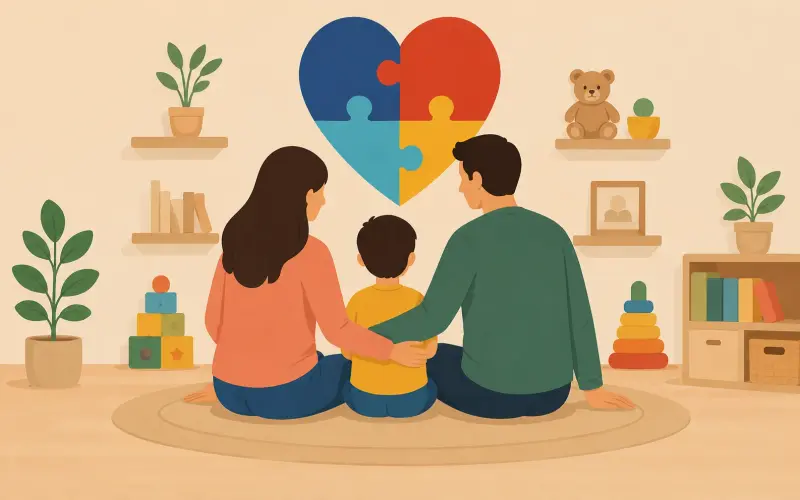
Autism spectrum disorder may enter a family’s awareness quietly through everyday details: a child who dislikes changes in routine, gets upset by sounds, or seems “in their own world” when you call their name. Feeling confused is natural—but it doesn’t mean the road is blocked. In the lines ahead, you’ll learn about the most notable early signs worth paying attention to, how a specialized assessment is understood, and realistic support ideas at home and at school—along with a reminder that speaking with licensed specialists through Tatmeen may give you clarity and reassurance without judgment.
What Is Autism Spectrum Disorder?
Autism spectrum disorder is a neurodevelopmental difference that affects communication and social interaction, and it may be linked to repetitive behaviors, specific interests, or differences in sensory responses. The word “spectrum” means that traits and needs vary along a range: some children need intensive support, while others need limited guidance while still experiencing subtle challenges in communication or flexibility.
It’s important not to place the responsibility for the cause on yourself. The appearance of these traits is not evidence of a parenting mistake, and it isn’t right to judge based on one behavior or one difficult day. The World Health Organization notes that early psychosocial interventions and practical family support can enhance communication, inclusion, and quality of life, and that the need is often for collaboration between health, education, and social services.
Early Signs a Family May Notice
Early signs are not a diagnostic checklist; they are signals that help you notice a repeating pattern over time and across more than one situation. Examples mentioned by the UK’s National Health Service and noticed by some parents include:
Limited eye contact or difficulty with shared attention (such as pointing to something that caught their interest or turning when you point).
Frequently not responding to their name, or a clear delay in turning toward a sound directed at them.
Differences in language: delayed speech, repeating phrases, or difficulty taking turns in conversation.
Limited imaginative play, or preferring solitary play for long periods.
Repetitive movements or patterns, or a strong attachment to specific objects.
Clear distress with change and transitions between activities, or strong attachment to a strict routine.
Noticeable sensory sensitivity (discomfort with a sound/texture/smell) or constant seeking of a particular sensation.
One sign alone does not necessarily mean autism spectrum disorder; what’s worth attention is repetition and its impact on the child’s communication, comfort, and learning—as well as the family’s feeling that they’re going in circles despite trying.
When Is an Assessment a Helpful Step?
An assessment may be appropriate when you notice that challenges are affecting day-to-day life: eating, sleep, leaving the house, integrating into a nursery, or the ability to express needs. It’s also important to pay attention to any loss of a skill that was previously present, or repeated episodes of distress that seem linked to sensory sensitivity or communication difficulties.
An assessment usually builds a full picture: the child’s developmental history, the family’s observations, and the nursery or school’s observations, in addition to interviews and assessment tools used by specialists. More than one specialty may be involved depending on need (such as speech and language therapy or occupational therapy). The goal isn’t to “put on a label,” but to understand how the child learns and communicates so an appropriate support plan can be designed—and so doors to educational and therapeutic services can open when needed.
Practical Support at Home: What Often Helps?
Even before the assessment is complete, simple steps can reduce stress and increase opportunities for communication. According to Tatmeen specialists, the best starting point is to turn the day into small, repeated learning opportunities, instead of waiting for one big leap all at once.
Start by reducing uncertainty: make the routine clear, and give a heads-up before moving from one activity to another. Use short sentences and limited choices, and give the child more time to respond without interrupting or rushing. And if sensory sensitivity is prominent, consider adjusting the environment instead of changing the child: a quiet corner, softer lighting, or reducing noise during crowded times.
Practical practices you can try:
Short, repeated interactive play that focuses on turn-taking and waiting.
Supporting communication with gestures or pictures when needed, while reinforcing any attempt to express.
Praising desired behavior immediately when it happens, and ignoring minor, non-harmful behaviors as much as possible.
During distress: reduce stimulation first, then return to guidance after calm—rather than discussing during heightened stress.
Collaborating With Nursery or School
School sometimes reveals challenges that don’t show at home, such as understanding group instructions, sharing play, or dealing with rapid change. A brief meeting with the teacher or counselor helps unify the approach: Which phrases calm the child? What triggers them? And how can a task be broken into steps?
It may help to request simple adjustments such as using visual cues, allowing short sensory breaks, choosing a less crowded seat, and clarifying classroom rules in a concrete way. Most importantly, celebrate progress no matter how small it seems—because realistic expectations reduce pressure and build the child’s confidence.
Parents’ Well-Being Is Part of the Support Plan
Following a child’s needs may open heavy questions: Did we start too late? Will we succeed? Will society accept them? Having these feelings doesn’t mean weakness. Sometimes parents need someone to hear their worries, help reorganize their thoughts, and suggest practical ways of coping with daily pressures.
Try to distribute roles within the family, ask for practical support from a trusted person close to you, and allow yourself moments of rest without guilt. Psychological support for parents is not a luxury; it’s part of the home’s stability—and the home’s stability reflects directly on the child.
Finally…
Autism spectrum disorder is a journey of understanding and adapting more than it is a reason for fear. When a family notices signs early and moves forward with calm steps, reaching the right support becomes easier, and the child grows in an environment that makes room for their differences and nurtures their strengths. And if you would like a safe space to sort through options with a licensed specialist, you can book a session through Tatmeen to help you create a practical plan that fits your child and your family’s routine.
Frequently Asked Questions
Does delayed speech necessarily mean autism spectrum disorder?
Not necessarily. Delayed speech can be linked to multiple reasons, such as differences in developmental pace, hearing difficulties, or language disorders. It’s best to look at the full picture: nonverbal communication, response to name, play, and the ability to interact across different situations.
Can signs be mild at first and become clearer later?
Yes. Traits may seem mild at first, then appear more clearly as communication or academic demands increase. Tracking over time is helpful—especially if difficulties show up in flexibility, forming relationships, or understanding social cues at school.
How do I talk to family without feeling stigma?
Use neutral language that focuses on need: “We want to understand how our child communicates and support them,” instead of phrases that carry judgment. Share specific examples, and ask for practical help. Calm knowledge reduces stigma, and consistency in support brings ease to everyone.
A writer and researcher specializing in psychiatry, she focuses on mental health and the human emotions we experience but cannot always find the words to name. She writes about us—about humanity and the human experience—and simplifies complex topics to offer content that helps us better understand ourselves and life, ultimately making us feel less alone.
Every Tatmeen article is reviewed by care providers licensed by the Saudi Commission for Health Specialties, so what you read is accurate and trustworthy.
This article builds understanding and does not replace a licensed care provider.
Need someone to talk to?
Tatmeen's licensed care providers are available around the clock, and the app's urgent consultation connects you with one within minutes.
Download Tatmeen to explore care providers and booking options.
Smart matchingFour quick questions suggest the right care provider
Urgent consultationTalk to an available care provider within minutes
Free psychological measuresMore than 20 tests to understand how you are doing
Scan to download
{"data":{"id":"b50109b1-d300-43a1-bc90-8d4a903c8ed8","slug":"autism-spectrum-early-signs-family-support","arTitle":"اضطراب طيف التوحّد: علامات مبكرة ودعم عملي للأسرة","enTitle":"Autism Spectrum Disorder: Early Signs and Practical Family Support","thumbnailAltText":"Parents and child sitting together on the floor in the living room surrounded by toys","estimatedReadingTime":5,"likesCount":193,"writer":{"id":"3ab72b74-f26f-4337-9b47-3114b0f90de5","arBio":"كاتبة وباحثة متخصصة في مجال الطب النفسي، تهتم بموضوعات الصحة النفسية وبالمشاعر الإنسانية التي نختبرها ولا نجد دائمًا الكلمات لتسميتها. تكتب عنّا؛ عن الإنسان وتجربته، وتبسّط الموضوعات المعقّدة لتقدّم محتوى يساعدنا على فهم ذواتنا والحياة أكثر، ويجعلنا نشعر بأننا بوحدة أقل.","enBio":"A writer and researcher specializing in psychiatry, she focuses on mental health and the human emotions we experience but cannot always find the words to name. She writes about us—about humanity and the human experience—and simplifies complex topics to offer content that helps us better understand ourselves and life, ultimately making us feel less alone.","user":{"slug":"ayat-alnajar","arFullName":"آيات النجار","enFullName":"Ayat Al-Najjar","publicProfileImageUrl":"https://cdn.tatmeen.sa/public/profile-images/02384455-68fa-40b6-ad05-609fde65cafa/21b9a610dde5dfc6d37af110c23e9c7ab3946be080c281beb000debf4f7d31a6.webp","publicProfileImage96Url":"https://cdn.tatmeen.sa/public/profile-images/02384455-68fa-40b6-ad05-609fde65cafa/21b9a610dde5dfc6d37af110c23e9c7ab3946be080c281beb000debf4f7d31a6-w96.webp","publicProfileImage192Url":"https://cdn.tatmeen.sa/public/profile-images/02384455-68fa-40b6-ad05-609fde65cafa/21b9a610dde5dfc6d37af110c23e9c7ab3946be080c281beb000debf4f7d31a6-w192.webp"}},"arContent":"","enContent":"","productionDocument":{"headings":[{"id":"article-section-what-is-autism-spectrum-disorder","text":"What Is Autism Spectrum Disorder?"},{"id":"article-section-early-signs-a-family-may-notice","text":"Early Signs a Family May Notice"},{"id":"article-section-when-is-an-assessment-a-helpful-step","text":"When Is an Assessment a Helpful Step?"},{"id":"article-section-practical-support-at-home-what-often-helps","text":"Practical Support at Home: What Often Helps?"},{"id":"article-section-collaborating-with-nursery-or-school","text":"Collaborating With Nursery or School"},{"id":"article-section-parents-well-being-is-part-of-the-support-plan","text":"Parents’ Well-Being Is Part of the Support Plan"},{"id":"article-section-finally","text":"Finally…"}],"faqs":[{"question":"Does delayed speech necessarily mean autism spectrum disorder?","answer":"<p><span style=\"color:#000000\">Not necessarily. Delayed speech can be linked to multiple reasons, such as differences in developmental pace, hearing difficulties, or language disorders. It’s best to look at the full picture: nonverbal communication, response to name, play, and the ability to interact across different situations.</span></p>"},{"question":"Can signs be mild at first and become clearer later?","answer":"<p><span style=\"color:#000000\">Yes. Traits may seem mild at first, then appear more clearly as communication or academic demands increase. Tracking over time is helpful—especially if difficulties show up in flexibility, forming relationships, or understanding social cues at school.</span></p>"},{"question":"How do I talk to family without feeling stigma?","answer":"<p><span style=\"color:#000000\">Use neutral language that focuses on need: “We want to understand how our child communicates and support them,” instead of phrases that carry judgment. Share specific examples, and ask for practical help. Calm knowledge reduces stigma, and consistency in support brings ease to everyone.</span></p>"}],"beforeSourcesHtml":"<p></p>","sources":[],"afterSourcesHtml":"","blocks":[{"type":"html","html":"<p><span style=\"color:#000000\">Autism spectrum disorder may enter a family’s awareness quietly through everyday details: a child who dislikes changes in routine, gets upset by sounds, or seems “in their own world” when you call their name. Feeling confused is natural—but it doesn’t mean the road is blocked. In the lines ahead, you’ll learn about the most notable early signs worth paying attention to, how a specialized assessment is understood, and realistic support ideas at home and at school—along with a reminder that speaking with licensed specialists through Tatmeen may give you clarity and reassurance without judgment.</span></p><h2 id=\"article-section-what-is-autism-spectrum-disorder\" data-toc-heading tabindex=\"-1\"><span id=\"what-is-autism-spectrum-disorder-1\" aria-hidden=\"true\"></span><span style=\"color:#000000\"><strong>What Is Autism Spectrum Disorder?</strong></span></h2><p><span style=\"color:#000000\">Autism spectrum disorder is a neurodevelopmental difference that affects communication and social interaction, and it may be linked to repetitive behaviors, specific interests, or differences in sensory responses. The word “spectrum” means that traits and needs vary along a range: some children need intensive support, while others need limited guidance while still experiencing subtle challenges in communication or flexibility.</span></p><p><span style=\"color:#000000\">It’s important not to place the responsibility for the cause on yourself. The appearance of these traits is not evidence of a parenting mistake, and it isn’t right to judge based on one behavior or one difficult day. </span><a href=\"https://www.who.int/news-room/fact-sheets/detail/autism-spectrum-disorders\" target=\"_blank\" rel=\"nofollow noopener noreferrer\"><span style=\"color:#1155cc\"><u>The World Health Organization </u></span></a><span style=\"color:#000000\">notes that early psychosocial interventions and practical family support can enhance communication, inclusion, and quality of life, and that the need is often for collaboration between health, education, and social services.</span></p><h2 id=\"article-section-early-signs-a-family-may-notice\" data-toc-heading tabindex=\"-1\"><span id=\"early-signs-a-family-may-notice-2\" aria-hidden=\"true\"></span><span style=\"color:#000000\"><strong>Early Signs a Family May Notice</strong></span></h2><p><span style=\"color:#000000\">Early signs are not a diagnostic checklist; they are signals that help you notice a repeating pattern over time and across more than one situation. Examples mentioned by </span><a href=\"https://www.nhs.uk/conditions/autism/signs/children/\" target=\"_blank\" rel=\"nofollow noopener noreferrer\"><span style=\"color:#1155cc\"><u>the UK’s National Health</u></span></a><span style=\"color:#000000\"> Service and noticed by some parents include:</span></p><ul><li><p><span style=\"color:#000000\">Limited eye contact or difficulty with shared attention (such as pointing to something that caught their interest or turning when you point).</span></p></li><li><p><span style=\"color:#000000\">Frequently not responding to their name, or a clear delay in turning toward a sound directed at them.</span></p></li><li><p><span style=\"color:#000000\">Differences in language: delayed speech, repeating phrases, or difficulty taking turns in conversation.</span></p></li><li><p><span style=\"color:#000000\">Limited imaginative play, or preferring solitary play for long periods.</span></p></li><li><p><span style=\"color:#000000\">Repetitive movements or patterns, or a strong attachment to specific objects.</span></p></li><li><p><span style=\"color:#000000\">Clear distress with change and transitions between activities, or strong attachment to a strict routine.</span></p></li><li><p><span style=\"color:#000000\">Noticeable sensory sensitivity (discomfort with a sound/texture/smell) or constant seeking of a particular sensation.</span></p></li></ul><p><span style=\"color:#000000\">One sign alone does not necessarily mean autism spectrum disorder; what’s worth attention is repetition and its impact on the child’s communication, comfort, and learning—as well as the family’s feeling that they’re going in circles despite trying.</span></p><h2 id=\"article-section-when-is-an-assessment-a-helpful-step\" data-toc-heading tabindex=\"-1\"><span id=\"when-is-an-assessment-a-helpful-step-3\" aria-hidden=\"true\"></span><span style=\"color:#000000\"><strong>When Is an Assessment a Helpful Step?</strong></span></h2><p><span style=\"color:#000000\">An assessment may be appropriate when you notice that challenges are affecting day-to-day life: eating, sleep, leaving the house, integrating into a nursery, or the ability to express needs. It’s also important to pay attention to any loss of a skill that was previously present, or repeated episodes of distress that seem linked to sensory sensitivity or communication difficulties.</span></p><p><span style=\"color:#000000\">An assessment usually builds a full picture: the child’s developmental history, the family’s observations, and the nursery or school’s observations, in addition to interviews and assessment tools used by specialists. More than one specialty may be involved depending on need (such as speech and language therapy or occupational therapy). The goal isn’t to “put on a label,” but to understand how the child learns and communicates so an appropriate support plan can be designed—and so doors to educational and therapeutic services can open when needed.</span></p><h2 id=\"article-section-practical-support-at-home-what-often-helps\" data-toc-heading tabindex=\"-1\"><span id=\"practical-support-at-home-what-often-helps-4\" aria-hidden=\"true\"></span><span style=\"color:#000000\"><strong>Practical Support at Home: What Often Helps?</strong></span></h2><p><span style=\"color:#000000\">Even before the assessment is complete, simple steps can reduce stress and increase opportunities for communication. According to Tatmeen specialists, the best starting point is to turn the day into small, repeated learning opportunities, instead of waiting for one big leap all at once.</span></p><p><span style=\"color:#000000\">Start by reducing uncertainty: make the routine clear, and give a heads-up before moving from one activity to another. Use short sentences and limited choices, and give the child more time to respond without interrupting or rushing. And if sensory sensitivity is prominent, consider adjusting the environment instead of changing the child: a quiet corner, softer lighting, or reducing noise during crowded times.</span></p><p><span style=\"color:#000000\">Practical practices you can try:</span></p><ul><li><p><span style=\"color:#000000\">Short, repeated interactive play that focuses on turn-taking and waiting.</span></p></li><li><p><span style=\"color:#000000\">Supporting communication with gestures or pictures when needed, while reinforcing any attempt to express.</span></p></li><li><p><span style=\"color:#000000\">Praising desired behavior immediately when it happens, and ignoring minor, non-harmful behaviors as much as possible.</span></p></li><li><p><span style=\"color:#000000\">During distress: reduce stimulation first, then return to guidance after calm—rather than discussing during heightened stress.</span></p></li></ul><h2 id=\"article-section-collaborating-with-nursery-or-school\" data-toc-heading tabindex=\"-1\"><span id=\"collaborating-with-nursery-or-school-5\" aria-hidden=\"true\"></span><span style=\"color:#000000\"><strong>Collaborating With Nursery or School</strong></span></h2><p><span style=\"color:#000000\">School sometimes reveals challenges that don’t show at home, such as understanding group instructions, sharing play, or dealing with rapid change. A brief meeting with the teacher or counselor helps unify the approach: Which phrases calm the child? What triggers them? And how can a task be broken into steps?</span></p><p><span style=\"color:#000000\">It may help to request simple adjustments such as using visual cues, allowing short sensory breaks, choosing a less crowded seat, and clarifying classroom rules in a concrete way. Most importantly, celebrate progress no matter how small it seems—because realistic expectations reduce pressure and build the child’s confidence.</span></p><h2 id=\"article-section-parents-well-being-is-part-of-the-support-plan\" data-toc-heading tabindex=\"-1\"><span id=\"parents-well-being-is-part-of-the-support-plan-6\" aria-hidden=\"true\"></span><span style=\"color:#000000\"><strong>Parents’ Well-Being Is Part of the Support Plan</strong></span></h2><p><span style=\"color:#000000\">Following a child’s needs may open heavy questions: Did we start too late? Will we succeed? Will society accept them? Having these feelings doesn’t mean weakness. Sometimes parents need someone to hear their worries, help reorganize their thoughts, and suggest practical ways of coping with daily pressures.</span></p><p><span style=\"color:#000000\">Try to distribute roles within the family, ask for practical support from a trusted person close to you, and allow yourself moments of rest without guilt. Psychological support for parents is not a luxury; it’s part of the home’s stability—and the home’s stability reflects directly on the child.</span></p><h2 id=\"article-section-finally\" data-toc-heading tabindex=\"-1\"><span id=\"finally-7\" aria-hidden=\"true\"></span><span style=\"color:#000000\"><strong>Finally…</strong></span></h2><p><span style=\"color:#000000\">Autism spectrum disorder is a journey of understanding and adapting more than it is a reason for fear. When a family notices signs early and moves forward with calm steps, reaching the right support becomes easier, and the child grows in an environment that makes room for their differences and nurtures their strengths. And if you would like a safe space to sort through options with a licensed specialist, you can <u>book a session through Tatmeen</u> to help you create a practical plan that fits your child and your family’s routine.</span></p>"}],"inlineCtaSignatures":[],"_experienceAliases":{"v":1,"fields":["html","bodyHtml"],"faqs":[0,1,2]}},"createdAt":"2026-05-19T21:00:00.000Z","updatedAt":"2026-06-24T23:49:57.988Z","disorderGroups":[{"id":"9fbda432-3713-400a-987b-3d56754a113e","slug":"children-and-adolescents","arName":"الأطفال والمراهقين","enName":"Children & Adolescents"}],"reviewer":{"arFullName":"فريق تطمين","enFullName":"Tatmeen team","slug":"tatmeen-team","kind":"organization"},"productionArticle":true,"promotionAllowed":true,"preparedCover":{"src":"https://cdn.tatmeen.sa/public/article-lcp/article-lcp-v2/sha256-6e702acaa10bf7db9f26952940afd43eaa659844dc6ad6ea16bb07fe1878b135/800-f5bc60c292a6dbd967a29a8db5142ba0cfa19748fe28681c0df763be06171eff.avif","fallback":"https://cdn.tatmeen.sa/public/article-lcp/article-lcp-v2/sha256-6e702acaa10bf7db9f26952940afd43eaa659844dc6ad6ea16bb07fe1878b135/800-029f38a81c1897fec99d33541fbc8c291ea0c67420eb15ecf19f8105974ddb4c.webp","directUrl":"https://cdn.tatmeen.sa/blog-cover/Tatmeen-1779295180031.webp","isGolden":true,"avifSrcset":"https://cdn.tatmeen.sa/public/article-lcp/article-lcp-v2/sha256-6e702acaa10bf7db9f26952940afd43eaa659844dc6ad6ea16bb07fe1878b135/400-f6a10b6060627cab3a432f7b79ff14dbc4854d445f86c3fea01c3a5ca85a2d20.avif 400w, https://cdn.tatmeen.sa/public/article-lcp/article-lcp-v2/sha256-6e702acaa10bf7db9f26952940afd43eaa659844dc6ad6ea16bb07fe1878b135/640-df28da5700fb242d45419580f6dd42e3faeb6cffb073d258e559e44fc2342042.avif 640w, https://cdn.tatmeen.sa/public/article-lcp/article-lcp-v2/sha256-6e702acaa10bf7db9f26952940afd43eaa659844dc6ad6ea16bb07fe1878b135/800-f5bc60c292a6dbd967a29a8db5142ba0cfa19748fe28681c0df763be06171eff.avif 800w, https://cdn.tatmeen.sa/public/article-lcp/article-lcp-v2/sha256-6e702acaa10bf7db9f26952940afd43eaa659844dc6ad6ea16bb07fe1878b135/1200-323ba36b19a9a02414cef6a7ab8fe54a22c9f88293d191b75eaab19356997f5f.avif 1200w","webpSrcset":"https://cdn.tatmeen.sa/public/article-lcp/article-lcp-v2/sha256-6e702acaa10bf7db9f26952940afd43eaa659844dc6ad6ea16bb07fe1878b135/400-5f2cda663e6fe9aed8edaa100b2a9d320347e23581779859344ea9f194d495dc.webp 400w, https://cdn.tatmeen.sa/public/article-lcp/article-lcp-v2/sha256-6e702acaa10bf7db9f26952940afd43eaa659844dc6ad6ea16bb07fe1878b135/640-f2fff335172d10da5197a63a421c068387535792916e9321d496175deb8fed0b.webp 640w, https://cdn.tatmeen.sa/public/article-lcp/article-lcp-v2/sha256-6e702acaa10bf7db9f26952940afd43eaa659844dc6ad6ea16bb07fe1878b135/800-029f38a81c1897fec99d33541fbc8c291ea0c67420eb15ecf19f8105974ddb4c.webp 800w, https://cdn.tatmeen.sa/public/article-lcp/article-lcp-v2/sha256-6e702acaa10bf7db9f26952940afd43eaa659844dc6ad6ea16bb07fe1878b135/1200-7a4a66bd04a4785da7522b39c0cea9c9fbac71fb179bf2aaf9b1a9698281b0c5.webp 1200w","phoneAvifSrcset":"https://cdn.tatmeen.sa/public/article-lcp/article-lcp-v2/sha256-6e702acaa10bf7db9f26952940afd43eaa659844dc6ad6ea16bb07fe1878b135/400-f6a10b6060627cab3a432f7b79ff14dbc4854d445f86c3fea01c3a5ca85a2d20.avif 400w, https://cdn.tatmeen.sa/public/article-lcp/article-lcp-v2/sha256-6e702acaa10bf7db9f26952940afd43eaa659844dc6ad6ea16bb07fe1878b135/640-df28da5700fb242d45419580f6dd42e3faeb6cffb073d258e559e44fc2342042.avif 640w, https://cdn.tatmeen.sa/public/article-lcp/article-lcp-v2/sha256-6e702acaa10bf7db9f26952940afd43eaa659844dc6ad6ea16bb07fe1878b135/800-f5bc60c292a6dbd967a29a8db5142ba0cfa19748fe28681c0df763be06171eff.avif 800w","phoneWebpSrcset":"https://cdn.tatmeen.sa/public/article-lcp/article-lcp-v2/sha256-6e702acaa10bf7db9f26952940afd43eaa659844dc6ad6ea16bb07fe1878b135/400-5f2cda663e6fe9aed8edaa100b2a9d320347e23581779859344ea9f194d495dc.webp 400w, https://cdn.tatmeen.sa/public/article-lcp/article-lcp-v2/sha256-6e702acaa10bf7db9f26952940afd43eaa659844dc6ad6ea16bb07fe1878b135/640-f2fff335172d10da5197a63a421c068387535792916e9321d496175deb8fed0b.webp 640w, https://cdn.tatmeen.sa/public/article-lcp/article-lcp-v2/sha256-6e702acaa10bf7db9f26952940afd43eaa659844dc6ad6ea16bb07fe1878b135/800-029f38a81c1897fec99d33541fbc8c291ea0c67420eb15ecf19f8105974ddb4c.webp 800w","width":800,"height":500},"previewTaxonomy":{"groups":[{"id":"9fbda432-3713-400a-987b-3d56754a113e","slug":"children-and-adolescents","arName":"الأطفال والمراهقين","enName":"Children & Adolescents"}],"topics":[{"id":"aa57ccb9-d146-4629-8aa1-8b6d36c4c9ee","slug":"parenting-skills","arName":"تربية الأطفال","enName":"Parenting Skills","groupSlug":"children-and-adolescents","href":"/blog/category/children-and-adolescents/parenting-skills/"},{"id":"0a694159-4503-4787-81f2-936dabebbdb4","slug":"autism","arName":"التوحّد","enName":"Autism","groupSlug":"children-and-adolescents","href":"/blog/category/children-and-adolescents/autism/"}],"tags":[{"id":"94df68f6-f3b0-4254-98e1-6522ffcfffdf","slug":"neurodevelopmental-adhd-autism","arName":"اضطرابات النمو العصبي","enName":"Neurodevelopmental (ADHD/Autism)"},{"id":"52aa8812-914e-495a-9ed5-13bec6c39a93","slug":"parents-children","arName":"الآباء والأطفال","enName":"Parents & Children"},{"id":"c2a6e8d3-de9c-435f-8c95-9727e7db14cc","slug":"explainer-awareness","arName":"دليل توعوي / شرح","enName":"Explainer / Awareness Guide"},{"id":"a7a7391b-bc2c-41de-91b1-7d701f1675b7","slug":"supporting-others","arName":"دعم شخص آخر","enName":"Supporting Someone Else"}]},"previewProviderRecommendations":[{"id":"a4a1f8a4-87a7-4447-8667-0bbf3fae006a","slug":"ghadah-alghamdi-2904","arFullName":"غاده الغامدي","enFullName":"Ghadah Alghamdi","publicProfileImageUrl":"","publicProfileImage96Url":"","publicProfileImage192Url":"","specialization":{"arName":"أخصائي نفسي","enName":"Psychologist"},"profileImageUrl":"","experienceYears":18,"consultantInfo":{"averageRating":{"average":0},"specialization":{"arGeneralName":"أخصائي نفسي","enGeneralName":"Psychologist"}}},{"id":"d754a189-f8c9-4aad-b4aa-a5dbd26c0bd7","slug":"talal-alshowaier-8694","arFullName":"طلال الشويعر","enFullName":"Talal Alshowaier","publicProfileImageUrl":"https://cdn.tatmeen.sa/public/profile-images/d754a189-f8c9-4aad-b4aa-a5dbd26c0bd7/74feb27848a47cf43189f6b5951e06a9b87b08269021d5bab765092fc65fce42.webp","publicProfileImage96Url":"https://cdn.tatmeen.sa/public/profile-images/d754a189-f8c9-4aad-b4aa-a5dbd26c0bd7/74feb27848a47cf43189f6b5951e06a9b87b08269021d5bab765092fc65fce42-w96.webp","publicProfileImage192Url":"https://cdn.tatmeen.sa/public/profile-images/d754a189-f8c9-4aad-b4aa-a5dbd26c0bd7/74feb27848a47cf43189f6b5951e06a9b87b08269021d5bab765092fc65fce42-w192.webp","specialization":{"arName":"أخصائي نفسي","enName":"Psychologist"},"profileImageUrl":"https://cdn.tatmeen.sa/public/profile-images/d754a189-f8c9-4aad-b4aa-a5dbd26c0bd7/74feb27848a47cf43189f6b5951e06a9b87b08269021d5bab765092fc65fce42-w192.webp","experienceYears":3,"consultantInfo":{"averageRating":{"average":5},"specialization":{"arGeneralName":"أخصائي نفسي","enGeneralName":"Psychologist"}}},{"id":"3d7ba28f-13ad-4c7b-926b-23e351d1dc9c","slug":"reyouf-alabdan-7326","arFullName":"ريوف العبدان","enFullName":"Reyouf Alabdan","publicProfileImageUrl":"","publicProfileImage96Url":"","publicProfileImage192Url":"","specialization":{"arName":"أخصائي نفسي","enName":"Psychologist"},"profileImageUrl":"","experienceYears":3,"consultantInfo":{"averageRating":{"average":5},"specialization":{"arGeneralName":"أخصائي نفسي","enGeneralName":"Psychologist"}}}],"previewCareProviders":[{"id":"09364052-c2a9-4c52-9717-7ce2093b8d0a","slug":"kholoud-alharbi-5221","arFullName":"خلود الحربي","enFullName":"Kholoud Alharbi","publicProfileImageUrl":"https://cdn.tatmeen.sa/public/profile-images/09364052-c2a9-4c52-9717-7ce2093b8d0a/4a0aeb81619e351b77f4323e3605a0a00acc7ca3c82ee7cc5ca2c9e8ef716049.webp","publicProfileImage96Url":"https://cdn.tatmeen.sa/public/profile-images/09364052-c2a9-4c52-9717-7ce2093b8d0a/4a0aeb81619e351b77f4323e3605a0a00acc7ca3c82ee7cc5ca2c9e8ef716049-w96.webp","publicProfileImage192Url":"https://cdn.tatmeen.sa/public/profile-images/09364052-c2a9-4c52-9717-7ce2093b8d0a/4a0aeb81619e351b77f4323e3605a0a00acc7ca3c82ee7cc5ca2c9e8ef716049-w192.webp","gender":"FEMALE","specialization":{"arName":"أخصائي نفسي","enName":"Psychologist"}},{"id":"6f037535-1dca-4b50-a8b2-5974b7323286","slug":"salah-althobaiti-9053","arFullName":"صلاح الثبيتي","enFullName":"Salah Althobaiti","publicProfileImageUrl":"https://cdn.tatmeen.sa/public/profile-images/6f037535-1dca-4b50-a8b2-5974b7323286/35b6bd7fad9b1e004c1835803eb9c1b56dcacd380685ec8bff141f0fb888005c.webp","publicProfileImage96Url":"https://cdn.tatmeen.sa/public/profile-images/6f037535-1dca-4b50-a8b2-5974b7323286/35b6bd7fad9b1e004c1835803eb9c1b56dcacd380685ec8bff141f0fb888005c-w96.webp","publicProfileImage192Url":"https://cdn.tatmeen.sa/public/profile-images/6f037535-1dca-4b50-a8b2-5974b7323286/35b6bd7fad9b1e004c1835803eb9c1b56dcacd380685ec8bff141f0fb888005c-w192.webp","gender":"MALE","specialization":{"arName":"أخصائي نفسي","enName":"Psychologist"}},{"id":"3cc806e8-616b-4884-9f21-a75b378580a2","slug":"aisha-al-hashim-8667","arFullName":"عائشة ال هاشم","enFullName":"Aisha Al Hashim","publicProfileImageUrl":"https://cdn.tatmeen.sa/public/profile-images/3cc806e8-616b-4884-9f21-a75b378580a2/27f523d03be4dcfa1f6a79f70c1773887434e698990d214cd990caec56a44798.webp","publicProfileImage96Url":"https://cdn.tatmeen.sa/public/profile-images/3cc806e8-616b-4884-9f21-a75b378580a2/27f523d03be4dcfa1f6a79f70c1773887434e698990d214cd990caec56a44798-w96.webp","publicProfileImage192Url":"https://cdn.tatmeen.sa/public/profile-images/3cc806e8-616b-4884-9f21-a75b378580a2/27f523d03be4dcfa1f6a79f70c1773887434e698990d214cd990caec56a44798-w192.webp","gender":"FEMALE","specialization":{"arName":"أخصائي نفسي","enName":"Psychologist"}},{"id":"db2ce1a0-9325-4471-b7ce-eb2e811c30a3","slug":"amer-qutub-2441","arFullName":"عامر قطب","enFullName":"Amer Qutub","publicProfileImageUrl":"https://cdn.tatmeen.sa/public/profile-images/db2ce1a0-9325-4471-b7ce-eb2e811c30a3/80580f99bfd7fe2b2a9cf8eed73ab532f5086d1efe053b0aa57358c1ce004261.webp","publicProfileImage96Url":"https://cdn.tatmeen.sa/public/profile-images/db2ce1a0-9325-4471-b7ce-eb2e811c30a3/80580f99bfd7fe2b2a9cf8eed73ab532f5086d1efe053b0aa57358c1ce004261-w96.webp","publicProfileImage192Url":"https://cdn.tatmeen.sa/public/profile-images/db2ce1a0-9325-4471-b7ce-eb2e811c30a3/80580f99bfd7fe2b2a9cf8eed73ab532f5086d1efe053b0aa57358c1ce004261-w192.webp","gender":"MALE","specialization":{"arName":"أخصائي نفسي","enName":"Psychologist"}},{"id":"94765496-dbdf-4631-a01b-7df5f788668d","slug":"abdullrahman-alhamoudi-3045","arFullName":"عبدالرحمن الحمودي","enFullName":"Abdulrahman Alhamoudi","publicProfileImageUrl":"https://cdn.tatmeen.sa/public/profile-images/94765496-dbdf-4631-a01b-7df5f788668d/2d49f6b6493c564afb6f50b6c3634231dff3a5cf8353acfab393d1b2a88037d1.webp","publicProfileImage96Url":"https://cdn.tatmeen.sa/public/profile-images/94765496-dbdf-4631-a01b-7df5f788668d/2d49f6b6493c564afb6f50b6c3634231dff3a5cf8353acfab393d1b2a88037d1-w96.webp","publicProfileImage192Url":"https://cdn.tatmeen.sa/public/profile-images/94765496-dbdf-4631-a01b-7df5f788668d/2d49f6b6493c564afb6f50b6c3634231dff3a5cf8353acfab393d1b2a88037d1-w192.webp","gender":"MALE","specialization":{"arName":"أخصائي نفسي","enName":"Psychologist"}},{"id":"618dba89-5b70-4b46-8304-741b7ac8ecd3","slug":"abdullah-mari-1311","arFullName":"عبدالله مرعي","enFullName":"Abdullah Mari","publicProfileImageUrl":"https://cdn.tatmeen.sa/public/profile-images/618dba89-5b70-4b46-8304-741b7ac8ecd3/6b4a3bfb59f8a304ca79083b32859b46baad2e1d692974a47c02c1f66bd11129.webp","publicProfileImage96Url":"https://cdn.tatmeen.sa/public/profile-images/618dba89-5b70-4b46-8304-741b7ac8ecd3/6b4a3bfb59f8a304ca79083b32859b46baad2e1d692974a47c02c1f66bd11129-w96.webp","publicProfileImage192Url":"https://cdn.tatmeen.sa/public/profile-images/618dba89-5b70-4b46-8304-741b7ac8ecd3/6b4a3bfb59f8a304ca79083b32859b46baad2e1d692974a47c02c1f66bd11129-w192.webp","gender":"MALE","specialization":{"arName":"أخصائي نفسي","enName":"Psychologist"}},{"id":"3b50a5d5-e795-407f-8676-fd7f0e1bb7a0","slug":"abdulaziz-bin-hudayan-4940","arFullName":"عبدالعزيز بن هديان","enFullName":"Abdulaziz Bin Hudayan","publicProfileImageUrl":"https://cdn.tatmeen.sa/public/profile-images/3b50a5d5-e795-407f-8676-fd7f0e1bb7a0/710ff0fe1fb00cdb5042092e27b7910b480a439b02251ecded62d7758eefce95.webp","publicProfileImage96Url":"https://cdn.tatmeen.sa/public/profile-images/3b50a5d5-e795-407f-8676-fd7f0e1bb7a0/710ff0fe1fb00cdb5042092e27b7910b480a439b02251ecded62d7758eefce95-w96.webp","publicProfileImage192Url":"https://cdn.tatmeen.sa/public/profile-images/3b50a5d5-e795-407f-8676-fd7f0e1bb7a0/710ff0fe1fb00cdb5042092e27b7910b480a439b02251ecded62d7758eefce95-w192.webp","gender":"MALE","specialization":{"arName":"أخصائي نفسي","enName":"Psychologist"}},{"id":"d4ffcb6b-90a7-45b6-b941-964866f4564b","slug":"dhaifallah-alhumaidi-1092","arFullName":"ضيف الله الحميدي","enFullName":"Dhaifallah Alhumaidi","publicProfileImageUrl":"https://cdn.tatmeen.sa/public/profile-images/d4ffcb6b-90a7-45b6-b941-964866f4564b/1817171c5828a9b57d6c30d12332cf154e335272548bc90a6e8456d74d356956.webp","publicProfileImage96Url":"https://cdn.tatmeen.sa/public/profile-images/d4ffcb6b-90a7-45b6-b941-964866f4564b/1817171c5828a9b57d6c30d12332cf154e335272548bc90a6e8456d74d356956-w96.webp","publicProfileImage192Url":"https://cdn.tatmeen.sa/public/profile-images/d4ffcb6b-90a7-45b6-b941-964866f4564b/1817171c5828a9b57d6c30d12332cf154e335272548bc90a6e8456d74d356956-w192.webp","gender":"MALE","specialization":{"arName":"أخصائي نفسي","enName":"Psychologist"}}],"previewDownload":{"href":"/download","title":{"ar":"خطوة واحدة لأجلك، ابدأ الآن","en":"One step for you, start now"},"description":{"ar":"حمّل تطبيق تطمين لاستكشاف مقدمي الرعاية وخيارات الحجز.","en":"Download Tatmeen to explore care providers and booking options."},"posterSrc":"/images/home/cta-ar-new-1.webp","videoSrc":"/images/home/cta-ar-new-1.mp4","videoPosterSrc":"/images/home/cta-ar-new-1.webp","videoPosterEnSrc":"/images/home/cta-en-new-1.webp","videoType":"video/mp4","appStoreHref":"https://apps.apple.com/us/app/tatmeen-%D8%AA%D8%B7%D9%85%D9%8A%D9%86/id6473836983","googlePlayHref":"https://play.google.com/store/apps/details?id=com.TatmeenApp.user&hl=en"},"previewRelatedArticles":[{"id":"92f8228a-1b65-42f5-8bb8-67bf62d55220","slug":"autism","route":"/blog/autism/","title":{"ar":"التوحد - أعراض وأسباب وعلاج وأنواع طيف التوحد","en":"Autism: Symptoms, Causes, Treatment, and Spectrum Types"},"image":"https://cdn.tatmeen.sa/public/article-lcp/article-lcp-v2/sha256-9cd452acd4e5771b62192c30a8a2f1a94621544a6bcf8cc4dda951072b30afd4/600-79e42dcddca6c8295b3eadb2b5879bdc499db6729fbb199e438e14d18483ed55.webp","directImageFallback":"https://cdn.tatmeen.sa/blog-cover/1704290556457-%C3%98%C2%A7%C3%99%C2%84%C3%98%C2%AA%C3%99%C2%88%C3%98%C2%AD%C3%98%C2%AF-%C3%98%C2%A7%C3%99%C2%94%C3%98%C2%B9%C3%98%C2%B1%C3%98%C2%A7%C3%98%C2%B6-%C3%99%C2%88%C3%98%C2%A7%C3%99%C2%94%C3%98%C2%B3%C3%98%C2%A8%C3%98%C2%A7%C3%98%C2%A8-%C3%99%C2%88%C3%98%C2%B9%C3%99%C2%84%C3%98%C2%A7%C3%98%C2%AC-%C3%99%C2%88%C3%98%C2%A7%C3%99%C2%94%C3%99%C2%86%C3%99%C2%88%C3%98%C2%A7%C3%98%C2%B9-%C3%98%C2%B7%C3%99%C2%8A%C3%99%C2%81-%C3%98%C2%A7%C3%99%C2%84%C3%98%C2%AA%C3%99%C2%88%C3%98%C2%AD%C3%98%C2%AF-600x400.jpeg","arThumbnailAltText":"Smiling child holding up both hands covered in colorful paint","thumbnailAltText":"Smiling child holding up both hands covered in colorful paint","topic":{"label":{"ar":"الأطفال والمراهقين","en":"Children & Adolescents"}},"readingTimeMinutes":5},{"id":"519c7517-f1bb-431f-ab97-5767eb22abf6","slug":"attachment-in-children","route":"/blog/attachment-in-children/","title":{"ar":"التعلق عند الأطفال - الأسباب والأعراض","en":"Attachment in Children: Causes and Symptoms"},"image":"https://cdn.tatmeen.sa/public/article-lcp/article-lcp-v2/sha256-010601a7cd298510111ab9f44d480581e34898cdc07a0ae2d9c027ca0d71d250/600-41530371ad65c59baad3a64164bf35b04d342f958c6f59896a08fff0fdf51342.webp","directImageFallback":"https://cdn.tatmeen.sa/blog-cover/1704372111135-%C3%98%C2%A7%C3%98%C2%B6%C3%98%C2%B7%C3%98%C2%B1%C3%98%C2%A7%C3%98%C2%A8-%C3%98%C2%A7%C3%99%C2%84%C3%98%C2%AA%C3%98%C2%B9%C3%99%C2%84%C3%99%C2%82-%C3%98%C2%B9%C3%99%C2%86%C3%98%C2%AF-%C3%98%C2%A7%C3%99%C2%84%C3%98%C2%A7%C3%99%C2%94%C3%98%C2%B7%C3%99%C2%81%C3%98%C2%A7%C3%99%C2%84-600x400.jpeg","arThumbnailAltText":"Adult holds a smiling baby against their shoulder in a bright room","thumbnailAltText":"Adult holds a smiling baby against their shoulder in a bright room","topic":{"label":{"ar":"الأطفال والمراهقين","en":"Children & Adolescents"}},"readingTimeMinutes":5},{"id":"f471ff32-97b5-46b7-a341-41e2d9420dcf","slug":"What-transpires-during-adolescence","route":"/blog/What-transpires-during-adolescence/","title":{"ar":"ماذا يحدث في سن المراهقة؟ ما هي التغييرات الجسدية والنفسية","en":"What Happens During Adolescence? Physical and Psychological Changes"},"image":"https://cdn.tatmeen.sa/public/article-lcp/article-lcp-v2/sha256-40798e6f90bcc482c82dbff588cd47726fa143e7d92be7294f64593dd1bcf07f/800-1a9640f83f195907ee3969a4d758e32161963fcdf0d8a717495ba4554fca762b.webp","directImageFallback":"https://cdn.tatmeen.sa/blog-cover/1704631975448-%C3%99%C2%85%C3%98%C2%A7%C3%98%C2%B0%C3%98%C2%A7-%C3%99%C2%8A%C3%98%C2%AD%C3%98%C2%AF%C3%98%C2%AB-%C3%99%C2%81%C3%99%C2%8A-%C3%98%C2%B3%C3%99%C2%86-%C3%98%C2%A7%C3%99%C2%84%C3%99%C2%85%C3%98%C2%B1%C3%98%C2%A7%C3%99%C2%87%C3%99%C2%82%C3%98%C2%A9-1000x700.jpeg","arThumbnailAltText":"A person in a yellow shirt stands with arms crossed against a white background","thumbnailAltText":"A person in a yellow shirt stands with arms crossed against a white background","topic":{"label":{"ar":"الأطفال والمراهقين","en":"Children & Adolescents"}},"readingTimeMinutes":5},{"id":"d4884620-44ae-4a3f-ad27-62dff4f94c33","slug":"parentified-children-early-maturity-future-effects","route":"/blog/parentified-children-early-maturity-future-effects/","title":{"ar":"أطفال ناضجون قبل أوانهم: كيف يؤثر النضج المبكر على الحياة مستقبلاً؟","en":"Children Who Grow Up Too Soon: How Parentification Affects Future Life"},"image":"https://cdn.tatmeen.sa/public/article-lcp/article-lcp-v2/sha256-1b104f945d1b6723df0bc4ffd522bd8edbabffc7d349f99e617edc407a2a4515/800-c073e5dd4f811cefb4488eb0ef0f5f0bc02882021f1d239b09b565ff8e1f63d3.webp","directImageFallback":"https://cdn.tatmeen.sa/blog-cover/Tatmeen-1775540619113.webp","arThumbnailAltText":"Small child silhouette carrying oversized adult burdens with a large adult shadow behind and warm light ahead","thumbnailAltText":"Small child silhouette carrying oversized adult burdens with a large adult shadow behind and warm light ahead","topic":{"label":{"ar":"الأطفال والمراهقين","en":"Children & Adolescents"}},"readingTimeMinutes":5}],"previewRelatedReadStates":{}},"locale":"en","device":"desktop","path":"/en/blog/autism-spectrum-early-signs-family-support/","readingControls":false,"config":{"public":{"BUCKET_URL":"https://cdn.tatmeen.sa/","APP_BASE_URL":"https://tatmeen.sa","intercomAppId":"ppcnu9e3"}}}