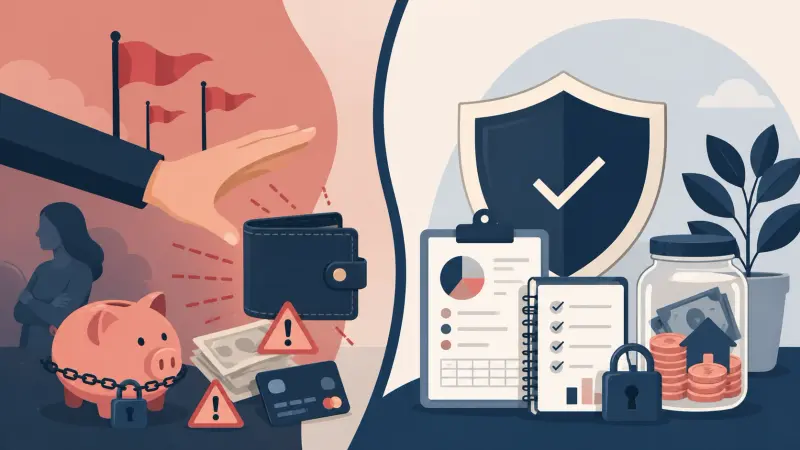
Financial control by a narcissist is not just a misunderstanding about money. It’s a systematic method to suffocate your independence and turn your resources into a tool of domination. Imagine that your salary has to be “approved” first, that every personal expense needs justification, and that financial decisions are imposed in the name of “the shared interest.” In this article, Tatmeen draws on the experience of its therapists to clarify the early signs of this kind of control, and how you can protect yourself with practical steps that preserve your dignity and your emotional and financial safety — without guilt, and without getting dragged into exhausting arguments that never end.
What is meant by financial control? And why is it considered abuse?
Financial control (also called financial/economic abuse) is the act of turning money into a pressure tool instead of a source of security within the family. It appears when expenses are managed through an account you are not allowed to access, when you’re interrogated about every purchase and pushed to justify your normal needs, or when you are not allowed to have personal money or to know the family’s true financial situation.
Specialized organizations describe this pattern as a deliberate reduction of the financially weaker partner’s ability to access, use, or keep resources, in a way that creates forced dependency. International studies also indicate that this pressure can happen quietly — through major financial decisions made without your knowledge, or by hiding essential information about income and debt — which leaves a long-term impact on your sense of safety and your ability to make your own decisions freely.
Early warning signs you should not ignore
Restricted access to money
When your partner’s permission becomes the only way to withdraw or transfer money, or your bank cards are taken away under the excuse of “budget control,” this is not innocent financial management. It’s a gradual displacement of your sovereignty over your own resources. Pay close attention if access to money is conditional on their mood or comes only after an exhausting argument.
Sudden debts or signing in your name
A loan or financial commitment is opened in your name without your knowledge, and then you’re made responsible for it. This is a common pattern in economic abuse because it binds you legally and lowers your ability to object or leave later. Such behaviors are documented as tools of financial control.
Micromanaging your spending and making you feel guilty
Every small expense is magnified and reframed as “your irresponsibility.” The goal here is not budgeting. It’s shaking your confidence in your ability to manage your own money — so that you eventually hand over all financial decision-making.
Preventing you from working or devaluing your work
You may be told that work “distracts you from the home,” and any attempt at promotion or training meets constant practical barriers. Cutting off your independent income is a key step in building financial dependency that becomes harder to break later.
But why does money hurt you like this?
The harm here doesn’t stop at numbers and bills. It goes straight into your nervous system and your heart. Studies on women who experienced financial control show that this kind of abuse is clearly linked to elevated symptoms of anxiety, depression, and even thoughts of self-harm — and that the risk increases as the forms of control expand and intensify, meaning as money turns into a tool of monitoring and threat instead of a shared safety.
When every financial decision needs approval, and every simple request is treated like a “loyalty test,” something inside you starts dimming. Your self-trust weakens gradually. You may start to hear an inner voice saying: “Am I exaggerating? Am I really irresponsible? Maybe I’m the problem.” This self-doubt is part of the emotional control strategy. It is not proof that you’re incapable. Financial control can keep a partner trapped in forced dependency, which makes resisting it harder and leaving the relationship more dangerous financially and more costly psychologically.
And this is where naming matters. Tatmeen’s specialists recommend saying the truth as it is: “My money and my decisions are being restricted.” Putting words to what’s happening is not drama. It’s an act of reclamation. When you clearly name what you are going through, you are not justifying yourself to anyone; you are restoring your right to decide, and opening the door to practical protection instead of silently enduring the pain.
Effective protection plans… step by step
Name the behavior calmly and clearly. Replace defensive language with declarative language: When you block my access to my own account, I feel dependent. I need permanent, unconditional access to my money.
Build a gradual safety fund. If possible, put a fixed small percentage of your income into an account in your name only, or into a protected digital wallet. This is not about hiding money. It’s about guaranteeing your basic needs in emergencies (medication, transport, phone).
Document everything. Keep receipts, transfer messages, screenshots of accounts, and any acknowledgment of debt or restriction. Documentation is not just for confrontation; it’s also for reminding yourself of the truth when the other person tries to deny it.
Free your financial tools. Change passwords, enable two-factor authentication, separate your email from their devices, and store recovery questions somewhere safe and unrelated to information they already know. The same rule applies to card apps and digital wallets.
Seek neutral professional support. A short check-in by text or voice can give you a safe space to define your boundaries, prepare ready-made scripts for handling arguments, and build a simple financial plan that fits your reality. Try booking a session with us now to get guidance — whether you decide to stay, renegotiate, or plan a safe exit.
Set communication boundaries around money. Decide for yourself that financial discussions will only happen at a specific time and, when needed, in the presence of a professional witness (a family counselor / financial counselor). Calm repetition of the boundary matters more than the sharpness of your tone.
Important note: If financial control is paired with explicit threats or physical violence, personal safety comes first. Your safety plan may include sharing your live location with someone you trust, agreeing on an emergency code word with a friend, and knowing the official support channels available in your country.
Can someone who practices financial control actually change?
Change is possible when there is real awareness, full ownership of responsibility, a repair plan that can be measured, and consistent follow-up. Conditional apologies or “let’s start fresh without talking about the past” are just the same loop repeating.
And finally…
Financial control by a narcissistic partner is not just “a money fight.” It’s a strategy designed to strip you of both decision-making power and self-worth. But this circle is not sealed. When you name what’s happening clearly, document the details, start building your own safety fund, and set limits on what is and isn’t acceptable, the financial and emotional chokehold begins to loosen — step by step. And if you feel that the load is too heavy to carry alone, there is help available. Book your session today with Tatmeen to find a safe space and accredited professionals who can walk with you, calmly and without judgment, to strengthen your financial and emotional independence through small decisions that can create real, sustainable change.
Frequently Asked Questions
Is financial control a form of domestic abuse, or just “financial differences”?
It is a documented form of abuse; its goal is control, not budgeting. Watch for restricted access to money, undisclosed debts, and blocking you from working. If the signs repeat, seek professional support to build a realistic protection plan.
What should I do if I have children and the household expenses depend on my partner’s mood?
Start by securing the essentials through a small, discreet safety fund, document every expense related to the children, and set a specific time to discuss money with a neutral third party. Stay calm, and seek professional guidance to set boundaries you can actually enforce.
Can a woman financially control a man, or the other way around?
Yes. Economic abuse is not tied to a specific gender, it’s tied to a pattern of control. What matters is the impact: Do you have the right to access, decide on, and keep your own money? If the answer is “no,” then you need boundaries and professional support that fits your situation.
A writer and researcher specializing in psychiatry, she focuses on mental health and the human emotions we experience but cannot always find the words to name. She writes about us—about humanity and the human experience—and simplifies complex topics to offer content that helps us better understand ourselves and life, ultimately making us feel less alone.
Every Tatmeen article is reviewed by care providers licensed by the Saudi Commission for Health Specialties, so what you read is accurate and trustworthy.
This article builds understanding and does not replace a licensed care provider.
Need someone to talk to?
Tatmeen's licensed care providers are available around the clock, and the app's urgent consultation connects you with one within minutes.
Download Tatmeen to explore care providers and booking options.
Smart matchingFour quick questions suggest the right care provider
Urgent consultationTalk to an available care provider within minutes
Free psychological measuresMore than 20 tests to understand how you are doing
Scan to download
{"data":{"id":"8157b526-725b-4eae-afe9-bcb2d7e62646","slug":"narcissistic-financial-control-early-signs-protection-plans","arTitle":"السيطرة المالية عند النرجسي: مؤشرات مبكرة وخطط حماية فعّالة","enTitle":"Narcissistic Financial Control: Warning Signs and Effective Protection Plans","thumbnailAltText":"split image left side represents financial control and right side represents financial protection","estimatedReadingTime":5,"likesCount":306,"writer":{"id":"3ab72b74-f26f-4337-9b47-3114b0f90de5","arBio":"كاتبة وباحثة متخصصة في مجال الطب النفسي، تهتم بموضوعات الصحة النفسية وبالمشاعر الإنسانية التي نختبرها ولا نجد دائمًا الكلمات لتسميتها. تكتب عنّا؛ عن الإنسان وتجربته، وتبسّط الموضوعات المعقّدة لتقدّم محتوى يساعدنا على فهم ذواتنا والحياة أكثر، ويجعلنا نشعر بأننا بوحدة أقل.","enBio":"A writer and researcher specializing in psychiatry, she focuses on mental health and the human emotions we experience but cannot always find the words to name. She writes about us—about humanity and the human experience—and simplifies complex topics to offer content that helps us better understand ourselves and life, ultimately making us feel less alone.","user":{"slug":"ayat-alnajar","arFullName":"آيات النجار","enFullName":"Ayat Al-Najjar","publicProfileImageUrl":"https://cdn.tatmeen.sa/public/profile-images/02384455-68fa-40b6-ad05-609fde65cafa/21b9a610dde5dfc6d37af110c23e9c7ab3946be080c281beb000debf4f7d31a6.webp","publicProfileImage96Url":"https://cdn.tatmeen.sa/public/profile-images/02384455-68fa-40b6-ad05-609fde65cafa/21b9a610dde5dfc6d37af110c23e9c7ab3946be080c281beb000debf4f7d31a6-w96.webp","publicProfileImage192Url":"https://cdn.tatmeen.sa/public/profile-images/02384455-68fa-40b6-ad05-609fde65cafa/21b9a610dde5dfc6d37af110c23e9c7ab3946be080c281beb000debf4f7d31a6-w192.webp"}},"arContent":"","enContent":"","productionDocument":{"headings":[{"id":"article-section-what-is-meant-by-financial-control-and-why-is-it-considered-abuse","text":"What is meant by financial control? And why is it considered abuse?"},{"id":"article-section-early-warning-signs-you-should-not-ignore","text":"Early warning signs you should not ignore"},{"id":"article-section-but-why-does-money-hurt-you-like-this","text":"But why does money hurt you like this?"},{"id":"article-section-effective-protection-plans-step-by-step","text":"Effective protection plans… step by step"},{"id":"article-section-can-someone-who-practices-financial-control-actually-change","text":"Can someone who practices financial control actually change?"},{"id":"article-section-and-finally","text":"And finally…"}],"faqs":[{"question":"Is financial control a form of domestic abuse, or just “financial differences”?","answer":"<p><span style=\"color:#000000\">It is a documented form of abuse; its goal is control, not budgeting. Watch for restricted access to money, undisclosed debts, and blocking you from working. If the signs repeat, seek professional support to build a realistic protection plan.</span></p>"},{"question":"What should I do if I have children and the household expenses depend on my partner’s mood?","answer":"<p><span style=\"color:#000000\">Start by securing the essentials through a small, discreet safety fund, document every expense related to the children, and set a specific time to discuss money with a neutral third party. Stay calm, and seek professional guidance to set boundaries you can actually enforce.</span></p>"},{"question":"Can a woman financially control a man, or the other way around?","answer":"<p><span style=\"color:#000000\">Yes. Economic abuse is not tied to a specific gender, it’s tied to a pattern of control. What matters is the impact: Do you have the right to access, decide on, and keep your own money? If the answer is “no,” then you need boundaries and professional support that fits your situation.</span></p>"}],"beforeSourcesHtml":"<p></p>","sources":[],"afterSourcesHtml":"","blocks":[{"type":"html","html":"<p><span style=\"color:#000000\">Financial control by a narcissist is not just a misunderstanding about money. It’s a systematic method to suffocate your independence and turn your resources into a tool of domination. Imagine that your salary has to be “approved” first, that every personal expense needs justification, and that financial decisions are imposed in the name of “the shared interest.” In this article, Tatmeen draws on the experience of its therapists to clarify the early signs of this kind of control, and how you can protect yourself with practical steps that preserve your dignity and your emotional and financial safety — without guilt, and without getting dragged into exhausting arguments that never end.</span></p><h2 id=\"article-section-what-is-meant-by-financial-control-and-why-is-it-considered-abuse\" data-toc-heading tabindex=\"-1\"><span id=\"what-is-meant-by-financial-control-and-why-is-it-considered-abuse-1\" aria-hidden=\"true\"></span><span style=\"color:#000000\"><strong>What is meant by financial control? And why is it considered abuse?</strong></span></h2><p><span style=\"color:#000000\">Financial control (also called financial/economic abuse) is the act of turning money into a pressure tool instead of a source of security within the family. It appears when expenses are managed through an account you are not allowed to access, when you’re interrogated about every purchase and pushed to justify your normal needs, or when you are not allowed to have personal money or to know the family’s true financial situation.</span></p><p><a href=\"https://nnedv.org/content/about-financial-abuse/\" target=\"_blank\" rel=\"nofollow noopener noreferrer\"><span style=\"color:#1155cc\"><u>Specialized organizations</u></span></a><span style=\"color:#000000\"> describe this pattern as a deliberate reduction of the financially weaker partner’s ability to access, use, or keep resources, in a way that creates forced dependency. </span><a href=\"https://survivingeconomicabuse.org/what-is-economic-abuse/\" target=\"_blank\" rel=\"nofollow noopener noreferrer\"><span style=\"color:#1155cc\"><u>International studies</u></span></a><span style=\"color:#000000\"> also indicate that this pressure can happen quietly — through major financial decisions made without your knowledge, or by hiding essential information about income and debt — which leaves a long-term impact on your sense of safety and your ability to make your own decisions freely.</span></p><h2 id=\"article-section-early-warning-signs-you-should-not-ignore\" data-toc-heading tabindex=\"-1\"><span id=\"early-warning-signs-you-should-not-ignore-2\" aria-hidden=\"true\"></span><span style=\"color:#000000\"><strong>Early warning signs you should not ignore</strong></span></h2><h3><span style=\"color:#000000\"><strong>Restricted access to money</strong></span></h3><p><span style=\"color:#000000\">When your partner’s permission becomes the only way to withdraw or transfer money, or your bank cards are taken away under the excuse of “budget control,” this is not innocent financial management. It’s a gradual displacement of your sovereignty over your own resources. Pay close attention if access to money is conditional on their mood or comes only after an exhausting argument.</span></p><h3><span style=\"color:#000000\"><strong>Sudden debts or signing in your name</strong></span></h3><p><span style=\"color:#000000\">A loan or financial commitment is opened in your name without your knowledge, and then you’re made responsible for it. This is a common pattern in economic abuse because it binds you legally and lowers your ability to object or leave later. Such behaviors are documented as tools of financial control.</span></p><h3><span style=\"color:#000000\"><strong>Micromanaging your spending and making you feel guilty</strong></span></h3><p><span style=\"color:#000000\">Every small expense is magnified and reframed as “your irresponsibility.” The goal here is not budgeting. It’s shaking your confidence in your ability to manage your own money — so that you eventually hand over all financial decision-making.</span></p><h3><span style=\"color:#000000\"><strong>Preventing you from working or devaluing your work</strong></span></h3><p><span style=\"color:#000000\">You may be told that work “distracts you from the home,” and any attempt at promotion or training meets constant practical barriers. Cutting off your independent income is a key step in building financial dependency that becomes harder to break later.</span></p><h2 id=\"article-section-but-why-does-money-hurt-you-like-this\" data-toc-heading tabindex=\"-1\"><span id=\"but-why-does-money-hurt-you-like-this-3\" aria-hidden=\"true\"></span><span style=\"color:#000000\"><strong>But why does money hurt you like this?</strong></span></h2><p><span style=\"color:#000000\">The harm here doesn’t stop at numbers and bills. It goes straight into your nervous system and your heart. </span><a href=\"https://bmcpublichealth.biomedcentral.com/articles/10.1186/s12889-022-13297-4\" target=\"_blank\" rel=\"nofollow noopener noreferrer\"><span style=\"color:#1155cc\"><u>Studies on women</u></span></a><span style=\"color:#000000\"> who experienced financial control show that this kind of abuse is clearly linked to elevated symptoms of anxiety, depression, and even thoughts of self-harm — and that the risk increases as the forms of control expand and intensify, meaning as money turns into a tool of monitoring and threat instead of a shared safety.</span></p><p><span style=\"color:#000000\">When every financial decision needs approval, and every simple request is treated like a “loyalty test,” something inside you starts dimming. Your self-trust weakens gradually. You may start to hear an inner voice saying: “Am I exaggerating? Am I really irresponsible? Maybe I’m the problem.” This self-doubt is part of the emotional control strategy. It is not proof that you’re incapable. Financial control can keep a partner trapped in forced dependency, which makes resisting it harder and leaving the relationship more dangerous financially and more costly psychologically.</span></p><p><span style=\"color:#000000\">And this is where naming matters. Tatmeen’s specialists recommend saying the truth as it is: “My money and my decisions are being restricted.” Putting words to what’s happening is not drama. It’s an act of reclamation. When you clearly name what you are going through, you are not justifying yourself to anyone; you are restoring your right to decide, and opening the door to practical protection instead of silently enduring the pain.</span></p><h2 id=\"article-section-effective-protection-plans-step-by-step\" data-toc-heading tabindex=\"-1\"><span id=\"effective-protection-plans-step-by-step-4\" aria-hidden=\"true\"></span><span style=\"color:#000000\"><strong>Effective protection plans… step by step</strong></span></h2><ol><li><p><span style=\"color:#000000\">Name the behavior calmly and clearly.<br /> Replace defensive language with declarative language: When you block my access to my own account, I feel dependent. I need permanent, unconditional access to my money.<br /></span></p></li><li><p><span style=\"color:#000000\">Build a gradual safety fund.<br /> If possible, put a fixed small percentage of your income into an account in your name only, or into a protected digital wallet. This is not about hiding money. It’s about guaranteeing your basic needs in emergencies (medication, transport, phone).<br /></span></p></li><li><p><span style=\"color:#000000\">Document everything.<br /> Keep receipts, transfer messages, screenshots of accounts, and any acknowledgment of debt or restriction. Documentation is not just for confrontation; it’s also for reminding yourself of the truth when the other person tries to deny it.<br /></span></p></li><li><p><span style=\"color:#000000\">Free your financial tools.<br /> Change passwords, enable two-factor authentication, separate your email from their devices, and store recovery questions somewhere safe and unrelated to information they already know. The same rule applies to card apps and digital wallets.<br /></span></p></li><li><p><span style=\"color:#000000\">Seek neutral professional support.<br /> A short check-in by text or voice can give you a safe space to define your boundaries, prepare ready-made scripts for handling arguments, and build a simple financial plan that fits your reality. Try booking a session with us now to get guidance — whether you decide to stay, renegotiate, or plan a safe exit.<br /></span></p></li><li><p><span style=\"color:#000000\">Set communication boundaries around money.<br /> Decide for yourself that financial discussions will only happen at a specific time and, when needed, in the presence of a professional witness (a family counselor / financial counselor). Calm repetition of the boundary matters more than the sharpness of your tone.</span></p></li></ol><p><span style=\"color:#000000\"><strong>Important note:</strong> If financial control is paired with explicit threats or physical violence, personal safety comes first. Your safety plan may include sharing your live location with someone you trust, agreeing on an emergency code word with a friend, and knowing the official support channels available in your country.</span></p><h2 id=\"article-section-can-someone-who-practices-financial-control-actually-change\" data-toc-heading tabindex=\"-1\"><span id=\"can-someone-who-practices-financial-control-actually-change-5\" aria-hidden=\"true\"></span><span style=\"color:#000000\"><strong>Can someone who practices financial control actually change?</strong></span></h2><p><span style=\"color:#000000\">Change is possible when there is real awareness, full ownership of responsibility, a repair plan that can be measured, and consistent follow-up. Conditional apologies or “let’s start fresh without talking about the past” are just the same loop repeating.</span></p><h2 id=\"article-section-and-finally\" data-toc-heading tabindex=\"-1\"><span id=\"and-finally-6\" aria-hidden=\"true\"></span><span style=\"color:#000000\"><strong>And finally…</strong></span></h2><p><span style=\"color:#000000\">Financial control by a narcissistic partner is not just “a money fight.” It’s a strategy designed to strip you of both decision-making power and self-worth. But this circle is not sealed. When you name what’s happening clearly, document the details, start building your own safety fund, and set limits on what is and isn’t acceptable, the financial and emotional chokehold begins to loosen — step by step. And if you feel that the load is too heavy to carry alone, there is help available. <u>Book your session today with Tatmeen</u> to find a safe space and accredited professionals who can walk with you, calmly and without judgment, to strengthen your financial and emotional independence through small decisions that can create real, sustainable change.</span></p>"}],"inlineCtaSignatures":[],"_experienceAliases":{"v":1,"fields":["html","bodyHtml"],"faqs":[0,1,2]}},"createdAt":"2026-04-26T21:00:00.000Z","updatedAt":"2026-06-24T23:51:05.153Z","disorderGroups":[{"id":"01b1a587-3584-435b-971a-c40ffce29802","slug":"family-and-marital-relations","arName":"العلاقات الأسرية والزوجية","enName":"Family & Marital Relations"}],"reviewer":{"arFullName":"فريق تطمين","enFullName":"Tatmeen team","slug":"tatmeen-team","kind":"organization"},"productionArticle":true,"promotionAllowed":true,"preparedCover":{"src":"https://cdn.tatmeen.sa/public/article-lcp/article-lcp-v2/sha256-1cc8cfe3502ece207b4ef7a4a4d648b5d4b272baaf9ff5410d34d3b57f6bd15c/800-bb128f4e0fc7e87100106cd2a0a6c437ea37c6d057fab86ed9c1a52ace165468.avif","fallback":"https://cdn.tatmeen.sa/public/article-lcp/article-lcp-v2/sha256-1cc8cfe3502ece207b4ef7a4a4d648b5d4b272baaf9ff5410d34d3b57f6bd15c/800-b752cc8a353a597c117220f7a0c260d6a8afa785b152a73601bbee6cc7601b20.webp","directUrl":"https://cdn.tatmeen.sa/blog-cover/Tatmeen-1777309706889.webp","isGolden":true,"avifSrcset":"https://cdn.tatmeen.sa/public/article-lcp/article-lcp-v2/sha256-1cc8cfe3502ece207b4ef7a4a4d648b5d4b272baaf9ff5410d34d3b57f6bd15c/400-ea3ad85a1fb980a2a480d38c22c2d598c7623071f1ffae4515b630335ce3a7cb.avif 400w, https://cdn.tatmeen.sa/public/article-lcp/article-lcp-v2/sha256-1cc8cfe3502ece207b4ef7a4a4d648b5d4b272baaf9ff5410d34d3b57f6bd15c/640-b99730bbb73386f1fa5e17a12972a4f3e998f523ccf829e106784c5b8a412763.avif 640w, https://cdn.tatmeen.sa/public/article-lcp/article-lcp-v2/sha256-1cc8cfe3502ece207b4ef7a4a4d648b5d4b272baaf9ff5410d34d3b57f6bd15c/800-bb128f4e0fc7e87100106cd2a0a6c437ea37c6d057fab86ed9c1a52ace165468.avif 800w, https://cdn.tatmeen.sa/public/article-lcp/article-lcp-v2/sha256-1cc8cfe3502ece207b4ef7a4a4d648b5d4b272baaf9ff5410d34d3b57f6bd15c/1200-9be549241d7179e171aaa700fb9a663cee704ea0df6472f71955a17b2df93912.avif 1200w","webpSrcset":"https://cdn.tatmeen.sa/public/article-lcp/article-lcp-v2/sha256-1cc8cfe3502ece207b4ef7a4a4d648b5d4b272baaf9ff5410d34d3b57f6bd15c/400-b64797363d2aef21036837f8fa8df9bd95b31f87464ac705cc762aa7d70595e1.webp 400w, https://cdn.tatmeen.sa/public/article-lcp/article-lcp-v2/sha256-1cc8cfe3502ece207b4ef7a4a4d648b5d4b272baaf9ff5410d34d3b57f6bd15c/640-e026bc3fd1eb653643cc26bbd5c53c930e775cb7b12c7e2cb73ac22a5ec34611.webp 640w, https://cdn.tatmeen.sa/public/article-lcp/article-lcp-v2/sha256-1cc8cfe3502ece207b4ef7a4a4d648b5d4b272baaf9ff5410d34d3b57f6bd15c/800-b752cc8a353a597c117220f7a0c260d6a8afa785b152a73601bbee6cc7601b20.webp 800w, https://cdn.tatmeen.sa/public/article-lcp/article-lcp-v2/sha256-1cc8cfe3502ece207b4ef7a4a4d648b5d4b272baaf9ff5410d34d3b57f6bd15c/1200-700b1f33334452aea07f65cd8e651652820f7a5e70b1890f4a294c872955ef67.webp 1200w","phoneAvifSrcset":"https://cdn.tatmeen.sa/public/article-lcp/article-lcp-v2/sha256-1cc8cfe3502ece207b4ef7a4a4d648b5d4b272baaf9ff5410d34d3b57f6bd15c/400-ea3ad85a1fb980a2a480d38c22c2d598c7623071f1ffae4515b630335ce3a7cb.avif 400w, https://cdn.tatmeen.sa/public/article-lcp/article-lcp-v2/sha256-1cc8cfe3502ece207b4ef7a4a4d648b5d4b272baaf9ff5410d34d3b57f6bd15c/640-b99730bbb73386f1fa5e17a12972a4f3e998f523ccf829e106784c5b8a412763.avif 640w, https://cdn.tatmeen.sa/public/article-lcp/article-lcp-v2/sha256-1cc8cfe3502ece207b4ef7a4a4d648b5d4b272baaf9ff5410d34d3b57f6bd15c/800-bb128f4e0fc7e87100106cd2a0a6c437ea37c6d057fab86ed9c1a52ace165468.avif 800w","phoneWebpSrcset":"https://cdn.tatmeen.sa/public/article-lcp/article-lcp-v2/sha256-1cc8cfe3502ece207b4ef7a4a4d648b5d4b272baaf9ff5410d34d3b57f6bd15c/400-b64797363d2aef21036837f8fa8df9bd95b31f87464ac705cc762aa7d70595e1.webp 400w, https://cdn.tatmeen.sa/public/article-lcp/article-lcp-v2/sha256-1cc8cfe3502ece207b4ef7a4a4d648b5d4b272baaf9ff5410d34d3b57f6bd15c/640-e026bc3fd1eb653643cc26bbd5c53c930e775cb7b12c7e2cb73ac22a5ec34611.webp 640w, https://cdn.tatmeen.sa/public/article-lcp/article-lcp-v2/sha256-1cc8cfe3502ece207b4ef7a4a4d648b5d4b272baaf9ff5410d34d3b57f6bd15c/800-b752cc8a353a597c117220f7a0c260d6a8afa785b152a73601bbee6cc7601b20.webp 800w","width":800,"height":450},"previewTaxonomy":{"groups":[{"id":"01b1a587-3584-435b-971a-c40ffce29802","slug":"family-and-marital-relations","arName":"العلاقات الأسرية والزوجية","enName":"Family & Marital Relations"}],"topics":[{"id":"4e48198e-aa5b-4a6f-bbf2-45a1c3afe5a4","slug":"narcissistic-partner","arName":"التعامل مع شريك نرجسي","enName":"Narcissistic Partner","groupSlug":"family-and-marital-relations","href":"/blog/category/family-and-marital-relations/narcissistic-partner/"},{"id":"195e0ad2-cd6a-4276-91e8-140e7386f7c7","slug":"domestic-violence","arName":"عنف أسري","enName":"Domestic Violence","groupSlug":"family-and-marital-relations","href":"/blog/category/family-and-marital-relations/domestic-violence/"}],"tags":[{"id":"740f9bdf-f4fe-4be8-a3fb-016b8c5eb5bc","slug":"narcissistic-abuse-recovery","arName":"التعافي من الإساءة النرجسية","enName":"Narcissistic Abuse Recovery"},{"id":"2faf13b8-07d4-40ee-89b2-ae2c507a580a","slug":"toxic-relationships-manipulation","arName":"العلاقات السامة والتلاعب النفسي","enName":"Toxic Relationships & Manipulation"},{"id":"d58e6187-021b-44a5-882c-245bccd77611","slug":"self-help-howto","arName":"مساعدة ذاتية / خطوات عملية","enName":"Self-Help / How-To"}]},"previewProviderRecommendations":[{"id":"5520abac-2d83-4b20-a11d-f63055316699","slug":"maha-alawad-4831","arFullName":"مها العواد","enFullName":"Maha Alawad","publicProfileImageUrl":"","publicProfileImage96Url":"","publicProfileImage192Url":"","specialization":{"arName":"أخصائي نفسي","enName":"Psychologist"},"profileImageUrl":"","experienceYears":13,"consultantInfo":{"averageRating":{"average":4.846153846153846},"specialization":{"arGeneralName":"أخصائي نفسي","enGeneralName":"Psychologist"}}},{"id":"d754a189-f8c9-4aad-b4aa-a5dbd26c0bd7","slug":"talal-alshowaier-8694","arFullName":"طلال الشويعر","enFullName":"Talal Alshowaier","publicProfileImageUrl":"https://cdn.tatmeen.sa/public/profile-images/d754a189-f8c9-4aad-b4aa-a5dbd26c0bd7/74feb27848a47cf43189f6b5951e06a9b87b08269021d5bab765092fc65fce42.webp","publicProfileImage96Url":"https://cdn.tatmeen.sa/public/profile-images/d754a189-f8c9-4aad-b4aa-a5dbd26c0bd7/74feb27848a47cf43189f6b5951e06a9b87b08269021d5bab765092fc65fce42-w96.webp","publicProfileImage192Url":"https://cdn.tatmeen.sa/public/profile-images/d754a189-f8c9-4aad-b4aa-a5dbd26c0bd7/74feb27848a47cf43189f6b5951e06a9b87b08269021d5bab765092fc65fce42-w192.webp","specialization":{"arName":"أخصائي نفسي","enName":"Psychologist"},"profileImageUrl":"https://cdn.tatmeen.sa/public/profile-images/d754a189-f8c9-4aad-b4aa-a5dbd26c0bd7/74feb27848a47cf43189f6b5951e06a9b87b08269021d5bab765092fc65fce42-w192.webp","experienceYears":3,"consultantInfo":{"averageRating":{"average":5},"specialization":{"arGeneralName":"أخصائي نفسي","enGeneralName":"Psychologist"}}},{"id":"8901fc01-b4d9-45d3-89c5-eaa33bcc0c10","slug":"alosaimi-amirah-8059","arFullName":"أميره العصيمي","enFullName":"Amirah Alosaimi","publicProfileImageUrl":"","publicProfileImage96Url":"","publicProfileImage192Url":"","specialization":{"arName":"أخصائي نفسي","enName":"Psychologist"},"profileImageUrl":"","experienceYears":6,"consultantInfo":{"averageRating":{"average":0},"specialization":{"arGeneralName":"أخصائي نفسي","enGeneralName":"Psychologist"}}}],"previewCareProviders":[{"id":"09364052-c2a9-4c52-9717-7ce2093b8d0a","slug":"kholoud-alharbi-5221","arFullName":"خلود الحربي","enFullName":"Kholoud Alharbi","publicProfileImageUrl":"https://cdn.tatmeen.sa/public/profile-images/09364052-c2a9-4c52-9717-7ce2093b8d0a/4a0aeb81619e351b77f4323e3605a0a00acc7ca3c82ee7cc5ca2c9e8ef716049.webp","publicProfileImage96Url":"https://cdn.tatmeen.sa/public/profile-images/09364052-c2a9-4c52-9717-7ce2093b8d0a/4a0aeb81619e351b77f4323e3605a0a00acc7ca3c82ee7cc5ca2c9e8ef716049-w96.webp","publicProfileImage192Url":"https://cdn.tatmeen.sa/public/profile-images/09364052-c2a9-4c52-9717-7ce2093b8d0a/4a0aeb81619e351b77f4323e3605a0a00acc7ca3c82ee7cc5ca2c9e8ef716049-w192.webp","gender":"FEMALE","specialization":{"arName":"أخصائي نفسي","enName":"Psychologist"}},{"id":"6f037535-1dca-4b50-a8b2-5974b7323286","slug":"salah-althobaiti-9053","arFullName":"صلاح الثبيتي","enFullName":"Salah Althobaiti","publicProfileImageUrl":"https://cdn.tatmeen.sa/public/profile-images/6f037535-1dca-4b50-a8b2-5974b7323286/35b6bd7fad9b1e004c1835803eb9c1b56dcacd380685ec8bff141f0fb888005c.webp","publicProfileImage96Url":"https://cdn.tatmeen.sa/public/profile-images/6f037535-1dca-4b50-a8b2-5974b7323286/35b6bd7fad9b1e004c1835803eb9c1b56dcacd380685ec8bff141f0fb888005c-w96.webp","publicProfileImage192Url":"https://cdn.tatmeen.sa/public/profile-images/6f037535-1dca-4b50-a8b2-5974b7323286/35b6bd7fad9b1e004c1835803eb9c1b56dcacd380685ec8bff141f0fb888005c-w192.webp","gender":"MALE","specialization":{"arName":"أخصائي نفسي","enName":"Psychologist"}},{"id":"3cc806e8-616b-4884-9f21-a75b378580a2","slug":"aisha-al-hashim-8667","arFullName":"عائشة ال هاشم","enFullName":"Aisha Al Hashim","publicProfileImageUrl":"https://cdn.tatmeen.sa/public/profile-images/3cc806e8-616b-4884-9f21-a75b378580a2/27f523d03be4dcfa1f6a79f70c1773887434e698990d214cd990caec56a44798.webp","publicProfileImage96Url":"https://cdn.tatmeen.sa/public/profile-images/3cc806e8-616b-4884-9f21-a75b378580a2/27f523d03be4dcfa1f6a79f70c1773887434e698990d214cd990caec56a44798-w96.webp","publicProfileImage192Url":"https://cdn.tatmeen.sa/public/profile-images/3cc806e8-616b-4884-9f21-a75b378580a2/27f523d03be4dcfa1f6a79f70c1773887434e698990d214cd990caec56a44798-w192.webp","gender":"FEMALE","specialization":{"arName":"أخصائي نفسي","enName":"Psychologist"}},{"id":"db2ce1a0-9325-4471-b7ce-eb2e811c30a3","slug":"amer-qutub-2441","arFullName":"عامر قطب","enFullName":"Amer Qutub","publicProfileImageUrl":"https://cdn.tatmeen.sa/public/profile-images/db2ce1a0-9325-4471-b7ce-eb2e811c30a3/80580f99bfd7fe2b2a9cf8eed73ab532f5086d1efe053b0aa57358c1ce004261.webp","publicProfileImage96Url":"https://cdn.tatmeen.sa/public/profile-images/db2ce1a0-9325-4471-b7ce-eb2e811c30a3/80580f99bfd7fe2b2a9cf8eed73ab532f5086d1efe053b0aa57358c1ce004261-w96.webp","publicProfileImage192Url":"https://cdn.tatmeen.sa/public/profile-images/db2ce1a0-9325-4471-b7ce-eb2e811c30a3/80580f99bfd7fe2b2a9cf8eed73ab532f5086d1efe053b0aa57358c1ce004261-w192.webp","gender":"MALE","specialization":{"arName":"أخصائي نفسي","enName":"Psychologist"}},{"id":"94765496-dbdf-4631-a01b-7df5f788668d","slug":"abdullrahman-alhamoudi-3045","arFullName":"عبدالرحمن الحمودي","enFullName":"Abdulrahman Alhamoudi","publicProfileImageUrl":"https://cdn.tatmeen.sa/public/profile-images/94765496-dbdf-4631-a01b-7df5f788668d/2d49f6b6493c564afb6f50b6c3634231dff3a5cf8353acfab393d1b2a88037d1.webp","publicProfileImage96Url":"https://cdn.tatmeen.sa/public/profile-images/94765496-dbdf-4631-a01b-7df5f788668d/2d49f6b6493c564afb6f50b6c3634231dff3a5cf8353acfab393d1b2a88037d1-w96.webp","publicProfileImage192Url":"https://cdn.tatmeen.sa/public/profile-images/94765496-dbdf-4631-a01b-7df5f788668d/2d49f6b6493c564afb6f50b6c3634231dff3a5cf8353acfab393d1b2a88037d1-w192.webp","gender":"MALE","specialization":{"arName":"أخصائي نفسي","enName":"Psychologist"}},{"id":"618dba89-5b70-4b46-8304-741b7ac8ecd3","slug":"abdullah-mari-1311","arFullName":"عبدالله مرعي","enFullName":"Abdullah Mari","publicProfileImageUrl":"https://cdn.tatmeen.sa/public/profile-images/618dba89-5b70-4b46-8304-741b7ac8ecd3/6b4a3bfb59f8a304ca79083b32859b46baad2e1d692974a47c02c1f66bd11129.webp","publicProfileImage96Url":"https://cdn.tatmeen.sa/public/profile-images/618dba89-5b70-4b46-8304-741b7ac8ecd3/6b4a3bfb59f8a304ca79083b32859b46baad2e1d692974a47c02c1f66bd11129-w96.webp","publicProfileImage192Url":"https://cdn.tatmeen.sa/public/profile-images/618dba89-5b70-4b46-8304-741b7ac8ecd3/6b4a3bfb59f8a304ca79083b32859b46baad2e1d692974a47c02c1f66bd11129-w192.webp","gender":"MALE","specialization":{"arName":"أخصائي نفسي","enName":"Psychologist"}},{"id":"3b50a5d5-e795-407f-8676-fd7f0e1bb7a0","slug":"abdulaziz-bin-hudayan-4940","arFullName":"عبدالعزيز بن هديان","enFullName":"Abdulaziz Bin Hudayan","publicProfileImageUrl":"https://cdn.tatmeen.sa/public/profile-images/3b50a5d5-e795-407f-8676-fd7f0e1bb7a0/710ff0fe1fb00cdb5042092e27b7910b480a439b02251ecded62d7758eefce95.webp","publicProfileImage96Url":"https://cdn.tatmeen.sa/public/profile-images/3b50a5d5-e795-407f-8676-fd7f0e1bb7a0/710ff0fe1fb00cdb5042092e27b7910b480a439b02251ecded62d7758eefce95-w96.webp","publicProfileImage192Url":"https://cdn.tatmeen.sa/public/profile-images/3b50a5d5-e795-407f-8676-fd7f0e1bb7a0/710ff0fe1fb00cdb5042092e27b7910b480a439b02251ecded62d7758eefce95-w192.webp","gender":"MALE","specialization":{"arName":"أخصائي نفسي","enName":"Psychologist"}},{"id":"d4ffcb6b-90a7-45b6-b941-964866f4564b","slug":"dhaifallah-alhumaidi-1092","arFullName":"ضيف الله الحميدي","enFullName":"Dhaifallah Alhumaidi","publicProfileImageUrl":"https://cdn.tatmeen.sa/public/profile-images/d4ffcb6b-90a7-45b6-b941-964866f4564b/1817171c5828a9b57d6c30d12332cf154e335272548bc90a6e8456d74d356956.webp","publicProfileImage96Url":"https://cdn.tatmeen.sa/public/profile-images/d4ffcb6b-90a7-45b6-b941-964866f4564b/1817171c5828a9b57d6c30d12332cf154e335272548bc90a6e8456d74d356956-w96.webp","publicProfileImage192Url":"https://cdn.tatmeen.sa/public/profile-images/d4ffcb6b-90a7-45b6-b941-964866f4564b/1817171c5828a9b57d6c30d12332cf154e335272548bc90a6e8456d74d356956-w192.webp","gender":"MALE","specialization":{"arName":"أخصائي نفسي","enName":"Psychologist"}}],"previewDownload":{"href":"/download","title":{"ar":"خطوة واحدة لأجلك، ابدأ الآن","en":"One step for you, start now"},"description":{"ar":"حمّل تطبيق تطمين لاستكشاف مقدمي الرعاية وخيارات الحجز.","en":"Download Tatmeen to explore care providers and booking options."},"posterSrc":"/images/home/cta-ar-new-1.webp","videoSrc":"/images/home/cta-ar-new-1.mp4","videoPosterSrc":"/images/home/cta-ar-new-1.webp","videoPosterEnSrc":"/images/home/cta-en-new-1.webp","videoType":"video/mp4","appStoreHref":"https://apps.apple.com/us/app/tatmeen-%D8%AA%D8%B7%D9%85%D9%8A%D9%86/id6473836983","googlePlayHref":"https://play.google.com/store/apps/details?id=com.TatmeenApp.user&hl=en"},"previewRelatedArticles":[{"id":"caf135dd-0eff-4508-9057-5fdea0d3dc11","slug":"trauma-bonding-why-return-narcissist-pain","route":"/blog/trauma-bonding-why-return-narcissist-pain/","title":{"ar":"رابطة الصدمة: لماذا نعود للنرجسي رغم الألم؟","en":"Trauma Bonding: Why Do We Go Back to a Narcissist Despite the Pain?"},"image":"https://cdn.tatmeen.sa/public/article-lcp/article-lcp-v2/sha256-3619b64285c6230d767e934dfc596d84dae65511c83b36afe504edefa5fae6cf/800-5e9a840971dc57f6168cbf9a33df976af219e2f80db65b3fd3fc556410ee3d3b.webp","directImageFallback":"https://cdn.tatmeen.sa/blog-cover/Tatmeen-1778339385951.webp","arThumbnailAltText":"Person walking away from a narcissistic partner but a heart shaped thread holding him back","thumbnailAltText":"Person walking away from a narcissistic partner but a heart shaped thread holding him back","topic":{"label":{"ar":"العلاقات الأسرية والزوجية","en":"Family & Marital Relations"}},"readingTimeMinutes":5},{"id":"5d12cd68-bee5-4af0-90a9-8fe738faed26","slug":"how-to-survive-narcissistic-abuse-recovery-strategies","route":"/blog/how-to-survive-narcissistic-abuse-recovery-strategies/","title":{"ar":"كيف أنجو من إساءة شخص نرجسي؟ استراتيجيات للتعافي والشفاء","en":"How Do I Survive Narcissistic Abuse? Strategies for Recovery and Healing"},"image":"https://cdn.tatmeen.sa/public/article-lcp/article-lcp-v2/sha256-73e9f6ea32bee6567b633192df9d84a884d4485300b30235c1ebd75b79dea967/800-4ab2558a300591b4ec13804cd1c6978b7c8ebb443d0d05f36c3ba032cafa013e.webp","directImageFallback":"https://cdn.tatmeen.sa/blog-cover/Tatmeen-1777482699295.webp","arThumbnailAltText":"كيف تنجو من إساءة الشخص النرجسي واستراتيجيات التعافي والشفاء","thumbnailAltText":"كيف تنجو من إساءة الشخص النرجسي واستراتيجيات التعافي والشفاء","topic":{"label":{"ar":"العلاقات الأسرية والزوجية","en":"Family & Marital Relations"}},"readingTimeMinutes":5},{"id":"d9f852bd-ff96-4be1-b13c-49fd23bdd915","slug":"Why-are-we-attracted-to-narcissistic-individuals","route":"/blog/Why-are-we-attracted-to-narcissistic-individuals/","title":{"ar":"لماذا أنجذب للأشخاص النرجسيين؟","en":"Why Am I Attracted to Narcissistic People?"},"image":"https://cdn.tatmeen.sa/public/article-lcp/article-lcp-v2/sha256-89c419fdd7f0018ac8b354481a021599e9dcac860d926550d9f4ddbad8221336/632-23b81a7e686d0c0c31168c794f266cfb52088ca817dce7e637a963ce24058528.webp","directImageFallback":"https://cdn.tatmeen.sa/blog-cover/1706455501096-Tatmeen-241.jpg","arThumbnailAltText":"Two faces appear through narrow openings in a dark composition","thumbnailAltText":"Two faces appear through narrow openings in a dark composition","topic":{"label":{"ar":"اضطرابات نفسية شائعة","en":"Common Mental Issues"}},"readingTimeMinutes":5},{"id":"9c2dd21b-4dc9-43cd-8058-3b9d8ab940e8","slug":"signs-living-with-narcissistic-person","route":"/blog/signs-living-with-narcissistic-person/","title":{"ar":"علامات تدل على أنك تعيش مع شخص نرجسي","en":"Signs That You Are Living with a Narcissistic Person"},"image":"https://cdn.tatmeen.sa/public/article-lcp/article-lcp-v2/sha256-6debe317902315a47e8bd30464c359f5c535e150e2970676b2fedb2a9244a7c7/800-d13792d0ff8cd3949b2b71967331c2630a461bff6b184672e0e681bed85eff17.webp","directImageFallback":"https://cdn.tatmeen.sa/blog-cover/Tatmeen-1777398005777.webp","arThumbnailAltText":"علامات العيش مع شخص نرجسي وكيفية التعرف على الشخصية النرجسية","thumbnailAltText":"علامات العيش مع شخص نرجسي وكيفية التعرف على الشخصية النرجسية","topic":{"label":{"ar":"اضطرابات نفسية شائعة","en":"Common Mental Issues"}},"readingTimeMinutes":5}],"previewRelatedReadStates":{}},"locale":"en","device":"desktop","path":"/en/blog/narcissistic-financial-control-early-signs-protection-plans/","readingControls":false,"config":{"public":{"BUCKET_URL":"https://cdn.tatmeen.sa/","APP_BASE_URL":"https://tatmeen.sa","intercomAppId":"ppcnu9e3"}}}