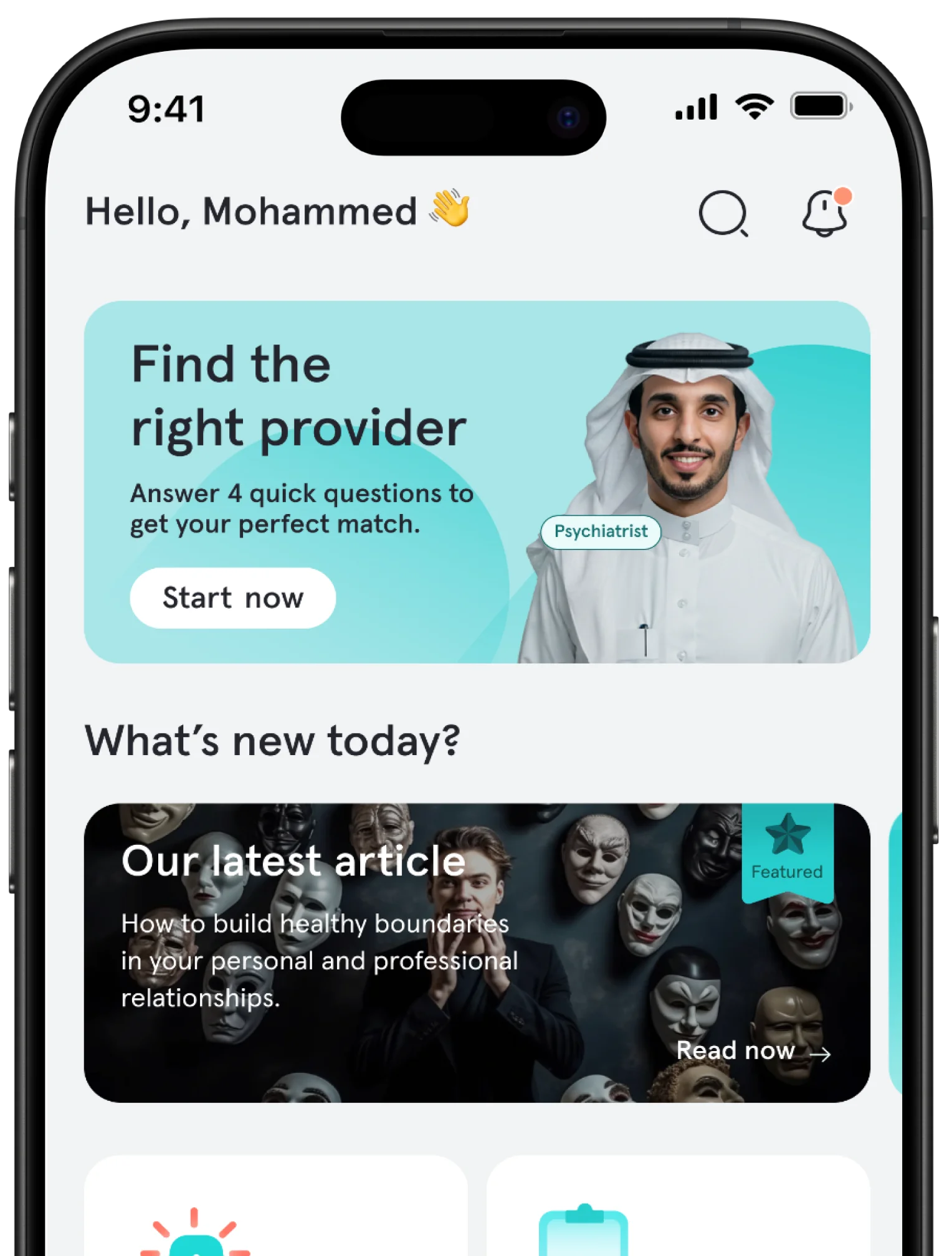
When someone thinks about seeking mental health support, the main barrier is not always the absence of care. Sometimes the barrier is a simple but heavy question: Where do I start? Do I need a psychiatrist or a therapist? Can I speak without feeling exposed? Can I get help at a time that fits my day instead of disrupting it?
This is where Tatmeen matters. The platform does not reduce mental health care to a booking screen or a video appointment. It reorganizes the journey around the person: emotions, time, privacy, and the need for continuity after the session. That philosophy clearly aligns with the direction of Saudi Arabia’s Health Sector Transformation Program5 under Vision 2030, which emphasizes easier access to health services, stronger quality and efficiency, and wider digital transformation.
The access problem: friction before the appointment
In mental health, the difficulty often begins long before the clinic door. A person may delay care because they do not know what to call what they are feeling, because they fear judgment, because they do not want an exhausting in-person experience as a first step, or because they need support now rather than weeks from now.
That is why real access means more than simply making a service available. It means reducing the emotional, time, and procedural distance between the need for care and the right specialist. Tatmeen stands out here because it starts from the user’s real question—what are you feeling?—rather than a cold medical question such as what is your diagnosis?
Starting from people’s language: feeling before diagnosis
One of the strongest parts of the Tatmeen experience is that it does not ask users to begin with a ready-made diagnosis. On Tatmeen’s home page, users can start from more than 120 emotions, experiences, or mental states, with more than 15 specialized clinics covering areas such as sleep disorders and fatigue, trauma, loss and grief, relationships and family, workplace mental health, and student mental health.
This is not cosmetic. It brings care closer to the language people already use in daily life, instead of making them feel they must first learn a full psychological vocabulary before asking for help. Many people begin with scattered descriptions only: anxiety, heaviness, exhaustion, loss of motivation, insomnia, fear of confrontation, or the feeling that they are no longer themselves.
When a platform allows people to enter from that door, it does more than simplify booking; it makes acknowledging the need for help feel less harsh and more humane.
Choice: from confusion to a clearer decision
Access is not achieved by finding just any specialist. It is achieved by finding the right one. Tatmeen offers more than one route: smart matching, urgent consultation, or browsing care providers. The care-provider page allows search and filtering by profession, gender, and sorting, while also showing profiles and ratings that make the decision clearer and less dependent on guesswork.
Tatmeen also explains an important practical distinction: both physicians and therapists can assess the case and recommend suitable solutions, but only a physician can issue a prescription when needed. That short clarification prevents false expectations and turns provider selection from another obstacle into an informed step.
The session itself: flexibility in time and format
When mental health care is available at the time and in the format that suits the user, the meaning of access changes completely. Tatmeen states that consultations are available 24/7 and that urgent consultations can be booked within 60 seconds, with written, voice, and video communication available.
The app pages also describe multiple session lengths such as 30, 45, and 60 minutes. In practice, this reduces more than travel distance. It also lowers the emotional effort associated with commuting, waiting, and reorganizing an entire day around one session. For someone hesitant to speak face-to-face, a written session may be the gentlest starting point. For someone who needs a deeper exchange, voice or video remains available.
Privacy: the first doorway to trust
In mental health care, privacy is not an added feature; it is a precondition for trust. Tatmeen presents this at several levels: quick registration with a mobile number only and no ID required, the option to use a nickname, and a clear statement that sessions are not recorded or stored.
The privacy policy also explains user rights related to data, including reviewing the policy, accessing data, correcting it, and requesting deletion. It further outlines protective measures such as secure servers, encrypted payment transactions, and a commitment not to disclose personal information except within the boundaries permitted by law.
This fits the broader direction in Saudi Arabia toward transparency, data governance, and stronger individual rights over personal data.
After the session: because access does not end when the call ends
Many digital services make the first appointment easier, but do not turn care into a continuing process. This is where Tatmeen becomes more valuable. The platform connects the session to what comes next: medical, psychological, and social reports, treatment plans, digital prescriptions when needed, lab and imaging requests, and sick leaves.
It also presents digital psychological tools and assessments, along with therapeutic homework that helps the work continue between sessions. The app pages also mention a free 15-minute follow-up within 14 days after the appointment. In that sense, Tatmeen is not just a way to reach a call. It is a space that preserves the effects of care itself: assessment, report, plan, and next steps.
From individuals to workplaces: access as supportive infrastructure
Access is not only an individual decision. Tatmeen for Business offers a dedicated path for organizations, with programs, events, and workplace services to support employee mental health, alongside online care, workplace mental health assessment, awareness materials, workshops, and tools that help organizations respond earlier to pressure and burnout.
That broadens the idea of mental health care from a service sought only in crisis to a preventive structure that can begin inside the workplace itself. For partners and employers, the value lies in reducing burnout, raising awareness, and enabling employees to reach confidential, flexible support before pressure becomes a prolonged absence or a sustained decline in performance.
Why this matters through 2030
Because Vision 2030 does not treat technology as decoration. In health care, it treats technology as a way to improve access, quality, and efficiency. The Ministry of Health1 explains that the Health Sector Transformation Program focuses on easier access to services, better quality and efficiency, and stronger prevention. The e-health initiative3 likewise emphasizes the role of digital solutions and health data in improving care delivery and planning.
From this angle, Tatmeen does not look like just another appointment app. It becomes a practical example of how health transformation principles can appear in a real user experience: a gentler start, clearer choice, greater flexibility, calmer privacy, and continuity after the session. That matters especially in mental health, where the barrier is rarely only clinical; it is often social, psychological, and time-related as well.
Finally: real access means care feels closer
Simplifying access to mental health care does not begin with talking more about mental health. It begins with reducing the number of exhausting steps between the need for care and the right specialist. Tatmeen succeeds to the extent that it shortens and softens that distance: you start from what you feel rather than from a difficult clinical term, you can see who fits you more clearly, you book in the format that suits you, and you receive follow-up that makes the session part of a process rather than an isolated event.
If this is the form of access Saudi Arabia is pursuing through 2030, the real measure will not simply be how many platforms exist. It will be how effectively each platform brings care closer to people, respects their time and privacy, and supports continuity after the first interaction.
How do I begin if I do not know exactly what the problem is?
You can begin from the feeling or experience you are going through, not from a ready-made diagnosis. Tatmeen presents more than 120 emotions, experiences, or mental states, alongside more than 15 specialized clinics that help users enter through the closest real-life description of what they are experiencing.
Can I use Tatmeen without revealing my real name?
Yes. Tatmeen’s official pages state that you can begin with a mobile number only and no ID, and that you can communicate with the specialist using a nickname.
How do I choose between a psychiatrist, physician, therapist, or specialist?
The care-provider page shows profession, ratings, and profiles, and explains that both physicians and therapists can assess the case and recommend appropriate next steps, while only a physician can issue a prescription when needed.
Are urgent sessions available, and what session formats are offered?
Yes. Tatmeen states that consultations are available 24/7 and that urgent consultations can be booked within 60 seconds. Written, voice, and video sessions are available, and the app pages list durations such as 30, 45, and 60 minutes.
What happens after the session?
According to Tatmeen’s official pages, the care journey can include medical, psychological, and social reports, treatment plans, prescriptions when needed, lab and imaging requests, sick leaves, digital tools and assessments, and therapeutic homework between sessions. The app pages also mention a free 15-minute follow-up within 14 days after the appointment.
What should I do if the situation is urgent or there is immediate danger?
If there is immediate danger or an acute health crisis, do not wait for a standard session and do not rely on the app alone. Go to emergency care or call local support numbers in Saudi Arabia. You can also review Tatmeen’s Emergency Help Center, which lists numbers such as 999 for emergency services, 997 for ambulance, and 937 for the Ministry of Health.
Why does this article connect Tatmeen with Saudi Vision 2030?
Because the Health Sector Transformation Program includes easier access, stronger quality and efficiency, better prevention, and wider digital health services. The article does not claim Tatmeen replaces the health system. It shows how the platform experience aligns with those broader national directions.
A writer and researcher specializing in psychiatry, she focuses on mental health and the human emotions we experience but cannot always find the words to name. She writes about us—about humanity and the human experience—and simplifies complex topics to offer content that helps us better understand ourselves and life, ultimately making us feel less alone.
Every Tatmeen article is reviewed by care providers licensed by the Saudi Commission for Health Specialties, so what you read is accurate and trustworthy.
This article builds understanding and does not replace a licensed care provider.
Need someone to talk to?
Tatmeen's licensed care providers are available around the clock, and the app's urgent consultation connects you with one within minutes.
Download Tatmeen to explore care providers and booking options.
Smart matchingFour quick questions suggest the right care provider
Urgent consultationTalk to an available care provider within minutes
Free psychological measuresMore than 20 tests to understand how you are doing
Scan to download
{"data":{"id":"2dc032b9-9ceb-4771-857d-db53cf617cac","slug":"mental-health-access-saudi-2030-tatmeen","arTitle":"الوصول بلا تعقيد: كيف يسهّل تطمين الحصول على الرعاية النفسية في المملكة حتى 2030","enTitle":"How Tatmeen Eases Access to Mental Health Care in Saudi Arabia Through 2030","thumbnailAltText":"Tatmeen x Vision 2030 Saudi arabia","estimatedReadingTime":5,"likesCount":379,"writer":{"id":"3ab72b74-f26f-4337-9b47-3114b0f90de5","arBio":"كاتبة وباحثة متخصصة في مجال الطب النفسي، تهتم بموضوعات الصحة النفسية وبالمشاعر الإنسانية التي نختبرها ولا نجد دائمًا الكلمات لتسميتها. تكتب عنّا؛ عن الإنسان وتجربته، وتبسّط الموضوعات المعقّدة لتقدّم محتوى يساعدنا على فهم ذواتنا والحياة أكثر، ويجعلنا نشعر بأننا بوحدة أقل.","enBio":"A writer and researcher specializing in psychiatry, she focuses on mental health and the human emotions we experience but cannot always find the words to name. She writes about us—about humanity and the human experience—and simplifies complex topics to offer content that helps us better understand ourselves and life, ultimately making us feel less alone.","user":{"slug":"ayat-alnajar","arFullName":"آيات النجار","enFullName":"Ayat Al-Najjar","publicProfileImageUrl":"https://cdn.tatmeen.sa/public/profile-images/02384455-68fa-40b6-ad05-609fde65cafa/21b9a610dde5dfc6d37af110c23e9c7ab3946be080c281beb000debf4f7d31a6.webp","publicProfileImage96Url":"https://cdn.tatmeen.sa/public/profile-images/02384455-68fa-40b6-ad05-609fde65cafa/21b9a610dde5dfc6d37af110c23e9c7ab3946be080c281beb000debf4f7d31a6-w96.webp","publicProfileImage192Url":"https://cdn.tatmeen.sa/public/profile-images/02384455-68fa-40b6-ad05-609fde65cafa/21b9a610dde5dfc6d37af110c23e9c7ab3946be080c281beb000debf4f7d31a6-w192.webp"}},"arContent":"","enContent":"","productionDocument":{"headings":[{"id":"article-section-the-access-problem-friction-before-the-appointment","text":"The access problem: friction before the appointment"},{"id":"article-section-starting-from-people-s-language-feeling-before-diagnosis","text":"Starting from people’s language: feeling before diagnosis"},{"id":"article-section-choice-from-confusion-to-a-clearer-decision","text":"Choice: from confusion to a clearer decision"},{"id":"article-section-the-session-itself-flexibility-in-time-and-format","text":"The session itself: flexibility in time and format"},{"id":"article-section-privacy-the-first-doorway-to-trust","text":"Privacy: the first doorway to trust"},{"id":"article-section-after-the-session-because-access-does-not-end-when-the-call-ends","text":"After the session: because access does not end when the call ends"},{"id":"article-section-from-individuals-to-workplaces-access-as-supportive-infrastructure","text":"From individuals to workplaces: access as supportive infrastructure"},{"id":"article-section-why-this-matters-through-2030","text":"Why this matters through 2030"},{"id":"article-section-finally-real-access-means-care-feels-closer","text":"Finally: real access means care feels closer"},{"id":"article-section-frequently-asked-questions","text":"Frequently Asked Questions"}],"faqs":[],"beforeSourcesHtml":"","sources":[{"title":"Ministry of Health — Health Sector Transformation goals","href":"https://www.moh.gov.sa/en/Support/FAQ/Pages/faq23.aspx","hostname":"moh.gov.sa"},{"title":"Ministry of Health — Health Sector Transformation Program guide","href":"https://www.moh.gov.sa/en/Ministry/vro/Pages/manual.aspx","hostname":"moh.gov.sa"},{"title":"Ministry of Health — E-health initiative","href":"https://www.moh.gov.sa/en/Ministry/nehs/Pages/vision2030.aspx","hostname":"moh.gov.sa"},{"title":"Ministry of Health — E-health strategy overview","href":"https://www.moh.gov.sa/en/Ministry/nehs/Pages/Ehealth.aspx","hostname":"moh.gov.sa"},{"title":"Saudi Vision 2030 — Health Sector Transformation Program","href":"https://www.vision2030.gov.sa/en/explore/programs/health-sector-transformation-program","hostname":"vision2030.gov.sa"},{"title":"Saudi Personal Data Protection Law guide","href":"https://dgp.sdaia.gov.sa/wps/portal/pdp/knowledgecenter/details/GPDPL","hostname":"dgp.sdaia.gov.sa"}],"afterSourcesHtml":"<p><br /><br /></p>","blocks":[{"type":"html","html":"<p>When someone thinks about seeking mental health support, the main barrier is not always the absence of care. Sometimes the barrier is a simple but heavy question: Where do I start? Do I need a psychiatrist or a therapist? Can I speak without feeling exposed? Can I get help at a time that fits my day instead of disrupting it?</p><p style=\"text-align:left\">This is where <a href=\"https://tatmeen.sa/en/\"><u>Tatmeen</u></a> matters. The platform does not reduce mental health care to a booking screen or a video appointment. It reorganizes the journey around the person: emotions, time, privacy, and the need for continuity after the session. That philosophy clearly aligns with the direction of Saudi Arabia’s <a href=\"https://www.vision2030.gov.sa/en/explore/programs/health-sector-transformation-program\" target=\"_blank\" rel=\"nofollow noopener noreferrer\"><u>Health Sector Transformation Program</u></a> under Vision 2030, which emphasizes easier access to health services, stronger quality and efficiency, and wider digital transformation.</p><h2 style=\"text-align:left\" id=\"article-section-the-access-problem-friction-before-the-appointment\" data-toc-heading tabindex=\"-1\"><span id=\"the-access-problem-friction-before-the-appointment-1\" aria-hidden=\"true\"></span>The access problem: friction before the appointment</h2><p style=\"text-align:left\">In mental health, the difficulty often begins long before the clinic door. A person may delay care because they do not know what to call what they are feeling, because they fear judgment, because they do not want an exhausting in-person experience as a first step, or because they need support now rather than weeks from now.</p><p style=\"text-align:left\">That is why real access means more than simply making a service available. It means reducing the emotional, time, and procedural distance between the need for care and the right specialist. Tatmeen stands out here because it starts from the user’s real question—what are you feeling?—rather than a cold medical question such as what is your diagnosis?</p><h2 style=\"text-align:left\" id=\"article-section-starting-from-people-s-language-feeling-before-diagnosis\" data-toc-heading tabindex=\"-1\"><span id=\"starting-from-people-s-language-feeling-before-diagnosis-2\" aria-hidden=\"true\"></span>Starting from people’s language: feeling before diagnosis</h2><p style=\"text-align:left\">One of the strongest parts of the Tatmeen experience is that it does not ask users to begin with a ready-made diagnosis. On <a href=\"https://tatmeen.sa/en/\"><u>Tatmeen’s home page</u></a>, users can start from more than 120 emotions, experiences, or mental states, with more than 15 specialized clinics covering areas such as sleep disorders and fatigue, trauma, loss and grief, relationships and family, workplace mental health, and student mental health.</p><p style=\"text-align:left\">This is not cosmetic. It brings care closer to the language people already use in daily life, instead of making them feel they must first learn a full psychological vocabulary before asking for help. Many people begin with scattered descriptions only: anxiety, heaviness, exhaustion, loss of motivation, insomnia, fear of confrontation, or the feeling that they are no longer themselves.</p><p style=\"text-align:left\">When a platform allows people to enter from that door, it does more than simplify booking; it makes acknowledging the need for help feel less harsh and more humane.</p><h2 style=\"text-align:left\" id=\"article-section-choice-from-confusion-to-a-clearer-decision\" data-toc-heading tabindex=\"-1\"><span id=\"choice-from-confusion-to-a-clearer-decision-3\" aria-hidden=\"true\"></span>Choice: from confusion to a clearer decision</h2><p style=\"text-align:left\">Access is not achieved by finding just any specialist. It is achieved by finding the right one. Tatmeen offers more than one route: smart matching, urgent consultation, or <a href=\"https://tatmeen.sa/en/care-providers/\"><u>browsing care providers</u></a>. The care-provider page allows search and filtering by profession, gender, and sorting, while also showing profiles and ratings that make the decision clearer and less dependent on guesswork.</p><p style=\"text-align:left\">Tatmeen also explains an important practical distinction: both physicians and therapists can assess the case and recommend suitable solutions, but only a physician can issue a prescription when needed. That short clarification prevents false expectations and turns provider selection from another obstacle into an informed step.</p><h2 style=\"text-align:left\" id=\"article-section-the-session-itself-flexibility-in-time-and-format\" data-toc-heading tabindex=\"-1\"><span id=\"the-session-itself-flexibility-in-time-and-format-4\" aria-hidden=\"true\"></span>The session itself: flexibility in time and format</h2><p style=\"text-align:left\">When mental health care is available at the time and in the format that suits the user, the meaning of access changes completely. Tatmeen states that consultations are available 24/7 and that urgent consultations can be booked within 60 seconds, with written, voice, and video communication available.</p><p style=\"text-align:left\">The app pages also describe multiple session lengths such as 30, 45, and 60 minutes. In practice, this reduces more than travel distance. It also lowers the emotional effort associated with commuting, waiting, and reorganizing an entire day around one session. For someone hesitant to speak face-to-face, a written session may be the gentlest starting point. For someone who needs a deeper exchange, voice or video remains available.</p><h2 style=\"text-align:left\" id=\"article-section-privacy-the-first-doorway-to-trust\" data-toc-heading tabindex=\"-1\"><span id=\"privacy-the-first-doorway-to-trust-5\" aria-hidden=\"true\"></span>Privacy: the first doorway to trust</h2><p style=\"text-align:left\">In mental health care, privacy is not an added feature; it is a precondition for trust. Tatmeen presents this at several levels: quick registration with a mobile number only and no ID required, the option to use a nickname, and a clear statement that sessions are not recorded or stored.</p><p style=\"text-align:left\">The <a href=\"https://tatmeen.sa/en/privacy/\"><u>privacy policy</u></a> also explains user rights related to data, including reviewing the policy, accessing data, correcting it, and requesting deletion. It further outlines protective measures such as secure servers, encrypted payment transactions, and a commitment not to disclose personal information except within the boundaries permitted by law.</p><p style=\"text-align:left\">This fits the broader direction in Saudi Arabia toward transparency, data governance, and stronger individual rights over personal data.</p><h2 style=\"text-align:left\" id=\"article-section-after-the-session-because-access-does-not-end-when-the-call-ends\" data-toc-heading tabindex=\"-1\"><span id=\"after-the-session-because-access-does-not-end-when-the-call-ends-6\" aria-hidden=\"true\"></span>After the session: because access does not end when the call ends</h2><p style=\"text-align:left\">Many digital services make the first appointment easier, but do not turn care into a continuing process. This is where Tatmeen becomes more valuable. The platform connects the session to what comes next: medical, psychological, and social reports, treatment plans, digital prescriptions when needed, lab and imaging requests, and sick leaves.</p><p style=\"text-align:left\">It also presents digital psychological tools and assessments, along with therapeutic homework that helps the work continue between sessions. The app pages also mention a free 15-minute follow-up within 14 days after the appointment. In that sense, Tatmeen is not just a way to reach a call. It is a space that preserves the effects of care itself: assessment, report, plan, and next steps.</p><h2 style=\"text-align:left\" id=\"article-section-from-individuals-to-workplaces-access-as-supportive-infrastructure\" data-toc-heading tabindex=\"-1\"><span id=\"from-individuals-to-workplaces-access-as-supportive-infrastructure-7\" aria-hidden=\"true\"></span>From individuals to workplaces: access as supportive infrastructure</h2><p style=\"text-align:left\">Access is not only an individual decision. <a href=\"https://tatmeen.sa/en/business/\"><u>Tatmeen for Business</u></a> offers a dedicated path for organizations, with programs, events, and workplace services to support employee mental health, alongside online care, workplace mental health assessment, awareness materials, workshops, and tools that help organizations respond earlier to pressure and burnout.</p><p style=\"text-align:left\">That broadens the idea of mental health care from a service sought only in crisis to a preventive structure that can begin inside the workplace itself. For partners and employers, the value lies in reducing burnout, raising awareness, and enabling employees to reach confidential, flexible support before pressure becomes a prolonged absence or a sustained decline in performance.</p><h2 style=\"text-align:left\" id=\"article-section-why-this-matters-through-2030\" data-toc-heading tabindex=\"-1\"><span id=\"why-this-matters-through-2030-8\" aria-hidden=\"true\"></span>Why this matters through 2030</h2><p style=\"text-align:left\">Because Vision 2030 does not treat technology as decoration. In health care, it treats technology as a way to improve access, quality, and efficiency. The <a href=\"https://www.moh.gov.sa/en/Support/FAQ/Pages/faq23.aspx\" target=\"_blank\" rel=\"nofollow noopener noreferrer\"><u>Ministry of Health</u></a> explains that the Health Sector Transformation Program focuses on easier access to services, better quality and efficiency, and stronger prevention. The <a href=\"https://www.moh.gov.sa/en/Ministry/nehs/Pages/vision2030.aspx\" target=\"_blank\" rel=\"nofollow noopener noreferrer\"><u>e-health initiative</u></a> likewise emphasizes the role of digital solutions and health data in improving care delivery and planning.</p><p style=\"text-align:left\">From this angle, Tatmeen does not look like just another appointment app. It becomes a practical example of how health transformation principles can appear in a real user experience: a gentler start, clearer choice, greater flexibility, calmer privacy, and continuity after the session. That matters especially in mental health, where the barrier is rarely only clinical; it is often social, psychological, and time-related as well.</p><h2 style=\"text-align:left\" id=\"article-section-finally-real-access-means-care-feels-closer\" data-toc-heading tabindex=\"-1\"><span id=\"finally-real-access-means-care-feels-closer-9\" aria-hidden=\"true\"></span>Finally: real access means care feels closer</h2><p style=\"text-align:left\">Simplifying access to mental health care does not begin with talking more about mental health. It begins with reducing the number of exhausting steps between the need for care and the right specialist. Tatmeen succeeds to the extent that it shortens and softens that distance: you start from what you feel rather than from a difficult clinical term, you can see who fits you more clearly, you book in the format that suits you, and you receive follow-up that makes the session part of a process rather than an isolated event.</p><p style=\"text-align:left\">If this is the form of access Saudi Arabia is pursuing through 2030, the real measure will not simply be how many platforms exist. It will be how effectively each platform brings care closer to people, respects their time and privacy, and supports continuity after the first interaction.</p><p style=\"text-align:left\">Suggested next step for the reader: start from <a href=\"https://tatmeen.sa/en/\"><u>Tatmeen’s home page</u></a>, <a href=\"https://tatmeen.sa/en/care-providers/\"><u>browse care providers</u></a>, or review the <a href=\"https://tatmeen.sa/en/privacy/\"><u>privacy policy</u></a> before booking if privacy is the main question holding you back.</p><h2 style=\"text-align:left\" id=\"article-section-frequently-asked-questions\" data-toc-heading tabindex=\"-1\"><span id=\"frequently-asked-questions-10\" aria-hidden=\"true\"></span>Frequently Asked Questions</h2><h3 style=\"text-align:left\">How do I begin if I do not know exactly what the problem is?</h3><p style=\"text-align:left\">You can begin from the feeling or experience you are going through, not from a ready-made diagnosis. Tatmeen presents more than 120 emotions, experiences, or mental states, alongside more than 15 specialized clinics that help users enter through the closest real-life description of what they are experiencing.</p><h3 style=\"text-align:left\">Can I use Tatmeen without revealing my real name?</h3><p style=\"text-align:left\">Yes. Tatmeen’s official pages state that you can begin with a mobile number only and no ID, and that you can communicate with the specialist using a nickname.</p><h3 style=\"text-align:left\">How do I choose between a psychiatrist, physician, therapist, or specialist?</h3><p style=\"text-align:left\">The care-provider page shows profession, ratings, and profiles, and explains that both physicians and therapists can assess the case and recommend appropriate next steps, while only a physician can issue a prescription when needed.</p><h3 style=\"text-align:left\">Are urgent sessions available, and what session formats are offered?</h3><p style=\"text-align:left\">Yes. Tatmeen states that consultations are available 24/7 and that urgent consultations can be booked within 60 seconds. Written, voice, and video sessions are available, and the app pages list durations such as 30, 45, and 60 minutes.</p><h3 style=\"text-align:left\">What happens after the session?</h3><p style=\"text-align:left\">According to Tatmeen’s official pages, the care journey can include medical, psychological, and social reports, treatment plans, prescriptions when needed, lab and imaging requests, sick leaves, digital tools and assessments, and therapeutic homework between sessions. The app pages also mention a free 15-minute follow-up within 14 days after the appointment.</p><h3 style=\"text-align:left\">What should I do if the situation is urgent or there is immediate danger?</h3><p style=\"text-align:left\">If there is immediate danger or an acute health crisis, do not wait for a standard session and do not rely on the app alone. Go to emergency care or call local support numbers in Saudi Arabia. You can also review Tatmeen’s <a href=\"https://tatmeen.sa/en/gethelpnow/\"><u>Emergency Help Center</u></a>, which lists numbers such as 999 for emergency services, 997 for ambulance, and 937 for the Ministry of Health.</p><h3 style=\"text-align:left\">Why does this article connect Tatmeen with Saudi Vision 2030?</h3><p style=\"text-align:left\">Because the Health Sector Transformation Program includes easier access, stronger quality and efficiency, better prevention, and wider digital health services. The article does not claim Tatmeen replaces the health system. It shows how the platform experience aligns with those broader national directions.</p>"}],"inlineCtaSignatures":[],"_experienceAliases":{"v":1,"fields":["html","bodyHtml"]}},"createdAt":"2026-04-20T22:00:00.000Z","updatedAt":"2026-06-24T23:51:21.859Z","disorderGroups":[{"id":"1e82772d-a1a7-4d29-b475-be9d6b67ae02","slug":"common-mental-issues","arName":"اضطرابات نفسية شائعة","enName":"Common Mental Issues"}],"reviewer":{"arFullName":"فريق تطمين","enFullName":"Tatmeen team","slug":"tatmeen-team","kind":"organization"},"productionArticle":true,"promotionAllowed":true,"preparedCover":{"src":"https://cdn.tatmeen.sa/public/article-lcp/article-lcp-v2/sha256-18f76ce7a8cbd509442ffd12bd1a6db440f11ba5eab7f2e91ac0f9a1f251348b/800-70e29f396746b44f774b87a75454b03a500abfa1121ccca89ce3cf611fa7faf5.avif","fallback":"https://cdn.tatmeen.sa/public/article-lcp/article-lcp-v2/sha256-18f76ce7a8cbd509442ffd12bd1a6db440f11ba5eab7f2e91ac0f9a1f251348b/800-1af91627978c2e13ea116cf37b8004c76d8717cfd7224bd1507ae88916bbd816.webp","directUrl":"https://cdn.tatmeen.sa/blog-cover/Tatmeen-1776800946081.webp","isGolden":true,"avifSrcset":"https://cdn.tatmeen.sa/public/article-lcp/article-lcp-v2/sha256-18f76ce7a8cbd509442ffd12bd1a6db440f11ba5eab7f2e91ac0f9a1f251348b/400-c8c0d967824e9fa46b993675fafcde775aeae0bb9e7da9fb0ff14cb94b3af900.avif 400w, https://cdn.tatmeen.sa/public/article-lcp/article-lcp-v2/sha256-18f76ce7a8cbd509442ffd12bd1a6db440f11ba5eab7f2e91ac0f9a1f251348b/640-e591f92e0b74488adc7671f9c29bab85a0dc53886dd7bc1cdf59bbf3e7d919bc.avif 640w, https://cdn.tatmeen.sa/public/article-lcp/article-lcp-v2/sha256-18f76ce7a8cbd509442ffd12bd1a6db440f11ba5eab7f2e91ac0f9a1f251348b/800-70e29f396746b44f774b87a75454b03a500abfa1121ccca89ce3cf611fa7faf5.avif 800w, https://cdn.tatmeen.sa/public/article-lcp/article-lcp-v2/sha256-18f76ce7a8cbd509442ffd12bd1a6db440f11ba5eab7f2e91ac0f9a1f251348b/1200-4548aca10f674cd14eebab1b5b6b2886feabff67db2447117b941ca21cb0e3f2.avif 1200w","webpSrcset":"https://cdn.tatmeen.sa/public/article-lcp/article-lcp-v2/sha256-18f76ce7a8cbd509442ffd12bd1a6db440f11ba5eab7f2e91ac0f9a1f251348b/400-e1af1de87cac1f27afaf160eb2d1e55a02f4bd0da88c11d8c02ed31be562b5c0.webp 400w, https://cdn.tatmeen.sa/public/article-lcp/article-lcp-v2/sha256-18f76ce7a8cbd509442ffd12bd1a6db440f11ba5eab7f2e91ac0f9a1f251348b/640-7458119fe17c8a5b3128318affb6d9c3ae845182a434a60ca137ae7394a1a15f.webp 640w, https://cdn.tatmeen.sa/public/article-lcp/article-lcp-v2/sha256-18f76ce7a8cbd509442ffd12bd1a6db440f11ba5eab7f2e91ac0f9a1f251348b/800-1af91627978c2e13ea116cf37b8004c76d8717cfd7224bd1507ae88916bbd816.webp 800w, https://cdn.tatmeen.sa/public/article-lcp/article-lcp-v2/sha256-18f76ce7a8cbd509442ffd12bd1a6db440f11ba5eab7f2e91ac0f9a1f251348b/1200-fcb64d03ded57106457d181a72d4d3d25c307753dfacdc8b6576e9b8e82818fe.webp 1200w","phoneAvifSrcset":"https://cdn.tatmeen.sa/public/article-lcp/article-lcp-v2/sha256-18f76ce7a8cbd509442ffd12bd1a6db440f11ba5eab7f2e91ac0f9a1f251348b/400-c8c0d967824e9fa46b993675fafcde775aeae0bb9e7da9fb0ff14cb94b3af900.avif 400w, https://cdn.tatmeen.sa/public/article-lcp/article-lcp-v2/sha256-18f76ce7a8cbd509442ffd12bd1a6db440f11ba5eab7f2e91ac0f9a1f251348b/640-e591f92e0b74488adc7671f9c29bab85a0dc53886dd7bc1cdf59bbf3e7d919bc.avif 640w, https://cdn.tatmeen.sa/public/article-lcp/article-lcp-v2/sha256-18f76ce7a8cbd509442ffd12bd1a6db440f11ba5eab7f2e91ac0f9a1f251348b/800-70e29f396746b44f774b87a75454b03a500abfa1121ccca89ce3cf611fa7faf5.avif 800w","phoneWebpSrcset":"https://cdn.tatmeen.sa/public/article-lcp/article-lcp-v2/sha256-18f76ce7a8cbd509442ffd12bd1a6db440f11ba5eab7f2e91ac0f9a1f251348b/400-e1af1de87cac1f27afaf160eb2d1e55a02f4bd0da88c11d8c02ed31be562b5c0.webp 400w, https://cdn.tatmeen.sa/public/article-lcp/article-lcp-v2/sha256-18f76ce7a8cbd509442ffd12bd1a6db440f11ba5eab7f2e91ac0f9a1f251348b/640-7458119fe17c8a5b3128318affb6d9c3ae845182a434a60ca137ae7394a1a15f.webp 640w, https://cdn.tatmeen.sa/public/article-lcp/article-lcp-v2/sha256-18f76ce7a8cbd509442ffd12bd1a6db440f11ba5eab7f2e91ac0f9a1f251348b/800-1af91627978c2e13ea116cf37b8004c76d8717cfd7224bd1507ae88916bbd816.webp 800w","width":800,"height":447},"previewTaxonomy":{"groups":[{"id":"1e82772d-a1a7-4d29-b475-be9d6b67ae02","slug":"common-mental-issues","arName":"اضطرابات نفسية شائعة","enName":"Common Mental Issues"}],"topics":[],"tags":[{"id":"0a7fb6ee-560f-4ee0-b5f5-a8af3b1bb1da","slug":"tatmeen","arName":"تطمين","enName":"Tatmeen"},{"id":"2d8923db-c6f5-48c4-a0d5-1a0664497491","slug":"saudi","arName":"السعودية","enName":"Saudi Arabia"},{"id":"7d4166fa-470f-4055-99cd-90ae10e2ecea","slug":"saudi-vision-2030","arName":"رؤية السعودية 2030","enName":"Saudi Vision 2030"},{"id":"300cd66c-9540-4ed3-8eae-47386be32d60","slug":"digital-health-telehealth","arName":"الصحة الرقمية والعلاج عن بُعد","enName":"Digital Health & Telehealth"},{"id":"8f632a07-06ba-44f3-afe9-d7cef3e09698","slug":"product-howto","arName":"دليل المنتج / كيفية الاستخدام","enName":"Product Explainer / How-To-Use"}]},"previewProviderRecommendations":[{"id":"6866c238-0223-4d20-b182-6bf8929dccca","slug":"bushra-alluhaibi-4189","arFullName":"بشرى اللهيبي","enFullName":"Bushra Alluhaibi","publicProfileImageUrl":"","publicProfileImage96Url":"","publicProfileImage192Url":"","specialization":{"arName":"أخصائي نفسي","enName":"Psychologist"},"profileImageUrl":"","experienceYears":12,"consultantInfo":{"averageRating":{"average":0},"specialization":{"arGeneralName":"أخصائي نفسي","enGeneralName":"Psychologist"}}},{"id":"23ba62b8-9679-46a2-9439-b2801cafc59b","slug":"dr-mohammed-alanazi-4132","arFullName":"د. محمد العنزي","enFullName":"Dr. Mohammed ALANAZI","publicProfileImageUrl":"https://cdn.tatmeen.sa/public/profile-images/23ba62b8-9679-46a2-9439-b2801cafc59b/233e70d98cd910633553abf60e5ee8dd305797b64c4172746ab379f3b91a1461.webp","publicProfileImage96Url":"https://cdn.tatmeen.sa/public/profile-images/23ba62b8-9679-46a2-9439-b2801cafc59b/233e70d98cd910633553abf60e5ee8dd305797b64c4172746ab379f3b91a1461-w96.webp","publicProfileImage192Url":"https://cdn.tatmeen.sa/public/profile-images/23ba62b8-9679-46a2-9439-b2801cafc59b/233e70d98cd910633553abf60e5ee8dd305797b64c4172746ab379f3b91a1461-w192.webp","specialization":{"arName":"طبيب أسرة","enName":"Family Physician"},"profileImageUrl":"https://cdn.tatmeen.sa/public/profile-images/23ba62b8-9679-46a2-9439-b2801cafc59b/233e70d98cd910633553abf60e5ee8dd305797b64c4172746ab379f3b91a1461-w192.webp","experienceYears":3,"consultantInfo":{"averageRating":{"average":0},"specialization":{"arGeneralName":"طبيب أسرة","enGeneralName":"Family Physician"}}},{"id":"4bcf0531-d58c-4284-aeed-b2563c966ee3","slug":"dr-sultan-albalawi-9701","arFullName":"د. سلطان البلوي","enFullName":"Dr. Sultan Albalawi","publicProfileImageUrl":"https://cdn.tatmeen.sa/public/profile-images/4bcf0531-d58c-4284-aeed-b2563c966ee3/7038797eec8398a3d17eebf66394b26366409d9a9faece56515311203b0600b2.webp","publicProfileImage96Url":"https://cdn.tatmeen.sa/public/profile-images/4bcf0531-d58c-4284-aeed-b2563c966ee3/7038797eec8398a3d17eebf66394b26366409d9a9faece56515311203b0600b2-w96.webp","publicProfileImage192Url":"https://cdn.tatmeen.sa/public/profile-images/4bcf0531-d58c-4284-aeed-b2563c966ee3/7038797eec8398a3d17eebf66394b26366409d9a9faece56515311203b0600b2-w192.webp","specialization":{"arName":"طبيب أسرة","enName":"Family Physician"},"profileImageUrl":"https://cdn.tatmeen.sa/public/profile-images/4bcf0531-d58c-4284-aeed-b2563c966ee3/7038797eec8398a3d17eebf66394b26366409d9a9faece56515311203b0600b2-w192.webp","experienceYears":3,"consultantInfo":{"averageRating":{"average":0},"specialization":{"arGeneralName":"طبيب أسرة","enGeneralName":"Family Physician"}}}],"previewCareProviders":[{"id":"09364052-c2a9-4c52-9717-7ce2093b8d0a","slug":"kholoud-alharbi-5221","arFullName":"خلود الحربي","enFullName":"Kholoud Alharbi","publicProfileImageUrl":"https://cdn.tatmeen.sa/public/profile-images/09364052-c2a9-4c52-9717-7ce2093b8d0a/4a0aeb81619e351b77f4323e3605a0a00acc7ca3c82ee7cc5ca2c9e8ef716049.webp","publicProfileImage96Url":"https://cdn.tatmeen.sa/public/profile-images/09364052-c2a9-4c52-9717-7ce2093b8d0a/4a0aeb81619e351b77f4323e3605a0a00acc7ca3c82ee7cc5ca2c9e8ef716049-w96.webp","publicProfileImage192Url":"https://cdn.tatmeen.sa/public/profile-images/09364052-c2a9-4c52-9717-7ce2093b8d0a/4a0aeb81619e351b77f4323e3605a0a00acc7ca3c82ee7cc5ca2c9e8ef716049-w192.webp","gender":"FEMALE","specialization":{"arName":"أخصائي نفسي","enName":"Psychologist"}},{"id":"6f037535-1dca-4b50-a8b2-5974b7323286","slug":"salah-althobaiti-9053","arFullName":"صلاح الثبيتي","enFullName":"Salah Althobaiti","publicProfileImageUrl":"https://cdn.tatmeen.sa/public/profile-images/6f037535-1dca-4b50-a8b2-5974b7323286/35b6bd7fad9b1e004c1835803eb9c1b56dcacd380685ec8bff141f0fb888005c.webp","publicProfileImage96Url":"https://cdn.tatmeen.sa/public/profile-images/6f037535-1dca-4b50-a8b2-5974b7323286/35b6bd7fad9b1e004c1835803eb9c1b56dcacd380685ec8bff141f0fb888005c-w96.webp","publicProfileImage192Url":"https://cdn.tatmeen.sa/public/profile-images/6f037535-1dca-4b50-a8b2-5974b7323286/35b6bd7fad9b1e004c1835803eb9c1b56dcacd380685ec8bff141f0fb888005c-w192.webp","gender":"MALE","specialization":{"arName":"أخصائي نفسي","enName":"Psychologist"}},{"id":"3cc806e8-616b-4884-9f21-a75b378580a2","slug":"aisha-al-hashim-8667","arFullName":"عائشة ال هاشم","enFullName":"Aisha Al Hashim","publicProfileImageUrl":"https://cdn.tatmeen.sa/public/profile-images/3cc806e8-616b-4884-9f21-a75b378580a2/27f523d03be4dcfa1f6a79f70c1773887434e698990d214cd990caec56a44798.webp","publicProfileImage96Url":"https://cdn.tatmeen.sa/public/profile-images/3cc806e8-616b-4884-9f21-a75b378580a2/27f523d03be4dcfa1f6a79f70c1773887434e698990d214cd990caec56a44798-w96.webp","publicProfileImage192Url":"https://cdn.tatmeen.sa/public/profile-images/3cc806e8-616b-4884-9f21-a75b378580a2/27f523d03be4dcfa1f6a79f70c1773887434e698990d214cd990caec56a44798-w192.webp","gender":"FEMALE","specialization":{"arName":"أخصائي نفسي","enName":"Psychologist"}},{"id":"db2ce1a0-9325-4471-b7ce-eb2e811c30a3","slug":"amer-qutub-2441","arFullName":"عامر قطب","enFullName":"Amer Qutub","publicProfileImageUrl":"https://cdn.tatmeen.sa/public/profile-images/db2ce1a0-9325-4471-b7ce-eb2e811c30a3/80580f99bfd7fe2b2a9cf8eed73ab532f5086d1efe053b0aa57358c1ce004261.webp","publicProfileImage96Url":"https://cdn.tatmeen.sa/public/profile-images/db2ce1a0-9325-4471-b7ce-eb2e811c30a3/80580f99bfd7fe2b2a9cf8eed73ab532f5086d1efe053b0aa57358c1ce004261-w96.webp","publicProfileImage192Url":"https://cdn.tatmeen.sa/public/profile-images/db2ce1a0-9325-4471-b7ce-eb2e811c30a3/80580f99bfd7fe2b2a9cf8eed73ab532f5086d1efe053b0aa57358c1ce004261-w192.webp","gender":"MALE","specialization":{"arName":"أخصائي نفسي","enName":"Psychologist"}},{"id":"94765496-dbdf-4631-a01b-7df5f788668d","slug":"abdullrahman-alhamoudi-3045","arFullName":"عبدالرحمن الحمودي","enFullName":"Abdulrahman Alhamoudi","publicProfileImageUrl":"https://cdn.tatmeen.sa/public/profile-images/94765496-dbdf-4631-a01b-7df5f788668d/2d49f6b6493c564afb6f50b6c3634231dff3a5cf8353acfab393d1b2a88037d1.webp","publicProfileImage96Url":"https://cdn.tatmeen.sa/public/profile-images/94765496-dbdf-4631-a01b-7df5f788668d/2d49f6b6493c564afb6f50b6c3634231dff3a5cf8353acfab393d1b2a88037d1-w96.webp","publicProfileImage192Url":"https://cdn.tatmeen.sa/public/profile-images/94765496-dbdf-4631-a01b-7df5f788668d/2d49f6b6493c564afb6f50b6c3634231dff3a5cf8353acfab393d1b2a88037d1-w192.webp","gender":"MALE","specialization":{"arName":"أخصائي نفسي","enName":"Psychologist"}},{"id":"618dba89-5b70-4b46-8304-741b7ac8ecd3","slug":"abdullah-mari-1311","arFullName":"عبدالله مرعي","enFullName":"Abdullah Mari","publicProfileImageUrl":"https://cdn.tatmeen.sa/public/profile-images/618dba89-5b70-4b46-8304-741b7ac8ecd3/6b4a3bfb59f8a304ca79083b32859b46baad2e1d692974a47c02c1f66bd11129.webp","publicProfileImage96Url":"https://cdn.tatmeen.sa/public/profile-images/618dba89-5b70-4b46-8304-741b7ac8ecd3/6b4a3bfb59f8a304ca79083b32859b46baad2e1d692974a47c02c1f66bd11129-w96.webp","publicProfileImage192Url":"https://cdn.tatmeen.sa/public/profile-images/618dba89-5b70-4b46-8304-741b7ac8ecd3/6b4a3bfb59f8a304ca79083b32859b46baad2e1d692974a47c02c1f66bd11129-w192.webp","gender":"MALE","specialization":{"arName":"أخصائي نفسي","enName":"Psychologist"}},{"id":"3b50a5d5-e795-407f-8676-fd7f0e1bb7a0","slug":"abdulaziz-bin-hudayan-4940","arFullName":"عبدالعزيز بن هديان","enFullName":"Abdulaziz Bin Hudayan","publicProfileImageUrl":"https://cdn.tatmeen.sa/public/profile-images/3b50a5d5-e795-407f-8676-fd7f0e1bb7a0/710ff0fe1fb00cdb5042092e27b7910b480a439b02251ecded62d7758eefce95.webp","publicProfileImage96Url":"https://cdn.tatmeen.sa/public/profile-images/3b50a5d5-e795-407f-8676-fd7f0e1bb7a0/710ff0fe1fb00cdb5042092e27b7910b480a439b02251ecded62d7758eefce95-w96.webp","publicProfileImage192Url":"https://cdn.tatmeen.sa/public/profile-images/3b50a5d5-e795-407f-8676-fd7f0e1bb7a0/710ff0fe1fb00cdb5042092e27b7910b480a439b02251ecded62d7758eefce95-w192.webp","gender":"MALE","specialization":{"arName":"أخصائي نفسي","enName":"Psychologist"}}],"previewDownload":{"href":"/download","title":{"ar":"خطوة واحدة لأجلك، ابدأ الآن","en":"One step for you, start now"},"description":{"ar":"حمّل تطبيق تطمين لاستكشاف مقدمي الرعاية وخيارات الحجز.","en":"Download Tatmeen to explore care providers and booking options."},"posterSrc":"/images/home/cta-ar-new-1.webp","videoSrc":"/images/home/cta-ar-new-1.mp4","videoPosterSrc":"/images/home/cta-ar-new-1.webp","videoPosterEnSrc":"/images/home/cta-en-new-1.webp","videoType":"video/mp4","appStoreHref":"https://apps.apple.com/us/app/tatmeen-%D8%AA%D8%B7%D9%85%D9%8A%D9%86/id6473836983","googlePlayHref":"https://play.google.com/store/apps/details?id=com.TatmeenApp.user&hl=en"},"previewRelatedArticles":[{"id":"f15994f6-0492-4e07-8bc7-089931339689","slug":"Psychological-Diagnosis-Criteria-Stages-Diagnosis","route":"/blog/Psychological-Diagnosis-Criteria-Stages-Diagnosis/","title":{"ar":"التشخيص النفسي : معايير ومراحل التشخيص ","en":"Psychological Diagnosis: Criteria and Stages"},"image":"https://cdn.tatmeen.sa/public/article-lcp/article-lcp-v2/sha256-b698f0d1c08246e3da62c1bc47dc13f216bacd4e933b63da2fce89624b075c1c/800-aa291240bb965051c37d479b39b5b7441eaad354169b34c80b3da4731a6b29d0.webp","directImageFallback":"https://cdn.tatmeen.sa/blog-cover/1706456301401-Tatmeen-761.jpg","arThumbnailAltText":"Seated person writes in a notebook while another person sits nearby","thumbnailAltText":"Seated person writes in a notebook while another person sits nearby","topic":{"label":{"ar":"اضطرابات نفسية شائعة","en":"Common Mental Issues"}},"readingTimeMinutes":5},{"id":"902e8652-7a14-4650-a5d4-77e1619c1c37","slug":"Investing-in-mental-health","route":"/blog/Investing-in-mental-health/","title":{"ar":"الاستثمار في الصحة النفسية","en":"Investing in Mental Health"},"image":"https://cdn.tatmeen.sa/public/article-lcp/article-lcp-v2/sha256-f1e11819edaebdd8f4d5b35ce003bafeda5408f16aa1c93af802b2e94319f332/800-8472e8a13090baf7e9d27110627b3a0f79fca7cd4c2564a3a94a2014610406d7.webp","directImageFallback":"https://cdn.tatmeen.sa/blog-cover/1704822504238-Tatmeen-img-564","arThumbnailAltText":"Globe encircled by Arabic text for World Mental Health Day, 10 October","thumbnailAltText":"Globe encircled by Arabic text for World Mental Health Day, 10 October","topic":{"label":{"ar":"اضطرابات نفسية شائعة","en":"Common Mental Issues"}},"readingTimeMinutes":5},{"id":"183c0c76-1f36-400c-bd02-3aab78bce145","slug":"Psychiatric-Illness-Relationship-to-Mental-illness","route":"/blog/Psychiatric-Illness-Relationship-to-Mental-illness/","title":{"ar":"المرض النفسي – علاج و أعراض وأسباب وعلاقته بالمرض العقلي","en":"Psychological Illness: Symptoms, Causes, Treatment, and Mental Illness"},"image":"https://cdn.tatmeen.sa/public/article-lcp/article-lcp-v2/sha256-d30fa57439910b10b1764f8d491e7b00f96927c57d556450e2935f7758c6ad2c/599-8567e6e62bfe8feb0ddbabbc46481b10da57eeb96d71424fa9b2612093f72d16.webp","directImageFallback":"https://cdn.tatmeen.sa/blog-cover/1706456221900-Tatmeen-20.jpg","arThumbnailAltText":"Seated figure with knees drawn up beneath a glowing brain graphic","thumbnailAltText":"Seated figure with knees drawn up beneath a glowing brain graphic","topic":{"label":{"ar":"اضطرابات نفسية شائعة","en":"Common Mental Issues"}},"readingTimeMinutes":5},{"id":"de0ece44-f735-4c1d-90bc-4075aa48d2c6","slug":"tatmeen-digital-psychiatry-saudi-2030","route":"/blog/tatmeen-digital-psychiatry-saudi-2030/","title":{"ar":"هل يقود تطمين مستقبل الطب النفسي الرقمي في المملكة بحلول 2030؟","en":"Does Tatmeen Lead the Future of Digital Psychiatry in the Kingdom by 2030?"},"image":"https://cdn.tatmeen.sa/public/article-lcp/article-lcp-v2/sha256-226466f50c60db4a26f9da999c7be66373168ac4d9990d88eddd4efcf5d899fc/800-6eea7ab1c1febd2b114a74ff2f8de039b047c0816f92d8e0b6002a25a9b799a8.webp","directImageFallback":"https://cdn.tatmeen.sa/blog-cover/Tatmeen-1782320316865.webp","arThumbnailAltText":"Glowing digital Saudi map with network nodes and Tatmeen logo center","thumbnailAltText":"Glowing digital Saudi map with network nodes and Tatmeen logo center","topic":{"label":{"ar":"اضطرابات نفسية شائعة","en":"Common Mental Issues"}},"readingTimeMinutes":5}],"previewRelatedReadStates":{}},"locale":"en","device":"desktop","path":"/en/blog/mental-health-access-saudi-2030-tatmeen/","readingControls":false,"config":{"public":{"BUCKET_URL":"https://cdn.tatmeen.sa/","APP_BASE_URL":"https://tatmeen.sa","intercomAppId":"ppcnu9e3"}}}