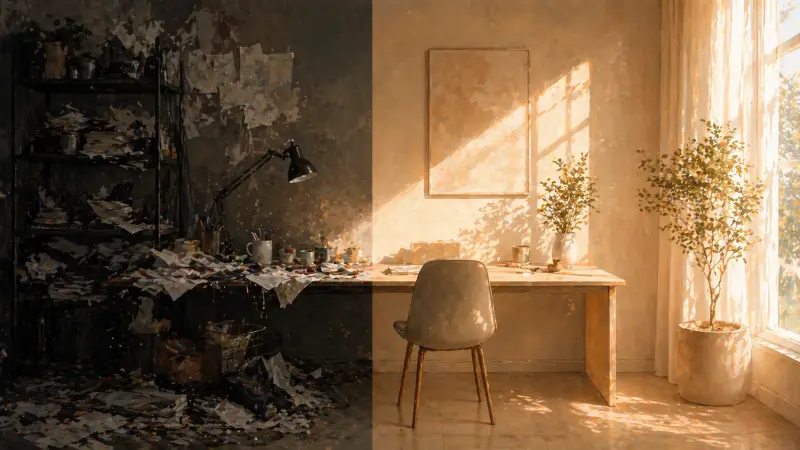
The environment you live in isn’t neutral; it doesn’t just contain your day—it can also help shape it. Accumulated clutter, even if it’s small things, can raise your stress level in the background and steal part of your focus without you noticing, because your eyes and mind keep picking up signals: unfinished tasks, things out of place, and visual crowding that resembles inner crowding. On the other hand, the point isn’t that tidiness solves everything—but it can give you a calmer space: a wider breath, lighter sleep, and a better ability to close out the day instead of leaving it open in your head.
Why Does the Surrounding Environment Affect Our Mental Health?
Your mind absorbs the signals of a place all the time: sounds, colors, smells, unfinished items, and spaces that are tight or crowded. When stimuli increase, the effort required to focus rises, and you may feel an unexplained tension because the body treats sensory overload as pressure.
The World Health Organization indicates that social and environmental factors can protect mental health or weaken it, and that improving environments in homes, schools, and workplaces is an important part of supporting mental well-being. In simpler terms, organizing your surroundings isn’t only a luxury—it can be a tool to reduce mental noise when used with flexibility.
Household Clutter and the Hidden Load of Thinking
Clutter isn’t just clothes on a chair or papers on a table; sometimes it’s an invisible to-do list. Every item that isn’t placed in a clear spot asks something from you: Where do I put it? Do I need it? When will I finish it? And with the repetition of these small decisions, the feeling of exhaustion multiplies.
Studies have found an association between household clutter and lower psychological well-being among some adults, while noting that these findings describe a relationship and may be influenced by other factors. The practical takeaway here is that clutter may increase the burden on mood and focus—especially when a person is already under pressure.
It’s also important to notice the emotional side: sometimes clutter triggers guilt or shame, turning the space into a daily reminder of what hasn’t been completed. That feeling can push you toward avoidance instead of action—so clutter grows, and distress grows with it.
Order as a Sense of Control, Not Perfection
Healthy order isn’t a race toward a perfect home, but building a comfortable minimum: stable places for essential items, and spaces you actually use the way you want. When your mind knows where things begin and end, anxiety linked to uncertainty decreases, and walking into a room becomes less draining.
At the same time, organizing can turn into pressure if it becomes tied to perfectionism or fear of other people’s judgment. The goal then becomes a home that is livable, not “display-ready”—one that serves your sleep, comfort, and daily relationships, rather than stealing your energy.
Signs Your Environment Is Increasing Your Stress
You might not notice the effect of a place until it repeats. Watch for these signals as a gentle alert, not a judgment:
Difficulty starting a simple task because you can’t quickly find what you need
Fast distraction while studying or working because of what’s around you
Higher-than-usual irritability over small details at home
A desire to avoid a certain room because it reminds you of what you “should” finish
Mental fatigue the moment you look at the clutter or search through belongings
Why Does Organizing Become Harder When You’re Exhausted?
According to specialists at Tatmeen, many people blame themselves for clutter when it’s sometimes a natural result of chronic stress, anxiety, or low mood; when energy and focus drop, a simple decision like “Where do I put this?” becomes a heavy task. That’s why a first helpful change may be easing self-blame, then choosing small, repeatable steps.
In some cases, accumulation is linked to difficulty letting go of things, fear of regret, or attachment to memories. In other cases, it’s caused by intense busyness, back-to-back family responsibilities, or a work environment that drains you. Understanding the reason helps you choose the right solution instead of trying to apply general rules that don’t fit you.
Practical Steps to Balance Clutter and Order
Start with One Small Space
Choose just one point: the table surface, one drawer, or the sleep corner. When you see a quick result in a limited space, the brain calms down and feels that change is possible.
Make Tidying One Decision, Not Dozens of Decisions
Instead of asking “Keep or throw away?” for everything, create three temporary categories: needs a fixed place, needs time later, don’t need it now. The idea is to reduce decisions today and postpone the harder decisions to a time when you’re calmer.
Use the Short-Time Rule
Set a timer for five or ten minutes only. The goal isn’t to finish the whole house—it’s to break the barrier of starting. Often, movement begins before motivation arrives, not the other way around.
Design the Environment to Work in Your Favor
Reduce what steals attention: a fixed basket for keys, calmer lighting before sleep, one place for important papers, and turning off notifications during focus times. Small repeated changes are often more effective than an exhausting “decluttering campaign” followed by a relapse.
Finally…
You may not be able to keep your life organized all the time, but you can give yourself a kinder environment: a less crowded sleep space, a clear work surface, and a small corner you return to when pressure rises. The goal isn’t to eliminate clutter completely, but to reduce what consumes your attention for no benefit. And if you feel the space reflects a deeper psychological load, talking with a specialist through Tatmeen may make it easier to begin.
Frequently Asked Questions
Does tidying improve anxiety right away?
Tidying may give you a quicker sense of control and calm and reduce distraction, but it doesn’t remove the causes of anxiety by itself. If anxiety is severe or persistent, it’s better to combine simple organizing steps with psychological support that helps you address the roots.
How do I organize when I feel exhausted or low in mood?
Start with what doesn’t require much energy: five minutes a day, or one small space. Ask for help from a family member if possible, and lower your expectations. If exhaustion continues and affects sleep, interest, and tasks, consulting a specialist is helpful.
Is clutter a sign of a mental disorder?
Not necessarily. Clutter is common and increases with busyness and stress. It becomes more significant when it disrupts your life, causes intense distress, or when it’s hard to let go of things despite their negative impact. In that case, a conversation with a specialist can help you understand the full picture.
A writer and researcher specializing in psychiatry, she focuses on mental health and the human emotions we experience but cannot always find the words to name. She writes about us—about humanity and the human experience—and simplifies complex topics to offer content that helps us better understand ourselves and life, ultimately making us feel less alone.
Every Tatmeen article is reviewed by care providers licensed by the Saudi Commission for Health Specialties, so what you read is accurate and trustworthy.
This article builds understanding and does not replace a licensed care provider.
Need someone to talk to?
Tatmeen's licensed care providers are available around the clock, and the app's urgent consultation connects you with one within minutes.
Download Tatmeen to explore care providers and booking options.
Smart matchingFour quick questions suggest the right care provider
Urgent consultationTalk to an available care provider within minutes
Free psychological measuresMore than 20 tests to understand how you are doing
Scan to download
{"data":{"id":"67d75628-2ac3-4d10-a734-5658abbeb3c1","slug":"clutter-order-environment-mental-health","arTitle":"الفوضى والترتيب وتأثير البيئة على صحتك النفسية","enTitle":"Clutter and Order: How Your Environment Affects Your Mental Health","thumbnailAltText":"Split room with one messy dark side and one tidy bright side showing the effect of environment","estimatedReadingTime":5,"likesCount":391,"writer":{"id":"3ab72b74-f26f-4337-9b47-3114b0f90de5","arBio":"كاتبة وباحثة متخصصة في مجال الطب النفسي، تهتم بموضوعات الصحة النفسية وبالمشاعر الإنسانية التي نختبرها ولا نجد دائمًا الكلمات لتسميتها. تكتب عنّا؛ عن الإنسان وتجربته، وتبسّط الموضوعات المعقّدة لتقدّم محتوى يساعدنا على فهم ذواتنا والحياة أكثر، ويجعلنا نشعر بأننا بوحدة أقل.","enBio":"A writer and researcher specializing in psychiatry, she focuses on mental health and the human emotions we experience but cannot always find the words to name. She writes about us—about humanity and the human experience—and simplifies complex topics to offer content that helps us better understand ourselves and life, ultimately making us feel less alone.","user":{"slug":"ayat-alnajar","arFullName":"آيات النجار","enFullName":"Ayat Al-Najjar","publicProfileImageUrl":"https://cdn.tatmeen.sa/public/profile-images/02384455-68fa-40b6-ad05-609fde65cafa/21b9a610dde5dfc6d37af110c23e9c7ab3946be080c281beb000debf4f7d31a6.webp","publicProfileImage96Url":"https://cdn.tatmeen.sa/public/profile-images/02384455-68fa-40b6-ad05-609fde65cafa/21b9a610dde5dfc6d37af110c23e9c7ab3946be080c281beb000debf4f7d31a6-w96.webp","publicProfileImage192Url":"https://cdn.tatmeen.sa/public/profile-images/02384455-68fa-40b6-ad05-609fde65cafa/21b9a610dde5dfc6d37af110c23e9c7ab3946be080c281beb000debf4f7d31a6-w192.webp"}},"arContent":"","enContent":"","productionDocument":{"headings":[{"id":"article-section-why-does-the-surrounding-environment-affect-our-mental-health","text":"Why Does the Surrounding Environment Affect Our Mental Health?"},{"id":"article-section-household-clutter-and-the-hidden-load-of-thinking","text":"Household Clutter and the Hidden Load of Thinking"},{"id":"article-section-order-as-a-sense-of-control-not-perfection","text":"Order as a Sense of Control, Not Perfection"},{"id":"article-section-signs-your-environment-is-increasing-your-stress","text":"Signs Your Environment Is Increasing Your Stress"},{"id":"article-section-why-does-organizing-become-harder-when-you-re-exhausted","text":"Why Does Organizing Become Harder When You’re Exhausted?"},{"id":"article-section-practical-steps-to-balance-clutter-and-order","text":"Practical Steps to Balance Clutter and Order"},{"id":"article-section-finally","text":"Finally…"}],"faqs":[{"question":"Does tidying improve anxiety right away?","answer":"<p><span style=\"color:#000000\">Tidying may give you a quicker sense of control and calm and reduce distraction, but it doesn’t remove the causes of anxiety by itself. If anxiety is severe or persistent, it’s better to combine simple organizing steps with psychological support that helps you address the roots.</span></p>"},{"question":"How do I organize when I feel exhausted or low in mood?","answer":"<p><span style=\"color:#000000\">Start with what doesn’t require much energy: five minutes a day, or one small space. Ask for help from a family member if possible, and lower your expectations. If exhaustion continues and affects sleep, interest, and tasks, consulting a specialist is helpful.</span></p>"},{"question":"Is clutter a sign of a mental disorder?","answer":"<p><span style=\"color:#000000\">Not necessarily. Clutter is common and increases with busyness and stress. It becomes more significant when it disrupts your life, causes intense distress, or when it’s hard to let go of things despite their negative impact. In that case, a conversation with a specialist can help you understand the full picture.</span></p>"}],"beforeSourcesHtml":"<p></p>","sources":[],"afterSourcesHtml":"","blocks":[{"type":"html","html":"<p><span style=\"color:#000000\">The environment you live in isn’t neutral; it doesn’t just contain your day—it can also help shape it. Accumulated clutter, even if it’s small things, can raise your stress level in the background and steal part of your focus without you noticing, because your eyes and mind keep picking up signals: unfinished tasks, things out of place, and visual crowding that resembles inner crowding. On the other hand, the point isn’t that tidiness solves everything—but it can give you a calmer space: a wider breath, lighter sleep, and a better ability to close out the day instead of leaving it open in your head.</span></p><h2 id=\"article-section-why-does-the-surrounding-environment-affect-our-mental-health\" data-toc-heading tabindex=\"-1\"><span id=\"why-does-the-surrounding-environment-affect-our-mental-health-1\" aria-hidden=\"true\"></span><span style=\"color:#000000\"><strong>Why Does the Surrounding Environment Affect Our Mental Health?</strong></span></h2><p><span style=\"color:#000000\">Your mind absorbs the signals of a place all the time: sounds, colors, smells, unfinished items, and spaces that are tight or crowded. When stimuli increase, the effort required to focus rises, and you may feel an unexplained tension because the body treats sensory overload as pressure.</span></p><p><a href=\"https://www.who.int/news-room/fact-sheets/detail/mental-health-strengthening-our-response\" target=\"_blank\" rel=\"nofollow noopener noreferrer\"><span style=\"color:#1155cc\"><u>The World Health Organization</u></span></a><span style=\"color:#000000\"> indicates that social and environmental factors can protect mental health or weaken it, and that improving environments in homes, schools, and workplaces is an important part of supporting mental well-being. In simpler terms, organizing your surroundings isn’t only a luxury—it can be a tool to reduce mental noise when used with flexibility.</span></p><h2 id=\"article-section-household-clutter-and-the-hidden-load-of-thinking\" data-toc-heading tabindex=\"-1\"><span id=\"household-clutter-and-the-hidden-load-of-thinking-2\" aria-hidden=\"true\"></span><span style=\"color:#000000\"><strong>Household Clutter and the Hidden Load of Thinking</strong></span></h2><p><span style=\"color:#000000\">Clutter isn’t just clothes on a chair or papers on a table; sometimes it’s an invisible to-do list. Every item that isn’t placed in a clear spot asks something from you: Where do I put it? Do I need it? When will I finish it? And with the repetition of these small decisions, the feeling of exhaustion multiplies.</span></p><p><a href=\"https://www.sciencedirect.com/science/article/pii/S0272494425001550\" target=\"_blank\" rel=\"nofollow noopener noreferrer\"><span style=\"color:#1155cc\"><u>Studies</u></span></a><span style=\"color:#000000\"> have found an association between household clutter and lower psychological well-being among some adults, while noting that these findings describe a relationship and may be influenced by other factors. The practical takeaway here is that clutter may increase the burden on mood and focus—especially when a person is already under pressure.</span></p><p><span style=\"color:#000000\">It’s also important to notice the emotional side: sometimes clutter triggers guilt or shame, turning the space into a daily reminder of what hasn’t been completed. That feeling can push you toward avoidance instead of action—so clutter grows, and distress grows with it.</span></p><h2 id=\"article-section-order-as-a-sense-of-control-not-perfection\" data-toc-heading tabindex=\"-1\"><span id=\"order-as-a-sense-of-control-not-perfection-3\" aria-hidden=\"true\"></span><span style=\"color:#000000\"><strong>Order as a Sense of Control, Not Perfection</strong></span></h2><p><span style=\"color:#000000\">Healthy order isn’t a race toward a perfect home, but building a comfortable minimum: stable places for essential items, and spaces you actually use the way you want. When your mind knows where things begin and end, anxiety linked to uncertainty decreases, and walking into a room becomes less draining.</span></p><p><span style=\"color:#000000\">At the same time, organizing can turn into pressure if it becomes tied to perfectionism or fear of other people’s judgment. The goal then becomes a home that is livable, not “display-ready”—one that serves your sleep, comfort, and daily relationships, rather than stealing your energy.</span></p><h2 id=\"article-section-signs-your-environment-is-increasing-your-stress\" data-toc-heading tabindex=\"-1\"><span id=\"signs-your-environment-is-increasing-your-stress-4\" aria-hidden=\"true\"></span><span style=\"color:#000000\"><strong>Signs Your Environment Is Increasing Your Stress</strong></span></h2><p><span style=\"color:#000000\">You might not notice the effect of a place until it repeats. Watch for these signals as a gentle alert, not a judgment:</span></p><ul><li><p><span style=\"color:#000000\">Difficulty starting a simple task because you can’t quickly find what you need</span></p></li><li><p><span style=\"color:#000000\">Fast distraction while studying or working because of what’s around you</span></p></li><li><p><span style=\"color:#000000\">Higher-than-usual irritability over small details at home</span></p></li><li><p><span style=\"color:#000000\">A desire to avoid a certain room because it reminds you of what you “should” finish</span></p></li><li><p><span style=\"color:#000000\">Mental fatigue the moment you look at the clutter or search through belongings</span></p></li></ul><h2 id=\"article-section-why-does-organizing-become-harder-when-you-re-exhausted\" data-toc-heading tabindex=\"-1\"><span id=\"why-does-organizing-become-harder-when-you-re-exhausted-5\" aria-hidden=\"true\"></span><span style=\"color:#000000\"><strong>Why Does Organizing Become Harder When You’re Exhausted?</strong></span></h2><p><span style=\"color:#000000\">According to specialists at <strong>Tatmeen</strong>, many people blame themselves for clutter when it’s sometimes a natural result of chronic stress, anxiety, or low mood; when energy and focus drop, a simple decision like “Where do I put this?” becomes a heavy task. That’s why a first helpful change may be easing self-blame, then choosing small, repeatable steps.</span></p><p><span style=\"color:#000000\">In some cases, accumulation is linked to difficulty letting go of things, fear of regret, or attachment to memories. In other cases, it’s caused by intense busyness, back-to-back family responsibilities, or a work environment that drains you. Understanding the reason helps you choose the right solution instead of trying to apply general rules that don’t fit you.</span></p><h2 id=\"article-section-practical-steps-to-balance-clutter-and-order\" data-toc-heading tabindex=\"-1\"><span id=\"practical-steps-to-balance-clutter-and-order-6\" aria-hidden=\"true\"></span><span style=\"color:#000000\"><strong>Practical Steps to Balance Clutter and Order</strong></span></h2><h3><span style=\"color:#000000\"><strong>Start with One Small Space</strong></span></h3><p><span style=\"color:#000000\">Choose just one point: the table surface, one drawer, or the sleep corner. When you see a quick result in a limited space, the brain calms down and feels that change is possible.</span></p><h3><span style=\"color:#000000\"><strong>Make Tidying One Decision, Not Dozens of Decisions</strong></span></h3><p><span style=\"color:#000000\">Instead of asking “Keep or throw away?” for everything, create three temporary categories: needs a fixed place, needs time later, don’t need it now. The idea is to reduce decisions today and postpone the harder decisions to a time when you’re calmer.</span></p><h3><span style=\"color:#000000\"><strong>Use the Short-Time Rule</strong></span></h3><p><span style=\"color:#000000\">Set a timer for five or ten minutes only. The goal isn’t to finish the whole house—it’s to break the barrier of starting. Often, movement begins before motivation arrives, not the other way around.</span></p><h3><span style=\"color:#000000\"><strong>Design the Environment to Work in Your Favor</strong></span></h3><p><span style=\"color:#000000\">Reduce what steals attention: a fixed basket for keys, calmer lighting before sleep, one place for important papers, and turning off notifications during focus times. Small repeated changes are often more effective than an exhausting “decluttering campaign” followed by a relapse.</span></p><h2 id=\"article-section-finally\" data-toc-heading tabindex=\"-1\"><span id=\"finally-7\" aria-hidden=\"true\"></span><span style=\"color:#000000\"><strong>Finally…</strong></span></h2><p><span style=\"color:#000000\">You may not be able to keep your life organized all the time, but you can give yourself a kinder environment: a less crowded sleep space, a clear work surface, and a small corner you return to when pressure rises. The goal isn’t to eliminate clutter completely, but to reduce what consumes your attention for no benefit. And if you feel the space reflects a deeper psychological load, <u>talking with a specialist through </u><strong><u>Tatmeen</u></strong> may make it easier to begin.</span></p>"}],"inlineCtaSignatures":[],"_experienceAliases":{"v":1,"fields":["html","bodyHtml"],"faqs":[0,1,2]}},"createdAt":"2026-04-25T21:00:00.000Z","updatedAt":"2026-06-24T23:51:07.743Z","disorderGroups":[{"id":"4499a52a-06f8-4022-a64d-304e5eca51cc","slug":"life-challenges-and-stress","arName":"تحديات الحياة والضغوط","enName":"Life Challenges & Stress"},{"id":"d807ea69-44d4-4e81-bee4-0a059fd36645","slug":"self-development","arName":"تنمية الذات","enName":"Self-Development"}],"reviewer":{"arFullName":"فريق تطمين","enFullName":"Tatmeen team","slug":"tatmeen-team","kind":"organization"},"productionArticle":true,"promotionAllowed":true,"preparedCover":{"src":"https://cdn.tatmeen.sa/public/article-lcp/article-lcp-v2/sha256-9eea2a07cc69b62aeb194639c78eb46e34b063c8b624cc11283a657f1a9d104b/800-7eaa2c1a20e2e279310ef76ea079710d06e9fe53ce095eb605943ba213596f63.avif","fallback":"https://cdn.tatmeen.sa/public/article-lcp/article-lcp-v2/sha256-9eea2a07cc69b62aeb194639c78eb46e34b063c8b624cc11283a657f1a9d104b/800-fd77c35f2e0103a7da01bdad3744bb012a71e41015c4999f6d9cf270dd59506c.webp","directUrl":"https://cdn.tatmeen.sa/blog-cover/Tatmeen-1777218030801.webp","isGolden":true,"avifSrcset":"https://cdn.tatmeen.sa/public/article-lcp/article-lcp-v2/sha256-9eea2a07cc69b62aeb194639c78eb46e34b063c8b624cc11283a657f1a9d104b/400-abf065e37e9887ebc53ad1d0ba553a28fb994a27a3d41fd4ca1e6643c1fba8b5.avif 400w, https://cdn.tatmeen.sa/public/article-lcp/article-lcp-v2/sha256-9eea2a07cc69b62aeb194639c78eb46e34b063c8b624cc11283a657f1a9d104b/640-95605c3674755475eefbb519b2a702bf6831a854f29d31d238f69bc2438302c3.avif 640w, https://cdn.tatmeen.sa/public/article-lcp/article-lcp-v2/sha256-9eea2a07cc69b62aeb194639c78eb46e34b063c8b624cc11283a657f1a9d104b/800-7eaa2c1a20e2e279310ef76ea079710d06e9fe53ce095eb605943ba213596f63.avif 800w, https://cdn.tatmeen.sa/public/article-lcp/article-lcp-v2/sha256-9eea2a07cc69b62aeb194639c78eb46e34b063c8b624cc11283a657f1a9d104b/1200-b556e906a77a84560e66dc74b00ea1951589c5c429f411bc9aaceba30fd90a88.avif 1200w","webpSrcset":"https://cdn.tatmeen.sa/public/article-lcp/article-lcp-v2/sha256-9eea2a07cc69b62aeb194639c78eb46e34b063c8b624cc11283a657f1a9d104b/400-44f08c9d8ab9363a0557b03a6edd546dad9dfb689e2c2604f3a6db8b5f562748.webp 400w, https://cdn.tatmeen.sa/public/article-lcp/article-lcp-v2/sha256-9eea2a07cc69b62aeb194639c78eb46e34b063c8b624cc11283a657f1a9d104b/640-fd6a77a0d204bafffa36366d0c51682a5f6b431a8228c0f3d1b6b23fb118b73f.webp 640w, https://cdn.tatmeen.sa/public/article-lcp/article-lcp-v2/sha256-9eea2a07cc69b62aeb194639c78eb46e34b063c8b624cc11283a657f1a9d104b/800-fd77c35f2e0103a7da01bdad3744bb012a71e41015c4999f6d9cf270dd59506c.webp 800w, https://cdn.tatmeen.sa/public/article-lcp/article-lcp-v2/sha256-9eea2a07cc69b62aeb194639c78eb46e34b063c8b624cc11283a657f1a9d104b/1200-63e11588a2b0b369becad0e16b57244fa2cfa1df98ff84992da6138dfe759ce6.webp 1200w","phoneAvifSrcset":"https://cdn.tatmeen.sa/public/article-lcp/article-lcp-v2/sha256-9eea2a07cc69b62aeb194639c78eb46e34b063c8b624cc11283a657f1a9d104b/400-abf065e37e9887ebc53ad1d0ba553a28fb994a27a3d41fd4ca1e6643c1fba8b5.avif 400w, https://cdn.tatmeen.sa/public/article-lcp/article-lcp-v2/sha256-9eea2a07cc69b62aeb194639c78eb46e34b063c8b624cc11283a657f1a9d104b/640-95605c3674755475eefbb519b2a702bf6831a854f29d31d238f69bc2438302c3.avif 640w, https://cdn.tatmeen.sa/public/article-lcp/article-lcp-v2/sha256-9eea2a07cc69b62aeb194639c78eb46e34b063c8b624cc11283a657f1a9d104b/800-7eaa2c1a20e2e279310ef76ea079710d06e9fe53ce095eb605943ba213596f63.avif 800w","phoneWebpSrcset":"https://cdn.tatmeen.sa/public/article-lcp/article-lcp-v2/sha256-9eea2a07cc69b62aeb194639c78eb46e34b063c8b624cc11283a657f1a9d104b/400-44f08c9d8ab9363a0557b03a6edd546dad9dfb689e2c2604f3a6db8b5f562748.webp 400w, https://cdn.tatmeen.sa/public/article-lcp/article-lcp-v2/sha256-9eea2a07cc69b62aeb194639c78eb46e34b063c8b624cc11283a657f1a9d104b/640-fd6a77a0d204bafffa36366d0c51682a5f6b431a8228c0f3d1b6b23fb118b73f.webp 640w, https://cdn.tatmeen.sa/public/article-lcp/article-lcp-v2/sha256-9eea2a07cc69b62aeb194639c78eb46e34b063c8b624cc11283a657f1a9d104b/800-fd77c35f2e0103a7da01bdad3744bb012a71e41015c4999f6d9cf270dd59506c.webp 800w","width":800,"height":450},"previewTaxonomy":{"groups":[{"id":"4499a52a-06f8-4022-a64d-304e5eca51cc","slug":"life-challenges-and-stress","arName":"تحديات الحياة والضغوط","enName":"Life Challenges & Stress"},{"id":"d807ea69-44d4-4e81-bee4-0a059fd36645","slug":"self-development","arName":"تنمية الذات","enName":"Self-Development"}],"topics":[{"id":"df422fae-2631-4acb-8a97-69baec4bbc8f","slug":"positive-habits","arName":"بناء عادات إيجابية","enName":"Positive Habits","groupSlug":"self-development","href":"/blog/category/self-development/positive-habits/"}],"tags":[{"id":"b897e937-ea28-464a-8ff7-12db934a625c","slug":"mind-body-connection","arName":"العلاقة بين الجسد والنفس","enName":"Mind-Body Connection"},{"id":"9d6e68c1-9bb5-4364-a082-963aaf55f77f","slug":"burnout-stress","arName":"الاحتراق والإرهاق والضغط النفسي","enName":"Burnout Fatigue & Stress"},{"id":"c2a6e8d3-de9c-435f-8c95-9727e7db14cc","slug":"explainer-awareness","arName":"دليل توعوي / شرح","enName":"Explainer / Awareness Guide"}]},"previewProviderRecommendations":[{"id":"6df31339-a6f5-4131-a603-3a7c7a34c143","slug":"joud-alodhayyani-9014","arFullName":"جود العتيبي","enFullName":"Joud Alotaibi","publicProfileImageUrl":"https://cdn.tatmeen.sa/public/profile-images/6df31339-a6f5-4131-a603-3a7c7a34c143/7bb005ef9d4315296aad2a7d142fb2af2cf89920a40b474fc5139b9530269282.webp","publicProfileImage96Url":"https://cdn.tatmeen.sa/public/profile-images/6df31339-a6f5-4131-a603-3a7c7a34c143/7bb005ef9d4315296aad2a7d142fb2af2cf89920a40b474fc5139b9530269282-w96.webp","publicProfileImage192Url":"https://cdn.tatmeen.sa/public/profile-images/6df31339-a6f5-4131-a603-3a7c7a34c143/7bb005ef9d4315296aad2a7d142fb2af2cf89920a40b474fc5139b9530269282-w192.webp","specialization":{"arName":"أخصائي نفسي","enName":"Psychologist"},"profileImageUrl":"https://cdn.tatmeen.sa/public/profile-images/6df31339-a6f5-4131-a603-3a7c7a34c143/7bb005ef9d4315296aad2a7d142fb2af2cf89920a40b474fc5139b9530269282-w192.webp","experienceYears":2,"consultantInfo":{"averageRating":{"average":3.5},"specialization":{"arGeneralName":"أخصائي نفسي","enGeneralName":"Psychologist"}}},{"id":"7771d078-cbd9-4acd-aa51-29cc905753c4","slug":"hatim-jafaari-2902","arFullName":"حاتم جعفرى","enFullName":"Hatim Jafaari","publicProfileImageUrl":"https://cdn.tatmeen.sa/public/profile-images/7771d078-cbd9-4acd-aa51-29cc905753c4/874a489ca72b87dacbde76d8496eef84ca341ee8074b9ec54464cd0a56bbdbe6.webp","publicProfileImage96Url":"https://cdn.tatmeen.sa/public/profile-images/7771d078-cbd9-4acd-aa51-29cc905753c4/874a489ca72b87dacbde76d8496eef84ca341ee8074b9ec54464cd0a56bbdbe6-w96.webp","publicProfileImage192Url":"https://cdn.tatmeen.sa/public/profile-images/7771d078-cbd9-4acd-aa51-29cc905753c4/874a489ca72b87dacbde76d8496eef84ca341ee8074b9ec54464cd0a56bbdbe6-w192.webp","specialization":{"arName":"أخصائي نفسي","enName":"Psychologist"},"profileImageUrl":"https://cdn.tatmeen.sa/public/profile-images/7771d078-cbd9-4acd-aa51-29cc905753c4/874a489ca72b87dacbde76d8496eef84ca341ee8074b9ec54464cd0a56bbdbe6-w192.webp","experienceYears":2,"consultantInfo":{"averageRating":{"average":5},"specialization":{"arGeneralName":"أخصائي نفسي","enGeneralName":"Psychologist"}}},{"id":"5520abac-2d83-4b20-a11d-f63055316699","slug":"maha-alawad-4831","arFullName":"مها العواد","enFullName":"Maha Alawad","publicProfileImageUrl":"","publicProfileImage96Url":"","publicProfileImage192Url":"","specialization":{"arName":"أخصائي نفسي","enName":"Psychologist"},"profileImageUrl":"","experienceYears":13,"consultantInfo":{"averageRating":{"average":4.846153846153846},"specialization":{"arGeneralName":"أخصائي نفسي","enGeneralName":"Psychologist"}}}],"previewCareProviders":[{"id":"09364052-c2a9-4c52-9717-7ce2093b8d0a","slug":"kholoud-alharbi-5221","arFullName":"خلود الحربي","enFullName":"Kholoud Alharbi","publicProfileImageUrl":"https://cdn.tatmeen.sa/public/profile-images/09364052-c2a9-4c52-9717-7ce2093b8d0a/4a0aeb81619e351b77f4323e3605a0a00acc7ca3c82ee7cc5ca2c9e8ef716049.webp","publicProfileImage96Url":"https://cdn.tatmeen.sa/public/profile-images/09364052-c2a9-4c52-9717-7ce2093b8d0a/4a0aeb81619e351b77f4323e3605a0a00acc7ca3c82ee7cc5ca2c9e8ef716049-w96.webp","publicProfileImage192Url":"https://cdn.tatmeen.sa/public/profile-images/09364052-c2a9-4c52-9717-7ce2093b8d0a/4a0aeb81619e351b77f4323e3605a0a00acc7ca3c82ee7cc5ca2c9e8ef716049-w192.webp","gender":"FEMALE","specialization":{"arName":"أخصائي نفسي","enName":"Psychologist"}},{"id":"6f037535-1dca-4b50-a8b2-5974b7323286","slug":"salah-althobaiti-9053","arFullName":"صلاح الثبيتي","enFullName":"Salah Althobaiti","publicProfileImageUrl":"https://cdn.tatmeen.sa/public/profile-images/6f037535-1dca-4b50-a8b2-5974b7323286/35b6bd7fad9b1e004c1835803eb9c1b56dcacd380685ec8bff141f0fb888005c.webp","publicProfileImage96Url":"https://cdn.tatmeen.sa/public/profile-images/6f037535-1dca-4b50-a8b2-5974b7323286/35b6bd7fad9b1e004c1835803eb9c1b56dcacd380685ec8bff141f0fb888005c-w96.webp","publicProfileImage192Url":"https://cdn.tatmeen.sa/public/profile-images/6f037535-1dca-4b50-a8b2-5974b7323286/35b6bd7fad9b1e004c1835803eb9c1b56dcacd380685ec8bff141f0fb888005c-w192.webp","gender":"MALE","specialization":{"arName":"أخصائي نفسي","enName":"Psychologist"}},{"id":"3cc806e8-616b-4884-9f21-a75b378580a2","slug":"aisha-al-hashim-8667","arFullName":"عائشة ال هاشم","enFullName":"Aisha Al Hashim","publicProfileImageUrl":"https://cdn.tatmeen.sa/public/profile-images/3cc806e8-616b-4884-9f21-a75b378580a2/27f523d03be4dcfa1f6a79f70c1773887434e698990d214cd990caec56a44798.webp","publicProfileImage96Url":"https://cdn.tatmeen.sa/public/profile-images/3cc806e8-616b-4884-9f21-a75b378580a2/27f523d03be4dcfa1f6a79f70c1773887434e698990d214cd990caec56a44798-w96.webp","publicProfileImage192Url":"https://cdn.tatmeen.sa/public/profile-images/3cc806e8-616b-4884-9f21-a75b378580a2/27f523d03be4dcfa1f6a79f70c1773887434e698990d214cd990caec56a44798-w192.webp","gender":"FEMALE","specialization":{"arName":"أخصائي نفسي","enName":"Psychologist"}},{"id":"db2ce1a0-9325-4471-b7ce-eb2e811c30a3","slug":"amer-qutub-2441","arFullName":"عامر قطب","enFullName":"Amer Qutub","publicProfileImageUrl":"https://cdn.tatmeen.sa/public/profile-images/db2ce1a0-9325-4471-b7ce-eb2e811c30a3/80580f99bfd7fe2b2a9cf8eed73ab532f5086d1efe053b0aa57358c1ce004261.webp","publicProfileImage96Url":"https://cdn.tatmeen.sa/public/profile-images/db2ce1a0-9325-4471-b7ce-eb2e811c30a3/80580f99bfd7fe2b2a9cf8eed73ab532f5086d1efe053b0aa57358c1ce004261-w96.webp","publicProfileImage192Url":"https://cdn.tatmeen.sa/public/profile-images/db2ce1a0-9325-4471-b7ce-eb2e811c30a3/80580f99bfd7fe2b2a9cf8eed73ab532f5086d1efe053b0aa57358c1ce004261-w192.webp","gender":"MALE","specialization":{"arName":"أخصائي نفسي","enName":"Psychologist"}},{"id":"94765496-dbdf-4631-a01b-7df5f788668d","slug":"abdullrahman-alhamoudi-3045","arFullName":"عبدالرحمن الحمودي","enFullName":"Abdulrahman Alhamoudi","publicProfileImageUrl":"https://cdn.tatmeen.sa/public/profile-images/94765496-dbdf-4631-a01b-7df5f788668d/2d49f6b6493c564afb6f50b6c3634231dff3a5cf8353acfab393d1b2a88037d1.webp","publicProfileImage96Url":"https://cdn.tatmeen.sa/public/profile-images/94765496-dbdf-4631-a01b-7df5f788668d/2d49f6b6493c564afb6f50b6c3634231dff3a5cf8353acfab393d1b2a88037d1-w96.webp","publicProfileImage192Url":"https://cdn.tatmeen.sa/public/profile-images/94765496-dbdf-4631-a01b-7df5f788668d/2d49f6b6493c564afb6f50b6c3634231dff3a5cf8353acfab393d1b2a88037d1-w192.webp","gender":"MALE","specialization":{"arName":"أخصائي نفسي","enName":"Psychologist"}},{"id":"618dba89-5b70-4b46-8304-741b7ac8ecd3","slug":"abdullah-mari-1311","arFullName":"عبدالله مرعي","enFullName":"Abdullah Mari","publicProfileImageUrl":"https://cdn.tatmeen.sa/public/profile-images/618dba89-5b70-4b46-8304-741b7ac8ecd3/6b4a3bfb59f8a304ca79083b32859b46baad2e1d692974a47c02c1f66bd11129.webp","publicProfileImage96Url":"https://cdn.tatmeen.sa/public/profile-images/618dba89-5b70-4b46-8304-741b7ac8ecd3/6b4a3bfb59f8a304ca79083b32859b46baad2e1d692974a47c02c1f66bd11129-w96.webp","publicProfileImage192Url":"https://cdn.tatmeen.sa/public/profile-images/618dba89-5b70-4b46-8304-741b7ac8ecd3/6b4a3bfb59f8a304ca79083b32859b46baad2e1d692974a47c02c1f66bd11129-w192.webp","gender":"MALE","specialization":{"arName":"أخصائي نفسي","enName":"Psychologist"}},{"id":"3b50a5d5-e795-407f-8676-fd7f0e1bb7a0","slug":"abdulaziz-bin-hudayan-4940","arFullName":"عبدالعزيز بن هديان","enFullName":"Abdulaziz Bin Hudayan","publicProfileImageUrl":"https://cdn.tatmeen.sa/public/profile-images/3b50a5d5-e795-407f-8676-fd7f0e1bb7a0/710ff0fe1fb00cdb5042092e27b7910b480a439b02251ecded62d7758eefce95.webp","publicProfileImage96Url":"https://cdn.tatmeen.sa/public/profile-images/3b50a5d5-e795-407f-8676-fd7f0e1bb7a0/710ff0fe1fb00cdb5042092e27b7910b480a439b02251ecded62d7758eefce95-w96.webp","publicProfileImage192Url":"https://cdn.tatmeen.sa/public/profile-images/3b50a5d5-e795-407f-8676-fd7f0e1bb7a0/710ff0fe1fb00cdb5042092e27b7910b480a439b02251ecded62d7758eefce95-w192.webp","gender":"MALE","specialization":{"arName":"أخصائي نفسي","enName":"Psychologist"}},{"id":"d4ffcb6b-90a7-45b6-b941-964866f4564b","slug":"dhaifallah-alhumaidi-1092","arFullName":"ضيف الله الحميدي","enFullName":"Dhaifallah Alhumaidi","publicProfileImageUrl":"https://cdn.tatmeen.sa/public/profile-images/d4ffcb6b-90a7-45b6-b941-964866f4564b/1817171c5828a9b57d6c30d12332cf154e335272548bc90a6e8456d74d356956.webp","publicProfileImage96Url":"https://cdn.tatmeen.sa/public/profile-images/d4ffcb6b-90a7-45b6-b941-964866f4564b/1817171c5828a9b57d6c30d12332cf154e335272548bc90a6e8456d74d356956-w96.webp","publicProfileImage192Url":"https://cdn.tatmeen.sa/public/profile-images/d4ffcb6b-90a7-45b6-b941-964866f4564b/1817171c5828a9b57d6c30d12332cf154e335272548bc90a6e8456d74d356956-w192.webp","gender":"MALE","specialization":{"arName":"أخصائي نفسي","enName":"Psychologist"}}],"previewDownload":{"href":"/download","title":{"ar":"خطوة واحدة لأجلك، ابدأ الآن","en":"One step for you, start now"},"description":{"ar":"حمّل تطبيق تطمين لاستكشاف مقدمي الرعاية وخيارات الحجز.","en":"Download Tatmeen to explore care providers and booking options."},"posterSrc":"/images/home/cta-ar-new-1.webp","videoSrc":"/images/home/cta-ar-new-1.mp4","videoPosterSrc":"/images/home/cta-ar-new-1.webp","videoPosterEnSrc":"/images/home/cta-en-new-1.webp","videoType":"video/mp4","appStoreHref":"https://apps.apple.com/us/app/tatmeen-%D8%AA%D8%B7%D9%85%D9%8A%D9%86/id6473836983","googlePlayHref":"https://play.google.com/store/apps/details?id=com.TatmeenApp.user&hl=en"},"previewRelatedArticles":[{"id":"a7b62173-1789-46bf-a7ce-f440f8a811b1","slug":"psychologically-shattered-when-to-seek-help","route":"/blog/psychologically-shattered-when-to-seek-help/","title":{"ar":"هل تشعر أنك مدمر نفسيًا وتحتاج إلى المساعدة؟","en":"Do You Feel Psychologically Shattered and in Need of Help?"},"image":"https://cdn.tatmeen.sa/public/article-lcp/article-lcp-v2/sha256-d7dcaa60188f389a65e1bce5c02e26f792f6822cdb952d88f177fa0d6b4ccd84/800-cd8aa8b15efa341d1ea33a7a5bb6aa43fb9b1d017372d6afefe8ebac2204a406.webp","directImageFallback":"https://cdn.tatmeen.sa/blog-cover/Tatmeen-1783442237081.webp","arThumbnailAltText":"Person curled up, surrounded by chaotic scribbles and storm-like thoughts closing in","thumbnailAltText":"Person curled up, surrounded by chaotic scribbles and storm-like thoughts closing in","topic":{"label":{"ar":"اضطرابات نفسية شائعة","en":"Common Mental Issues"}},"readingTimeMinutes":5},{"id":"0301e07e-6c8b-4f00-abc2-599192644e12","slug":"difference-between-psychotherapist-and-life-coach","route":"/blog/difference-between-psychotherapist-and-life-coach/","title":{"ar":"الفرق بين المعالج النفسي واللايف كوتش","en":"The Difference Between a Psychotherapist and a Life Coach"},"image":"https://cdn.tatmeen.sa/public/article-lcp/article-lcp-v2/sha256-ab7b0f7151c048b72b2dbef25adfc9193ed7d948b07dfab7fde23681c35dd11b/800-172b8668e37dfd0e109e7b49bf8ac2dcd07ddd4ffddd8ab7e00b690fdfc002b3.webp","directImageFallback":"https://cdn.tatmeen.sa/blog-cover/Tatmeen-1783100322572.webp","arThumbnailAltText":"Two women sit facing each other as blue chaos transforms into warm, calm growth","thumbnailAltText":"Two women sit facing each other as blue chaos transforms into warm, calm growth","topic":{"label":{"ar":"اضطرابات نفسية شائعة","en":"Common Mental Issues"}},"readingTimeMinutes":5},{"id":"e405107a-ccc4-459f-9fc3-c611e5c2a09e","slug":"porn-addiction-treatment-self-help-specialist","route":"/blog/porn-addiction-treatment-self-help-specialist/","title":{"ar":"علاج إدمان الإباحية: خطوات تساعدك ومتى تحتاج مختصًا؟","en":"Porn Addiction Treatment: Helpful Steps and When to See a Specialist"},"image":"https://cdn.tatmeen.sa/public/article-lcp/article-lcp-v2/sha256-16c581aef7167e6b1c4ad466c039cd2931a6835c287f7108e24fb86edb516c15/800-0fae8acd6469f00a009077aae85fb5e3cee8fa52e8d4854ed9466ba74b70fc03.webp","directImageFallback":"https://cdn.tatmeen.sa/blog-cover/Tatmeen-1780941367354.webp","arThumbnailAltText":"Helping hands reaching across abstract shapes, symbolizing support and addiction recovery.","thumbnailAltText":"Helping hands reaching across abstract shapes, symbolizing support and addiction recovery.","topic":{"label":{"ar":"الإدمان والسلوكيات القهرية","en":"Addictions & Compulsive Behaviors"}},"readingTimeMinutes":5},{"id":"af904b56-631b-40d5-8a89-c6abf387235a","slug":"How-to-treat-anxiety-and-fear","route":"/blog/How-to-treat-anxiety-and-fear/","title":{"ar":"كيفية علاج القلق والخوف؟","en":"How to Treat Anxiety and Fear"},"image":"https://cdn.tatmeen.sa/public/article-lcp/article-lcp-v2/sha256-931de9b7b43c4633adaec24c0c8cf9efb725ada1d97ffc76d1aef5e51d9e139f/630-ac596fd9d80670a5122493befe493613483a9038c4cf168208d84bab6de3440b.webp","directImageFallback":"https://cdn.tatmeen.sa/blog-cover/1704726770215-Tatmeen-img-812","arThumbnailAltText":"Person grips their hair with both hands and looks ahead with wide eyes","thumbnailAltText":"Person grips their hair with both hands and looks ahead with wide eyes","topic":{"label":{"ar":"اضطرابات نفسية شائعة","en":"Common Mental Issues"}},"readingTimeMinutes":5}],"previewRelatedReadStates":{}},"locale":"en","device":"desktop","path":"/en/blog/clutter-order-environment-mental-health/","readingControls":false,"config":{"public":{"BUCKET_URL":"https://cdn.tatmeen.sa/","APP_BASE_URL":"https://tatmeen.sa","intercomAppId":"ppcnu9e3"}}}